Introduction
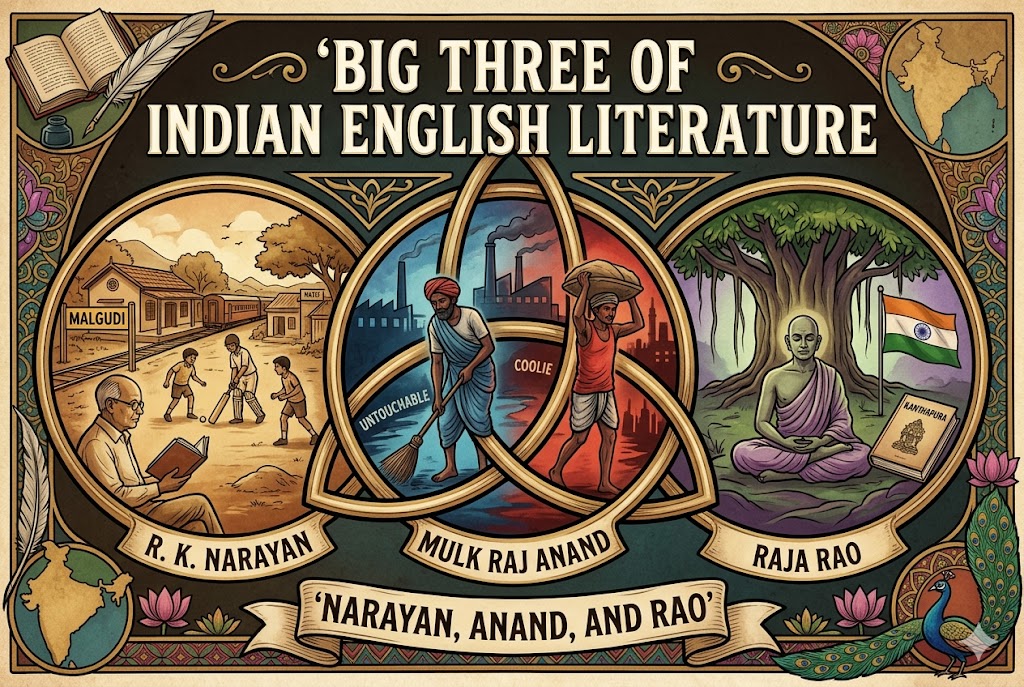
Before Salman Rushdie or Arundhati Roy dazzled global readers, the Big Three of Indian English—Mulk Raj Anand, R.K. Narayan, and Raja Rao—proved the Indian experience could thrive authentically in English.
The Context
The 1930s marked the golden decade for Indian Writing in English (IWE). Amid the Gandhian freedom struggle, these writers drew inspiration from India’s fight for independence, blending local voices with colonial tongues. Though active in the same era, Anand, Narayan, and Rao captured India from distinct angles: societal reform, individual quirks, and spiritual depths.
Mulk Raj Anand: The Societal Reformer
Mulk Raj Anand led the Big Three of Indian English with a fierce social conscience. Born in 1905 in Punjab, he channelled the era’s inequalities into raw, proletarian novels. His breakthrough, Untouchable (1935), follows Bakha, a day labourer trapped in caste horrors, exposing untouchability’s brutality.
Anand drew from Gandhian ideals but pushed further, influenced by Marxism and Joyce. Works like Coolie (1936) and Two Leaves and a Bud (1937) spotlight exploited workers in factories and tea plantations. He humanized the marginalised, making IWE a tool for protest.
Unlike later postmodernists, Anand’s realism was urgent and documentary. His style—vivid dialogues in Indian English—bridged East and West, earning praise from E.M. Forster.
R.K. Narayan: The Individual Chronicler
R.K. Narayan brought humor and humanity to the Big Three of Indian English, focusing on everyday lives in fictional Malgudi. Born in 1906 in Madras, he crafted serene tales amid national turmoil. Swami and Friends (1935), his debut, introduces boyhood adventures untouched by politics.
Narayan’s genius lay in the ordinary: merchants, astrologers, and dreamers navigating fate. Novels like The Bachelor of Arts (1937) and The English Teacher (1945) explore personal growth with gentle irony. He sidestepped Gandhian fervor for universal quirks, as in The Guide (1958), where a tour guide turns reluctant saint.
His prose mimics spoken Tamil-English, simple yet profound. Graham Greene championed him, calling Malgudi “as real as Tuscany”. Narayan humanised India’s soul through individuals, not ideologies.
Raja Rao: The Spiritual Visionary
Raja Rao completed the Big Three of Indian English with metaphysical depth. Born in 1908 in Mysore, he fused Vedanta philosophy with English syntax. Kanthapura (1938) weaves the Gandhian struggle into a village myth, where goddess Kenchamma inspires satyagraha.
Rao’s thesis in his preface? English must become “Indian English,” rhythmic like Sanskrit. Later works like The Serpent and the Rope (1960) delve into Advaita non-dualism, questing beyond illusion (maya). Spirituality trumps society here—characters grapple with karma and moksha.
His dense, poetic style contrasts Anand’s grit and Narayan’s lightness. Yet all three elevated IWE, proving English could express India’s dharma.
The Big Three of Indian English laid IWE’s foundation, influencing Rushdie’s magic realism and Roy’s activism. Anand reformed, Narayan reflected, Rao transcended—together, they decolonised language during freedom’s dawn.
“If you are an English major, owning a comprehensive histo
ry of this era is mandatory. The absolute best resource for university students is [A History of Indian English Literature by M.K. Naik on Amazon].”
Quick Summary: The Big Three
In the 1930s, the Indian English novel was firmly established by a trio of writers known as the “Big Three”. Each brought a completely unique perspective to Indian literature: Mulk Raj Anand focused on social realism, exposing the harsh realities of the caste system and poverty. R.K. Narayan focused on comic irony, chronicling the everyday struggles of the middle class in his fictional South Indian town of Malgudi. Raja Rao focused on philosophy and myth, adapting the English language to capture the rhythms of traditional Indian storytelling and Advaita Vedanta.
Mulk Raj Anand: The Champion of the Downtrodden
Mulk Raj Anand stood as the fiery champion among the Big Three of Indian English, wielding his pen against injustice. Born in 1905 in Punjab, he transformed Indian Writing in English (IWE) into a megaphone for the voiceless.
His Focus: Social Realism and Marxist Influence
Anand zeroed in on social realism, heavily shaped by Marxism. He spotlighted society’s ignored masses—sweepers, coolies, and laborers—trapped in dehumanizing cycles. Unlike Narayan’s whimsy or Rao’s mysticism, Anand demanded change through unflinching portraits of exploitation.
Key Themes: Caste, Poverty, and Dual Oppression
His novels dissect the caste system’s rot, grinding poverty, and exploitation by both traditional religion and British colonialism. Gandhi inspired him, but Anand critiqued complacency, urging radical reform. These themes echo the 1930s Gandhian struggle, yet push toward class uprising.
Writing Style: Angry, Urgent, and Authentic
Anand’s prose burns with anger and urgency, rendered in stark realism. He revolutionized IWE by infusing English with Punjabi and Hindi idioms, literal translations, and raw swear words. Dialogues pulse like street chatter: “Hai Bhagwan!” or gritty oaths, making colonial English bend to Indian fury. E.M. Forster praised this authenticity in his Untouchable foreword.
Must-Know Works
Untouchable (1935): Tracks one day in sweeper Bakha’s life, exposing untouchability’s horrors—from latrine drudgery to casual humiliations. A modernist stream-of-consciousness gem, it humanises the “unclean”.
Coolie (1936): Follows Munoo, a 15-year-old orphan bounced from servant boy to factory slave. It indicts urban poverty and imperialism, ending in tragic tuberculosis.
Anand’s rage fuelled over 20 books, cementing his role in the Big Three of Indian
English.
R.K. Narayan: The Chronicler of the Common Man
R.K. Narayan captured the heartbeat of ordinary Indians as a cornerstone of the Big Three of Indian English. Born in 1906 in Madras, he observed life with detached affection, turning everyday India into timeless literature.
His Focus: Gentle Comic Irony and the Indian Middle Class
Narayan mastered gentle comic irony, centring the Indian middle class—shopkeepers, teachers, and dreamers. He sidestepped Anand’s militancy for subtle humor, revealing human follies without judgement.
Key Themes: Tradition vs. Modernity, Family, and Absurdities
His stories explore tradition clashing with modernity, intricate family dynamics, and life’s quiet absurdities. Unlike Anand the activist, Narayan was a keen observer of human nature. Politics fades; personal quirks shine amid 1930s-1950s transitions.
The Magic of Malgudi
Enter Malgudi, Narayan’s fictional South Indian town—often likened to
Thomas Hardy’s Wessex. This vivid microcosm hosts Brahmins, rickshaw men, and schemers, mirroring changing India. From dusty streets to temple festivals, Malgudi breathes authenticity, hosting 14+ novels and short stories.
Writing Style: Pure, Simple, Unpretentious English
Narayan’s prose gleams with purity: simple, unpretentious English, free of heavy vocabulary. It flows like spoken Tamil-inflected dialogue, powering brilliant storytelling. Graham Greene, his champion, called it “styleless” mastery.
Must-Know Works
Swami and Friends (1935): Boyhood antics in Malgudi during freedom stirrings. Swami’s cricket passion sparks rebellion against school tyranny—pure, nostalgic joy.
The Guide (1958): Raju, a rogue tour guide, evolves into a faux saint via misunderstandings. Winner of the Sahitya Akademi Award; a Booker-shortlisted gem on fate and fakery.
Narayan’s Malgudi endures, enriching the Big Three of Indian English with humanity’s warmth.
“The way these three authors adapted the English language to serve Indian narratives is a perfect example of the literary resistance we discussed in our guide to [Postcolonialism in English Literature].”
Raja Rao: The Philosophical Voice
Raja Rao elevated the Big Three of Indian English with profound metaphysics. Born in 1908 in Mysore, he infused IWE with India’s spiritual core, transcending social grit for cosmic quests.
His Focus: Metaphysics, Indian Philosophy, and Spiritual Essence
Rao delved into metaphysics and Advaita Vedanta, capturing India’s spiritual essence. While Anand raged and Narayan chuckled, Rao sought the eternal, blending philosophy with narrative.
Key Themes: Gandhi, Truth, and Mythic History
His works probe Mahatma Gandhi’s impact on the rural Indian soul, the quest for absolute truth, and myth fused with modern history. Village life pulses with satyagraha, karma, and moksha.
Writing Style: Sanskrit Rhythms in English
Crucial for exams: Rao bent English to echo Sanskrit syntax, Kannada rhythms, and Harikatha breath—oral storytelling tales. In Kanthapura‘s famous foreword, he declares: “We in India… think only in Indian languages… English must wed itself to our rhythm.” This “Indian English” innovates, dense with repetitions and chants.
Must-Know Works
Kanthapura (1938): A village epic where Gandhi’s ideals ignite resistance via goddess Kenchamma. Blends myth, history, and oral epic—Rao’s IWE manifesto.
The Serpent and the Rope (1960): Philosophical odyssey through marriage, Maya (illusion), and non-dualism. Ramaswamy debates reality in France and India; Sahitya Akademi winner.
Rao’s vision crowns the Big Three of Indian English, proving philosophy’s power in borrowed tongues.
“Raja Rao’s heavy reliance on traditional fables and oral storytelling mirrors the narrative techniques found in our analysis of ancient texts like the [Hitopadesha Tales] and the [Jataka Tales].”
Exam Cheat Sheet: Comparing the Big Three of Indian English
Memorize this trio breakdown for UGC NET or lit exams. Each angle defines their 1930s IWE legacy:
Anand = The Social: Society breaks the marginalized (sweepers, coolies). Themes: caste, poverty, Marxist reform. Style: Angry realism with Punjabi idioms. Key: Untouchable.
Narayan = The Psychological/Local: Middle-class individuals navigate daily absurdities in Malgudi. Themes: tradition vs. modernity, family quirks. Style: Simple, ironic storytelling. Key: The Guide.
Rao = The Spiritual/Mythic: The Indian soul connects to the cosmos via Vedanta. Themes: Gandhi, truth, myth-history blend. Style: Sanskrit-rhythmic English (per Kanthapura foreword). Key: Kanthapura.
Quick mnemonic: S-P-S (Social, Psychological, Spiritual). Anand fights systems, Narayan watches people, Rao seeks eternity.
For a quick analysis visit BIG 3 EXPLAINED ON YOUTUBE CHANNEL
Conclusion
Together, the Big Three of Indian English—Mulk Raj Anand, R.K. Narayan, and Raja Rao—decolonized the language. They reshaped English from a tool of British Empire into a vibrant native Indian voice, blending social fire, human warmth, and spiritual depth.
Enduring Relevance
Their 1930s works form the bedrock of Indian Writing in English (IWE). Anand’s protests, Narayan’s Malgudi, and Rao’s rhythms influence Rushdie, Roy, and beyond. For UGC NET aspirants, they anchor postcolonial studies—master them for essays on hybridity and identity.
FAQS
Who coined the term the Big Three of Indian English literature?
William Walsh established it in the 1970s. Walsh's R.K. Narayan 1972 and Indian Literature in English grouped Anand, Narayan and Rao as IWE pioneers.
What is the fictional town in RK Narayan's novels?
Malgudi—a timeless South Indian microcosm compared to Hardy's Wessex. It hosts dozens of novels, capturing middle-class life amid India's changes.
Why is the foreword to Kanthapura so important?
It is Raja Rao's manifesto for Indian English writing. He argues English must adopt Indian rhythms, theorising a native IWE syntax.