Browsing Category: World Literature

  • All Post
  • American Literature
  • Blog
  • English Literature
  • Indian Writings in English
  • Literary Trivia
  • World Literature
    •   Back
    • UGC NET ENGLISH
A stylized illustration serving as a blog post feature image with the title Judith Butler’s Gender Performativity prominently displayed in large white letters at the top. The scene is set on a theatrical stage with red and blue curtains, where a spotlight shines on a figure in the center. The figure is dressed in a split costume, with a dark suit and tie on the left side and a flowing blue and pink dress with a scarf on the right, while also wearing a yellow construction helmet. They are holding a white mask to their face with one hand and another mask in their other hand. At their feet is a pile of open books and scrolls, some with text and symbols, illuminated by the spotlight. A silhouette of an audience is visible in the background, watching the performance. The entire illustration has a textured, digital art style.

January 13, 2026/

Introduction Judith Butler’s Gender Performativity challenges how we understand identity itself. As Simone de Beauvoir famously said, “One is not born, but rather becomes, a woman.” Butler takes this revolutionary idea even further—she argues that there is no fixed “being” behind the act of becoming. In her view, gender does not arise from some inner truth or natural essence. Instead, it is something we continuously do—a performance shaped by repeated actions, words, and social expectations. In...

An illustration titled THE FEMINIST APPROACH at the top in bold, black letters. Below the text, a diverse group of women in profile, rendered in purple and green tones, stand together with some raising their fists in solidarity. They are surrounded by symbolic elements including scales of justice and gears, against a bright yellow sunburst background. The illustration style is that of a comic book or graphic novel.

January 12, 2026/

Introduction The Feminist Approach: Is Jane Eyre a romantic heroine or a victim of a patriarchal society? This question has intrigued readers and critics for generations, sparking countless interpretations. Feminist criticism invites us to look beyond the surface of love and passion to uncover the deeper power structures shaping women’s lives within literature. The feminist approach is not about opposing men or dismissing traditional narratives—it is about analysing how gender, identity, and authority...

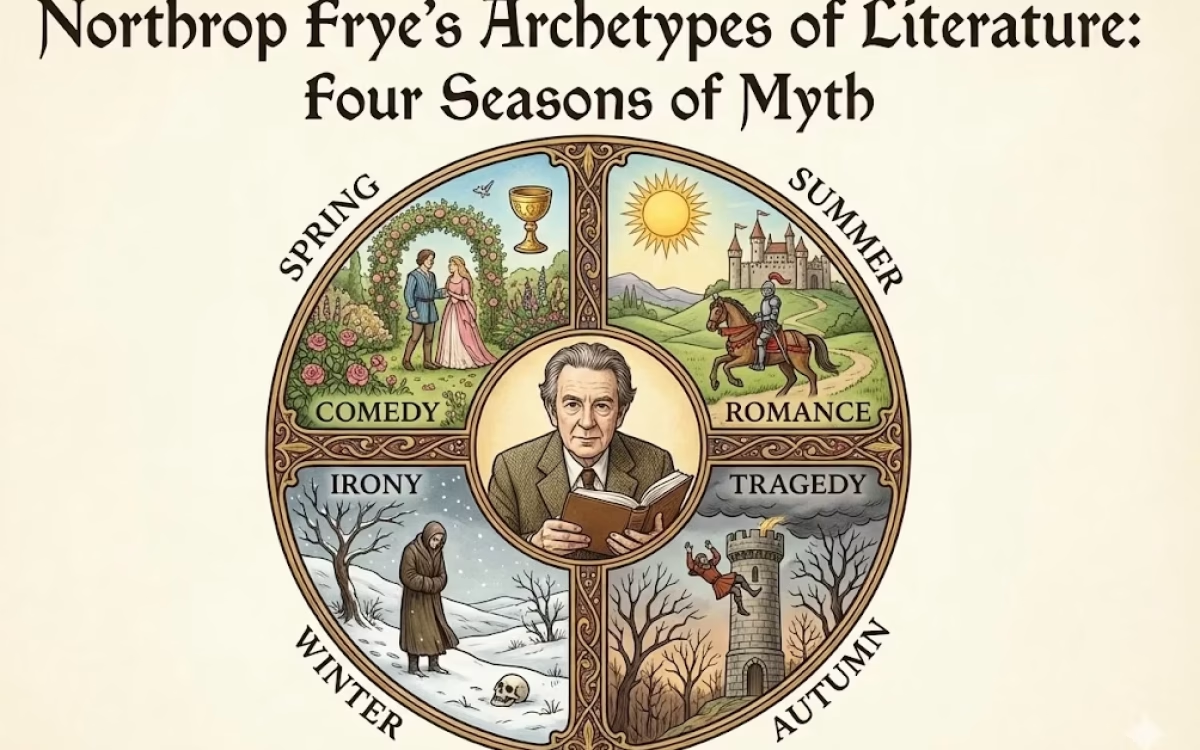
A digital feature image for a blog post titled Mythological and Archetypal Approaches in bold, elegant typography. The background features symbolic and artistic imagery evoking ancient mythology and literary archetypes, creating a classic and academic atmosphere.

January 9, 2026/

Introduction Mythological and Archetypal Approaches help us understand why we never tire of the same stories—whether it’s Harry Potter, Star Wars, or Greek myths. These tales may seem different on the surface, but they share universal patterns that speak to the human experience. Their power lies in repeating symbols and archetypes that reflect our deepest emotions and truths. In Wilfred L. Guerin’s chapter on this approach, the word “myth” doesn’t mean a “fake story”. Instead, it...

"A digital feature image for a blog post displaying the title The Play of Meanings, in prominent, elegant typography. The background features an artistic and conceptual design, using abstract elements or soft lighting to symbolize the depth and complexity of literary interpretation."

January 8, 2026/

Introduction The Play of Meanings lies at the centre of modern literary theory, capturing the shift from order to openness in how texts are read and understood. Wilfred L. Guerin’s A Handbook of Critical Approaches to Literature has long served as a standard textbook for exploring such shifts in interpretation. It introduces readers to the evolution of critical thought—from the structured logic of Structuralism to the self-questioning dynamics of Post-structuralism. Structuralism sought patterns, systems,...

A conceptual illustration for a blog post entitled Umberto Eco’s The Open Work. The image features an open book at the center, from which glowing, transparent panels filled with musical notes, architectural sketches, and abstract geometric shapes emerge and float outwards. Silhouetted figures surround the book, interacting with the floating panels: one holds a magnifying glass, another examines a panel closely, and others reach out to touch or rearrange the elements. The scene is rendered in warm gold, blue, and sepia tones, symbolizing the active, participatory nature of interpreting art and literature.

January 7, 2026/

Introduction Umberto Eco’s The Open Work is one of the most influential critical texts of the twentieth century, redefining how we understand the relationship between an artist, a text, and its audience. While many know Eco as the novelist behind The Name of the Rose, he was first and foremost a brilliant semiotician—a thinker deeply concerned with how meaning is created and shared. In classical art, the artist acts as a dictator, shaping every detail...

A composite feature image for a blog post titled SIGMUND FREUD'S PSYCHOANALYTIC THEORY displayed on a banner at the bottom. The central part of the image contains a portrait of Sigmund Freud superimposed over an iceberg diagram. The top of the iceberg above the water is labeled "CONSCIOUS", while the submerged, larger portion is labeled "UNCONSCIOUS" and also "ID, EGO, SUPEREGO". This central graphic is set against a backdrop of a vintage, wood-paneled study filled with tall bookshelves, a roll-top desk, and a leather armchair, creating an academic and historical feel.

January 2, 2026/

Introduction Sigmund Freud’s Psychoanalytic Theory helps us understand why characters in literature often behave irrationally. Why does Hamlet hesitate endlessly while Macbeth rushes into murder? Freud’s answer lies in the unconscious mind—a hidden space where suppressed emotions, desires, and fears shape human actions. Developed in the late 19th and early 20th centuries, Freud’s ideas forever changed the way we see the human psyche. He suggested that our conscious thoughts are only a small part...

A feature image for a blog post titled Miguel de Cervantes’ Don Quixote. The illustration captures the iconic imagery of the Spanish Golden Age, depicting the silhouette of the knight Don Quixote on his horse, lance in hand, facing giant windmills in the distance. The background features a warm, sunset-hued Spanish landscape, and the title text is displayed in a classic, adventurous serif typeface.

December 19, 2025/

Introduction Miguel de Cervantes’ Don Quixote stands as a towering achievement in world literature. It has inspired generations of readers, writers, and thinkers across continents and centuries. For students, scholars, and literature lovers in India and beyond, the story of the delusional knight remains timeless. His quest to tilt at windmills is as relevant today as it was in the early 1600s. At its heart, Don Quixote is more than a tale of madness and adventure....

A promotional image for Franz Kafka's The Trial, featuring a man in a trench coat standing in a dimly lit, arch-lined hallway filled with stacks of papers, with a large gavel and scales of justice hanging overhead.

December 16, 2025/

Introduction Franz Kafka’s The Trial stands as one of the most haunting and influential novels of the 20th century. From its very first line—Kafka pulls readers into a world where logic falters and justice becomes a shadowy, unreachable concept. This opening immediately sets the tone for a narrative that is both deeply unsettling and profoundly relevant. At its heart, The Trial is not just a story about a man caught in a legal nightmare. It...

A dramatic feature image for a blog post titled "Sophocles’ Antigone." The illustration depicts a solemn scene evocative of Greek tragedy, featuring a female figure in ancient robes standing defiantly or mourning near stone ruins. The background includes classical Greek architecture, such as columns, set against a moody atmosphere. The text "Sophocles’ Antigone" is prominently displayed in a stylized, ancient Greek-inspired font.

December 15, 2025/

Introduction Sophocles’ Antigone offers one of the most compelling journeys through Greek tragedy, where private conscience collides head‑on with public law. In this powerful play, the city of Thebes becomes a testing ground for questions that still trouble modern societies. For example, how far should citizens obey the state? Additionally, when, if ever, does an inner moral law override an official decree? Also, the readers who search for Sophocles’ Antigone seek a...

A feature image for a blog post titled Seneca's De Otio (On Leisure). The illustration features a classical Roman aesthetic, centering on a contemplative marble bust of the philosopher Seneca. He is set against a peaceful backdrop, such as a quiet garden or a study filled with scrolls, symbolizing the Stoic concept of productive leisure. The title text is displayed prominently in an elegant, Roman-style typeface.

December 12, 2025/

Introduction Seneca’s De Otio, usually translated as On Leisure, is a brief but provocative Stoic dialogue. It asks a very modern question: what should a wise person do with spare time in a noisy and demanding world? Written in first-century Rome, probably around the early 60s CE, the text survives in fragmentary form. Yet it still speaks powerfully to anyone caught between public responsibilities and the desire for a more reflective life....

Previous Page
123

About Me

Hello, I'm Bangera Rupinder Kaur

It is a space where readers can find insightful articles, thoughtful analyses, and engaging discussions on various literary topics.

Popular Posts

  • All Post
  • American Literature
  • Blog
  • English Literature
  • Indian Writings in English
  • Literary Trivia
  • World Literature
    •   Back
    • UGC NET ENGLISH

Featured Posts

  • All Post
  • American Literature
  • Blog
  • English Literature
  • Indian Writings in English
  • Literary Trivia
  • World Literature
    •   Back
    • UGC NET ENGLISH

Categories

Tags

Edit Template

© 2025 a2zliterature.com | All Rights Reserved