Introduction
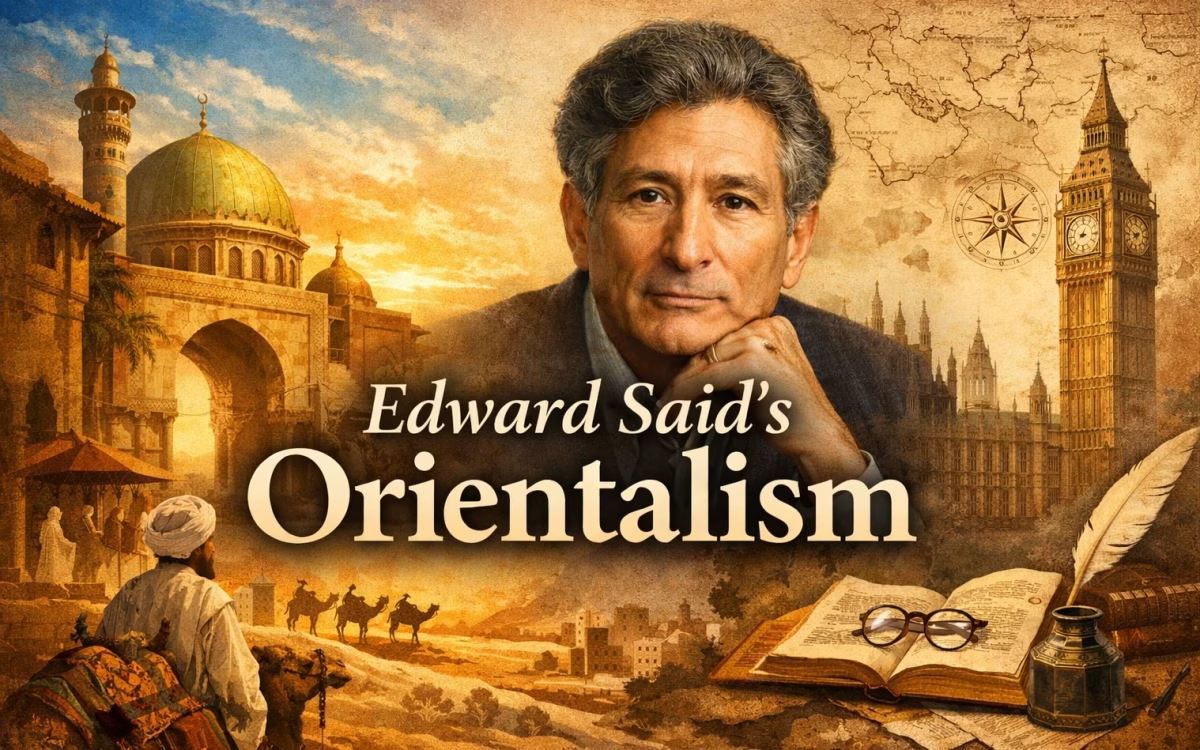
Edward Said’s Orientalism begins with a striking idea: “The East is not a place on a map; it is an idea invented by the West.” This idea captures the heart of Said’s 1978 work. His book reshaped how readers understand power, culture, and representation.
Before Said, scholars usually spoke of the East as part of “Colonial Literature.” His research transformed this view. He showed how Western writers, artists, and academics created the image of the “Orient” to justify control over it.
Orientalism is not just a literary theory—it is a system of knowledge as power. Said explained that the West dominated the East not only through armies and empires, but also through books, maps, and long-lasting stereotypes.
Quick Summary: Orientalism
Published in 1978, Orientalism is the foundational text of Postcolonial theory. Edward Said argues that the West (the Occident) created a false, romanticized, and dangerous image of the East (the Orient) to justify colonial rule. By defining the East as “irrational,” “exotic,” and “backward,” the West could define itself as “rational,” “progressive,” and “superior.” Orientalism is not about the East itself, but about the West’s representation of the East.
Core Concept: The Binary Opposition
Edward Said’s Orientalism: The Binary Opposition lies at the heart of his theory. Said explains that the world was intellectually divided into two unequal halves—the Occident (the West) and the Orient (the East). This division wasn’t natural; it was created and maintained by centuries of Western writing, art, and scholarship.
Teacher’s Tip: Emphasise to students that Said’s concept of binary opposition is about power through difference. The West defined itself by contrasting everything it claimed the East was not.
The Occident, which includes Europe and the USA, sees itself as rational, masculine, strong, and logical. In contrast, the Orient—Asia, the Middle East, and North Africa—was portrayed by the West as irrational, feminine, weak, and mystical. This stereotype-based contrast made the West appear superior and justified colonial domination.
Said also highlights a powerful psychological idea known as the Mirror Effect. The West needs the East to confirm its own identity. In other words, “We know we are civilised because they are savages.” The Orient became the West’s mirror—an imagined “other” used to define what “civilised” meant.
“While this summary covers the main concepts, Edward Said’s writing style is famously dense and layered. To truly master Postcolonial theory for your exams or research, you need to read his original arguments on Foucault and the colonial gaze. [Get your copy of Orientalism by Edward Said on Amazon].”
The “Other” (The ‘Othering’ Process)
The “Other” (The ‘Othering’ Process) explains how the West defined itself by turning non-Western people and cultures into “the Other.” To “other” someone means to treat them not as an equal human being but as a contrasting object—something strange, inferior, or fundamentally different. This process strips away individuality and humanity, reducing entire cultures to stereotypes.
Said shows that Othering is central to how the West constructed the idea of the “Orient”. By labelling Eastern societies as exotic, emotional, or backward, Western culture reinforced its own image as rational, modern, and superior. The “Other” becomes the mirror against which the West measures its own identity.
Example for Students: In Charlotte Brontë’s Jane Eyre, Bertha Mason is portrayed as the “Other”—a mad, wild Creole woman locked in the attic so that the “proper” English heroine, Jane, can find happiness. This literary example reflects the same logic Said criticises: one group builds its identity and power by suppressing and silencing another.
Foucault and “Knowledge is Power”
Foucault and “Knowledge is Power” draws on the ideas of French philosopher Michel Foucault, who developed the theory of Discourse. This is often the most challenging concept for students, but it becomes simple once you connect it to real-world examples.
Discourse means the way knowledge is created, shared, and used to maintain power. Foucault argued that those who control knowledge—through books, maps, laws, and education—also control how others see the world. Said applies this idea to the relationship between the West and the East.
The key argument is that knowledge itself becomes a form of control. When the British wrote the history books, drew the maps, and compiled encyclopedias about India, they claimed to “know” the country better than Indians did. This so-called superior knowledge gave them a sense of authority—and even the supposed right to rule.
In this way, Orientalism shows how culture and power work together. The West didn’t need only weapons to dominate; it used ideas, language, and scholarship as powerful tools of empire.
Latent vs. Manifest Orientalism
Latent vs. Manifest Orientalism helps us understand how the West’s view of the East operates on two levels—one visible and political, the other hidden and cultural. Said uses these terms to show that Orientalism isn’t just about what governments do but also about what people imagine.
Manifest Orientalism refers to the visible, official, and explicit actions of the West toward the East. This includes laws, colonial administration, government policies, and wars. It’s the Orientalism we can see in history books—the physical control of land and people.
Latent Orientalism, on the other hand, is the unconscious, cultural, and emotional side. Western imagination holds deep-seated stereotypes, fantasies, and desires about the East. This “dream” of the Orient portrays a world filled with mystery, luxury, and danger.
Common examples of latent Orientalism appear in art and media: paintings of harems, snake charmers, or the “magic carpet” image of Arabia. These images may seem harmless, but they reinforce an exotic and unrealistic picture of Eastern cultures. Said warns that latent Orientalism is harder to erase because it lives not in laws but in the imagination.
Examples in Literature
Examples in literature reveal how some of the most respected works in English literature reflect the power dynamics of empire. Said shows that even classic novels often carry hidden assumptions about the East as mysterious, inferior, or unknowable.
Joseph Conrad’s Heart of Darkness presents Africa not as a continent full of real people, but as a backdrop of darkness and silence through which European characters define their own moral struggle. Africa itself has no voice; it becomes the “Other” against which the story of European civilisation unfolds.
E.M. Forster’s A Passage to India also illustrates Orientalist thinking. Even the most sympathetic British characters cannot truly understand the complexity—or as Forster calls it, the “muddle”—of India. This inability to connect reflects how deep the cultural divide created by colonial discourse runs.
Jane Austen’s Mansfield Park became central to Said’s analysis in his famous essay. He points out that the elegance and comfort of the British estate depend on invisible imperial labour—specifically the slave-driven economy of Antigua. Said uses this example to show that imperialism wasn’t just happening in faraway colonies; it was quietly embedded in the moral and economic fabric of English domestic life.
Conclusion: The Relevance of Edward Said’s Orientalism Today
Orientalism is not a relic of the past—it is very much alive in today’s global culture. Said’s theory remains relevant when we look at how modern media continues to shape our views of the East. For instance, Hollywood often portrays the Middle East through yellow filters, associating it with deserts, danger, and disorder. Characters from these regions are frequently cast as terrorists, oppressed women, or helpless victims, reinforcing the same binaries Said criticised decades ago.
These stereotypes may seem subtle, but they influence how people perceive entire cultures. Said’s work challenges us to look deeper and question who creates these images and why.
The final lesson from Edward Said’s Orientalism is clear: we must learn to unlearn these inherited ideas. Only by recognising and dismantling such stereotypes can we begin to see other cultures—and ourselves—with honesty, empathy, and equality.
FAQS
Who is the Other in Postcolonial Theory?
In postcolonial theory, the “Other” refers to people or cultures portrayed as different, inferior, or outside the dominant Western norm. This concept highlights how colonial powers defined themselves as civilised and rational by contrasting themselves with those they ruled—who were labelled exotic, primitive, or emotional. In Edward Said’s Orientalism, the East becomes the “Other” that helps the West reinforce its own identity.
How is Knowledge Related to Power in Orientalism?
In Orientalism, Edward Said builds on Michel Foucault’s idea that knowledge is power. The more the West claimed to “know” the East—through history books, maps, or scholarly studies—the more it justified its right to control it. This knowledge was never neutral; it was shaped by power.