Lewis Caroll’s Alice in Wonderland: Introduction
Lewis Caroll’s Alice in Wonderland is more than just a whimsical tale for children. In fact, it is a literary phenomenon that has captivated readers across generations and continents. Since its first publication in 1865, the story of a curious girl falling down a rabbit hole into a world of absurdity and wonder has fascinated audiences. Moreover, it has become a touchstone for discussions about identity, logic, and the boundaries between childhood and adulthood. Indeed, Alice in Wonderland continues to resonate through its playful critique of authority, its exploration of self-discovery, and its timeless appeal to the imagination.
At its core, Lewis Carroll’s Alice in Wonderland is about navigating a world that often feels illogical and overwhelming. As Alice journeys through Wonderland, she experiences constant change, confusion, and encounters that mirror everyday challenges. From the moment she falls down the rabbit hole, she begins to question everything she thought she knew. This includes her own identity and the unwritten rules of polite society. Consequently, this sense of disorientation resonates deeply with readers in India and beyond, especially in an age where change is the only constant.
What makes Alice in Wonderland so compelling is the way it invites readers to see the world through the eyes of a child—curious, questioning, and unafraid to challenge authority. Alice’s encounters with the Mad Hatter, the Cheshire Cat, and the Queen of Hearts are not mere whimsical episodes. Rather, they are sharp critiques of adult logic, social hierarchies, and the arbitrary nature of power. Furthermore, in a world where rules often seem designed to confuse rather than clarify, Alice’s journey reminds us of the importance of critical thinking and moral courage. Her refusal to accept nonsense, even from those in power, remains as relevant today as it was in Victorian England.
Lewis Carroll’s Alice in Wonderland is also a rich text open to multiple interpretations. Its themes of identity, growth, and the tension between childhood and adulthood are universal. At the same time, they reflect the specific challenges faced by young people around the world. Whether you are struggling with academic pressure, navigating social complexity or discovering your sense of self, Alice’s Adventures in Wonderland mirrors your own experiences. Moreover, the story’s unique blend of humour, absurdity, and philosophical insight makes it deeply engaging. It also serves as an ideal starting point for reflection on self-discovery and resilience. Finally, it inspires the courage to question the status quo and embrace life’s uncertainties with curiosity and confidence.
Quick Summary: Alice’s Adventures in Wonderland
Alice’s Adventures in Wonderland (1865) is the masterpiece of the “Literary Nonsense” genre written by Lewis Carroll (the pseudonym of mathematician Charles Lutwidge Dodgson). The story begins when young Alice follows a White Rabbit down a hole into a fantasy world where logic, physics, and size are constantly changing. She encounters iconic characters like the Mad Hatter, the Cheshire Cat, and the tyrannical Queen of Hearts. Beyond its whimsy, the novel is a complex satire on Victorian education, the arbitrary rules of adult society, and the instability of identity.
Lewis Caroll’s Alice in Wonderland: Plot Overview
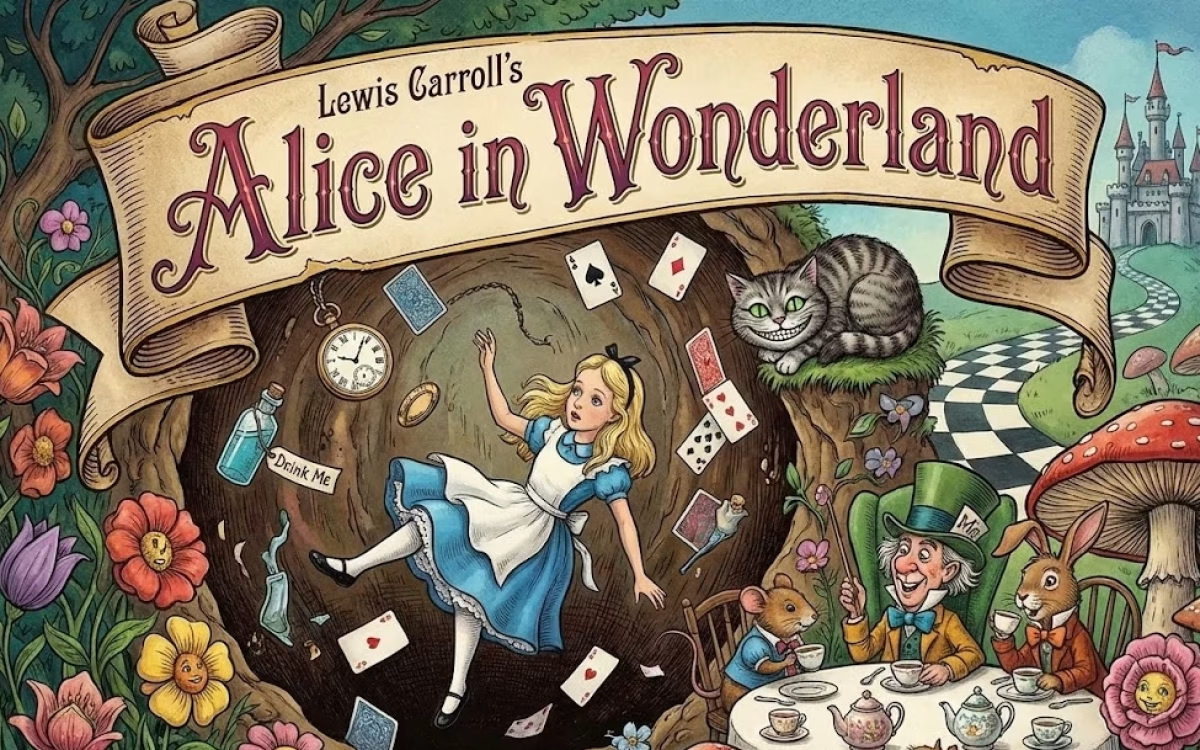
Lewis Carroll’s Alice in Wonderland follows the story of a young girl named Alice. While sitting by a riverbank, she notices a white rabbit wearing a waistcoat and a pocket watch. Out of curiosity, she impulsively decides to follow him down a rabbit hole. This decision marks the beginning of her extraordinary adventure into a world where logic is reversed, and nothing is quite as it seems. Upon entering Wonderland, Alice experiences a series of strange and surreal encounters. Each of these events challenges her sense of identity and her understanding of the world around her.
Alice’s journey begins with her dramatic fall down the rabbit hole, a moment that sets the tone for the entire story. As she tumbles through the air, she passes by shelves filled with curious objects. These mysterious items reflect her imagination and her deep desire to explore the unknown. When she finally lands, she discovers a hall filled with locked doors and a tiny key. Soon after, she experiences her first magical transformation. She drinks from a bottle and shrinks, only to realise she can no longer reach the key.
Throughout her journey, Alice’s size keeps changing. By eating and drinking strange things, she alternates between growing and shrinking. These transformations symbolise the awkwardness and confusion of growing up. As a young girl, Alice must learn to adjust and find her place in a world that lacks stability or logic. Along the way, she meets several eccentric characters, including the Cheshire Cat, the Mad Hatter, the March Hare, and the Caterpillar. Each encounter challenges her with riddles, nonsense, and strange behaviour.
One of the most memorable scenes is the Mad Hatter’s tea party. In this absurd moment, time is stuck at six o’clock, and everyone talks in riddles. Later, Alice attends a chaotic trial led by the Queen of Hearts, who is known for her wild temper and the cry, “Off with their heads!” Through these experiences, Alice’s sense of self is tested. She questions her identity, her memories, and her confidence to face a world that constantly defies reason.
The plot of Alice in Wonderland unfolds as a sequence of loosely connected episodes rather than a traditional story arc. This fragmented style mirrors the dreamlike atmosphere of the tale. Each episode gives Alice new challenges and moments of self-discovery. Eventually, her adventure ends abruptly when the playing cards rise against her. At that instant, she wakes up beside her sister on the riverbank, realising that everything she experienced was only a dream.
Lewis Carroll’s Alice in Wonderland is not merely a fantastical tale. Instead, it is a profound exploration of identity, logic, and the absurdities of adult society. The novel’s surreal events and unforgettable characters encourage readers to question the rules and conventions shaping their own world. As a result, it remains a timeless classic that continues to fascinate readers across ages and cultures.
“Lewis Carroll filled this book with mathematical puzzles and Victorian political satire that most readers miss. To understand the hidden meanings, I highly recommend ‘The Annotated Alice’ by Martin Gardner. [Get The Annotated Alice (Definitive Edition) on Amazon].”
Lewis Caroll’s Alice in Wonderland: Major Themes
Each theme in Alice in Wonderland offers rich material for analysis, making the story a timeless exploration of human experience and societal norms. Moreover, the narrative delves into concepts such as identity, authority, logic, and imagination, revealing the tensions between conformity and individuality. In addition, Carroll uses fantasy and absurdity not merely for entertainment but as powerful tools to question how people understand themselves and the world around them. Consequently, the story encourages readers to reflect on the structures that shape behaviour, thought, and moral judgment. Ultimately, these layered themes ensure that Alice in Wonderland continues to inspire new interpretations, bridging the gap between childhood wonder and adult introspection:
1. Childhood and Adulthood
Alice in Wonderland explores the transition from childhood to adulthood. It shows how Alice’s journey reflects the confusion, curiosity, and identity struggles that come with growing up. As she moves through Wonderland, she constantly questions who she is and what she has been taught. Moreover, her experiences highlight the tension between childlike innocence and the rigid logic of adulthood.
2. Identity and Self-Discovery
Throughout the story, Alice’s changing size and shifting roles symbolise her ongoing search for identity. Moreover, each transformation reflects her struggle to adjust to a world that constantly tests her understanding of who she is. As she grows and shrinks, she confronts the instability of self-perception and the confusion of adapting to new circumstances. At several points, she pauses to ask herself, “Who in the world am I?”—a question that captures the essence of her internal conflict. In addition, these moments mirror the challenges of adolescence, a period marked by uncertainty, discovery, and personal growth. Ultimately, Alice’s journey becomes a powerful metaphor for the process of finding balance and self-awareness in a world that rarely makes sense.
3. Nonsense and the Limits of Logic
Carroll, a skilled logician, employs absurdity and nonsense to highlight the fragility of logic and reason. Through irony and wit, he reveals how rational systems can collapse when stripped of empathy and context. Moreover, episodes such as the Mad Hatter’s tea party and the Queen’s chaotic trial illustrate this theme vividly. In both scenes, logic is pushed to the point of absurdity, showing how rigid rules lose meaning when followed blindly. As a result, Carroll invites readers to reflect on the limitations of structured thought and the flaws of unquestioned authority. Ultimately, the narrative encourages a more flexible and imaginative approach to understanding the world—one that balances intellect with curiosity, reason with empathy, and order with creativity.
4. Authority and Power
Wonderland’s arbitrary rules and the Queen of Hearts’ capricious decrees serve as a sharp critique of the abuse of authority and the absurdity of power. Through exaggerated displays of control, Carroll exposes how those in power often rely on fear and chaos to maintain dominance. Moreover, the Queen’s impulsive judgments and frequent cries of “Off with their heads!” reveal the instability underlying oppressive leadership. In stark contrast, Alice’s calm defiance and rational mindset highlight the strength of independent thought amid irrational systems. As she questions unfair orders and refuses to submit to nonsense, she embodies the values of moral courage and critical thinking. Ultimately, her resistance becomes a powerful reminder that genuine authority must be rooted in justice, reason, and empathy rather than in fear or domination.
5. Social Conventions and Rules
The story satirises Victorian social conventions, revealing how rigid etiquette and moral instruction can become meaningless—or even harmful—when applied without understanding or compassion. Carroll uses parody and exaggeration to expose the emptiness behind superficial politeness and blind conformity. Moreover, Alice’s encounters with figures like the Duchess and the Queen underscore the arbitrary and often hypocritical nature of societal expectations. The Duchess, obsessed with moral lessons, delivers advice that lacks logic or empathy, while the Queen enforces order through fear and punishment. Together, they represent a world where authority is unquestioned and manners are valued over morality. Consequently, Alice’s growing ability to question and resist their absurdity reflects the triumph of personal judgment over blind obedience. Ultimately, Carroll’s satire encourages readers to think critically about social norms and to value authenticity, empathy, and reason above rigid tradition.
6. Imagination and Creativity
Alice’s adventures celebrate the power of imagination and creativity, encouraging readers to embrace curiosity and playfulness. Wonderland itself is a testament to the boundless possibilities of the human mind, inviting readers to see the world from new perspectives.
7. Growth and Transformation
Alice’s physical changes—growing and shrinking—symbolise the emotional and psychological transformations of adolescence. Her journey reflects the awkwardness and uncertainty of growing up, as well as the resilience needed to adapt to new challenges.
8. The Absurdity of Bureaucracy
The nonsensical trial scene and the “caucus race” parody bureaucratic systems, exposing their inefficiency and lack of logic. Carroll’s critique resonates with modern readers navigating complex institutions and arbitrary procedures.
Lewis Caroll’s Alice in Wonderland: Character Analysis
Each character in Alice in Wonderland serves as a vehicle for exploring deeper themes of identity, logic, authority, and transformation. Moreover, these characters embody different aspects of human nature, forcing Alice—and readers—to question what is real, rational, and meaningful. The Cheshire Cat, for instance, represents philosophical ambiguity and the fluidity of identity, while the Mad Hatter illustrates the absurd consequences of rigid logic taken to extremes. Similarly, the Queen of Hearts exposes the dangers of unchecked authority and emotional impulsiveness. Through these encounters, Alice learns to think critically, challenge irrational rules, and develop a stronger sense of self. Ultimately, their interactions reveal the complexities of growing up and underscore the need for imagination, resilience, and moral courage when navigating a world that often defies reason:
Alice
Alice is the heart and lens of the story, embodying curiosity, resilience, and a growing sense of self-awareness. At the beginning, she is a polite, obedient Victorian child, eager to follow rules and recite lessons. But as she journeys through Wonderland, she learns to question authority, trust her own judgment, and assert her individuality. Her frequent changes in size and identity mirror the awkwardness of adolescence, making her a relatable figure for readers navigating the transition from childhood to adulthood.
The White Rabbit
The White Rabbit is the catalyst for Alice’s adventure, representing urgency, anxiety, and the pressure to conform to societal expectations. His constant worry about being late and his preoccupation with time reflect the Victorian obsession with punctuality and order. He serves as a symbol of the adult world’s relentless pace, which Alice must confront and ultimately transcend.
The Cheshire Cat
The Cheshire Cat is one of Wonderland’s most enigmatic characters, known for his mischievous grin and philosophical musings. He embodies ambiguity and the idea that things are not always as they seem. His ability to appear and disappear at will, along with his cryptic advice, challenges Alice to think beyond conventional logic and embrace uncertainty.
The Mad Hatter and the March Hare
The Mad Hatter and the March Hare represent the absurdity and chaos of adult social rituals. Their never-ending tea party, stuck at six o’clock, is a satirical take on the meaningless routines and empty conversations that often characterise social gatherings. Their madness highlights the fragility of logic and the importance of questioning established norms.
The Caterpillar
The Caterpillar is a symbol of transformation and self-discovery. He challenges Alice to think critically about her identity and the rules she follows, encouraging her to question who she is and what she believes. His cryptic advice and mysterious nature reflect the complexities of personal growth and the search for meaning.
The Queen of Hearts
The Queen of Hearts is the epitome of arbitrary authority and unchecked power. Her infamous decree, “Off with their heads!”, exposes the dangers of tyranny and the absurdity of unjust rules. Alice’s confrontation with the Queen demonstrates her growing courage and moral clarity, as she learns to stand up to oppressive authority.
The Duchess
The Duchess represents the contradictions and hypocrisies of Victorian society. Her moralising and violent behaviour highlight the disconnect between outward appearances and inner reality. Through her interactions with Alice, Carroll critiques the rigid social conventions and moral lessons that often fail to address real human needs.
Lewis Caroll’s Alice in Wonderland: Relevance Today
In today’s context, where technology and globalisation make the world feel both more connected and more chaotic, Alice’s journey feels especially relevant. The story’s playful critique of authority and its celebration of imagination and creativity hold even greater significance now. Moreover, in an age when we are constantly bombarded with information and expectations, Alice in Wonderland gently reminds us to pause and reflect. It encourages us to question our surroundings and find our own path through the confusion and noise.
Ultimately, Alice in Wonderland is much more than a story about a girl in a fantastical world. Instead, it serves as a mirror to our own experiences, challenges, and aspirations. Its lasting relevance lies in its power to inspire readers to embrace curiosity and challenge authority. Furthermore, it motivates us to navigate life’s complexities with courage, resilience, and a sense of wonder. EXPLORE OTHER WRITINGS
Lewis Caroll’s Alice in Wonderland: Conclusion
Lewis Carroll’s Alice in Wonderland remains a timeless classic that continues to captivate readers. It blends whimsy, satire, and profound insight in a unique way. Through Alice’s journey, the story gently explores universal themes such as identity, authority, and the challenges of growing up. Consequently, it feels relevant to audiences across different generations and cultures.
Moreover, the characters—from the curious Alice to the enigmatic Cheshire Cat and the tyrannical Queen of Hearts—mirror human struggles with logic, power, and self-discovery. In today’s fast-paced and often confusing world, Alice in Wonderland offers lasting lessons about curiosity, critical thinking, and resilience.
Furthermore, its playful critique of authority and celebration of imagination inspire readers to question the status quo. They also encourage us to embrace the beautiful chaos of life. Whether you are facing academic pressure, workplace challenges, or complex social norms, the story’s enduring relevance reminds you to approach life with courage, humour, and curiosity.
In conclusion, Lewis Carroll’s Alice in Wonderland is far more than a children’s tale. Instead, it is a deep, thought-provoking reflection on the human condition. Therefore, its timeless themes and unforgettable characters ensure that Alice’s adventures will continue to inspire and challenge readers for generations to come.
Lewis Caroll’s Alice in Wonderland: FAQS
What is the main theme of Alice in Wonderland?
The main theme of Alice in Wonderland is the struggle between childhood and adulthood, exploring identity, logic, and the absurdity of adult authority.
Who is Alice in Wonderland based on?
Alice in Wonderland is inspired by Alice Liddell, the daughter of Henry Liddell, a friend of Lewis Carroll. Carroll created the story during a boat trip with Alice and her sisters.
What does the rabbit hole symbolise in Alice in Wonderland?
The rabbit hole symbolises the transition from the familiar world into the unknown, representing curiosity, change, and the journey of self-discovery.
Why is Alice in Wonderland considered a classic?
Alice in Wonderland is considered a classic because of its imaginative storytelling, timeless themes, and its ability to resonate with readers of all ages across generations.
What lessons can we learn from Alice in Wonderland?
Alice in Wonderland teaches the importance of curiosity, critical thinking, resilience, and the courage to question authority and embrace uncertainty.