Introduction
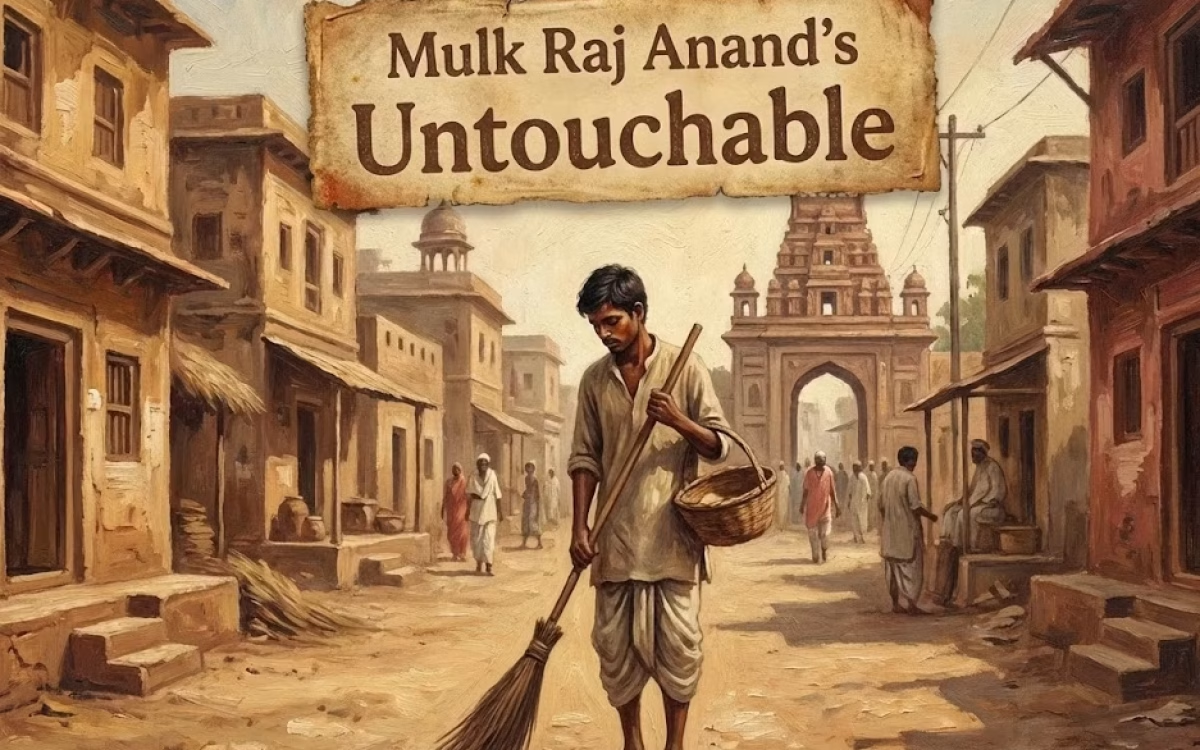
Mulk Raj Anand’s Untouchable stands as a groundbreaking novel in Indian writing in English. It places Anand alongside R.K. Narayan and Raja Rao as one of the “big three” pioneers of the genre. Yet, unlike the gentle humour of Malgudi or the mythic scope of Kanthapura, Untouchable takes the novel form in a bold new direction. Anand compresses the entire narrative into a single day in the life of Bakha, a young sweeper in a North Indian town. The novel turns twenty-four hours into an intense exploration of humiliation, desire, and fragile hope.
This work goes far beyond a simple social-problem story about caste. Through its modernist stream-of-consciousness technique, Untouchable immerses readers in Bakha’s racing thoughts and wounded pride. It also reveals his restless longing, offering a psychological deep dive into the interior world of the marginalised—a realm Indian English fiction had largely overlooked before this novel.
Quick Summary: Untouchable
Untouchable (1935) is a landmark social novel by Mulk Raj Anand. Set in pre-independence India, it covers a single day in the life of Bakha, an 18-year-old sweeper and latrine cleaner from the outcast colony. The narrative follows a series of humiliating incidents—being slapped for “polluting” a high-caste Hindu, seeing his sister Sohini molested by a priest, and being insulted for his caste—that trigger his awakening against the caste system. The novel ends with three potential solutions for his plight: Christ (Conversion), Gandhi (Social Reform), and the Machine (Technology/Flush System).
Mulk Raj Anand’s Untouchable: Plot Overview
The novel is unique in its structure because it does not cover weeks or years; it chronicles a single day in the life of Bakha, an 18-year-old sweeper. By focusing on just 24 hours, Anand shows how the cycle of humiliation is endless and repetitive for the marginalised.
“Read the groundbreaking novel that defined social realism in Indian English Literature. [Buy Mulk Raj Anand’s Untouchable].”
The narrative is divided into three distinct phases:
1. The Morning: The “Touch” The day begins with Bakha working in the latrines of the fictional town of Bulashah. Despite his grim reality, Bakha is a dreamer who admires the British soldiers and tries to mimic their fashion (the “Fauji” style). However, his dreams are crushed when he enters the town market. Lost in thought, he forgets to announce his presence and accidentally brushes against a high-caste Hindu. The man is furious at being “polluted”, and Bakha is slapped in public while a crowd watches. This moment destroys his dignity and makes him painfully aware of his identity as an “Untouchable”.
2. The Afternoon: The Temple and The Accusation seeking escape, Bakha goes to the temple but is forbidden from entering. When he climbs the steps to get a glimpse of the deity, he is spotted and accused of defiling the shrine. At the same time, the temple priest, Pundit Kali Nath, attempts to molest Bakha’s sister, Sohini. When she resists, the priest cries “Pollution!” to cover up his own crime. Bakha is filled with rage but realises he is powerless to strike a Brahmin.
3. The Evening: Three Possible Solutions The day ends with Bakha wandering the outskirts of the town, where he encounters three different paths to potential freedom:
Religion: A Salvation Army missionary attempts to convert him to Christianity to escape caste, but Bakha finds the theology confusing.
Politics: He listens to a speech by Mahatma Gandhi, who calls for social reform and dignity for the “Harijans”.
Technology: Finally, he overhears a poet arguing that the flush system (modern plumbing) is the only real saviour. If a machine can clean the waste, the sweeper will no longer be “unclean”.
The novel ends without a definite conclusion. Bakha returns home, not with a solution, but with a lingering hope in the “machine” that might one day set him free.
Mulk Raj Anand’s Untouchable: Detailed Summary:
Morning: Work and Aspirations
Bakha’s day begins with the grim routine of cleaning latrines in the outcaste colony and the town’s public spaces. As he works, his mind drifts to his admiration for the British soldiers—the “Tommies”—whose crisp uniforms and confident bearing fascinate him. Bakha dreams of dressing like them, adopting the “fauji style,” and escaping the stigma attached to his occupation. This obsession with fashion and appearance is not mere vanity; it’s a desperate bid for dignity in a world that denies him even basic respect.
The “Touch”: The Inciting Incident
Bakha later goes to the bazaar to buy a hockey stick. There, an accidental brush with a high-caste Hindu sparks a chain of public humiliation. The man slaps Bakha and shouts that he is “polluted.” He then forces Bakha to announce his presence in the streets, shouting warnings like a walking curse. The crowd reacts quickly and harshly. No one questions the injustice. Bakha feels both angry and powerless—a vivid picture of how caste works as a machinery of everyday violence.
The Temple Incident: Hypocrisy and Abuse
Seeking solace, Bakha visits the temple to see the deity but is immediately accused of “polluting” the sacred space. The scene takes a darker turn when Bakha’s sister, Sohini, is molested by the priest, Kali Nath, who then accuses her of polluting him. The crowd turns on Sohini instead of the priest, revealing the deep hypocrisy of religious and social practices that shield the powerful while punishing the vulnerable.
The Hockey Match: Fleeting Joy, Persistent Prejudice
In the afternoon, Bakha finds a moment of respite playing hockey with friends, but even here, caste politics intrude. The game is disrupted when someone points out Bakha’s status, reminding everyone of the invisible barriers that define his life. What should have been a carefree escape becomes another painful reminder that he cannot outrun his identity.
Evening: Anger, Hopelessness and Three Solutions
By evening, Bakha wanders the streets, overwhelmed by anger and hopelessness. Bakha encounters three distinct voices offering different solutions. A Christian missionary suggests conversion as a path to equality. Mahatma Gandhi condemns untouchability as a moral sin. Meanwhile, a modern poet argues that technology—especially the flush latrine—can end manual scavenging. Bakha listens to each carefully and holds these ideas in his mind as he walks away. He remains uncertain, yet he carries a small spark of hope.
Mulk Raj Anand’s Untouchable: Critical Analysis
Social Realism
Anand’s Untouchable avoids any romanticised depiction of poverty or caste oppression. Anand confronts readers with vivid sensory details—the foul smell of latrines, the dirt-streaked faces, and the sweat of manual scavengers. These images create a raw and unfiltered picture of social reality. Far from sentimental, his narrative works as a strong instrument of social protest. It exposes the brutal machinery of the caste system in pre-independence India. His direct descriptions act as a bold call for reform and social awareness. Thus, the novel stands as a powerful literary work that seeks to awaken collective conscience.
The Stream of Consciousness Technique
Influenced by modernist writers like James Joyce, Anand employs the stream of consciousness to immerse readers directly inside Bakha’s mind. This narrative style allows us to hear Bakha’s confused thoughts, his silent fury, and his unspoken dreams—all racing through his head as he navigates a hostile world. Such a technique gives dignity to Bakha as a complex, thinking human being, dismantling any notion of the “untouchable” as merely a symbol of pity or social failure. Instead, it presents him as a creature of inner life, deserving of empathy and understanding.
The Three Solutions
Untouchable presents three potential paths for Bakha’s future, each reflective of different social visions:
Christianity: Symbolised by Colonel Hutchinson, who represents Western salvation through religion. Bakha finds the missionary’s charity confusing and somewhat alien, highlighting the cultural disconnect inherent in the colonial encounter.
Gandhism: Gandhi appears in the novel, and Bakha feels inspired by his call to regard untouchables as “Harijan.” Yet, Bakha harbours doubts—will Hindus truly reform, or is this merely a performative gesture? That scepticism underscores the gap between moral appeal and systemic change.
The Machine (Technology): The modernist poet Iqbal Nath Sarshar advocates for technological solutions—particularly the flush latrine—as the most practical way to end manual scavenging. Anand suggests that technological invention, especially the sanitation system, is the only realistic hope for genuine emancipation of the outcaste, pointing to the importance of infrastructure in social reform.
These three paths encapsulate contrasting visions: religious salvation, moral reform, and technological progress. Anand leans towards the machine as the most tangible, effective remedy, emphasising that real change demands systemic solutions rather than spiritual or moral appeals alone.
Mulk Raj Anand’s Untouchable: Character Sketch
Bakha
The Universal Victim
Bakha symbolises the countless marginalised and silenced voices oppressed by India’s caste system. His experiences of humiliation, discrimination, and social exclusion reflect the collective suffering of untouchables. Moreover, he stands as a universal symbol of all who face dehumanisation through systemic injustice. Anand’s powerful portrayal, therefore, urges readers to see not only Bakha’s personal struggle but also the broader social reality of oppressed communities across India. Thus, the novel becomes both a personal and collective portrait of resilience and pain.
The “Fauji” Dreamer
Bakha’s obsession with imitating the dress and manners of the British soldiers—the “Tommies”—shows his deep desire for dignity and respect beyond caste boundaries. Moreover, his wish to dress like a fauji (soldier) reflects rebellion and resistance against social oppression. It becomes his way of escaping a marginalised identity and asserting his humanity. Furthermore, this aspiration highlights his inner conflict—the hope for transformation through Western ideals versus the painful reality of social rejection. However, his dream also exposes the limits of such imitation in a society still chained by caste.
Physicality: Strength and Powerlessness
Anand vividly describes Bakha as physically strong and capable—“a tiger”—which starkly contrasts with his social powerlessness. Moreover, this juxtaposition highlights the deep dissonance between Bakha’s bodily strength and the rigid hierarchy that demeans and devalues him. Furthermore, his robustness suggests untapped potential and inner vitality. However, the oppressive social structures keep him trapped in constant subjugation and humiliation. Thus, Anand emphasises the novel’s central critique of a society that suppresses both physical and moral agency in the oppressed. EXPLORE OTHER AUTHORS
Conclusion
Mulk Raj Anand’s Untouchable remains powerfully relevant today. The issues it addresses—caste discrimination, social exclusion, and the struggle for dignity—are not relics of the past. In modern India, Dalit communities still face violence, prejudice, and systemic barriers. Bakha’s story feels as urgent now as it did in 1935. The novel’s stark portrayal of everyday injustice reminds readers that progress, though possible, is never automatic or guaranteed.
At its core, Untouchable is a passionate plea for human dignity. It calls on readers to recognise the inner life, aspirations, and suffering of those society pushes to the margins. Moreover, Anand’s narrative urges us to look beyond caste, religion, or social status and see the shared humanity in all people—especially those silenced by oppression. The novel stands not just as a historical record but as a living testament to the ongoing fight for equality and respect in India and beyond.
FAQS
What is the main theme of Untouchable?
The main theme is the brutality of the Indian Caste System. The novel exposes the hypocrisy of society and the psychological trauma inflicted on the “untouchables” (Dalits) who are treated as sub-human despite performing essential work.
Why does the novel take place in one day?
Anand uses a single-day structure to show that the humiliation Bakha suffers is not a rare event, but a daily cycle. It emphasises that for an untouchable, every single day is a repetition of the same abuse.
What is the ending of Untouchable?
The novel ends with Bakha rejecting religion and politics in favour of technology. He places his hope in the “Flush System” (modern plumbing), realising that if a machine can clean the waste, the stigma attached to his caste will finally disappear.
Who is Bakha in the novel?
Bakha is the 18-year-old protagonist, a sweeper boy who is physically strong and sensitive. He represents the “universal victim”—a young man with dreams and dignity who is constantly crushed by the rigid social hierarchy of pre-independence India.