Introduction
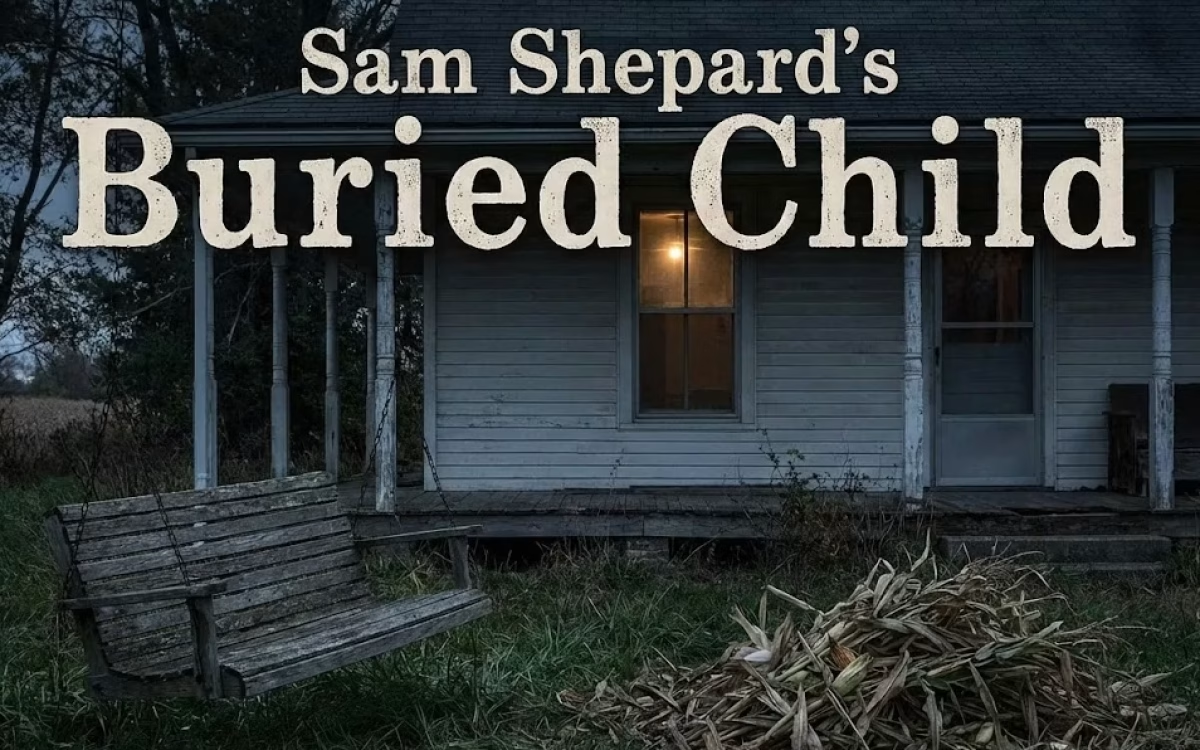
Sam Shepard’s Buried Child is not the America of white picket fences, cheerful families, and fertile cornfields we often imagine. Instead, it pulls us into a decaying farmhouse in Illinois, where the once‑glorious American Dream has collapsed into silence, denial, and moral rot. The smiling family portrait has cracked; the land is barren, and the heart of the home hides a dark, disturbing secret buried in its backyard.
This is Shepard’s version of the Dream gone wrong—a haunting landscape where the promises of prosperity have turned to dust. Through broken conversations and eerie moments of revelation, Buried Child strips away illusions of success, faith, and family harmony to reveal something far more unsettling: a nation in spiritual decay.
Awarded the Pulitzer Prize for Drama in 1979, the play revitalised American Gothic theatre with its stark realism and surreal undertones. It transformed the comforting image of a cosy farmhouse into a symbol of the country’s buried guilt and forgotten conscience. In exposing what lies beneath the Midwestern soil, Sam Shepard forced America to confront the truth it desperately wanted to forget.
“Discover why this masterpiece won the Pulitzer Prize for Drama. Add this modern American classic to your library: [Buy Buried Child by Sam Shepard].”
Quick Summary: Sam Shepard’s Buried Child
Buried Child (1978) is a Pulitzer Prize-winning play by Sam Shepard that explores the disintegration of the American Dream. Set in a decaying Illinois farmhouse, the story follows Vince, who returns home after six years only to find that his dysfunctional family—his grandfather Dodge and father Tilden—does not recognise him. The plot revolves around a dark family secret: an incestuous child born to Tilden and his mother Halie, which was murdered and buried in the backyard. As Tilden literally unearths the corpse, the family is forced to confront their hidden trauma and moral decay.
Plot Summary (Act by Act)
Act 1: The Rotting House and the Mysterious Corn
The play opens in a run-down farmhouse in rural Illinois. The furniture creaks, the rain falls, and Dodge lies coughing on the sofa. He hides a bottle of whiskey under a blanket, drinking secretly to dull his pain. Once the proud head of the family, he is now frail, bitter, and haunted by the past.
His wife, Halie, never appears downstairs. She spends her time upstairs, talking to a local minister and reminiscing about their dead son, Ansel. Her voice echoes through the house like a ghost clinging to memories. She speaks of faith and family pride, but her words feel empty.
Then enters Tilden, their eldest surviving son. He carries an armful of fresh corn, even though Dodge insists the field has been barren for years. The corn’s sudden appearance unsettles everyone. It suggests that the earth—like the family—holds a secret it refuses to keep buried. The act ends with unease hanging heavy in the air, hinting at a truth too horrible to name.
Act 2: The Strangers Who Should Be Family
Vince, Tilden’s son, arrives at the farmhouse after years away. His girlfriend, Shelly, accompanies him, curious and polite. They expect a warm welcome, but the family stares at them blankly. No one recognizes Vince—not even his father. This shock leaves him confused and angry. The loss of identity becomes painfully real, as if the family’s buried guilt has erased their memories.
Shelly tries to make sense of the situation, engaging with each member of the household. Her discomfort grows as she realizes that she has stepped into something far darker than a family reunion. The emotional distance between the family members deepens, and the silence of their shared guilt becomes almost unbearable.
Act 3: The Truth Unearthed
In the final act, the secrets that have poisoned the family finally surface. Dodge, near death, breaks the silence and confesses the truth: Halie once gave birth to a child fathered by their son, Tilden. Horrified, Dodge drowned the baby and buried it in the backyard.
The revelation transforms the house into a site of spiritual reckoning. Vince returns, now changed—drunk, defiant, almost possessed by the family’s madness. As Dodge dies quietly on the sofa, the cycle of decay and rebirth begins again. Halie calls down excitedly that the corn has started to grow in the backyard. At that moment, Tilden enters silently, carrying the buried child’s muddy corpse in his arms.
The image is haunting—the harvest of sins finally brought to light. Shepard closes the play on this chilling note, leaving us to wonder whether new life can ever grow on such cursed ground.
Sam Shepard’s Buried Child: Character Analysis
Dodge – The Dying Patriarch
Dodge is the head of the family, but his authority has long crumbled. Once a proud farmer, he now lies coughing on the sofa, clutching a bottle of whiskey instead of a Bible or a plough. He represents the decaying old guard of America—once powerful, now hollow and bitter.
Cynical and defensive, Dodge hides behind sarcasm to cover his guilt. Yet beneath the rot, he remains the keeper of truth. His final confession about the buried child exposes the moral collapse not only of his family but of the American Dream itself. In a sense, Dodge’s death marks the end of old illusions, making room for brutal honesty, even if it arrives too late.
Halie – The Hypocritical Matriarch
Halie spends most of the play upstairs, both literally and symbolically above her family’s filth. She clings to religion and nostalgia, constantly praising her dead son Ansel and preaching morality. However, her behaviour exposes her hypocrisy. She carries on an affair with Father Dewis and denies any involvement in the family’s buried sin.
Halie represents America’s self-deception—the tendency to glorify the past while ignoring present decay. Her faith feels more like a shield than salvation. Even when confronted with the truth, she escapes into delusion, symbolising moral blindness wrapped in piety.
Tilden – The Broken Son and Truth-Seeker
Tilden is the most tragic figure in Sam Shepard’s Buried Child. Once a promising athlete, he has returned home shattered—mentally unstable, haunted, yet mysteriously attuned to the land. While others deny the past, Tilden feels its pulse through the soil. His act of bringing corn and carrots into the house is deeply symbolic. It is as though the earth itself speaks through him, refusing to keep secrets buried.
He becomes the voice of suppressed truth. Although childlike and confused, Tilden alone confronts what others suppress. In the final scene, he carries the buried child’s corpse upstairs—a chilling act of revelation that forces the family’s denial into the open.
Vince – The Prodigal Son Inheriting a Curse
Vince enters the farmhouse with hope. He wants to reconnect with his father and grandparents, seeking the comfort of belonging. But no one recognises him. Their blank stares reflect not only personal amnesia but the family’s moral disintegration. Forgotten by his own bloodline, Vince experiences an identity crisis that mirrors a generation cut off from its roots.
By the end, Vince changes. He assumes the role of patriarch, taking over the farmhouse and repeating the cycle he hoped to escape. Instead of restoration, his “inheritance” becomes a moral curse. Shepard’s irony is sharp—Vince returns home to reclaim his roots, only to find they are poisoned.
Sam Shepard’s Buried Child: Critical Themes
1. The Disintegration of the American Dream
At its core, Sam Shepard’s Buried Child dismantles the shining myth of the American Dream. Once, the family farmhouse stood as a symbol of hard work, fertility, and hope. Now, however, it has turned into a place of decay and denial. Consequently, the cornfield yields nothing, and the rooms smell of whisky, sickness, and wasted time. Instead of crops, this family harvests lies, secrets, and unspoken guilt.
Shepard transforms the archetypal American farm, often idealised in literature, into a haunting warning. The house is no longer a home; it is a tomb where dreams have withered. Dodge’s coughing, Halie’s delusions, and the sons’ failures all show a society that has lost faith in progress. The dream of prosperity has turned inward, rotting from neglect and moral corruption.
For audiences worldwide—including Indian readers familiar with similar tales of generational strife—this collapse of idealism feels universal. The American Dream, like any national myth, becomes hollow when built on denial.
2. The “Buried Child” as a Metaphor for Original Sin
The play’s title carries enormous symbolic weight. The buried child is not only a literal corpse but also the embodiment of collective guilt. Born from an incestuous union between Tilden and Halie, the child represents the family’s original sin—the moral crime that poisons everything above ground.
By burying the infant, Dodge tries to bury the shame, but Shepard makes it clear that such secrets never stay hidden. The earth itself rebels; corn grows from barren soil, and Tilden instinctively digs at the truth. The buried child thus becomes a metaphor for suppressed memory and generational trauma.
Every character’s silence adds another layer of dirt to the grave. Yet, as with all repressed guilt, the truth resurfaces with disturbing force. When Tilden finally carries the child’s body back into the house, Shepard visualises the unavoidable return of what has been denied. No family, and no nation, can build a future on top of undealt sins.
3. The American Gothic and the Grotesque
Buried Child revitalised the American Gothic tradition by transplanting its haunted castles and decaying mansions to the heartland of America. Instead of supernatural ghosts, Shepard replaces them with guilt, yet the atmosphere remains just as eerie. In fact, the farmhouse—dimly lit and crumbling—becomes a stage for grotesque imagery and psychological decay.
Moreover, Dodge’s hacking cough, Bradley’s wooden leg, and Tilden’s eerie fixation on fertility all work as Gothic symbols of physical and moral deformity. Together, these grotesque details magnify the discomfort, pushing the ordinary into the realm of nightmare. Rather than using horror for shock value, Shepard employs it to explore the sickness hidden beneath American normalcy.
Ultimately, in this version of the American Dream, the “monster” is not outside the door—it lives within the family. Therefore, Shepard’s Gothic vision transforms domestic life into something silently terrifying, where love decays into guilt and memory slowly curdles into madness.
Sam Shepard’s Buried Child: Symbolism
The Vegetables (Corn and Carrots)
Tilden’s repeated act of bringing in vegetables from a field declared “barren” is one of the play’s most striking images. The corn and carrots seem to appear from nowhere, defying Dodge’s insistence that nothing has grown there in years. This mysterious harvest becomes a powerful symbol of truth rising to the surface.
Just as the vegetables push through the soil, long‑buried secrets push through the family’s silence. No matter how deeply the past is buried, it finds a way to grow back. The fertility of the earth contrasts sharply with the emotional sterility of the family, making the crops both miraculous and unsettling. They remind us that nature refuses to keep their guilt hidden.
The Rain
Throughout Sam Shepard’s Buried Child, rain serves as a haunting backdrop. It confines the family indoors, trapping them with their secrets and forcing them to face one another. The relentless downpour mirrors their emotional suffocation—the more it rains outside, the heavier the tension inside.
Rain also carries traditional associations of cleansing and rebirth, yet Shepard twists that meaning. Here, the rain does not cleanse; it suffocates. Instead of renewal, it signals decay. The storm outside becomes a reflection of the moral storm inside, where confession and purification come only through pain.
Bradley’s Wooden Leg
Bradley’s wooden leg is one of Shepard’s darkest symbols. It represents both castration and powerlessness—the loss of masculine strength that defines this broken family. Once capable and aggressive, Bradley is now incomplete, relying on aggression to assert control.
His attempt to cut Dodge’s hair with his wooden leg nearby creates a grotesque image of dominance turned hollow. Shepard uses the leg as a emblem of failed authority and frustrated masculinity in modern America. Also, beneath the surface, it also reveals the play’s recurring fear of impotence—not just sexual, but spiritual and emotional. EXPLORE OTHER WRITERS
Conclusion
By the end of Sam Shepard’s Buried Child, the farmhouse becomes both a grave and a throne. Dodge’s death leaves his grandson, Vince, as the new head of the family. He takes over Dodge’s spot on the sofa, the same position of power and decay. The moment feels less like renewal and more like repetition. The younger generation inherits not wisdom or land, but guilt and silence.
Vince, once the hopeful outsider seeking identity, now carries the family’s curse. The cycle of denial and destruction begins again, proving that the buried truth still rules the house. Shepard’s final image—Tilden carrying the dead child upstairs while Halie speaks of new corn in the garden—captures the terrible irony of rebirth built on corruption.
Ultimately, Buried Child warns that we cannot bury the past. Secrets, like seeds, always find their way back to the surface. The play turns the American Dream into a nightmare of inheritance and memory, reminding us that what is sown in silence will one day demand to be seen.
FAQS
What is the secret in Buried Child?
The dark secret in Sam Shepard’s Buried Child is that Halie had a child with her son, Tilden. As a result, the family becomes trapped in a web of shame and denial. In an attempt to conceal the incestuous relationship, Dodge drowns the baby and buries it in the backyard. However, the secret refuses to stay buried. Ultimately, this terrible act becomes the family’s unspoken guilt—the moral infection that poisons their home and gradually destroys their sense of identity.
What does the corn symbolise in the play?
The corn in Buried Child symbolises the truth refusing to stay buried. Although Dodge insists the field is barren, corn and carrots mysteriously appear. This unnatural fertility suggests that secrets, like crops, eventually surface no matter how deeply they are hidden. Also, the corn contrasts the family’s moral sterility, showing that nature reveals what humans try to repress.
How does Buried Child relate to the American Dream?
Buried Child serves as Sam Shepard’s grim critique of the American Dream. The family’s farm—once a symbol of prosperity and independence—has become barren and lifeless. The smiling myth of American success collapses into alcoholism, hypocrisy, and denial. Moreover, Shepard exposes how the Dream rots from within when built on lies and forgotten sins, turning the home into a haunted wasteland rather than a place of hope.