Introduction
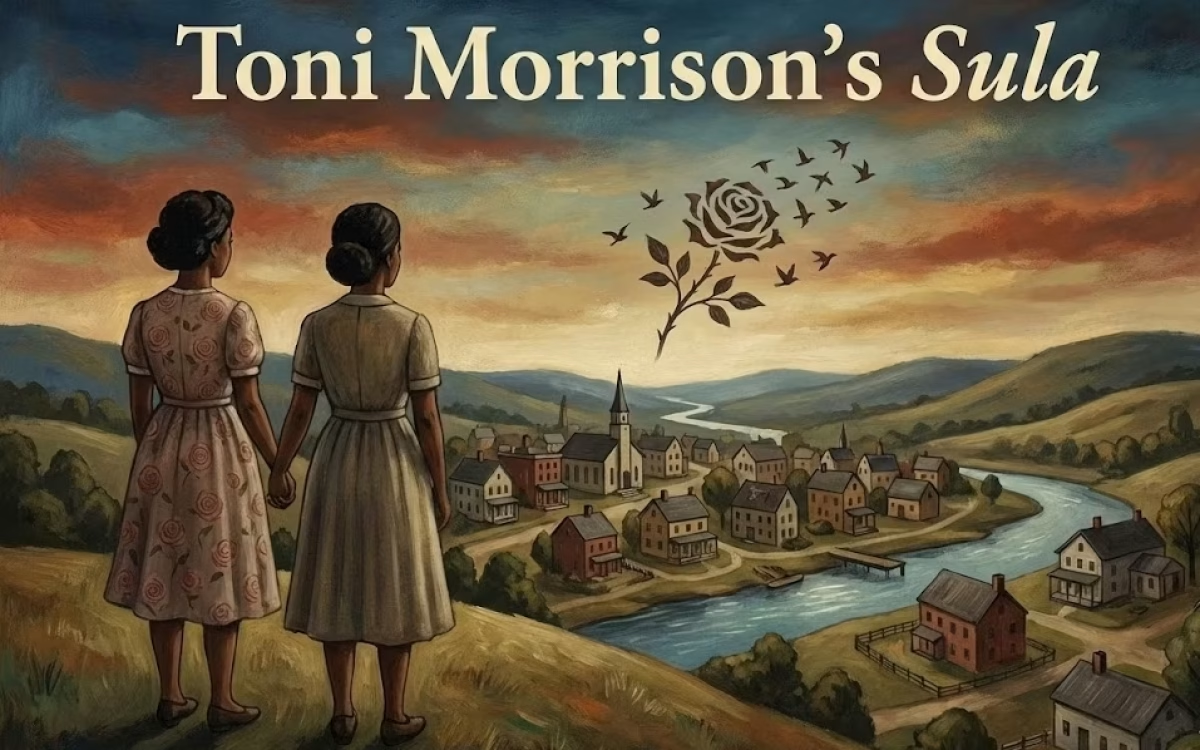
Toni Morrison’s Sula challenges the traditional idea that romantic love is the most meaningful connection in life. Most novels celebrate marriage as the ultimate human bond, but Morrison’s powerful narrative insists otherwise. In Sula, female friendship—raw, tender, and rebellious—emerges as a force more primal, dangerous, and enduring than romance itself.
Written during the height of Second Wave Feminism, Sula reflects the spirit of women seeking liberation. Morrison, however, offers a distinctly Black feminist perspective that resists universalised notions of womanhood. Her writing roots this struggle in the unique experiences of Black women. Their desires, conflicts, and loyalties are shaped by race, gender, and community.
Although Morrison would later win the Nobel Prize in Literature for her extraordinary body of work, Sula already reveals her bold narrative vision. The novel’s protagonist, Sula Peace, stands at the centre of this vision. She is not a villain, but an “experimental life,” a woman who refuses to fold herself into a socially acceptable shape. Through Sula’s defiance, Morrison explores what it means for a woman to be truly free. That freedom often isolates her from the world around her.
Quick Summary: Sula
Published in 1973, Sula is Toni Morrison’s second novel. Set in a tight-knit African American community called “The Bottom” in Ohio, it spans the years 1919 to 1965. The story focuses on the intense bond between two girls: Nel Wright (who chooses marriage and convention) and Sula Peace (who chooses radical freedom and becomes a social pariah). The novel deconstructs the binary of “good woman” vs. “bad woman,” suggesting that Sula’s rebellion is necessary for the community’s survival, even if they hate her for it.
The Setting: “The Bottom” (Irony)
In Toni Morrison’s Sula, the story unfolds in a place called “The Bottom,” a Black neighbourhood ironically located high up in the hills. The name itself is a cruel joke with deep symbolic meaning. According to the novel’s backstory, a white farmer once tricked his Black slave by promising freedom and a piece of land “at the bottom.” When the slave discovered that the land was actually on top of the hills, the farmer justified the deception by claiming the land was “closer to God.”
This darkly humorous exchange captures the bitter irony of racial exploitation. The Bottom becomes both a literal and metaphorical inversion of social reality. It is a place where what is considered “good” for whites is “bad” for Blacks. What is exalted in white culture is degraded in Black life. Morrison uses this irony to expose the warped logic of racism, in which oppression is disguised as generosity and deprivation masquerades as privilege.
Symbolically, The Bottom represents the moral and social topsy-turviness of America’s racial hierarchy. Its residents live physically above the white town yet remain economically and socially beneath it. This inversion sets the tone for the novel’s exploration of contradiction, resistance, and survival. The world of the novel is turned upside down by injustice.
“Toni Morrison’s language is poetic and dense. To truly understand the nuance of ‘The Bottom,’ I recommend reading the Vintage International Edition, which includes Morrison’s own retrospective foreword. [Buy Sula on Amazon].”
Toni Morrison’s Sula: Plot Summary
In Toni Morrison’s Sula, the story unfolds across several decades in the Black community of The Bottom, beginning in the 1920s. At the heart of the novel is the intense, complex friendship between Nel Wright and Sula Peace, two girls described as “two throats and one eye.” Their bond is so deep that they seem to share a single soul—inseparable in spirit and imagination.
Their innocence ends abruptly with a traumatic event: the accidental drowning of Chicken Little. While playing by the river, Sula loses her grip on the boy’s hands, and he falls into the water and drowns. The girls are horrified, but they never confess the truth to anyone. The shared secret becomes a haunting presence in their lives—a symbol of both their intimacy and their separation.
As they grow older, their paths diverge. Nel chooses stability, marrying Jude, a working-class man who dreams of building a respectable life. Sula chooses freedom, leaving The Bottom to seek new experiences. She spends ten years away—attending college, travelling, and defying the racial and sexual restrictions placed on Black women. When she returns, Sula is self-possessed and independent, but her presence disrupts the community’s fragile moral order.
The breaking point comes with Sula’s affair with Jude, Nel’s husband. It is not an act of calculated betrayal but an impulsive search for connection—Sula simply says Jude “filled a space.” Yet the act shatters their friendship and Nel’s marriage. The community turns on Sula, labelling her an outcast and a sinner.
In the novel’s final act, Sula dies alone, unrepentant yet reflective. Years later, Nel confronts the profound emptiness left behind. Visiting Sula’s grave, she suddenly realises that her deepest grief was never for her husband, but for her lost friend. Her final, heart-wrenching words—“We was girls together”—capture the enduring power of their bond and the tragedy of its rupture.
Toni Morrison’s Sula: Character Analysis
Sula Peace: The “New Woman”
Sula Peace embodies the spirit of rebellion and self-definition. She represents the “New Woman”—a figure without a fixed centre, unbound by convention, and unafraid to follow her impulses. Sula’s choices often shock the community, yet Morrison portrays her not as evil but as radically honest. She refuses to conform, even when her freedom isolates her. Sula’s life becomes a daring experiment in autonomy—a test of what it means to exist outside society’s moral and gendered boundaries. Her danger lies not in malice, but in her integrity; she lives in complete alignment with her desires, no matter the cost.
Nel Wright: The “Traditional Woman”
In contrast, Nel Wright represents the “Traditional Woman”, moulded by social and cultural expectations. She values respectability, stability, and marriage—believing these will bring her happiness and moral standing. However, Morrison exposes the fragility of that belief. Nel’s “goodness” is not rooted in moral strength but in fear—fear of chaos, desire, and freedom. Her journey reveals the emotional cost of conformity. By the novel’s end, Nel realises that her careful life may have left her empty, disconnected from the emotional truth she once shared with Sula.
Eva Peace: The Matriarch
Eva Peace, Sula’s grandmother, stands as the formidable matriarch of the Peace household. Fierce, cunning, and sometimes cruel, Eva’s love manifests through acts of survival and violence. In one unforgettable scene, she lets a train sever her leg to collect insurance money—a desperate act of self-mutilation to feed her children. Later, she burns her son Plum alive, an act Morrison frames as both horrifying and tender. Eva’s twisted mercy—killing her child to free him from addiction—reveals the novel’s recurring theme: that love and violence can coexist in the same act, blurring the line between nurture and destruction.
Shadrack: The Survivor of Chaos
Shadrack, a shell-shocked veteran of World War I, embodies the trauma of dislocation and fear. Haunted by the constant possibility of death, he creates “National Suicide Day”—a symbolic ritual meant to contain chaos and give people control over the inevitable. While the townspeople dismiss him as mad, Morrison grants Shadrack profound psychological insight. He is the only character who understands Sula, recognising in her the same acceptance of life’s disorder that he seeks. Together, they form a quiet kinship grounded in their shared defiance of fear.
Toni Morrison’s Sula: Major Themes
1. Good vs. Evil
In Toni Morrison’s Sula, the line between good and evil is never clear. The people of The Bottom brand Sula a witch, labelling her as evil to affirm their own sense of morality. Yet, Morrison challenges this simplistic division. The community’s morality thrives only because it has Sula to condemn. When Sula dies, the town begins to unravel—families grow distant, marriages weaken, and old resentments return. Morrison reveals that Sula served as a scapegoat, an outlet for the town’s unacknowledged vices. Through her, the residents defined themselves as “good”. Without her, they must face their own flaws. The novel suggests that good and evil are not absolute forces but social constructions born from fear, guilt, and the need for belonging.
2. Female Friendship
The most powerful relationship in the novel is not romantic, but rather a female friendship. Importantly, the bond between Sula Peace and Nel Wright transcends the limited roles offered to women in their community. For a brief time, they are each other’s mirrors—able to be wild, honest, and imaginative without judgement.
In fact, their friendship represents a space of creative and emotional freedom. Here, both can explore who they are before society divides them into “good” and “bad” women. However, when this bond breaks, the emotional core of both women collapses. Ultimately, Morrison elevates female friendship as a deeper, truer connection than marriage—one capable of revealing both the beauty and pain of womanhood.
3. Fire and Water
Morrison uses the opposing elements of fire and water to symbolise the novel’s emotional and moral tensions. Sula is linked with water—fluid, shifting, and dangerous, embodying the chaos of life and emotion. Water marks key moments in her story, from the drowning of Chicken Little to the flood of unspoken emotions that define her inner world. Nel, by contrast, is associated with earth and fire—stable, contained, and rooted in structure. Yet, fire also burns within the Peace family: Eva’s fiery act of love when she kills her son Plum echoes both destruction and purification. Through these elemental contrasts, Morrison explores how passion and restraint coexist—and how both can lead to creation or ruin.
“Sula is a radical text for feminist critics. Compare Sula’s independence to the theories in [Feminist Approaches to Literature].”
Critical Analysis (Feminism)
The famous line, “Because each had discovered years before that they were neither white nor male, and that all freedom and triumph was forbidden to them, they had set about creating something else to be,” captures Morrison’s Black feminist insight into how race and gender jointly restrict Nel and Sula. As young Black girls, they already understand that the dominant scripts of “freedom” and “success” in America are written for white men, not for them. They improvise a different way of being, rooted in imagination, intimacy, and shared defiance. Their friendship becomes a secret site of self‑making. It is a space where they can experiment with identity outside the white, patriarchal gaze that constantly names them lacking.
This vision directly engages and revises Zora Neale Hurston’s famous image of Black women as the “mules of the world.” They are overworked, overburdened, and used as beasts of labour and care. Nel initially seems to accept this role. She allows herself to be shaped into the dutiful wife and respectable Black woman. She carries emotional and domestic weight for others.
Sula, by contrast, refuses to be a mule. She rejects marriage, domestic service, and community expectations. She insists on sexual and personal autonomy, even when it makes her a pariah. Morrison’s feminism here is not about making Black women “stronger” mules. It is about imagining a woman who steps out of the harness entirely. She chooses an “experimental” life that exposes how deeply exploitative the old roles always were.
Conclusion
The ending of Toni Morrison’s Sula is ultimately a cry of loss, not of moral resolution. Nel, standing at Sula’s grave years after her death, suddenly realises that the true wound in her life is not her husband’s betrayal, but the absence of Sula. She was the one person with whom Nel had once been fully herself. Her final anguished words, “We was girls together,” distil the entire novel into a single moment of belated recognition. They mourn the irretrievable intimacy and imaginative freedom of their shared girlhood.
This conclusion suggests that wholeness requires both the apparent order of Nel and the disruptive chaos of Sula. Nel’s stability without Sula’s risk becomes rigidity. Sula’s freedom without Nel’s rootedness becomes isolation. Morrison’s final message is that a fully realised life—and a fully honest community—must hold space for both forces. The safety of structure and the danger of experimentation, respectability and rebellion, sameness and difference, together shape a more complete vision of what it means to be human.
FAQS
What does the birthmark over Sula’s eye represent?
Sula’s birthmark is a shifting symbol that reveals more about the beholder than about Sula herself: some see a rose, others a snake, others a tadpole. It suggests that Sula’s identity is fluid and unreadable, and that the community projects its fears, desires, and fantasies onto her body, turning her into whatever they need her to be—temptress, danger, or mystery.
Is Sula a villain?
Sula is not a straightforward villain; she is an “experimental life,” a woman who refuses to collapse herself into the roles of wife, mother, or martyr. The town calls her evil because her freedom exposes the limits of their own choices, but the novel implies that her existence is necessary, even generative—without her, the community loses the dark mirror that forces it to confront its own hypocrisy.