Introduction
Joseph Conrad’s Heart of Darkness remains an essential subject for literary scholarship and critical thought more than a century after its publication in 1899. This novella, situated at the intersection of modernist literature and postcolonial critique, artfully dissects the complexities of imperialism and the human condition. Its enduring relevance stems from its multifaceted narrative—a work that interrogates the veneer of civilisation, the insidious nature of colonial power, and the psychological depths of human identity.
In undertaking this analysis, I approach Heart of Darkness not merely as a historical artifact but as a dynamic text whose ambiguous symbolism and ethical provocations demand continuous scholarly engagement. This essay will endeavour to provide a nuanced examination of Conrad’s narrative technique, his thematic concerns, and the pervasive symbolism that structures the novella’s reflective journey into the “darkness” at the heart of empire and self.
Narrative Structure and Overview: Marlow’s Journey as a Meditative Quest
At the structural core of Joseph Conrad’s Heart of Darkness lies the frame narrative—a layered storytelling device which Conrad employs to profound effect. The novella opens on the River Thames, where an unnamed narrator introduces Charles Marlow, a seaman who undertakes a voyage into the Congo Free State to retrieve Kurtz, an enigmatic ivory trader whose reputation precedes him. The embedded narrative unfolds as Marlow recounts his expedition, creating a dialectic between the “civilised” outer world and the chaotic interiorities represented by the African Congo.
This narrative framing is central to understanding the work’s thematic complexity. The juxtaposition of the familiar London setting with the mysterious Congo invites readers to question prevailing notions of civilisation and savagery. What is particularly compelling—and disconcerting—is how Marlow’s tale destabilises the very concept of truth, as his story is suffused with ambiguity and mediated through layers of interpretation. This choice challenges readers to critically evaluate the trustworthiness of narratives and exposes the opacity inherent in understanding historical and human realities. FULL TEXT
Thematic Inquiry: Imperialism’s Ethical Paradox
One cannot approach Joseph Conrad’s Heart of Darkness without grappling with its incisive examination of imperialism—a system portrayed in all its hypocrisy, violence, and moral ambiguity. Conrad’s critique is not a straightforward condemnation but an exploration of imperialism’s profound capacities to corrupt both the dominators and the dominated.
The Economic and Human Cost of Empire
The novella vividly portrays imperialism’s dual nature: outwardly justified by European civilising missions but fundamentally driven by avarice and exploitation. The ivory trade, a central motif, symbolises the economic greed fueling imperial conquest. Marlow’s observations reveal a world where human lives are expendable in the pursuit of commercial gain, where the colonial enterprise operates under a veil of deception and self-justification.
This portrayal aligns with contemporary historical accounts of the Congo Free State under King Leopold II, wherein brutal atrocities were committed in the name of empire-building. Conrad’s choice to situate the narrative within this context underscores the novella’s grounding in real political and ethical dilemmas.
The Moral Ambiguity of Civilisation
Yet, the novella complicates the easy moral binaries frequently associated with colonial discourse. Through Marlow’s reflections and encounters, Conrad exposes the fragility of Western concepts of civilisation. The ostensibly “civilised” Europeans, far from embodying moral superiority, are frequently shown as complicit in acts of barbarism.
Such ambivalence culminates in the figure of Kurtz—a charismatic yet deeply flawed individual. He embodies the potential for savagery that lies at the heart of the empire. Kurtz’s descent into madness and moral depravity unsettles the colonialist narrative of progress and enlightenment. Instead, it reveals the hollow core that sustains imperial authority.
Symbolism and Imagery: Layers of Meaning in Heart of Darkness
Conrad’s novella is notoriously rich in symbolism, which, while opaque at times, contributes significantly to its thematic resonance.
The Congo River: A Symbolic Axis
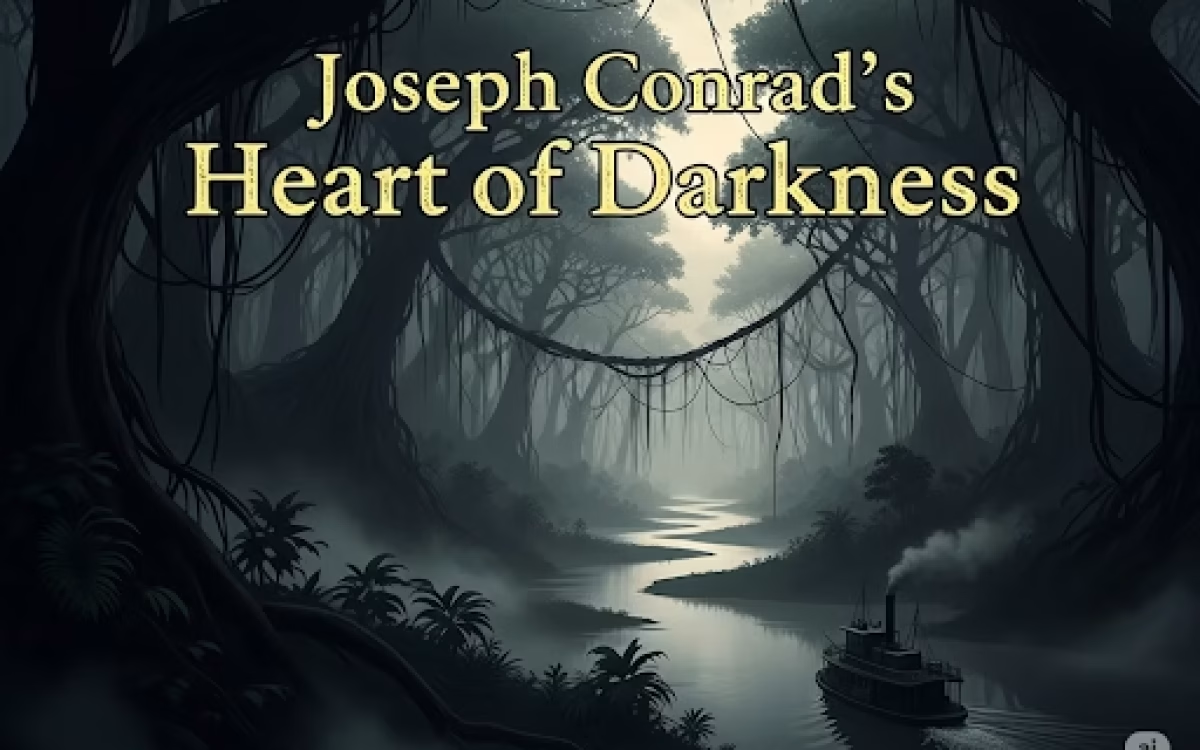
The river guides Marlow’s journey and serves as a powerful symbol. It represents several dimensions. On one level, it is a physical pathway into the African interior. On another, it becomes a metaphorical passage into the human subconscious. The river also stands as an emblem of the inscrutability of experience. Its winding and unpredictable nature reflects the complexity of the imperial world. It also mirrors the internal struggles that shape Marlow’s sense of identity.
Interplay of Light and Darkness
Perhaps the most iconic symbolic framework in the novella is the dialectic between light and darkness. However, Conrad’s use of these images transcends simplistic oppositions. The “darkness” is not merely a racialised or geographical marker, but a pervasive force residing within all human beings and institutions.
The ostensibly “enlightened” metropolis of London is ironically described in terms evocative of darkness and moral ambiguity, suggesting that imperial violence and ethical corruption extend beyond colonial frontiers. This inversion demands readers reconsider assumptions about the source and meaning of “darkness.”
Kurtz as a Symbolic Figure
Kurtz’s character functions as a nexus of many of these symbolic tensions. He is simultaneously an idealist, a tyrant, and a victim of his own profound inner turmoil. His final, haunting exclamation—“The horror! The horror!”—serves as a cryptic summation of the novella’s exploration of human depravity, imperial abuse, and existential despair.
Conrad’s Style: The Language of Ambiguity and Suggestion
Conrad’s prose in Heart of Darkness is characterised by its density, poetic quality, and pervasive ambiguity. His rhetorical strategy often involves the use of qualifying language—“seemed,” “appeared”—which destabilises unequivocal meaning and reflects the novella’s themes of uncertainty and elusive truth.
This stylistic choice compels readers into an active engagement with the text, interpreting and questioning rather than passively consuming the narrative. The frequent recurrence of motifs such as “darkness,” “gloom,” and “shadows” evokes an atmosphere laden with foreboding and moral complexity.
Personal Reflection
When I engage with Heart of Darkness, I am struck by its enduring power to provoke reflection. The novella consistently raises questions about the human condition and the structures of power that shape our society. Conrad refuses to provide definitive answers. Instead, he cultivates ambiguity and discomfort. This mirrors the complexities we face in contemporary global issues, including colonial legacies, racial identity, and ethical responsibility.
Conrad’s work, while a product of its time, continues to confront readers with the “darkness” that persists within modernity. Its psychological and political insights challenge us to confront our own complicities and question the narratives we inherit. EXPLORE MORE AUTHORS
Conclusion
Joseph Conrad’s Heart of Darkness stands as a monumental work in the literary canon. Its power lies not only in narrative artistry but also in a relentless interrogation of moral and political certainties. The novella examines the ethical contradictions of imperialism. It explores the fragility of civilisation and the depths of human darkness. These aspects secure its ongoing place in scholarly discourse.
Moreover, for academics, students, and literary enthusiasts alike, engaging with Heart of Darkness offers an opportunity to explore fundamental questions about power, identity, and morality. Its rich symbolism, narrative complexity, and stylistic innovation continue to inspire diverse interpretations and critical debates.
As we revisit Heart of Darkness today, literature reveals its profound ability to illuminate the darkest facets of history and the psyche, guiding us toward a deeper understanding of ourselves and the world we inhabit.
Frequently Asked Questions
1. What is the main theme of Heart of Darkness?
The primary theme is the critique of European colonialism. Conrad exposes the brutality and moral ambiguity of imperial ventures, suggesting that the so-called “civilising mission” is a cover for exploitation and greed. The novel also grapples with the darkness within human nature and the thin veneer of civilisation.
2. Who is Kurtz, and why is he significant?
Kurtz is an ivory trader whose descent into madness in the Congo represents the devastating psychological and ethical effects of unchecked power. He embodies both the ideals and the failures of European imperialism, culminating in his final words, “The horror! The horror!” which reflect the novella’s exploration of evil and self-knowledge.
3. How does the narrative structure contribute to the novella’s meaning?
Conrad employs a frame narrative, with Marlow’s story being told by another unnamed narrator. This structure distances readers from the events and foregrounds issues of reliability and subjectivity in storytelling. The story-within-a-story device also reinforces the theme of interpretive ambiguity.
4. What symbols are most important in Heart of Darkness?
The Congo River symbolises a journey into the unknown—both the African continent and the depths of the human psyche. Light and darkness appear repeatedly, but Conrad destabilises their usual meanings to highlight the complexity of moral judgment. Kurtz himself is a potent symbol of the dangers of power and the fragility of civilisation.
5. Is Heart of Darkness autobiographical?
While not a direct autobiography, the novella is rooted in Conrad’s own experiences in the Belgian Congo. Many scholars interpret Marlow as a semi-autobiographical figure, with the story reflecting Conrad’s disillusionment with imperialism.