Introduction
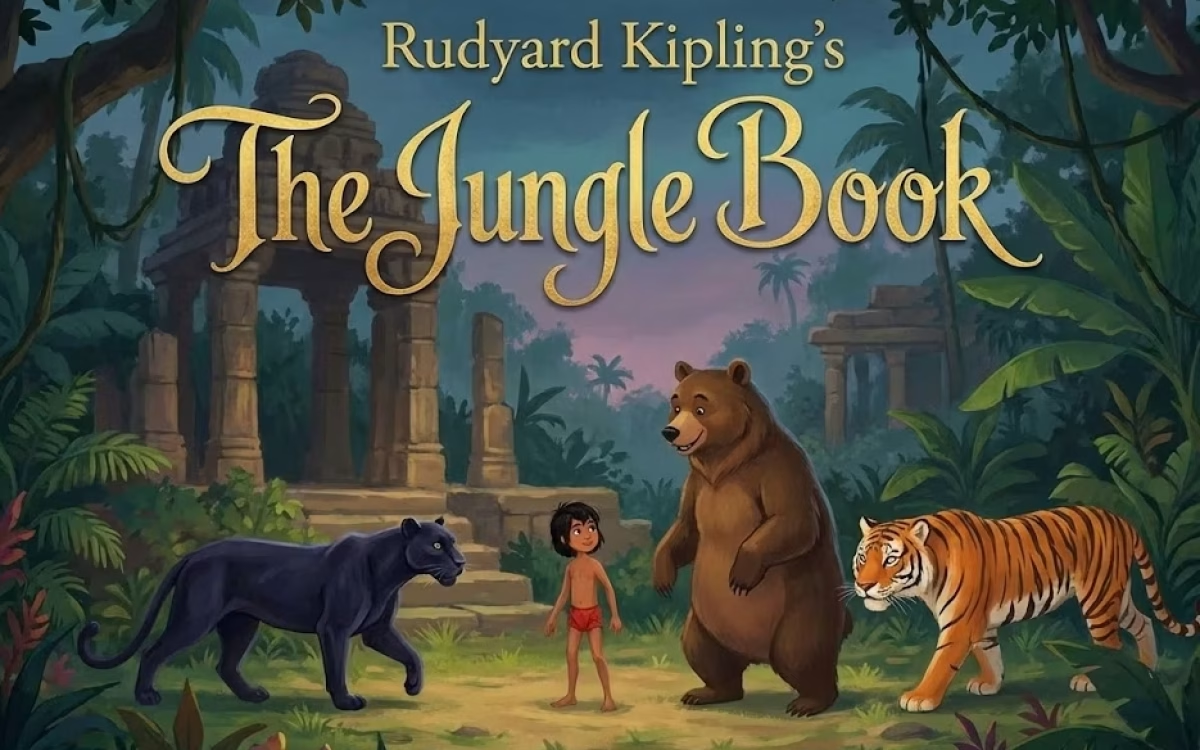
Most readers know The Jungle Book from the famous Disney movie. However, Rudyard Kipling’s The Jungle Book is far darker, deeper, and more thought-provoking than its animated version. Kipling wrote it in the 1890s while living in Vermont, USA. Still, the stories draw heavily from his childhood experiences in India. The book beautifully captures the tension between civilisation and the wild.
Through the story of Mowgli—the boy raised by wolves—Kipling explores timeless themes of belonging, law, and moral order. Unlike the playful adaptation many of us grew up with, Rudyard Kipling’s The Jungle Book reveals the harsh realities of life in the jungle. Every creature must follow the “Law of the Jungle” to survive. Beneath its thrilling adventures and animal fables lies a deeper reflection on society, self-discipline, and the constant search for one’s place in the world.
Quick Summary: The Jungle Book
The Jungle Book (1894) is a collection of seven stories by Rudyard Kipling. While famous for the “Mowgli” stories—about a “man-cub” raised by wolves in the Seoni forests of India—it also includes standalone classics like “Rikki-Tikki-Tavi” (a mongoose fighting cobras) and “The White Seal”. The stories are fables that use anthropomorphic animals to teach moral lessons about “The Law of the Jungle”, loyalty, and the complex relationship between nature and civilisation.
The Structure of the Book
Rudyard Kipling’s The Jungle Book is not a single, continuous novel but an anthology—a collection of independent short stories connected by common themes, settings, and moral ideas. Each story uses animals and nature to explore concepts of loyalty, courage, and the balance between freedom and responsibility.
The book is divided into two main sections: The Mowgli Stories and The Non-Mowgli Stories.
The Mowgli Stories: The first three tales—Mowgli’s Brothers, Kaa’s Hunting, and Tiger! Tiger!—follow the life of Mowgli, a human child raised by wolves in the Indian jungle. These stories trace his journey of growth, survival, and self-discovery as he learns the “Law of the Jungle” and faces challenges from both man and beast.
The Non-Mowgli Stories: The remaining four tales—The White Seal, Rikki-Tikki-Tavi, Toomai of the Elephants, and Her Majesty’s Servants—shift focus to other animal adventures. Each presents a different setting and moral lesson: from the courage of the brave mongoose Rikki-Tikki-Tavi to the loyalty of elephants in serving humans.
Through this anthology structure, Kipling weaves together a diverse yet unified vision of the natural world, showing that every creature—human or animal—has its own place and purpose within a larger moral order.
“Kipling’s vivid descriptions deserve beautiful artwork. I recommend this illustrated edition—it’s perfect for both children and adult collectors.
[Check Price: Rudyard Kipling’s The Jungle Book].”
Plot Summary
At the heart of Rudyard Kipling’s The Jungle Book lies the story of Mowgli, a human child raised by wolves in the Indian jungle. This arc unfolds across three key stories—Mowgli’s Brothers, Kaa’s Hunting, and Tiger! Tiger!—and forms the emotional and moral centre of the book.
Adoption: The tale begins when Father Wolf discovers an abandoned human baby and brings him to the den. Raksha, the fierce and loving Mother Wolf, protects the child and names him Mowgli. Despite opposition from Shere Khan, the lame but deadly tiger, Mowgli is accepted into the Wolf Pack under the protection of Baloo the bear and Bagheera the panther.
The Tutors: As Mowgli grows, Baloo teaches him the Law of the Jungle—a moral code that emphasises respect, obedience, and community—while Bagheera trains him in hunting and survival. Together, they help Mowgli navigate a world where strength and intelligence must coexist with compassion and justice.
The Conflict: Shere Khan, who despises man and sees Mowgli as an intruder, vows to kill him. He symbolises chaos, pride, and the defiance of natural order, standing in stark contrast to the discipline of the jungle’s law-abiding creatures.
The Resolution: In the story’s climax, Mowgli uses the Red Flower—the jungle’s fearful name for fire—to defeat Shere Khan and prove his mastery over both nature and himself. However, this victory isolates him from the animals he loves, forcing Mowgli to leave the jungle and rejoin human society. His journey becomes a profound reflection on identity, belonging, and the challenge of finding peace between two worlds.
Character Analysis
Mowgli:
Mowgli stands at the centre of Rudyard Kipling’s The Jungle Book as a powerful symbol of the struggle between nature and civilisation. Raised by wolves yet born human, he becomes the “bridge” between two worlds but never fully belongs to either. His inner conflict—torn between instinct and intellect—reflects Kipling’s broader themes of identity, discipline, and belonging. Through Mowgli, Kipling asks what it means to live by the Law of the Jungle while still remaining human.
Shere Khan:
As the primary antagonist, Shere Khan embodies pride, lawlessness, and moral corruption. The lame tiger kills not for survival but for pleasure, defying the sacred code that governs jungle life. His arrogance and refusal to respect authority make him a clear contrast to Mowgli and Akela, both of whom value order and honour. Shere Khan’s downfall reinforces Kipling’s idea that power without discipline leads to destruction.
Akela:
Known as the Lone Wolf, Akela leads the Wolf Pack with wisdom and fairness. He represents the burden of leadership and the dignity of age. His eventual decline mirrors the cycle of strength and weakness found in all societies—animal and human alike. Akela’s guidance helps Mowgli learn integrity, self-control, and respect for the law, virtues essential to his growth.
Rikki-Tikki-Tavi:
Though not part of the Mowgli stories, Rikki-Tikki-Tavi stands out as another of Kipling’s memorable heroes. The brave mongoose represents unwavering courage and loyalty. His battle against the cobras in the human household symbolises the triumph of vigilance, loyalty, and duty over fear and chaos—themes that echo throughout Rudyard Kipling’s The Jungle Book.
Major Themes
1. The Law of the Jungle
The central theme of Rudyard Kipling’s The Jungle Book is the Law of the Jungle. Contrary to common belief, this law does not represent chaos or violence. Instead, it stands for a strict moral and social code that maintains harmony among the jungle’s creatures. The law teaches respect for elders and forbids the killing of humans. It also includes small yet meaningful rules, such as washing before eating.
Through these laws, Kipling highlights discipline, mutual respect, and order as the foundations of every civilisation. This applies both to the animal world and to human society. In contrast, the Bandar-log—the monkeys—have no law or leader. They represent the dangers of disorder, vanity, and life without purpose.
2. Nature vs. Nurture
Another recurring question in Rudyard Kipling’s The Jungle Book is whether identity comes from nature or upbringing. Mowgli, raised by wolves yet born human, embodies this inner conflict. His instincts are wild—he hunts, runs, and thinks as part of the pack. Still, his reasoning and emotions show his human side.
Kipling uses Mowgli to explore how both nature and nurture shape personality. The story suggests that true maturity comes not from choosing one over the other but from learning to reconcile both worlds.
3. Colonial Allegory
Many critics interpret Rudyard Kipling’s The Jungle Book as a metaphor for colonial order. The stories were written during the height of the British Empire. They reflect Kipling’s belief in hierarchy, discipline, and moral restraint—values closely linked to imperial rule. The Law of the Jungle can be seen as a symbol of British authority, bringing “civilisation” to a wild and untamed world.
In contrast, the Bandar-log—lazy, chaotic, and self-absorbed—represent those who live without structure or purpose. They mirror Kipling’s portrayal of rebellious or non-governing groups in colonial society. While modern readers often critique this colonial mindset, the text remains valuable. It helps us understand how literature can both reflect and question historical power and ideology.
[“Sour Grapes,” “Wolf in Sheep’s Clothing,” and “The Lion’s Share”… 🍇🦁 We use these phrases every day, but do you know where they actually come from? They all trace back to one man: Aesop, a storyteller (and alleged slave) from ancient Greece. Like The Jungle Book, I’ve just published a deep dive into Aesop’s Fables, exploring the man behind the myths and why these stories have survived for 2,500 years. READ FULL ANALYSIS HERE]
Literary Devices
Anthropomorphism
One of the key literary devices in Rudyard Kipling’s The Jungle Book is anthropomorphism. It means giving animals human qualities, emotions, and moral understanding. Kipling transforms wolves, tigers, bears, and even snakes into reasoning, speaking beings. These creatures follow ethical codes and social hierarchies like humans do.
Through this technique, Kipling creates a miniature version of human society within the natural world. The animals are not simple caricatures but symbols of moral values. Baloo represents wisdom, while Bagheera stands for independence and discipline. Shere Khan, on the other hand, embodies arrogance and lawlessness. Using these characters, Kipling teaches lessons about duty, justice, and cooperation in a way that both children and adults can understand.
The Use of Verse
Each story in Rudyard Kipling’s The Jungle Book begins and ends with a short poem or song. This is a hallmark of Kipling’s poetic craftsmanship. Before becoming famous as a storyteller, Kipling was first and foremost a poet. His lyrical skill shapes the rhythm and mood of every narrative.
The verses often sum up the moral essence of the story or reveal a character’s thoughts. At times, they celebrate courage, mourn loss, or praise the beauty of the jungle. These poems give the stories a timeless and mythic tone. They transform simple fables into moral epics that continue to inspire readers across generations.
By combining anthropomorphic storytelling with poetic framing, Kipling adds emotional depth and universal meaning to his work. This blend makes The Jungle Book not just an adventure collection, but a lasting moral allegory and a true work of art.
Conclusion
More than a collection of animal tales, Rudyard Kipling’s The Jungle Book endures as a timeless classic because it speaks directly to the “wild” part of every child—and, indeed, every reader. Its balance of adventure, morality, and poetic beauty makes it far more than a simple children’s story. Through Mowgli’s journey, Kipling reminds us that growth requires courage, discipline, and understanding of both nature and society.
The book’s lasting appeal lies in its blend of excitement and ethics. It invites readers to see the jungle not just as a wilderness, but as a mirror of the human spirit—a world where rules exist not to limit freedom, but to give it meaning. That is why The Jungle Book continues to enchant generations, teaching us that the law of life, like the Law of the Jungle, is built on respect, balance, and belonging.
FAQS
Is Rikki-Tikki-Tavi part of The Jungle Book?
Yes. Rikki-Tikki-Tavi is one of the non-Mowgli stories in Rudyard Kipling’s The Jungle Book. It tells the heroic tale of a brave mongoose who protects a British family from deadly cobras in their garden.
What is the “Red Flower” in The Jungle Book?
The “Red Flower” in Rudyard Kipling’s The Jungle Book refers to fire. The animals fear it for its power and destruction, but Mowgli uses it as a symbol of human intelligence and mastery over nature.