Introduction
Umberto Eco’s The Open Work is one of the most influential critical texts of the twentieth century, redefining how we understand the relationship between an artist, a text, and its audience. While many know Eco as the novelist behind The Name of the Rose, he was first and foremost a brilliant semiotician—a thinker deeply concerned with how meaning is created and shared.
In classical art, the artist acts as a dictator, shaping every detail to control how the audience interprets the work. Meaning flows in one direction—from creator to consumer. But modern art challenges this hierarchy. Here, the artist becomes a facilitator who invites the audience into the creative process, allowing multiple meanings and interpretations to coexist.
This radical shift is at the heart of The Open Work. Eco’s theory marks the transition from the authoritarian “Author-God” to the empowered “Active Reader.” By recognising that every reader participates in constructing meaning, Eco opened the door to a new way of experiencing literature, art, and culture itself.
Quick Summary: The Open Work
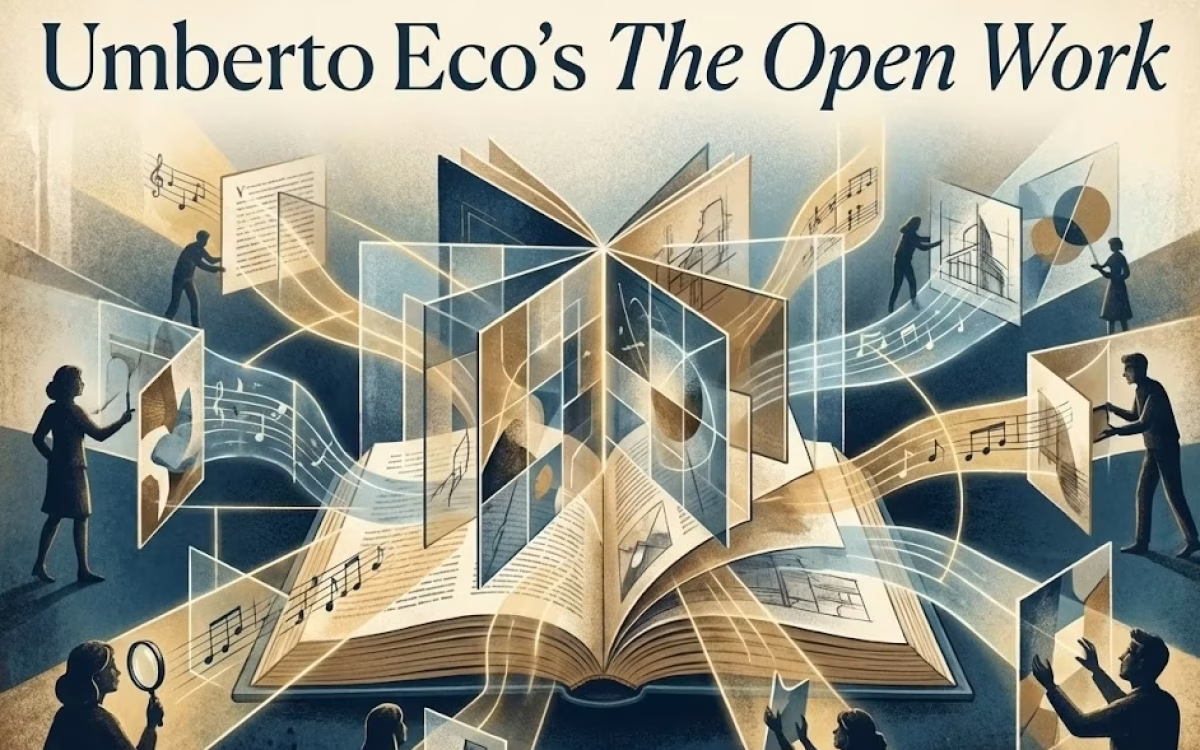
The Open Work (Opera Aperta, 1962) is a seminal text by Umberto Eco that revolutionised literary criticism. Eco argues that modern art (music, literature, painting) is intentionally “open” to multiple interpretations. Unlike classical art, which often dictates a single “correct” way to be read, an Open Work invites the reader/performer to actively participate in generating meaning. It conceptualises the artwork not as a finished object, but as a “field of possibilities” where the reader becomes a co-creator.
What Is an “Open Work”?
Umberto Eco’s The Open Work introduces one of the most revolutionary ideas in modern aesthetics—the notion that a work of art can remain open to multiple interpretations rather than dictating a single, fixed meaning.
In a closed work, the artist provides a clear and complete message. Its meaning is univocal—expressed in one voice. For example, a road sign that says “Stop” communicates one precise instruction. Similarly, a classic detective novel that ends with a solved mystery leaves no room for alternative readings. The audience’s role is passive: to receive, not to interpret.
An open work, by contrast, invites the reader or viewer to participate in creating meaning. Such works are plurivocal—they speak with many voices. Novels like James Joyce’s Finnegans Wake or abstract paintings allow endless interpretations depending on the spectator’s knowledge, emotion, and imagination. The artist becomes a facilitator of possibilities rather than a dictator of meaning.
As Eco explains, “The work of art is a complete and closed form in its uniqueness as a balanced organic whole, while at the same time constituting an open product on account of its susceptibility to countless different interpretations.” This dual nature—structured yet limitless—is what makes an open work endlessly alive, renewed each time it’s experienced.
“This is one of the most important texts for understanding Postmodernism. If you are a Masters student or preparing for UGC NET, this book is essential reading. [Get The Open Work (Harvard University Press Edition)].”
The Two Types of Openness
Umberto Eco’s The Open Work distinguishes between two important forms of openness: interpretative openness and structural openness (also called works in movement). Understanding this distinction helps readers and students grasp how different kinds of art invite participation.
1. Interpretative Openness
This is the more common type of openness in literature and traditional art. Here, the structure of the work itself is fixed, but its meaning is flexible. Each reader or viewer brings personal experience, emotions, and context to the work, creating fresh interpretations every time it is read or viewed.
For example, Shakespeare’s Hamlet remains the same text, but no two readers or performances interpret Hamlet’s hesitation, madness, or morality in exactly the same way. This is interpretative openness—the text allows multiple meanings without altering its physical form.
2. Structural Openness (Works in Movement)
Structural openness goes a step further. In these works, the form itself is not fixed—the structure can be altered, reshaped, or reassembled during each performance or reading. The work is “in movement”, always becoming something new.
For instance, in Karlheinz Stockhausen’s musical compositions, performers can choose the order of movements or sheets, creating a unique version each time. Stéphane Mallarmé’s imagined Book operated on a similar principle: its pages could be rearranged, ensuring no two readings were alike.
These “works in movement” embody the highest level of openness, where the audience is not just an interpreter but a co-creator, participating in the making of the artwork itself.
Historical Context: Medieval vs. Modern
To fully understand Umberto Eco’s The Open Work, it’s important to see how the idea of openness evolved historically. Eco traces this shift from the “closed” art of the medieval period to the “open” art of the modern era, revealing how our understanding of meaning in art has transformed over time.
Medieval Art: The Closed Tradition
In medieval Europe, art was created to instruct and inspire faith, not to be interpreted freely. Every element carried a fixed symbolic meaning understood by the audience of the time. For instance, a white lily always represented purity, and a lamb symbolized Christ’s sacrifice. Religious paintings, sculptures, and stained-glass windows were visual sermons—closed works designed to communicate one sacred message with no room for alternative readings.
Modern Art: The Age of Ambiguity
By contrast, modern art—from Symbolism to Postmodernism—celebrates ambiguity. Artists no longer aim to convey a single moral or theological truth. Instead, they embrace uncertainty, irony, and multiple layers of meaning. The ambiguity becomes a feature, not a flaw. Whether in the fragmented poetry of T.S. Eliot, the abstract canvases of Kandinsky, or the experimental narratives of James Joyce, modern art invites audiences to actively participate in constructing meaning.
Eco sees this evolution as part of a larger cultural transformation—from a world that sought absolute truth to one that values interpretation, diversity, and dialogue.
The Role of the Reader
In Umberto Eco’s The Open Work, the reader (or viewer, or listener) becomes central to the creation of meaning. Eco argues that artistic communication is not a one-way process from author to audience—it is a collaboration.
The “Field of Possibilities”
Eco borrows the idea of a “field of possibilities” from physics to describe how a text functions. The author does not fix one final meaning; instead, they create a structured field where multiple interpretations are possible. Within this field, the reader moves, explores, and selects pathways of understanding. The text sets boundaries, but the reader activates its potential.
Collaboration and Completion
For Eco, a work of art remains unfinished until it encounters a reader. The author initiates meaning, but the reader completes it. Each act of interpretation is an act of creation in itself. As a result, every reading is unique—a dialogue between the artist’s structure and the reader’s imagination, culture, and context.
In this sense, the reader is not a passive consumer but a co-creator. Without the reader, the open work remains only a potential work, waiting to be completed through interpretation. This shift—from author-centred to reader-centred meaning—is what makes Eco’s theory revolutionary and deeply relevant to modern literary criticism.
Does “Open” Mean “Anything Goes”?
A common misconception about Umberto Eco’s The Open Work is that openness means total interpretative freedom—that anything goes. But Eco firmly rejects this idea. Openness does not mean chaos. It means meaningful flexibility within a structured framework.
Freedom Within Limits
Eco warns that not every interpretation is valid. The reader has the freedom to explore, but that freedom exists within the boundaries set by the text itself. The work offers a “field of possibilities,” not infinite anarchy. The interpretations must make sense in relation to the language, symbols, and logic of the work.
For example, interpreting Dante’s Inferno as a science-fiction story about aliens would be absurd. That’s not creative insight—it’s over-interpretation, a reading detached from the textual and cultural context.
The Rule of Responsible Reading
Eco’s golden rule is this: an open work allows multiple legitimate readings, but not limitless or random ones. The artist designs a flexible structure; the reader collaborates by finding meaning supported by the text. True openness involves both creativity and discipline—a balance between individual response and textual evidence.
In short, the reader is free, but not lawless. The openness of the work invites participation, not distortion.
Literary Examples
Umberto Eco’s The Open Work uses several landmark texts to illustrate how openness functions in literature. These examples show how modern writers deliberately create ambiguous, multilayered works that invite active reader participation.
James Joyce: Ulysses and Finnegans Wake
Joyce is one of Eco’s favorite examples of an open work in action. In Ulysses, Joyce transforms a single day in Dublin into a multilayered narrative filled with literary allusions, shifting perspectives, and stylistic experiments. Each reader navigates this “field of possibilities” differently, constructing unique meanings based on their cultural knowledge and interpretative lens.
Finnegans Wake takes this even further. The novel’s fragmented language, multilingual puns, and cyclical structure create what seems like pure chaos. Yet Eco argues that the reader turns this chaos into order through active interpretation. The novel remains unfinished until the reader engages with it—making Joyce’s text one of the clearest examples of structural and interpretative openness combined.
Franz Kafka: The Trial
Kafka’s The Trial is another paradigmatic open work. The story of Josef K., arrested and prosecuted for an unnamed crime, resists a single definitive reading. Is it a critique of totalitarian bureaucracy? A theological parable about guilt and divine judgment? A psychological exploration of existential anxiety? All these interpretations are valid and supported by the text, yet none exhausts its meaning. Kafka’s deliberate ambiguity ensures that The Trial remains open to endless readings across political, religious, and philosophical frameworks.
“For a perfect example of an ‘Open Work’ where meaning is never fixed, read our analysis of [Franz Kafka’s The Trial].”
Conclusion
Umberto Eco’s The Open Work transformed how critics and readers understand art, meaning, and interpretation. By shifting focus from the author’s intention to the reader’s participation, Eco paved the way for Reader-Response Theory. Thinkers like Roland Barthes (with his famous idea of the “Death of the Author”) and Wolfgang Iser (with his concept of the “Implied Reader”) expanded upon Eco’s insight: that meaning is not fixed in the text but created through the act of reading.
Eco’s vision feels even more relevant today. We live in a world filled with open works—interactive media, video games, online fan fiction, and hypertext literature—all demanding that users become co-creators. Each interaction reshapes the experience, just as Eco predicted.
In recognizing that meaning is dynamic, participatory, and plural, Eco didn’t just analyze modern art—he anticipated the digital age itself. In this sense, The Open Work is not just a theory of art but a philosophy for living in an era defined by openness, complexity, and creative collaboration.
FAQS
What is the difference between a closed and an open work?
A closed work communicates one fixed meaning decided by the author. The audience’s role is passive. They receive the message without space for alternate interpretation. Typical examples include a road sign that says “Stop” or a detective novel with one clear ending. An open work, however, invites the reader or viewer to take part in making meaning. It allows many interpretations, all supported by the text. Examples include James Joyce’s Finnegans Wake, which demands active reading, or abstract paintings that evoke different emotions for each observer.
Does Umberto Eco believe the author is dead?
No, Umberto Eco does not believe the author is dead. Unlike Roland Barthes, he argues that the author still has an important role—but the role changes. The author is no longer a dictator of meaning but a designer of openness.