Introduction
George Bernard Shaw’s Pygmalion is more than just a witty social comedy. It is a searing critique of class, language, and gender that continues to resonate across the world. Even today, questions of accent, social mobility, and identity remain deeply relevant.
First performed in 1913, the play tells the story of Eliza Doolittle, a Cockney flower girl who is transformed by Professor Henry Higgins. Higgins, a phonetics expert, turns her from a street vendor into a lady who can pass as a duchess in high society. On the surface, Pygmalion appears to be a tale of transformation and ambition. However, beneath the playful dialogue and memorable characters, Shaw exposes the uncomfortable truths about how society judges people by their speech, appearance, and background.
What makes Pygmalion such a timeless piece is its ability to challenge the status quo. Shaw uses the myth of Pygmalion—the Greek sculptor who falls in love with his own creation—to highlight deeper power dynamics. When one person seeks to “create” or “remake” another, the balance between control and individuality becomes blurred. Higgins views Eliza as raw material, a project to prove his professional prowess. In contrast, Eliza’s journey forces the audience to confront questions about agency, autonomy, and human dignity. Furthermore, the play’s refusal to end with a conventional romantic resolution underscores Shaw’s commitment to realism and social critique.
For readers today, Pygmalion offers a mirror to their own struggles with language and hierarchy. The pressure to speak “proper” English, the anxiety about accent, and the subtle discrimination faced by non-conforming speakers are all timeless issues. These themes still echo in Indian classrooms and workplaces. Shaw’s portrayal of Eliza’s transformation is not just about phonetics. Instead, it reveals the emotional and psychological toll of constantly performing for acceptance—of trying to fit into a mould that may never fully embrace you.
Moreover, Pygmalion remains a masterclass in character development and social satire. Higgins’s arrogance, Eliza’s resilience, and Alfred Doolittle’s unexpected rise each reveal the absurdities of the British class system. Shaw’s sharp wit and incisive commentary make the play both entertaining and thought-provoking. Therefore, it continues to hold a deserved place in the canon of world literature.
Quick Summary: Pygmalion
Pygmalion (1913) is a play by George Bernard Shaw, named after the Greek mythological figure who fell in love with his own sculpture. The story follows Professor Henry Higgins, an arrogant phonetics expert who makes a bet with Colonel Pickering that he can transform a Cockney flower girl, Eliza Doolittle, into a duchess simply by changing her speech and manners. The play is a sharp satire on the rigid British class system and gender roles. Unlike the romantic musical adaptation (My Fair Lady), Shaw’s original text ends with Eliza asserting her independence rather than marrying Higgins.
George Bernard Shaw’s Pygmalion: Plot Overview
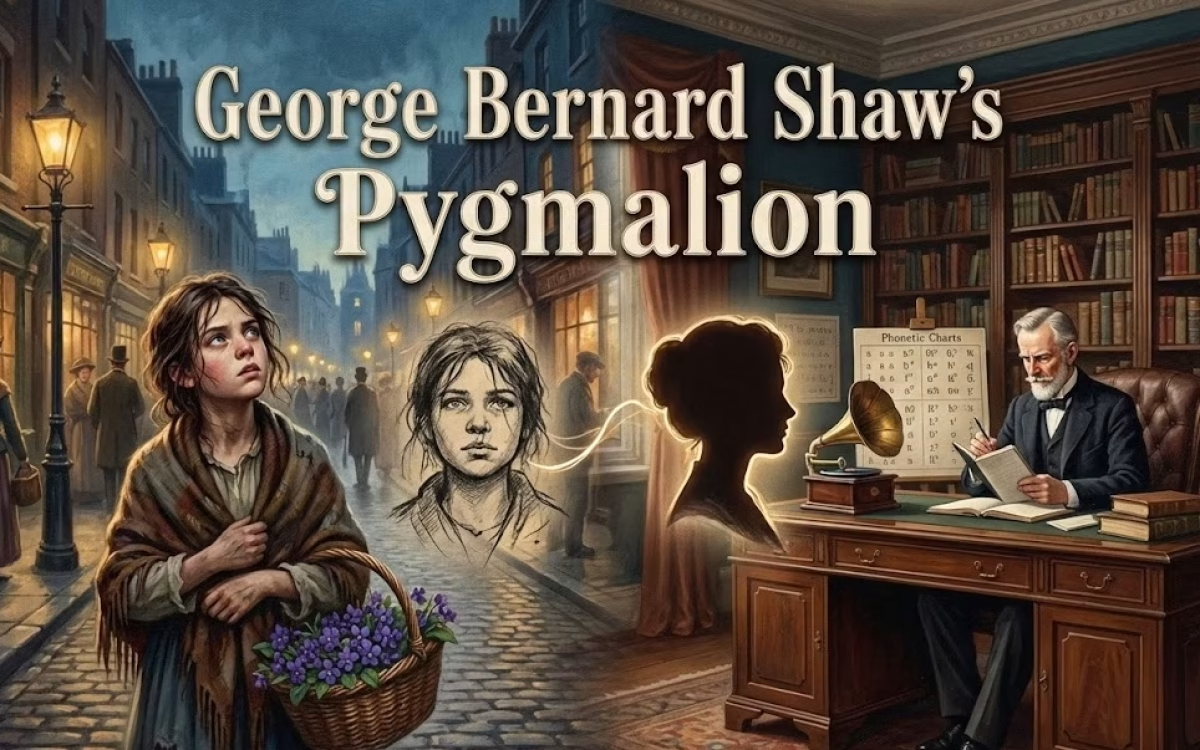
The plot of Pygmalion by George Bernard Shaw unfolds as a sharp social comedy that challenges ideas of class, identity, and transformation. Set in early twentieth-century London, the story begins with Eliza Doolittle, a Cockney flower girl, selling flowers in Covent Garden on a rainy evening. Professor Henry Higgins, a brilliant yet arrogant phonetician, overhears her accent and boasts that he could train her to speak so properly that she could pass as a duchess at a high-society event. Meanwhile, Colonel Pickering, another linguist, becomes intrigued and offers to cover the cost if Higgins can actually achieve this transformation.
The next day, Eliza arrives at Higgins’s home to seek lessons. She wants to improve her speech so she can work in a flower shop and leave street life behind. Higgins, viewing her as a challenge, agrees to take her on, with Pickering’s support. Shortly after, Eliza’s father, Alfred Doolittle, a dustman, visits Higgins and demands money for letting his daughter stay. Higgins, amused by his boldness, gives him five pounds. Thereafter, Higgins begins Eliza’s rigorous training in pronunciation, etiquette, and manners, gradually transforming both her speech and appearance.
The first major test comes when Eliza attends a gathering at Mrs. Higgins’s house. Although her speech has improved, she surprises the guests with her candid and socially awkward remarks. This moment reveals that refined language and appearance alone cannot erase one’s background. Nevertheless, Eliza continues her lessons with determination. Her real triumph arrives when she successfully passes as a lady at an ambassador’s garden party. In this moment, Higgins’s theory that accent and behaviour can transcend class boundaries seems proven.
However, this success comes at an emotional cost. Higgins continues to treat Eliza as a mere experiment, ignoring her feelings and independence. Gradually, Eliza realises her own worth and emotional depth. In frustration, she throws Higgins’s slippers at him and demands to be treated with dignity. At this turning point, she understands that she no longer belongs to her old world, yet she still feels alienated from high society. Consequently, she faces uncertainty about where she truly fits in.
Finally, in the last act, Eliza claims her independence. She rejects Higgins’s efforts to control her and decides to build her own future by teaching phonetics—the very skill she learned from him. Shaw ends the play without a romantic resolution. Instead, he highlights Eliza’s growth, self-assertion, and newfound agency. Therefore, Pygmalion stands as a powerful commentary on identity, autonomy, and social transformation.
“Shaw’s preface is just as important as the play. I recommend the Penguin Classics edition because it includes Shaw’s definitive ‘Sequel’ essay, which is essential for answering university questions on the ending. [Buy Pygmalion (Penguin Classics)].”
George Bernard Shaw’s Pygmalion: Major Themes
Language and Class
Shaw uses language as a powerful tool to expose social class divisions. Higgins’s ability to change Eliza’s accent shows how speech determines one’s social status. In the play, people are judged and accepted or rejected based on how they speak, not on their character or intelligence. For example, Eliza is treated as inferior because of her Cockney accent but once she learns “proper” English, she is welcomed into high society, proving that language is a barrier and a weapon in class struggles.
Transformation and Identity
Eliza’s transformation is not just about changing her speech; it’s about discovering her own identity. As she learns new manners and speech, she also gains self-awareness and independence. However, Shaw shows that transformation is not a simple process—Eliza struggles with her new identity, feeling lost between her old life and her new one. Her journey highlights the emotional and psychological cost of social mobility.
Gender and Feminism
Shaw challenges traditional gender roles through Eliza’s character. Unlike the mythological Pygmalion, where the statue is passive, Eliza is active and assertive. She refuses to be Higgins’s creation and demands respect and independence. Eliza’s defiance of Higgins’s control and her decision to pursue her own future reflect Shaw’s feminist ideals, showing that women can shape their own destinies.
Social Mobility and Satire
The play satirises the British class system and the idea that social mobility is possible through education and effort. While Eliza’s transformation proves that class can be changed, Shaw also shows the limitations and contradictions of this idea. Eliza’s father, Alfred Doolittle, unexpectedly rises in class due to an inheritance, but he finds that wealth brings its own problems, highlighting the absurdity of class distinctions.
Power and Control
The relationship between Higgins and Eliza is a study in power dynamics. Higgins sees Eliza as an object to be moulded, while Eliza resists his control and asserts her own agency. Shaw uses this dynamic to explore the broader theme of power in society, showing how people use knowledge, language, and status to dominate others.
Individuality and Self-Respect
Eliza’s journey is ultimately about finding her own voice and self-respect. She refuses to be defined by Higgins’s experiment and demands to be treated as an equal. Shaw emphasises the importance of individuality and self-respect, showing that true transformation comes from within, not from external changes.
George Bernard Shaw’s Pygmalion: Problem Play, Comedy of Manners, Social Satire
George Bernard Shaw’s Pygmalion is a remarkable blend of a problem play, a comedy of manners, and a social satire, each element contributing to its enduring appeal and relevance.
Pygmalion as a Problem Play
A problem play typically addresses a social issue or moral dilemma, prompting the audience to think critically about contemporary problems. Pygmalion confronts the issue of class inequality and the rigid social hierarchy of early twentieth-century England. Shaw uses Eliza’s transformation to question the fairness of a society where one’s accent and background determine their opportunities and treatment. The play does not offer easy solutions but instead exposes the complexities and contradictions of social mobility, inviting audiences to reflect on the barriers that prevent true equality.
Pygmalion as a Comedy of Manners
As a comedy of manners, Pygmalion satirises the customs, behaviours, and pretensions of the upper class. Shaw’s witty dialogue and sharp observations highlight the absurdities of social etiquette and the superficiality of class distinctions. The scenes at Mrs. Higgins’s at-home day and the ambassador’s garden party showcase the ridiculousness of high society’s obsession with appearances and propriety. Eliza’s awkward attempts to navigate these social rituals underscore the artificiality of class boundaries and the performative nature of social status.
Pygmalion as a Social Satire
Shaw’s Pygmalion is a biting social satire that critiques the British class system and the myth of meritocracy. Through the characters of Higgins, Pickering, and Eliza, Shaw exposes the hypocrisy and contradictions of a society that claims to value hard work and talent but remains deeply entrenched in class prejudice. The play’s humour and irony serve to undermine the pretensions of the upper class and highlight the arbitrary nature of social distinctions. Shaw’s satire is both entertaining and thought-provoking, encouraging audiences to question the values and assumptions of their own society.
Pygmalion functions as a problem play by addressing social issues, a comedy of manners by satirising social customs, and a social satire by critiquing class and meritocracy.
George Bernard Shaw’s Pygmalion: Reflections and Relevance
The reflections and ongoing relevance of Pygmalion by George Bernard Shaw extend far beyond its original Edwardian context, making it a play that still speaks powerfully to contemporary audiences where issues of class, language, and social mobility remain pressing concerns.
Reflections on Identity and Transformation
Shaw’s exploration of identity in Pygmalion encourages readers to reflect on the nature of selfhood and the ways society shapes individual lives. Eliza’s transformation is not only about changing her accent or manners. It is also about discovering her own voice and asserting her independence. Her journey from a simple flower girl to a confident woman who demands respect stands as a powerful example of self-awareness and personal growth. Moreover, Shaw challenges the belief that identity is fixed. Instead, he suggests that identity is fluid and evolves through experience and personal choice. EXPLORE MORE WRITINGS
Relevance to Modern Society
The themes of Pygmalion remain highly relevant in modern society. Questions of language, class, and social mobility still influence how people live and interact. In India, for instance, the pressure to speak “standard” English reflects similar struggles. The subtle discrimination faced by those with regional accents mirrors Eliza’s experiences in the play. Moreover, Shaw’s critique of the class system and the arbitrary nature of social divisions resonates deeply with anyone who has felt excluded or marginalised because of their background. Finally, the play’s focus on individuality and self-respect inspires readers to challenge social expectations and recognise their own worth.
Feminist and Social Commentary
Pygmalion also offers a feminist commentary on gender roles and the ways in which women are often objectified and controlled by men. Eliza’s defiance of Higgins’s authority and her assertion of her own agency reflect Shaw’s progressive views on gender equality. The play’s refusal to end with a conventional romantic resolution further underscores Shaw’s commitment to realism and social critique, reminding audiences that true transformation comes from within and is not dependent on external validation.
Enduring Legacy
The enduring legacy of Pygmalion lies in its ability to provoke thought and inspire change. Shaw’s sharp wit and incisive commentary make the play both entertaining and thought-provoking, ensuring its place in the canon of world literature. Whether studied in classrooms or performed on stages, Pygmalion continues to captivate audiences with its timeless themes and universal relevance.
Pygmalion remains a powerful and relevant work that challenges readers to reflect on issues of identity, class, and social justice. Its enduring legacy is a testament to Shaw’s genius and his ability to create a play that continues to resonate with audiences around the world.
Conclusion
George Bernard Shaw’s Pygmalion stands as a timeless masterpiece that continues to challenge and inspire readers across generations. At its heart, the play is more than a witty comedy about a flower girl transformed into a lady. It is also a profound exploration of identity, class, and the power of language. Shaw uses Eliza Doolittle’s journey to expose the arbitrary nature of social hierarchies. He also questions the assumptions that sustain them. Through sharp dialogue and memorable characters, he shows how accent and manners can act as tools of both oppression and liberation. As a result, Pygmalion remains a vital text for anyone interested in social justice and personal growth.
The play’s refusal to offer a conventional happy ending is one of its boldest features. Instead of letting Eliza be absorbed into the upper class or become Higgins’s romantic partner, Shaw insists on her independence and agency. This focus on self-determination and integrity resonates strongly in today’s world, where identity and autonomy remain central debates. Eliza’s transformation is not only about her speech and appearance. More importantly, it represents her discovery of self-respect and her right to be treated as an equal.
Furthermore, Pygmalion serves as a sharp social satire that criticises the pretensions and contradictions of the British class system. Shaw’s humour and irony reveal the absurdity of rigid social boundaries. His play encourages audiences to reflect on their own values and assumptions, prompting both laughter and self-awareness. Therefore, the enduring relevance of Pygmalion lies in its power to provoke thought and inspire social change, ensuring its continuing influence on modern drama.
In conclusion, Pygmalion transcends its historical context to address universal human experiences. Its exploration of identity, class, and transformation continues to resonate with readers and theatre audiences alike. Thus, Shaw’s masterpiece endures as a classic of world literature and a compelling study of personal growth and social critique.
FAQS
1. What is the main theme of Pygmalion?
The main theme of Pygmalion is the relationship between language, class, and identity. Shaw explores how accent and speech determine social status and examines the impact of social mobility on individual identity and self-worth.
2. Why is Pygmalion considered a problem play?
Pygmalion is considered a problem play because it addresses social issues such as class inequality, gender roles, and the arbitrary nature of social distinctions. Shaw uses the play to provoke thought and encourage audiences to reflect on these contemporary problems.
3. How does Eliza Doolittle change throughout the play?
Eliza transforms from a Cockney flower girl into a confident woman who asserts her independence and demands respect. Her journey highlights the emotional and psychological cost of social mobility and the importance of self-awareness and personal growth.
4. What is the significance of the title Pygmalion?
The title Pygmalion references the Greek myth of the sculptor who falls in love with his own creation. Shaw uses this myth to explore the power dynamics between Higgins and Eliza, challenging traditional notions of creation and control.
5. Why does Shaw refuse to give Pygmalion a romantic ending?
Shaw refuses to give Pygmalion a romantic ending to emphasise Eliza’s independence and agency. By avoiding a conventional resolution, Shaw underscores the importance of self-determination and personal integrity, encouraging audiences to think critically about gender roles and social expectations.