Introduction
Homi Bhabha’s Of Mimicry and Man: A Psychological Trap in Postcolonial Theory
The Departure from Said
To understand Bhabha, one must first look at Edward Said. In Orientalism, Said argued that colonial discourse was a monolithic, totalising system of power—the West looking at the East and defining it as an “Other” to be controlled. Bhabha shifts the conversation. He suggests that colonial power is not a stable, absolute domination but rather a site of psychological vulnerability and profound anxiety.
The Thesis: The Blurred Copy
Bhabha’s central thesis is that colonial discourse seeks to produce “compliant subjects” who reproduce the assumptions, habits, and values of the coloniser. However, this process creates a “mimic man”—a subject who is a blurred, distorted copy of the original.
The Defining Quote
The anchor of the entire essay lies in Bhabha’s description of mimicry:
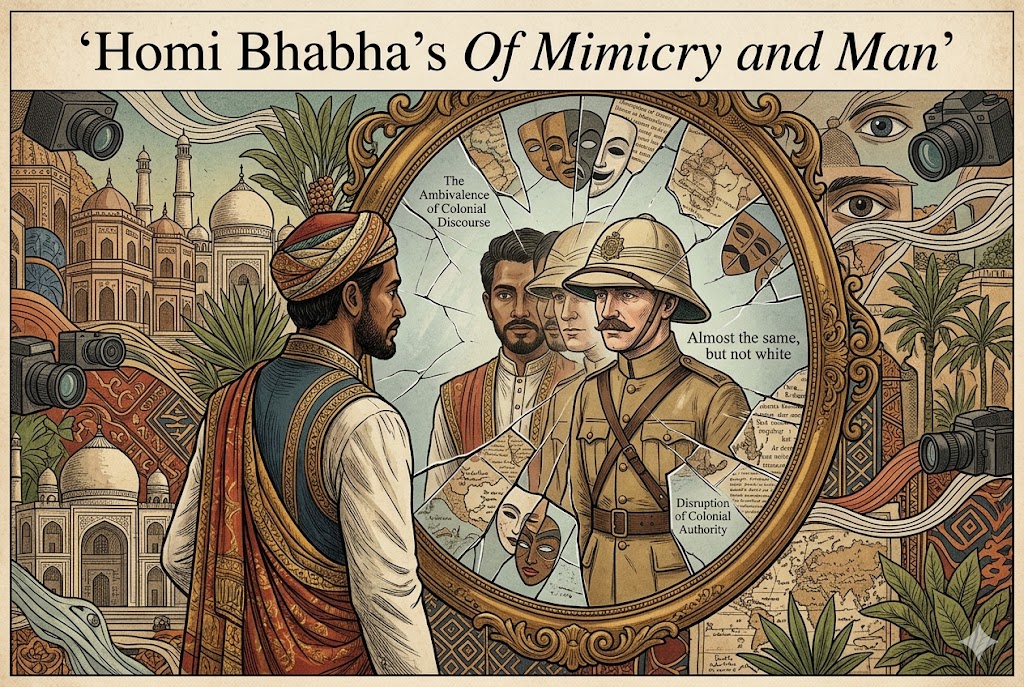
“Mimicry is the desire for a reformed, recognizable Other, as a subject of a difference that is ‘almost the same, but not quite.’”
Quick Summary
In his essay Of Mimicry and Man, postcolonial theorist Homi K. Bhabha defines Mimicry as the process where the coloniser forces the colonised subject to adopt their culture, habits, and values. However, Bhabha argues this imitation is never perfect. It produces a subject that is “almost the same, but not quite.” This slight difference creates Ambivalence. Because the colonised person looks and acts like the coloniser but is still fundamentally different, the imitation suddenly feels like a mockery or a threat (a “menace”) to the coloniser’s absolute authority.
The Mechanism of Mimicry: The Colonial Strategy
The Civilising Mission
Mimicry begins with the “Civilising Mission”. To justify the occupation of foreign lands, empires claimed a moral duty to “civilise” the native population through Western education, Christianity, and law. However, this creates a paradox: if the native is “civilised” into a European, the justification for colonial rule (the native’s supposed inferiority) vanishes.
“Bhabha’s original essays are challenging but essential for advanced degrees. You can find his complete, defining work here: [The Location of Culture on Amazon].”
Macaulay’s Minute (1835)
Bhabha famously anchors his theory in Thomas Macaulay’s “Minute on Indian Education”. Macaulay explicitly called for the creation of a middle class of people who would be:
Indian in blood and colour
English in taste, in opinions, in morals, and in intellect
This group was intended to serve as interpreters between the British and the millions they governed—a “buffer” class of mimic men.
The Double Vision
Mimicry requires the coloniser to maintain a “Double Vision.” They must recognise the colonised subject’s humanity enough to educate them, yet simultaneously deny their equality to maintain the right to rule. This split perception is the birthplace of colonial ambivalence.
The Ambivalence of the “Not Quite” (The Slippage)
The Necessity of Difference
For the colonial system to function, the imitation must fail. If the colonised subject becomes a perfect Englishman, the boundary between “Self” and “Other” collapses. Therefore, the coloniser must maintain a margin of difference. The mimicry must be “almost the same”, but never “the same”.
The “Not Quite/Not White” Concept
This intentional boundary creates a fundamental contradiction. The subject is “civilised” enough to follow British law but still “savage” enough to require British oversight. This “slippage” between the intention of the coloniser and the result in the subject creates ambivalence—a state where colonial authority is constantly undermining its own logic.
The Resulting Parody
Because the copy is fundamentally flawed by design, the mimicry often feels like a parody. The colonised subject’s imitation of English manners or dress becomes exaggerated or “unnatural”, creating a version of Englishness that feels distorted and ghostly.
“Bhabha’s idea of power creating its own resistance pairs perfectly with our previous breakdown of [Raymond Williams’ Dominant, Residual, and Emergent Cultures].”
Mimicry as Menace: The Turn
The Disruption of Authority
This is where Bhabha’s argument takes a radical turn. Mimicry is not just a tool of the coloniser; it is a threat. When the imitation is “almost the same but not quite,” it stops being flattering to the coloniser and starts becoming deeply unsettling.
The Gaze Returns
In traditional colonial narratives, the coloniser is the observer and the colonised is the observed. But in mimicry, the “Gaze Returns”. By mastering the coloniser’s language, the mimic man holds up a mirror to the Empire. He performs “Englishness” in a way that exposes it as a performative act rather than a natural superiority.
From Obedience to Mockery
The “mimic man” eventually uses the very tools of the Empire against it. By adopting Western concepts of “Democracy,” “Liberty,” and “Justice,” the colonised subject points out the hypocrisy of a democratic nation (like Britain) denying those same rights to its colonies. The “civilised” mimic man becomes a menace to the system that created him, using the coloniser’s own logic to demand independence.
Literary Proof:
Applying Mimicry to Literature
Apply Homi Bhabha’s mimicry to your postcolonial essays. Use this blueprint: identify the mimicked subject, spot the “almost but not quite” ambivalence, and trace how it mocks colonial power.
Things Fall Apart by Chinua Achebe: Native Igbo characters adopt British religion and government systems. Their imitation erodes traditional culture from within. Yet, it unnerves the British—exposing the coloniser’s fragile control as converts question the mission itself.
The Tempest by William Shakespeare: Prospero forces Caliban to learn his language. But Caliban retorts, “You taught me language, and my profit on’t / Is, I know how to curse.” Mimicry becomes a weapon, turning imposed tools against the master.
Conclusion
The Seeds of Destruction
Bhabha’s ultimate point is that colonial authority is never absolute or secure. It is inherently unstable. Because it relies on mimicry to function, it carries the seeds of its own destruction within its own psychological strategies. The very act of “civilising” the native creates the “mimic” who will eventually dismantle the Empire.
The Legacy of the Essay
Of Mimicry and Man allows us to re-read colonial literature—such as Joseph Conrad’s Heart of Darkness or E.M. Forster’s A Passage to India—not as records of absolute power, but as documents of colonial anxiety. It teaches us that in the “not quite” of the mimic man, we find the first cracks in the walls of the imperial world.
FAQS
What is the difference between mimicry and hybridity?
Mimicry is partial imitation that mocks colonial power. Hybridity is fuller cultural mixing, creating new identities. Bhabha sees mimicry as hybridity's disruptive seed in postcolonial theory.
What does Bhabha mean by ambivalence?
Ambivalence is the coloniser's uneasy mix of authority and anxiety. The mimicked subject—close yet other—threatens control, turning mimicry menacing.
Who influenced Homi Bhabha?
Jacques Lacan’s psychoanalysis shaped Bhabha’s ideas on mimicry as a mirror-stage gone wrong. Freudian slips and lack also inform the colonizer’s insecure gaze.