
Introduction
Michel Foucault’s Panopticism
Have you ever slowed your car down because you saw a traffic camera, even if you weren’t sure it was turned on? That uneasy feeling of being watched captures Michel Foucault’s Panopticism in everyday life.
French philosopher Michel Foucault introduced this idea in his landmark 1975 book, Discipline and Punish: The Birth of the Prison. Drawing from Jeremy Bentham’s Panopticon prison design—a circular structure where inmates are always visible to a central watchtower—Foucault explores how surveillance shapes society.
At its core, Foucault argues that modern power relies on psychology, not physical force. We police ourselves through the constant threat of being seen, turning discipline into an invisible, all-seeing mechanism.
Quick Summary
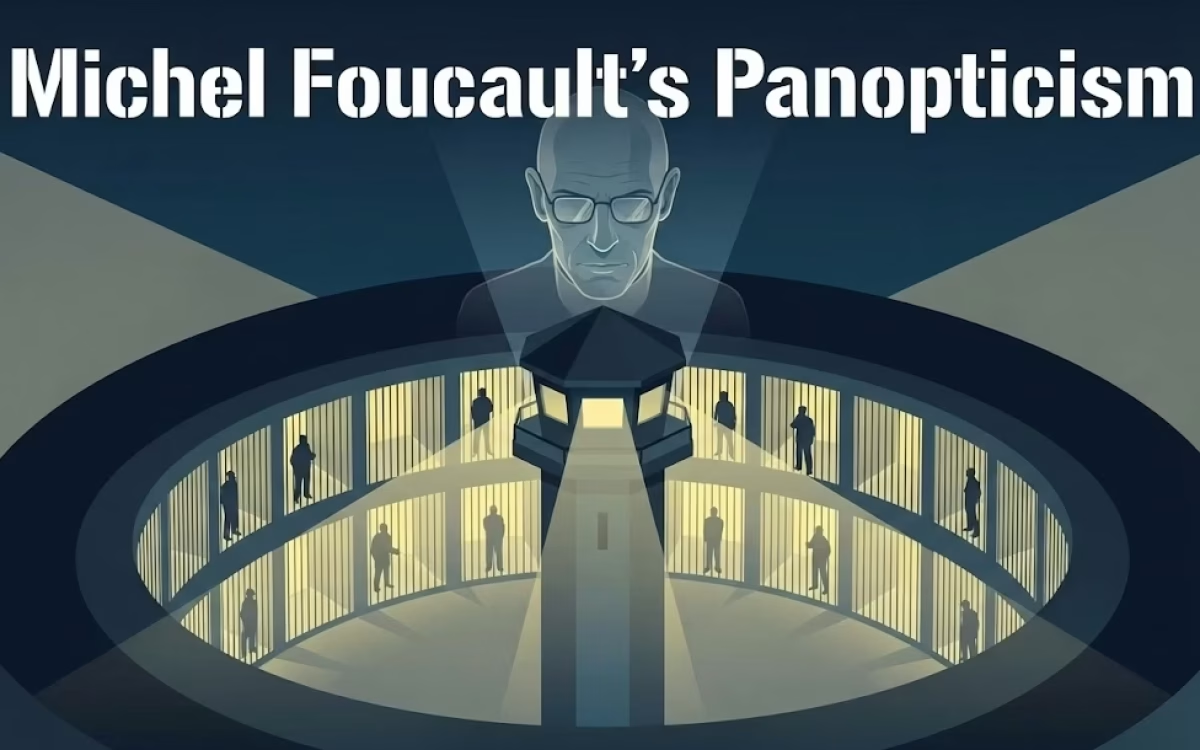
In his 1975 book Discipline and Punish, French philosopher Michel Foucault uses the architectural design of the Panopticon (a prison designed by Jeremy Bentham) as a metaphor for modern society. In a Panopticon, a central guard tower can see into every backlit cell, but the prisoners cannot see into the tower. Because the inmates never know exactly when they are being watched, they must assume they are always being watched. Foucault calls this “Panopticism”—a system of power where surveillance is invisible and unverifiable, forcing individuals to internalise the rules and police themselves.
The Architectural Inspiration: Jeremy Bentham’s Prison
Jeremy Bentham unveiled his revolutionary Panopticon prison design around 1787. He refined an inspection idea from his brother Samuel. The blueprint was simple. It featured a circular building. This was often a multi-story rotunda. A glass-roofed central tower sat at the heart. Individual prisoner cells lined the outer perimeter. Each faced inward toward the solitary guard tower.
The design had an ingenious trick. The guard tower used blinds or shaded windows. Prisoners in isolated cells could never confirm if a guard watched them. This one-way visibility bred uncertainty. Inmates stayed fully exposed. The observer remained concealed.
The result changed prison management. Constant guards were no longer needed. Overt force became obsolete. The illusion of surveillance was enough. Prisoners self-regulated and kept order automatically.
Bentham saw broader uses. He believed this mechanism fit schools, factories, and hospitals too. It promoted discipline through psychology, not physical coercion.
“If you are studying critical theory, you need this book on your shelf. Foucault’s writing is dense but absolutely fascinating. Grab a copy of [Discipline and Punish on Amazon].”
The Shift in Power (From the Scaffold to the Mind)
Pre-modern power relied on spectacle. Kings asserted dominance through public executions. They used torture on the scaffold. This turned punishment into a bloody theatre. It reinforced authority via fear. Communal witnessing played a key role.
Modern power shifted with the Panopticon. Authority became faceless and capillary. The state stopped ravaging bodies in public squares. It now disciplines the soul in private. Constant, unseen observation reforms behaviour.
This change is cheaper and cleaner. It proves more effective too. Psychological control permeates society. No mess of physical violence occurs. Discipline operates continuously. It works subtly across institutions.
Internalised Surveillance (The Core Concept)
Panopticism’s brilliance lies in unverifiable power. For example, the tower stands visibly omnipresent. Yet, prisoners can never confirm if the guard watches. This creates constant uncertainty. As a result, it amplifies authority. Importantly, it does so without constant effort.
This uncertainty triggers self-policing. Specifically, the mere possibility of scrutiny compels flawless behaviour at all times. Thus, you become the principle of your own subjection, as Foucault famously described. In turn, you internalise discipline thoroughly. Consequently, external force becomes obsolete.
The result is profound. Surveillance evolves from overt control. Instead, it becomes an automatic mechanism. Here, subjects regulate themselves. Therefore, Panopticism’s logic extends into everyday life. This happens beyond prison walls.
Michel Foucault’s Panopticism in Everyday Society
Foucault saw the Panopticon model replicated across modern institutions, turning society into a “disciplinary machine” where surveillance normalises self-regulation.
In schools, desks align in rows facing the teacher at the front; exams and bells enforce constant visibility and timed behaviour, training students to monitor themselves.
Hospitals and asylums use patient charts, round-the-clock monitoring, and doctor rounds to track bodies and minds, isolating patients for efficient observation and correction.
Factories and offices adopt open-plan cubicles, timecards, and managers in glass-walled overlooks, ensuring workers remain visible and productive under perpetual potential scrutiny.
Michel Foucault’s Panopticism in Literature (The Dystopian Connection)
Foucault’s Panopticism echoes chillingly in dystopian literature. For example, authors amplify surveillance’s psychological grip. They critique modern power this way. Importantly, this suits literary scholars. They trace disciplinary themes across texts.
In George Orwell’s 1984, telescreens embody the ultimate Panopticon. Specifically, Winston Smith lives in perpetual uncertainty. He never knows if the Thought Police watch. As a result, he polices every facial twitch. He controls thoughts too. This happens in preemptive obedience.
Margaret Atwood’s The Handmaid’s Tale mirrors this idea. It uses “the Eyes,” a shadowy secret police. Anyone might be an informant. Consequently, this breeds total paranoia. Thus, women become mutual jailers. They self-enforce Gilead’s oppressive gaze.
“Like Julia Kristeva’s work on intertextuality, Foucault breaks down traditional ideas of how humans interact with invisible systems. Read more about structural and post-structural theories in our guide to [Julia Kristeva’s Intertextuality].”
Digital Panopticism (A Modern Update)
Foucault’s Panopticism thrives in the digital age. For example, surveillance permeates daily life. It uses social media algorithms. CCTV networks play a role too. Browser cookies track us. Employee software monitors closely. Importantly, all this renders power invisible. Yet, it stays omnipresent.
We now carry our own guard towers. Specifically, smartphones sit in our pockets. They log locations and conversations. They track behaviours too. As a result, users become willing participants. Consequently, we self-censor. Big Tech and data brokers watch closely.
This evolution shows Panopticism’s relevance. It is cheaper than Bentham’s prison. It proves more pervasive too. Digital oversight disciplines us automatically. Often, no central authority exists. Thus, we curate perfect online selves. We do this in anticipation of judgement.
Conclusion
Foucault reveals power not as a dictator’s scepter clutched by a single tyrant, but as an inescapable web binding us all through unseen gazes, subtle pressures, and self-imposed discipline that permeates every layer of social life.
This theory remains essential for literary analysis, bridging Victorian institutional novels—think Dickens’ grim depictions of workhouses in Oliver Twist or Hard Times, where hierarchical oversight crushes the individual—with modern dystopian sci-fi like Orwell’s 1984 and Atwood’s The Handmaid’s Tale. In these works, surveillance distorts human freedom, turning characters into shadows of themselves under the weight of potential observation, a thread that connects 19th-century reform critiques to today’s digital anxieties.
Ultimately, Panopticism endures because it unmasks how we internalise control, offering scholars and readers a timeless lens to dissect power’s quiet infiltration in both historical texts and contemporary narratives.
FAQS
What is the main idea of Foucault's Discipline and Punish?
Foucault traces punishment's evolution from public torture to subtle prison discipline, arguing modern society controls souls through constant observation rather than bodies.
What is the difference between Bentham's Panopticon and Foucault's Panopticism?
Bentham's Panopticon is a physical prison blueprint for efficient oversight; Foucault's Panopticism extends it into a broader societal mechanism of psychological self-control.
