
Introduction
“That’s my last Duchess painted on the wall, / Looking as if she were alive.” These haunting opening lines from Robert Browning’s My Last Duchess immediately pull you into a world of aristocratic menace, where a Renaissance duke casually reveals his dark secrets behind a masterpiece portrait.
Robert Browning, master of the dramatic monologue, loved crafting poems around “mad” characters—like this possessive Duke of Ferrara—who speak directly to us, unveiling their twisted psyches. However, My Last Duchess (1842) isn’t just a character study; it’s a sharp critique of Victorian gender dynamics hidden in a historical guise.
Ultimately, the poem explores how male power turns insecure when it cannot control a woman’s heart, transforming possessive love into something far more sinister.
Quick Summary
“My Last Duchess” (1842) is the most famous example of a Dramatic Monologue in English literature. Set in the Italian Renaissance, the poem is spoken by the Duke of Ferrara to an envoy who has come to negotiate the Duke’s next marriage. As the Duke shows off a portrait of his late wife (the Last Duchess), he reveals his obsessive need for control. He implies that because she smiled at everyone equally, he “gave commands” and had her killed. The poem is a chilling study of arrogance, jealousy, and the objectification of women.
The Narrative Situation:
In Robert Browning’s My Last Duchess, the narrative situation unfolds as a tense, one-sided conversation that drives the entire dramatic monologue forward.
The Setting
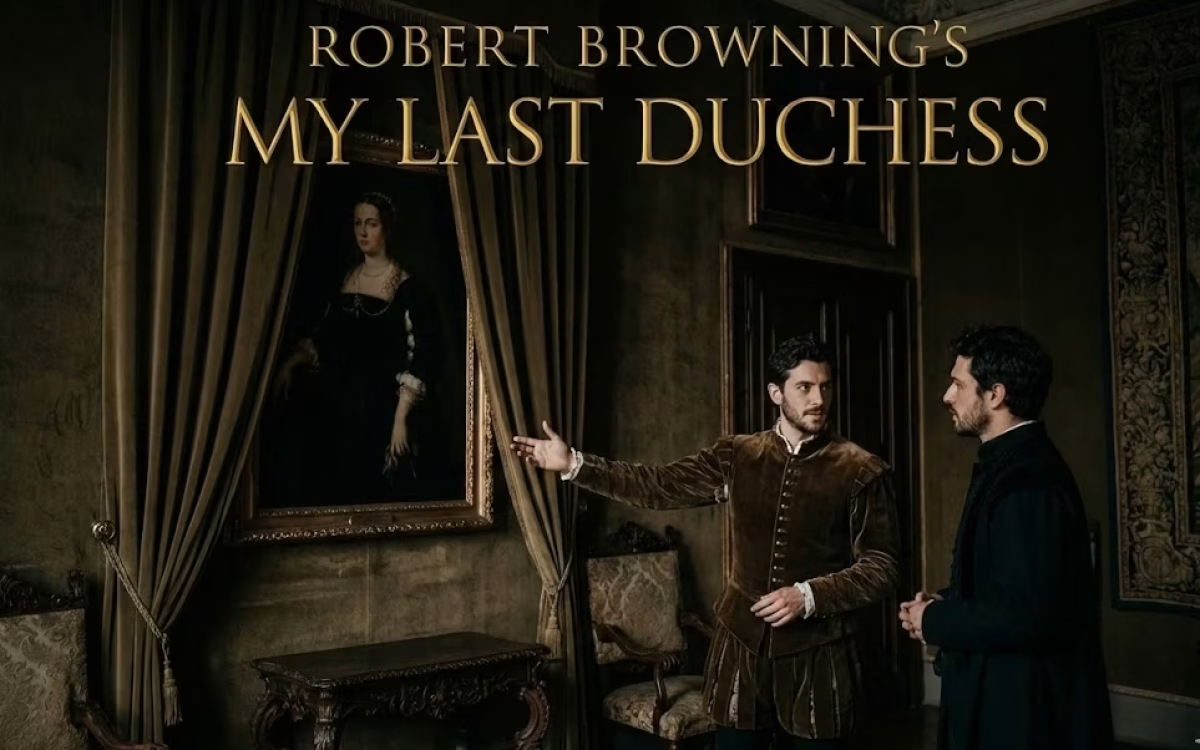
The scene is set in the opulent private gallery of the Duke’s palace in Ferrara, Italy. The Duke addresses a silent listener—the Envoy from a neighbouring count—negotiating his next marriage. This intimate, confined space heightens the Duke’s control, as no one else can access this room without his permission.
The Action
While negotiating, they pause before a lifelike portrait of the Duke’s late wife, hidden behind a curtain that only he can draw. As the Duke pulls it aside, he gazes at her painted smile and begins his chilling monologue, revealing her “faults” and his response.
Why It Matters
This controlled reveal symbolises the Duke’s ultimate triumph: his last Duchess now smiles only for him. She can “look” at visitors or “flush” with pleasure only when he allows it by lifting the curtain—proving he has objectified her completely, reducing a living woman to a possession he alone commands.
“Browning’s poetry is complex. If you are studying this for A-Levels, we highly recommend the [York Notes on Robert Browning] for detailed essay plans.”
The Duke’s Complaint
At the heart of Robert Browning’s My Last Duchess lies the Duke’s simmering rage, exposed through his dramatic monologue as he critiques his late wife’s innocent joys.
Her “Crime”
The Duchess’s fatal flaw? She was “too soon made glad.” She smiled equally at simple delights—a sunset’s warmth, a branch of cherries from the orchard, or the white mule’s gentle frolic—as she did at the Duke’s presence or his “gift.” Her heart overflowed with gratitude for life’s small wonders, diluting his exclusivity.
His Ego
Furious, the Duke resents that she ranked his “nine-hundred-years-old name”—a pinnacle of aristocratic prestige—no higher than a servant’s cherries or a painter’s flattery. To him, her equal delight devalued his superiority; she should have reserved her blushes solely for his favour.
Analysis
This isn’t love—it’s ownership. The Duke craves total dominion over her emotions, demanding to be her sole source of joy. Her free spirit threatens his ego, turning affection into a zero-sum game where her happiness elsewhere feels like betrayal.
The Climax
Robert Browning’s My Last Duchess builds to a chilling climax, where the Duke casually drops a bombshell line that hints at murder without confessing outright.
The Line
“I gave commands; / Then all smiles stopped together.” Spoken mid-monologue, this ambiguous phrase follows his frustration with her smiles—abruptly shifting from complaint to consequence.
The Meaning
Browning masterfully crafts uncertainty: Did the Duke order her execution? Banish her to a convent? Most critics agree he orchestrated her murder, as the poem’s tone and historical context (inspired by real Duke Alfonso II) point to assassination. Yet the vagueness forces us to infer his crime, amplifying the horror.
The Aftermath
Unfazed, he pivots seamlessly to haggling over the “dowry” for his next wife, treating women like rare art in his collection. This cold pragmatism reveals a serial collector of beauties, each portrait a trophy of his unchallenged power.
Key Literary Devices
Robert Browning’s My Last Duchess shines through masterful literary devices that deepen its psychological punch and dramatic irony. Here’s a breakdown:
Dramatic Monologue: The Duke addresses a silent Envoy, assuming his words justify his power. Ironically, we learn more about him than he intends—he aims to sound commanding but reveals himself as a jealous sociopath, exposing his flaws through what he omits.
Enjambment: Sentences spill over line ends without pause (e.g., “Sir, ’twas not / Her husband’s presence only”), mimicking a relentless stream of consciousness. This mirrors his uncontrollable jealousy, making his speech feel obsessive and unfiltered.
Symbolism
The Portrait: Hidden behind a curtain, it represents the Duchess silenced forever—objectified as art, her gaze and smiles now dictated solely by the Duke.
Neptune Taming a Seahorse: The bronze statue glimpsed at the end symbolises raw dominance—the god Neptune (the Duke) brutally subdues the sea creature (the defiant Duchess), foreshadowing his unyielding control over women.
These devices transform a simple confession into a timeless critique of possessiveness.
“Studying for the exam? A common essay question asks you to compare Browning’s My Last Duchess with Tennyson’s Ulysses. Both feature powerful male speakers revealing their true selves. [Click here to read our full guide to Ulysses] to find the differences.”
Key Themes
Robert Browning’s My Last Duchess unpacks dark Victorian undercurrents through its central themes, making it a staple in literary analysis for students and critics alike.
Power & Control: Central to the dramatic monologue, this theme warns of absolute power’s corruption in relationships. The Duke’s need to dominate his Duchess’s every smile reveals how unchecked authority breeds tyranny, echoing Browning’s fascination with flawed psyches.
Art vs. Reality: The Duke cherishes the portrait over the living woman because he can curtain it at will—controlling her gaze eternally. This contrast critiques how art freezes imperfect reality into perfection, prioritising possession over genuine connection.
Objectification: Women become commodities, like the portrait or Neptune’s seahorse—bought via dowry, displayed as trophies, and discarded if defiant. The Duke “collects” wives as art, reducing the Duchess to a silenced object devoid of agency.
These interconnected themes solidify the poem’s enduring critique of patriarchal entitlement.
Conclusion
In Robert Browning’s My Last Duchess, the Duke believes he’s triumphed by immortalising his wife as controllable art. Yet his monologue backfires spectacularly—he exposes himself not as a noble lord, but an insecure tyrant haunted by her independent joy.
This dramatic monologue remains a powerful warning about possessive relationships, where love twists into lethal control. Centuries later, it resonates in discussions of jealousy, power imbalances, and gender dynamics.
What are your thoughts on the Duke’s character? Share in the comments below!
FAQS
Who is the listener in My Last Duchess?
The silent listener is the Envoy, a representative from a neighbouring count's court. The Duke negotiates his next marriage while showing off the portrait, unwittingly revealing his dangerous nature to this marriage broker.
Why is the statue of Neptune important?
The bronze statue of Neptune is the poem's final image, gifted to the Envoy. It symbolises the Duke's brutal dominance—Neptune represents him forcibly subduing the wild seahorse, just as he controlled (and destroyed) his defiant Duchess.
