
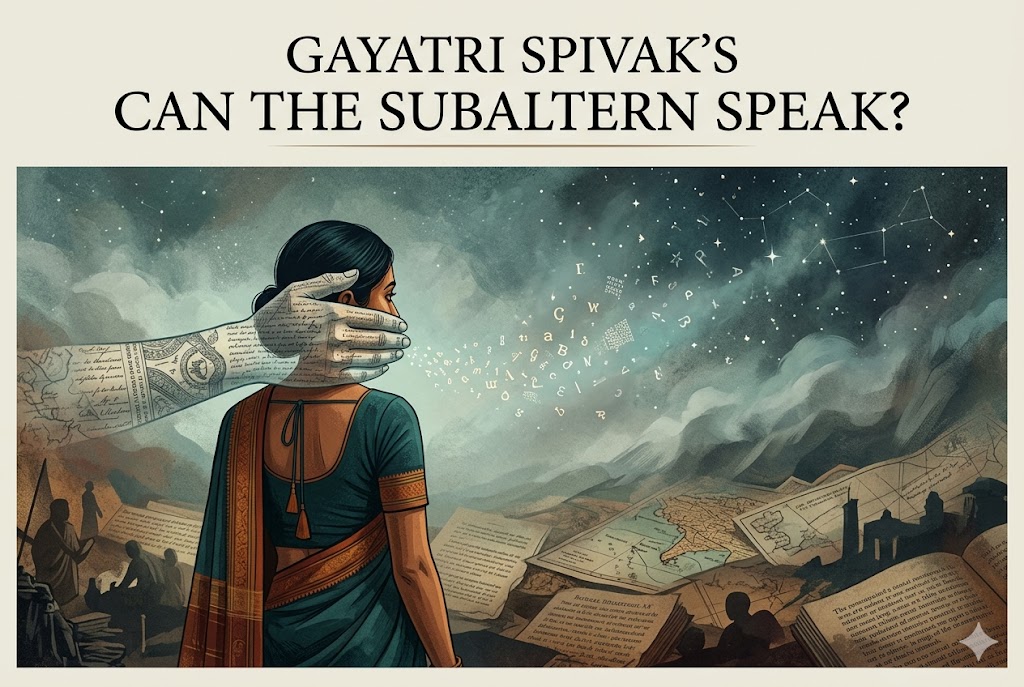
Spivak’s Can the Subaltern Speak: An Introduction
Does the subaltern speak if their utterance is appropriated and refracted through the interpretive frameworks of hegemonic powers?
This query animates Gayatri Chakravorty Spivak’s landmark 1988 essay, Can the Subaltern Speak?, a cornerstone of postcolonial theory.
Spivak draws on Derrida and Foucault’s deconstructive methods. Her prose shows profound complexity. Readers facing interpretive challenges should see this opacity as key to her critique.
Spivak argues Western efforts “rescue” the Third World subaltern.
Quick Summary
In her foundational 1988 essay Can the Subaltern Speak?, postcolonial theorist Gayatri Chakravorty Spivak argues that the most marginalised groups in society (the “subaltern”) are structurally prevented from speaking for themselves. When Western intellectuals try to “give a voice” to these oppressed groups, they inadvertently commit epistemic violence—overwriting the subaltern’s true lived experience with Western assumptions and vocabulary. Ultimately, Spivak concludes that within the current global systems of power, the pure, unmediated voice of the subaltern cannot be heard; it is always filtered, translated, or distorted by those in charge.
What (or Who) is a “Subaltern”?
Understanding the “Subaltern”: Definition and Key Theories
The term ‘subaltern’ is a cornerstone of post-colonial studies and political theory. While often used interchangeably with “oppressed”, its academic meaning is far more specific and complex.
Understanding the subaltern requires looking at how power, representation, and social mobility intersect to silence certain groups.
“Spivak’s original essay is incredibly dense. For students, the best way to tackle her work is alongside clear academic commentary. I highly recommend picking up the Norton Critical Edition: [Can the Subaltern Speak?: Reflections on the History of an Idea on Amazon].”
1. The Origin: Antonio Gramsci’s Power Structures
The term was first popularised by Antonio Gramsci, an Italian Marxist theorist, in his Prison Notebooks. Gramsci used “subaltern” (a word originally meaning a lower-ranking military officer) as a code for the working classes to bypass prison censors.
Social Exclusion: Gramsci used it to describe groups who are excluded from the established institutions of power.
The Struggle for Hegemony: For Gramsci, the subaltern classes are those who are subject to the “hegemony” (cultural and political dominance) of the ruling classes. They lack their own political voice and are forced to live within a system built by and for others.
2. Spivak’s Definition: Can the Subaltern Speak?
While Gramsci laid the groundwork, Gayatri Chakravorty Spivak refined the term in her seminal essay, “Can the Subaltern Speak?” Spivak argues that we must narrow the definition to maintain its political urgency.
Beyond Simple Oppression: To Spivak, a factory worker or a middle-class person experiencing discrimination is not necessarily a subaltern. These groups still have access to some “lines of social mobility” (like unions or legal systems).
Total Erasure: A true subaltern is someone who is completely removed from all avenues of representation. They are not just unheard; they are “un-representable” within the current global discourse. When we try to “speak for” them, we often overwrite their actual needs with our own biases.
3. The Prime Example: The Third World Woman
The most striking example of the subaltern is the poor, rural woman in the Global South. Her position is unique because she faces what scholars call “double colonisation”.
The Layers of Oppression:
Imperialism: She is marginalised by the global economic and political structures left behind by foreign empires.
Native Patriarchy: Simultaneously, she is oppressed by the traditional patriarchal structures of her own culture.
These two massive power systems trap her. They erase her specific identity and voice. She cannot “speak.” Neither Western nor local structures listen to her.
The Trap of Representation
In post-colonial theory—and specifically for university-level literary criticism exams—the Trap of Representation is the core of Spivak’s critique of Western intellectuals.
To understand this trap, you must master the distinction between the two German words for “representation” that Spivak borrows from Marx.
The Dual Meanings of Representation
1. Vertreten: Representation as “Proxy”
The first form of representation is Vertreten. Think of this in a political or legal sense.
The Mechanism: This is “speaking for” someone.
The Analogy: Much like a lawyer represents a client in court or a Member of Parliament represents a district, the vertreter stands in the place of the person they are representing to protect their interests.
The Requirement: In a healthy system, this usually requires a mandate—someone must give you the authority to speak for them.
2. Darstellen: Representation as “Portrait”
The second form is Darstellen. This is representation in an aesthetic or philosophical sense.
The Mechanism: This is “re-presenting” or “placing before”. It is about description, imagery, and stage-setting.
The Analogy: Think of a portrait in a gallery or a character in a novel. When you describe what a “typical villager” looks like or how they live, you are engaging in darstellen.
The Requirement: This requires observation and artistic skill, but not necessarily a mandate from the subject.
“Spivak’s theories form one-third of the foundation of modern postcolonial study. See how her ideas connect to other major thinkers in our complete guide to [Postcolonialism in English Literature].”
Epistemic Violence
Spivak’s concept of epistemic violence constitutes a cornerstone of her critique in Can the Subaltern Speak?, targeting the obliteration of subaltern knowledges. In the landscape of post-colonial theory, Epistemic Violence is perhaps the most “invisible” form of harm. Unlike physical violence, it doesn’t leave scars on the body; it erases the mind, the culture, and the history of the colonised.
Definition
The term “epistemic” comes from epistemology, the branch of philosophy concerned with knowledge. Therefore, epistemic violence is violence committed against a way of knowing.
It is the systematic destruction or marginalisation of non-Western knowledge systems. When a colonial power enters a territory, they don’t just take the land; they invalidate the native’s medicine, law, religion, and social structures, labelling them as “superstition” or “primitive”.
Mechanism in Practice
Epistemic violence occurs through the imposition of Western categories on a reality they weren’t designed to describe.
The Intellectual “Filter”: When a Western intellectual (or a Western-trained academic) writes about the “Third World,” they use Western frameworks like Marxism or Liberal Feminism to explain people who may not view the world through those lenses.
Forced Categorisation: An Indian woman’s struggle might be rooted in local spiritual or communal traditions. However, a Western paper might “translate” her experience into a struggle for “individual rights” or “class consciousness”.
The Erasure: In this translation, the “native reality” disappears. The woman’s actual motives are replaced by the academic’s theory. The world no longer sees her; it only sees the theory about her.
The ultimate goal (or result) of epistemic violence is to make the subaltern speak in a language that is not their own.
If the subaltern wants to be heard in the global “Canon,” they must learn to speak the language of the oppressor. They must frame their pain in Western academic terms. If they speak in their native “epistemology” (their own way of knowing), they are dismissed as unscientific or irrelevant.
“While Spivak focuses on the silenced voices at the bottom, Edward Said analyzed how the West manufactured the entire concept of the East. Read our breakdown of [Edward Said’s Orientalism].”
“White Men Saving Brown Women from Brown Men”
Spivak’s most renowned proposition—”White men are saving brown women from brown men”—marks the essay’s rhetorical apogee, unmasking representational violence. This phrase is the intellectual climax of Gayatri Spivak’s “Can the Subaltern Speak?” It serves as a devastating critique of how colonial power justifies itself through “humanitarian” rhetoric while simultaneously silencing the very people it claims to protect.
1. The Historical Context: The Sati Abolition (1829)
To illustrate her point, Spivak looks at the British colonial ban on Sati (the practice of a widow immolating herself on her husband’s funeral pyre).
While the ban was a positive legal step in terms of human rights, Spivak isn’t interested in the law itself; she is interested in the narrative used to justify it. She identifies two competing “scripts” that were written over the lives of Indian women.
2. The Narrative Trap: Two Sides of the Same Coin
Spivak argues that the discourse around Sati was a battle between two patriarchal powers. Neither side actually cared about the woman’s subjective experience.
A. The British Colonial Narrative
“White men saving brown women from brown men.”
The Goal: To justify British Imperialism as a “civilizing mission.”
The Logic: By framing Indian men as “savages” and “oppressors,” the British cast themselves as the “heroic saviors.” This narrative suggests that the brown woman is a helpless victim who needs a Western “liberator” to give her agency.
B. The Indian Nationalist Narrative
“The women actually wanted to die.”
The Goal: To resist colonial interference in local culture.
The Logic: Indian nationalists argued that Sati was a sign of a woman’s “pure devotion” (bhakti) and traditional honor. They claimed the woman chose this path out of spiritual strength.
The Problem: This romanticized the woman’s death to serve a political agenda of anti-colonial resistance.
3. The Tragedy: The Disappearance of the Subject
The “violence” of this situation is that the woman at the center of the pyre becomes a shadow.
The Silence: Between the “White Man” (Imperialism) and the “Brown Man” (Patriarchy), the widow’s own voice is erased.
The Lack of Agency: Nobody asked the woman what she felt, thought, or desired. She was turned into an object used to prove a political point.
The Erasure: Even if she did speak, her words would be interpreted through one of these two existing lenses. If she said she wanted to live, she was a “victim” to the British. If she said she wanted to die, she was a “hero” to the Nationalists. Her actual, complicated human reality had no “space” to exist.
4. Why the Subaltern “Cannot Speak”
This is why Spivak concludes that the subaltern cannot speak. It is not that the woman is physically mute. Powerful structures block non-aligned space for her voice. They capture her words right away. Then they categorize and “translate” them—via law, academy, or patriarchy.
Key Exam Takeaway: “White men saving brown women from brown men” is the perfect example of Epistemic Violence. It shows how the subaltern is “spoken for” by outsiders, which effectively renders the subaltern’s own voice non-existent in the eyes of history.
Conclusion
Readers often misunderstand Spivak’s essay conclusion. They think she calls the marginalized “mute.” In reality, it is a sophisticated critique of the ears of the world, not the tongues of the oppressed.
When Spivak famously concludes that “the subaltern cannot speak,” she is making a structural point, not a biological one.
The Translation Problem: The subaltern is speaking, but the infrastructure of global power (universities, international law, global media) has no mechanism to listen to them.
The Filter: Western academics and politicians translate the subaltern’s voice first. They aim it at power’s “center.” They use terms like Marxism, liberalism, or Western feminism.
The Loss of Essence: In this translation, the specific, local, and authentic “truth” of the subaltern is lost. By the time we hear it, we are only hearing a version of ourselves reflected back at us.
The “Subaltern” is not a fixed identity; it is a space of silence created by power. Spivak’s legacy is the realization that true ethical engagement requires more than just “speaking for” others—it requires the much harder work of dismantling the structures that prevent us from actually listening to them.
FAQS
What does epistemic violence mean?
Epistemic violence refers to the destruction of non-Western knowledges by forcing them into dominant Western frameworks, erasing indigenous realities. Example: Analysing Indian women’s struggles solely through Marxism.
Who coined the term subaltern?
Antonio Gramsci coined 'subaltern' in his Prison Notebooks (1929–1935) to describe proletarian classes excluded from hegemonic power. Spivak refines it for Third World women doubly colonised by imperialism and patriarchy.
