
Introduction
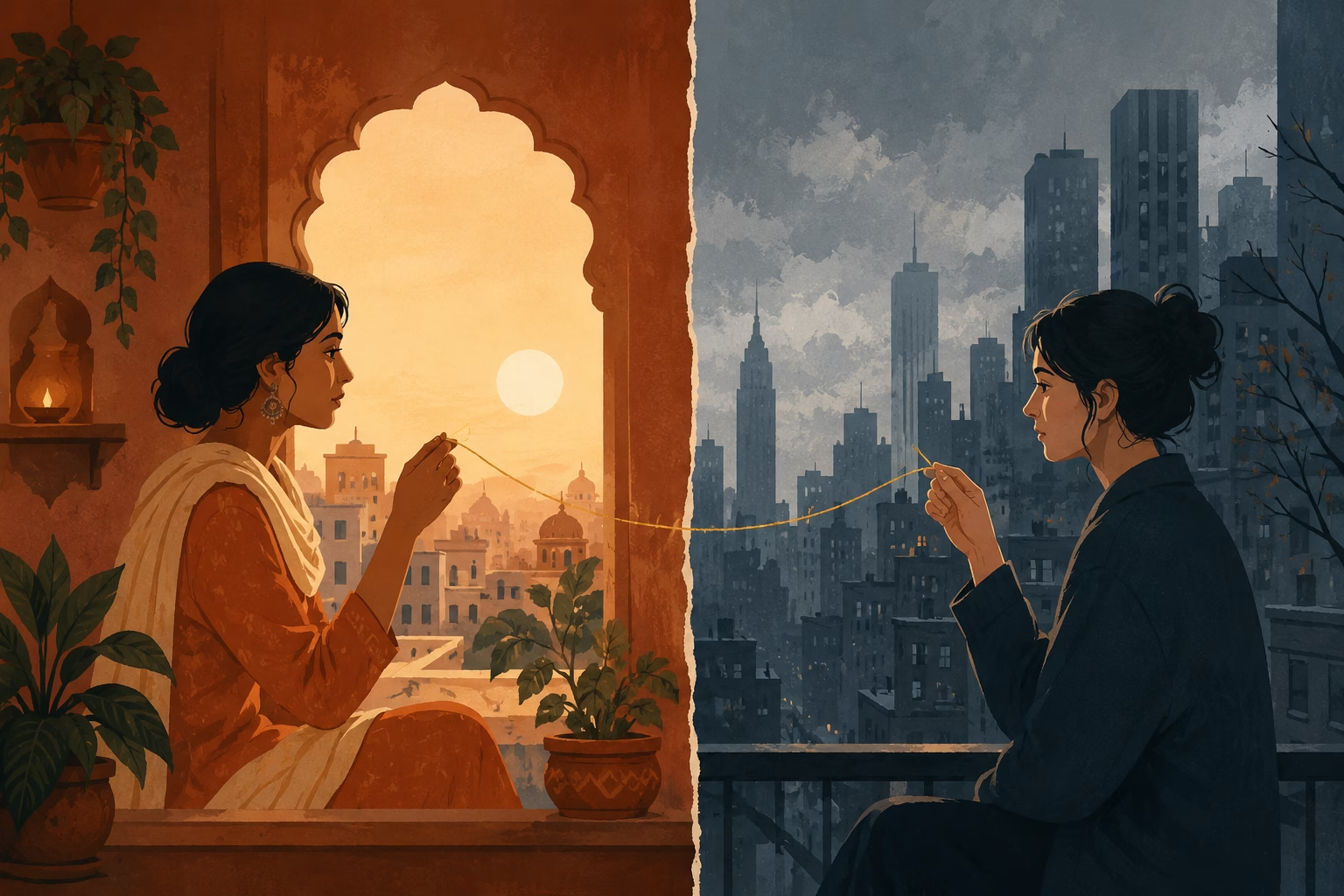
Arundhati Roy’s The God of Small Things is not just a story—it’s an experience. Set in the lush green landscapes of Kerala, the novel moves like the monsoon: slow, rhythmic, but unstoppable. Its rain doesn’t merely fall; it seeps into the soil of memory and family history. Published in 1997, the book won the Booker Prize, marking Roy’s explosive arrival on the global literary scene.
What makes The God of Small Things special is how it merges the intimate with the political. Through a fragmented yet lyrical narrative, Roy exposes the quiet violence embedded in everyday life—where love becomes dangerous, caste boundaries suffocate, and the past forever invades the present. Her writing, full of musical cadences and sharp imagery, defies the ordinary logic of time.
In the novel, every detail is deliberate. Every “small thing” — a scent, a river, a whisper — has a memory attached to it. Roy’s brilliance lies in showing how history exists not only in grand monuments or nationalist pride but also in these small, invisible things. For Indian readers, this story feels deeply local—rooted in Kerala’s rivers and rain—but it also speaks universally about pain, inequality, and forbidden love.
The God of Small Things: Plot Overview
The story unfolds around Rahel and Estha, fraternal twins who reunite in their hometown of Ayemenem after years of separation. But their reunion is heavy with silence and memory. Roy doesn’t tell their story in a straight line. Instead, she shuffles time like a deck of cards, letting the reader slowly piece together their tragic past.
At the center of that past lies their mother, Ammu, a woman who tried to claim love in a society that denied her agency. After leaving her abusive husband, she returns to her family home, bringing her twins. In Ayemenem, social hierarchies rule everything. Ammu’s affair with Velutha, a Dalit carpenter working for her family, becomes an unforgivable act. The “Love Laws” of caste and tradition punish them brutally.
Velutha is beaten to death by the police, while Ammu is ostracized and dies alone. The twins, witnesses to these horrors, are separated. Their cousin, Sophie Mol—Chacko’s daughter from his British ex-wife—dies in a river accident that becomes the novel’s tragic pivot. Her death binds all events, merging personal guilt and societal sin.
Roy’s structure is cyclical, not linear. The reader always feels that the past is never truly past. Every chapter peels back a new layer, revealing not just what happened but how those events continue to echo in each character’s present life.
The God of Small Things is about more than a forbidden romance—it’s about how systems of caste, class, religion, and gender conspire to destroy the possibility of love and innocence. LEARN MORE
The God of Small Things: Themes
1. Love and Its Laws
The novel’s heart beats with forbidden love. Roy’s “Love Laws”—who should be loved, and how, and how much—form the backbone of her narrative. Love here is both tender and transgressive. Ammu’s love for Velutha is an act of rebellion against everything her conservative society holds sacred. Yet it’s punished as a moral crime.
At another level, Rahel and Estha share a love that defies ordinary boundaries of sibling affection, suggesting how trauma and isolation drive people to seek connection against all norms. Roy uses this love to confront hypocrisy: the same society that condemns natural affection tolerates corruption, cruelty, and violence.
2. The Caste System and Social Hierarchies
Velutha’s tragedy exposes the brutal machinery of India’s caste system. Despite being a Communist activist’s son, his worth is measured only by his caste. His relationship with Ammu threatens social balance and exposes hypocrisy—even those preaching equality enforce caste hierarchies in private.
Roy doesn’t write caste as an abstract concept; she humanizes it through suffering. The violence Velutha faces is not just personal—it is structural, sanctioned by law and religion.
3. Postcolonial Disillusionment
The novel portrays postcolonial India as a space still haunted by its colonial masters. The family’s obsession with Englishness—reflected in Baby Kochamma’s pretentious manners and Chacko’s Oxford nostalgia—shows how colonial mindsets persist long after independence.
Ayemenem becomes a microcosm of modern India: beautiful on the surface but fractured beneath by internalized oppression.
4. Feminism and Female Defiance
Ammu’s story is central to feminist readings of The God of Small Things. She refuses to live quietly within a patriarchal system that defines women through obedience. Her decision to love on her own terms becomes an act of resistance.
Even though society destroys her for it, Ammu’s defiance resonates as an early echo of feminist consciousness in Indian English fiction. Roy’s portrayal of women—Ammu, Rahel, even the bitter Baby Kochamma—reveals how patriarchy traps women in different cages.
5. Memory, Childhood, and Trauma
Roy constructs memory as a living entity. The twins remember through smells, colors, and fragmented thoughts. Trauma is felt not in grand melodrama but in the quiet details—the cracking of a floorboard, a half-heard whisper.
The child’s perspective gives the novel an unsettling power. Through Rahel and Estha’s innocent gaze, the horrors of caste and death appear both distorted and amplified, showing how children absorb social violence long before they understand it.
The God of Small Things: Symbolism
The Meenachal River: The river in Ayemenem functions as both life-giver and destroyer. It hosts childhood play but also claims Sophie Mol’s life, symbolizing innocence and death intertwined.
The History House: This abandoned building stands as a metaphor for India’s colonial and social memory. It is where forbidden histories—like Ammu and Velutha’s affair—are hidden and violently silenced.
Pappachi’s Moth: The moth that Pappachi obsessed over and failed to classify becomes a symbol of personal failure and patriarchal rage. It also embodies the persistence of colonial inferiority.
Through these recurring motifs, Roy builds a layered symbolic system, turning domestic spaces into political arenas.
The God of Small Things: Style and Structure
Roy’s narrative technique breaks convention. She weaves nonlinear storytelling with Malayalam-infused English, blending poetry with realism. Her fragmented style mirrors memory’s fluidity—events loop and overlap, reminding the reader that trauma refuses to behave chronologically.
The use of repetition and capitalization (“A Love Law,” “Small Things”) creates a rhythmic prose style that mimics oral storytelling. This language, rich and defiant, reclaims English from colonial stiffness, giving it a uniquely Indian elasticity.
Her children’s-eye narration balances innocence with irony, allowing the reader to witness social cruelty through fresh yet tragic eyes.
The Political and Social Undercurrents
Every personal event in the novel reflects broader social tensions. The Communism of Kerala, for example, is portrayed not as a liberating ideology but as another hierarchical structure filled with double standards.
Roy’s critique of politics extends to postcolonial governance itself. Through the Ayemenem household, she shows how colonialism’s ghosts still whisper in independent India’s institutions, language, and morality.
The novel’s politics is intimate. It lives in the body—in love, in shame, in silence. By placing political oppression beside familial relationships, Roy makes readers feel how the social order invades the most private spaces.
Arundhati Roy’s Literary Philosophy
Roy has often described her writing as political art born from empathy. In interviews, she insists that fiction must confront injustice. The God of Small Things, though deeply lyrical, is a political act. It exposes caste, patriarchy, and hypocrisy without preaching.
Her style resists simplicity. She invites readers to linger on rhythm and sound. Her language flows like Kerala’s backwaters—sometimes tranquil, sometimes violent. That duality reflects her worldview: beauty cannot exist without recognizing pain.
The Booker Prize and Global Reception
When The God of Small Things won the 1997 Booker Prize, it reshaped global interest in Indian writing in English. Roy became a literary icon overnight, yet also a controversial figure at home. Critics accused her of “airing India’s dirty laundry.”
However, her novel transcended such nationalism. It became a text taught across universities worldwide—as a feminist, postcolonial, and environmental critique. Readers from different nations found themselves in its universal emotions of love, loss, and resistance.
Three decades later, the novel continues to sell in global markets, translated into more than 40 languages. Its relevance endures because its questions remain urgent: Who decides what love is? Who gets punished for it?
The God of Small Things and Dalit Consciousness
Though Roy herself is not Dalit, her portrayal of Velutha connects deeply with Dalit literature’s ethos. Velutha’s humanity resists erasure; through him, Roy gives voice to the silenced. The brutality he endures mirrors centuries of caste-based violence that India still struggles to address.
Roy has since evolved into a political activist, writing essays like The Algebra of Infinite Justice and An Ordinary Person’s Guide to Empire, where she expands upon themes of marginalization, democracy, and dissent. Her fiction, though poetic, is part of this same moral and political project of empathy. EXPLORE MORE
Conclusion: The Eternal Power of Small Things
Arundhati Roy’s The God of Small Things remains an extraordinary achievement—a novel that captures the soul of postcolonial India while transcending borders. Through its fragmented narrative, it teaches that personal pain and societal injustice are entwined; you cannot heal one without confronting the other.
Roy’s world is full of beauty and brutality, tenderness and rebellion. Her prose invites readers not simply to observe but to participate—to feel guilty, to reflect, to question.
Ultimately, the novel asks us to remember that “small things” often carry the heaviest truths. Love, even when destroyed, leaves behind a trace that no system can erase. That is Roy’s gift: to reveal the sacred power hidden in the ordinary, making The God of Small Things both a love story and a lament for humanity itself.
FAQs
Q.1. What is the main theme of The God of Small Things?
The central theme of The God of Small Things is love — how personal affection clashes with rigid social laws. Arundhati Roy explores the “Love Laws” that dictate relationships within a caste-bound society. The novel highlights class inequality, gender constraints, and postcolonial disillusionment. Through this lens, The God of Small Things analysis reveals how systems of power shape intimate human emotions.
Q.2.Who are the main characters in The God of Small Things?
The key characters are Ammu, her twin children Rahel and Estha, and Velutha, a Dalit carpenter. Each character represents a struggle against societal norms. Ammu’s love for Velutha challenges caste and gender barriers, creating the emotional heart of The God of Small Things analysis. Supporting figures like Baby Kochamma and Chacko reveal hypocrisy within traditional families.
Q.3. Why is the novel called The God of Small Things?
The title symbolizes the beauty and tragedy found in life’s “small things.” These include emotions, memories, and moments that shape destiny. Arundhati Roy contrasts “small things” — personal and emotional — with “Big Things” such as politics, class, and history. Hence, The God of Small Things analysis focuses on how minor acts of love and defiance hold lasting power.
Q.4. What is the plot of The God of Small Things?
Set in Kerala in the 1960s, the story follows twins Estha and Rahel as they return to their ancestral home years after childhood tragedy. Through shifting timelines, readers discover a forbidden love between Ammu and Velutha. Their romance defies the caste system and leads to Velutha’s death. In essence, The God of Small Things analysis captures love’s cost in a world ruled by prejudice.
Q.5. How does Arundhati Roy use language in the novel?
Roy’s prose blends Malayalam phrases with poetic English, breaking standard grammar to mimic childhood thought and trauma. Her rhythm and wordplay redefine narrative voice in Indian literature. Through her linguistic innovation, The God of Small Things analysis shows language as both resistance and reclamation against colonial structures.