
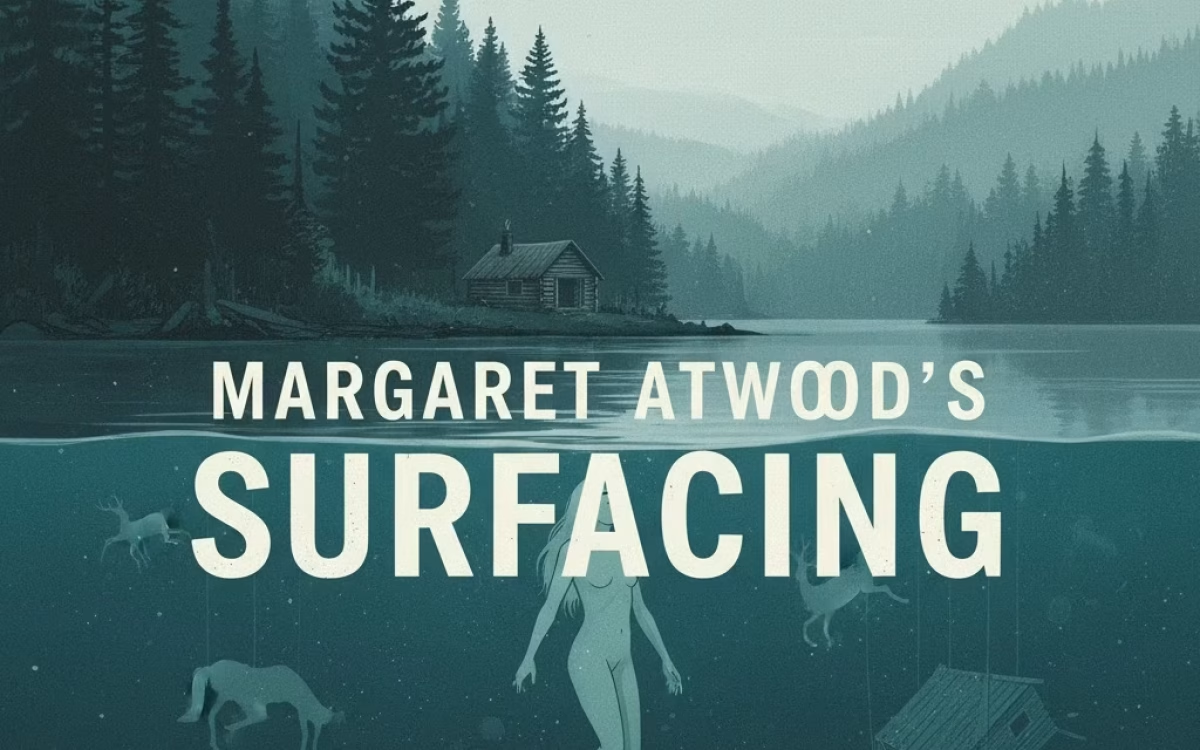
INTRODUCTION
Margaret Atwood’s Surfacing is a masterpiece of Canadian literature that unravels the tangled relationship between selfhood, nature, and cultural identity. First published in 1972, this novel sits at the intersection of feminism, ecology, and psychoanalysis. It is deeply introspective and disturbingly honest, exploring the emotional aftermath of trauma and the struggle of reclaiming identity in a patriarchal and colonised world.
Set in the dense wilderness of northern Quebec, Surfacing follows an unnamed woman who returns to her childhood home in search of her missing father. What begins as a physical quest slowly transforms into a profound psychological excavation, where the narrator confronts suppressed memories, gendered violence, colonial guilt, and ecological estrangement.
Atwood, writing at a time when second-wave feminism and environmental consciousness were reshaping public discourse, intertwines both concerns seamlessly. Surfacing becomes not merely a story about returning home but about rediscovering one’s authentic self beneath layers of cultural conditioning.
Margaret Atwood’s Surfacing: The Story
The premise of Surfacing is deceptively simple. The unnamed narrator, a commercial artist living in Toronto, travels with her boyfriend Joe and her friends—Anna and David—to a remote island in Quebec. They embark on this journey to locate her father, who has disappeared without explanation. But as the days pass, the narrator’s search for her father gradually becomes a journey into her own fragmented psyche. The physical landscape mirrors her internal landscape—wild, obscure, and filled with shadows of the past.
The Canadian wilderness Atwood crafts is symbolic—a living entity that rejects intrusion yet offers purification. The isolation of the island strips away social artifices. What remains is the raw essence of the self caught between civilization and savagery, reason and instinct, guilt and rebirth. FULL TEXT
Margaret Atwood’s Surfacing: Feminist Awakening
From the very beginning, Atwood sets Surfacing in a world heavily defined by patriarchal constraints. The narrator’s anonymity becomes political: her namelessness reflects the broader silencing of women by male authority and cultural convention.
Her companions embody stereotypical gender constructs. David, the manipulative filmmaker, represents the gaze of male dominance—his constant filming transforms life into a voyeuristic spectacle. His wife, Anna, is objectified both sexually and socially, her forced nudity for David’s film symbolizing women’s subjugation in patriarchal systems.
Atwood’s feminism, however, is far from didactic. Through the narrator’s gradual withdrawal from civilized society, she redefines liberation as an inward act—a refusal to perform assigned roles. She must “surface” from the lies imposed by men, memory, and cultural myths.
Margaret Atwood’s Surfacing: Guilt and Memory
As the narrator delves deeper into her father’s disappearance, she begins to recall traumatic fragments—a failed relationship, a forced abortion, and emotional alienation. These buried experiences resurface like drowned bodies from the depths of her subconscious.
Atwood portrays trauma as cyclical—a haunting that cannot be silenced by denial. The narrator’s repression and detachment from emotion reflect the psychic numbness of one who has internalized shame and loss. When she finally acknowledges the abortion, the revelation becomes both a descent into madness and the beginning of catharsis.
The act of “surfacing,” then, becomes a metaphor for reclaiming buried truths. It is a psychological rite of passage from illusion to self-awareness. Through raw introspection, Atwood connects personal trauma with collective female pain—where every repressed memory stands as testimony to a patriarchal wrong.
Margaret Atwood’s Surfacing: Nature
In Surfacing, nature assumes the power of an ethical and spiritual force. The wilderness is both brutal and restorative—a sanctuary where the narrator confronts her inner chaos. Water, the novel’s central image, symbolizes transformation and rebirth. When the narrator dives into the lake, she does not simply swim; she undergoes a symbolic baptism. Her resurfacing marks the threshold between her old, fragmented self and the new, instinctual identity born through communion with nature.
Atwood’s imagery often borders on the mythic. The narrator’s identification with animals, her visions of her father as a fish and mother as a bird, and her eventual rejection of human language express her transcendence beyond civilization’s corruption. She seeks to reclaim purity—not in a literal sense but as psychological wholeness untainted by cultural deceit.
This ecological consciousness correlates with contemporary ecofeminism—the belief that the domination of women and the exploitation of the environment stem from the same patriarchal ideology. Atwood critiques industrial modernity’s tendency to commodify both female bodies and natural landscapes. The wilderness, in contrast, offers resistance—a space for authenticity and healing.
Margaret Atwood’s Surfacing: Postcolonial Identity
Atwood’s narrative also functions as a metaphor for Canada’s own search for cultural identity. Published during the rise of Canadian nationalism, Surfacing engages in a subtle critique of American cultural imperialism. The American tourists who hunt, film, and consume the Canadian wilderness symbolize foreign exploitation and spiritual emptiness.
David’s sarcastic slogan “Canadians are losers” and his obsession with making a “documentary” on the trip encapsulate the colonial inferiority complex that plagues many postcolonial nations. The narrator’s retreat into the wilderness, by contrast, represents a reclaiming of native identity—a symbolic decolonization of the mind. Through her, Atwood weaves the personal and the political, suggesting that spiritual independence mirrors national autonomy.
Margaret Atwood’s Surfacing: The Descent
Midway through the novel, the boundary between sanity and madness dissolves. Haunted by visions, the narrator rejects human contact, burns her drawings, discards clothes, and decides to live as a creature of the forest. Critics often interpret this regression as psychosis; yet, Atwood frames it as an act of purification.
The stripping away of language, artifice, and social restraint parallels a spiritual rebirth. Her temporary madness is not destruction—it is renewal. The narrator must lose her civilized self to rediscover her primal self. When she says, “The animals have no need for speech, why talk when you are a word,” she articulates her metaphysical belonging to the natural world.
This transformation echoes Carl Jung’s concept of individuation—the reconciliation of the conscious and unconscious self. Through symbolic death and rebirth, the narrator achieves psychological wholeness. EXPLORE OTHER WORKS
Margaret Atwood’s Surfacing: Resurrection
By the novel’s conclusion, the narrator’s surfacing is both literal and metaphorical. Emerging from isolation, she acknowledges her humanity and guilt yet accepts her continuity with life around her. She becomes a woman who can love without losing herself.
Her final act—conceiving a child with Joe—represents a reconciliation between nature and culture, passion and reason. It is not surrender but renewal, reaffirming life’s cycle through creation.
Atwood’s ending is deliberately ambiguous. Whether she returns to civilisation or remains in nature is left unstated. The point is not her physical survival but her inner awakening—the courage to claim her truth amid uncertainty.
Margaret Atwood’s Surfacing: Literary Techniques
Atwood’s style in Surfacing combines lyrical description with psychological depth. The narrative voice is fragmented, unreliable, and introspective, immersing readers in the unstable consciousness of the protagonist.
Imagery plays a vital role. Water signifies rebirth; mirrors reflect self-deception; animals symbolize purity. Throughout the text, Atwood employs archetypes and mythic symbolism to elevate the personal journey into a universal ritual of transformation.
Her use of tense, present and immediate, reinforces existential dislocation—suggesting the narrator’s immersion in perpetual introspection. The prose oscillates between poetic reflection and sharp irony, creating a tone both hypnotic and unsettling.
Margaret Atwood’s Surfacing: Themes
Surfacing dismantles binaries—male and female, human and animal, civilization and wilderness. Atwood exposes how these divisions uphold systemic violence. The narrator’s rebellion against David’s camera is a pivotal act of defiance, rejecting the mechanized eye of patriarchy and reclaiming her agency.
The novel insists that true empowerment lies in awareness. For Atwood, resistance begins in consciousness—an awakening that frees both women and nations from dependency, guilt, and repression.
Relevance
Even decades after its publication, Surfacing remains hauntingly relevant. Atwood’s ecological warnings anticipate today’s environmental crises, while her psychological and feminist insights echo contemporary struggles for identity and equality.
The protagonist’s journey parallels modern quests for authenticity amid digital noise and cultural homogenization. Her call to “surface” feels profoundly urgent—to unlearn oppressive narratives and reconnect with inner and ecological truth.
In today’s India, Canada, and beyond, Surfacing speaks to layered histories of colonization, gender bias, and cultural displacement. It invites readers worldwide to embark on their own act of surfacing—to rediscover dignity, connection, and introspection amid fractured realities.
Conclusion
Surfacing ultimately reveals what lies beneath civilization’s facade—the silent wilderness of the soul. Margaret Atwood’s narrator, nameless yet universal, transcends trauma to re-emerge whole, neither victim nor saint but a survivor in harmony with nature’s pulse.
Her journey is humanity’s journey: from suppression to recognition, from fragmentation to wholeness. In an era craving authenticity, Atwood’s Surfacing remains a revelatory guide—a call not merely to return to nature but to reawaken to one’s truest, uncolonized self.
FAQs
1. What is the main theme of Margaret Atwood’s Surfacing?
The central theme of Surfacing is the quest for identity and self-awareness. The protagonist’s journey into the wilderness symbolizes an inward exploration of her repressed memory, guilt, and womanhood. Atwood intertwines feminist, ecological, and postcolonial issues to depict a woman’s search for integrity in a fragmented world.
2. Why is the novel called Surfacing?
The title Surfacing refers to psychological and emotional rebirth. The narrator “surfaces” from the depths of trauma, denial, and alienation to confront truth and regain her authentic self. It symbolizes emergence from guilt, memory, and societal falsehoods into awareness and renewal.
3. Why is the narrator unnamed in Surfacing?
Atwood deliberately leaves the narrator nameless to represent universal female experience—silenced, objectified, and suppressed. Anonymity reinforces the loss of identity caused by patriarchal and colonial control, turning the protagonist into a symbol of all women seeking voice and recognition.
4. What role does nature play in Surfacing?
Nature functions as both setting and spiritual guide. The Canadian wilderness becomes a mirror reflecting the narrator’s emotional turmoil and a healer restoring her wholeness. It embodies Atwood’s ecofeminist belief that the exploitation of women and nature stem from the same patriarchal structures.
5. How does Atwood portray feminism in Surfacing?
Atwood uses the strained relationships among the characters—especially David’s dominance and Anna’s submission—to expose the performative and repressive aspects of gender roles. The narrator’s eventual rejection of these patterns signifies liberation through redefining womanhood beyond male prescription.