Introduction
Virginia Woolf’s “To the Lighthouse” stands as a landmark in modernist literature, blending innovative narrative style with deep philosophical inquiry. At first glance, the novel’s pace appears meditative, drifting through the rhythms of domestic life along the Isle of Skye. Beneath this calm, however, Woolf orchestrates an intense psychological study, using the ordinary moments to reveal life’s extraordinary depths.
What makes “To the Lighthouse” especially resonant for Indian readers today is the way Woolf captures the essence of familial dynamics, gender expectations, and the universal quest for meaning. This novel does not simply ask “what happens?” but rather “what does it feel like to happen?”—and in doing so, it becomes profoundly relevant to those who seek to understand identity amid tradition and change. Its subtlety in portraying the minutiae of memory and hope, through the Ramsay family’s joys, tensions, and silences, mirrors the fabric of many Indian households, where much is understood without words.
Virginia Woolf’s To the Lighthouse: Plot Overview
“To the Lighthouse” centres on the Ramsay family’s visits to their summer home on the Isle of Skye in Scotland, spanning from 1910 to 1920. In the first section, young James Ramsay longs to visit the nearby lighthouse, but his father, Mr. Ramsay, doubts the weather will permit it, setting up tensions between hope and realism within the family. Mrs. Ramsay’s kindness and optimism counterbalance her husband’s rationality, while their guests—including the artist Lily Briscoe—add their own perspectives and complexities to the household.
The second section, “Time Passes,” swiftly narrates the impact of war and loss on the family: Mrs. Ramsay dies, and two children, Prue and Andrew, also pass away, while the summer house falls into neglect. A decade later, the remaining family members and friends return. In the final section, Mr. Ramsay finally takes James and his sister Cam on the long-promised boat trip to the lighthouse, while Lily Briscoe works to finish her painting, achieving her vision as the family reaches their symbolic destination.
Woolf’s narrative blends inner thoughts, family drama, and the inexorable movement of time, culminating in hard-won moments of reconciliation and artistic completion. FULL TEXT
Virginia Woolf’s To the Lighthouse: Analysis
Modernism and Stream of Consciousness
As a cornerstone of literary modernism, “To the Lighthouse” eschews linear plot and conventional narration in favor of stream of consciousness. By allowing readers intimate access into the thoughts of her characters—especially Mrs. Ramsay, Mr. Ramsay, and Lily Briscoe—Woolf achieves a remarkable psychological realism. The shifting perspectives create a sense of emotional immediacy and complexity, inviting readers to experience events as interconnected moments rather than as a straightforward story.
Structural Innovation
The novel’s tripartite structure—”The Window,” “Time Passes,” and “The Lighthouse”—is revolutionary in its approach to time and narrative pacing. “The Window” immerses us in the Ramsays’ summer home, capturing fleeting interactions and unspoken aspirations. In “Time Passes,” Woolf compresses ten years, including the impact of World War I and profound personal losses, into a lyrical meditation on decay and renewal. This middle section is haunting, with even the Ramsay home itself portrayed as if it possesses memory. Finally, “The Lighthouse” brings resolution, though in a way that is subtle, quiet, and reflective—true to life’s own uncertain endings.
Virginia Woolf’s To the Lighthouse: Thematic Depth
Time, Memory, and Art
Woolf explores the relentless passage of time and its effects on people, relationships, and art. For Indian readers, this evokes a cultural reverence for ancestry and generational change, mirrored in festivals, rituals, and familial roles. Lily Briscoe’s artistic journey—her battle against internal doubts and societal expectations—serves as a powerful metaphor for the creative life, particularly for women who find themselves negotiating space within tradition.
Gender and Society
Feminist interpretations of the novel highlight the tension between patriarchy and matriarchy, with Mrs. Ramsay embodying the ideal of domestic womanhood and Lily Briscoe challenging those confines through her art. Woolf deftly examines both the limits and the sources of women’s power, tracing the intricate negotiations that take place in homes everywhere.
Symbolism
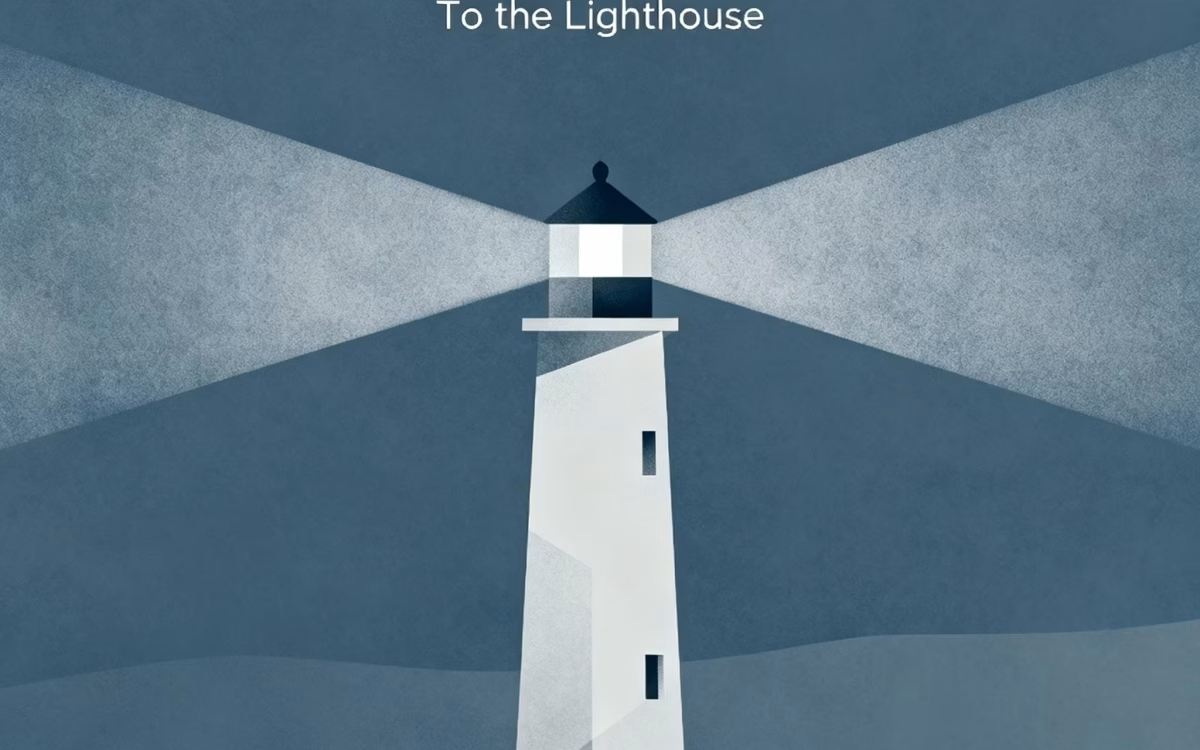
Key symbols—such as the lighthouse, the sea, and Lily’s painting—function on multiple levels. The lighthouse is both a physical destination and a symbol for unattainable ideals or goals, its light representing hope amid darkness. The sea’s unending movement echoes the flux of time and experience, while Lily’s canvas stands for the act of creation itself, reflecting Woolf’s own anxieties and ambitions as an artist.
Virginia Woolf’s To the Lighthouse: Narrative Technique
Not much happens in terms of traditional plot, but the internal drama is profound. Woolf’s poetic prose, intricate characterisation, and evocative imagery anchor the novel’s lasting appeal. Mrs. Ramsay’s tenderness and James Ramsay’s evolving relationship with his father lend an intensely human dimension. Every “little daily miracle”—as Woolf might call it—matters.
Personal Reflections
Reading “To the Lighthouse” for the first time felt like stepping into the ebb and flow of my own inner life; Woolf’s prose gently tugged at the emotional currents beneath my routine, making me linger over the small, poignant moments that routinely pass unnoticed. The novel’s stream-of-consciousness style was initially disorienting, but as I settled in, its rhythms became familiar—a literary parallel to the unpredictability of daily existence in India, where much is understood through tone, gesture, and silence.
Mrs. Ramsay’s balancing act between hope and realism reminded me of matriarchs I’ve known—often the quiet centre of chaotic households, their influence extending well beyond the boundaries of spoken rules and family traditions. Lily Briscoe’s persistent battle with her canvas crystallised my own creative struggles, especially the doubt that comes from working against both societal and self-imposed expectations. The moment Lily finally lays down her brush, having “had her vision,” felt like a reminder to trust small moments of clarity rather than chase dramatic resolutions.
What stays with me most is how Woolf captures the variety of personal meaning—each character’s search for truth, purpose, and connection echoing the complexity of our own experiences. Returning to “To the Lighthouse” always reveals fresh insight, and it convinces me that, in literature as in life, there is immense power in seeing and being seen in all our ordinary, luminous humanity. EXPLORE OTHER WRITERS
Conclusion
Virginia Woolf’s “To the Lighthouse” concludes with moments of quiet revelation and healing, offering closure not through dramatic events but through subtle, internal transformation. The final journey to the lighthouse represents a long-awaited reconciliation: Mr. Ramsay surprisingly praises his son James, shifting the tone from earlier tensions and allowing for the fragile bonds of family to be gently restored.
Meanwhile, Lily Briscoe’s completion of her painting symbolises acceptance—of impermanence, of memory, and of her own artistic vision. This small act reflects Woolf’s belief that articulating one’s authentic perspective, despite uncertainty or external judgement, is itself a moment of profound achievement. The lighthouse, standing unchanged against the passage of time and loss, becomes a powerful emblem for the endurance of hope and creativity.
In the end, Woolf’s masterpiece urges readers to find meaning in fleeting experiences and everyday relationships, confirming that true resolution comes from embracing multiplicity and ambiguity—in art, in family, and in life itself.
FAQs
Q1: What is “To the Lighthouse” about?
A: The novel explores the lives of the Ramsay family and their guests at a summer house on the Isle of Skye, focusing on themes of family, memory, loss, and creativity through shifting perspectives, culminating in a symbolic journey to a distant lighthouse.
Q2: What narrative style is used in “To the Lighthouse”?
A: Virginia Woolf employs stream of consciousness, allowing readers intimate access to her characters’ thoughts and emotions, making the narrative feel fluid, layered, and deeply psychological.
Q3: Who are the main characters in “To the Lighthouse”?
A: Key characters include Mr. and Mrs. Ramsay, their children James and Cam, and Lily Briscoe, an artist whose creative struggles parallel the family’s emotional journey.
Q4: What does the lighthouse symbolise?
A: The lighthouse in the novel functions as a multifaceted symbol—representing aspiration, hope, and the often unattainable nature of idealized goals in life and art.
Q5: Why is “To the Lighthouse” considered a modernist masterpiece?
A: Woolf’s innovative narrative structure, nonlinear chronology, and focus on subjective perception and fleeting moments exemplify literary modernism’s shift away from traditional storytelling.