INTRODUCTION
HG Wells’ The Time Machine is a landmark literary work that invites readers to embark on an extraordinary voyage beyond ordinary existence into the mysterious dimension of time. Published in 1895, this novella not only pioneered the science fiction genre but also provided a sharp critique of Victorian society and humanity’s future possibilities. At its core is the adventurous journey of a Victorian scientist, known simply as the Time Traveller, who unveils a machine that can traverse time as easily as moving through space. As he travels nearly a million years into the future, Wells explores themes of evolution, social division, and the impermanence of human achievement.
The introduction skillfully sets the stage by centering on a gathering of sophisticated Victorian gentlemen, including scientists, doctors, and scholars. They listen with skeptical curiosity as the Time Traveller reveals his theories about time as a fourth dimension. Wells captures the spirit of the era—marked by rapid scientific advancement, industrialization, and rigid social hierarchies—while also planting subtle doubts about civilization’s seemingly inevitable progress. These opening scenes establish both the scientific ingenuity and social class consciousness of the protagonist and guests. They highlight underlying tensions that will unfold dramatically throughout the story.
This opening frames time travel not merely as a thrilling concept but as a tool to examine humanity’s trajectory. It forces readers to confront uncomfortable questions about social inequality, complacency’s consequences, and mankind’s ultimate fate. Moreover, Wells’ narrative cleverly balances scientific speculation and philosophical inquiry, making it a story that resonates intellectually and emotionally across generations.
HG Wells’ The Time Machine: Plot Overview
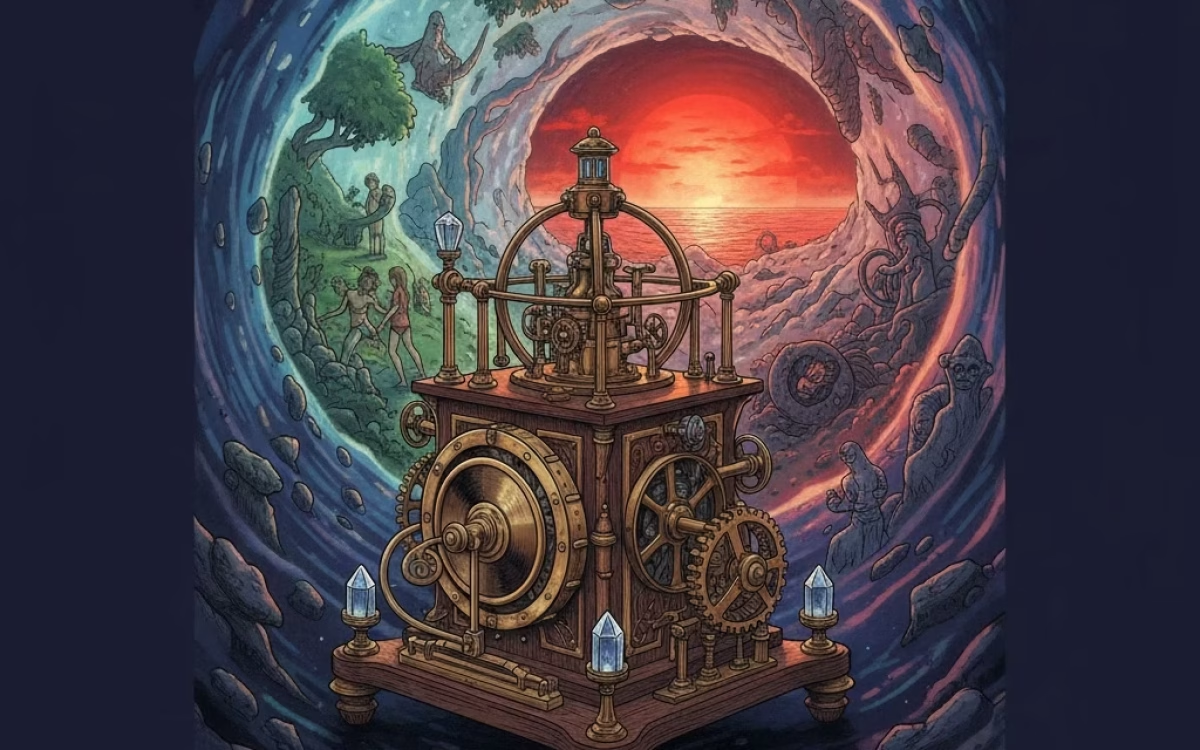
The Time Machine begins with a gathering of Victorian gentlemen, including the narrator, who listen with intrigue as an unnamed scientist, known simply as the Time Traveller, explains his revolutionary theory that time is the fourth dimension and can be traversed like space. To demonstrate his idea, the Time Traveller shows his guests a miniature model of a time machine, which mysteriously disappears as one lever is pushed, proving his claim. The following week, the group reconvenes, and the Time Traveller arrives looking disheveled and exhausted. He announces that he has traveled through time, and after dinner, he recounts his incredible journey to the future.
His machine propels him forward to the year 802,701 AD, where he finds himself in a strange and seemingly idyllic world. Here, he encounters the Eloi, small, delicate humanoid creatures who live in a pastoral landscape filled with ruins of a once-great civilization. These Eloi appear gentle and carefree but lack curiosity, intelligence, and vitality. They live communally and have an almost childlike innocence, seemingly free from worry or labor. Initially, the Time Traveller hypothesizes that the Eloi embody a utopian society where class struggle and hardship have vanished.
However, this peace soon reveals darker undertones. The Time Traveller discovers that his time machine has vanished, cleverly hidden behind a metal panel in the pedestal of a towering white Sphinx statue. As he investigates further, he begins to observe strange, nocturnal creatures called Morlocks—white, ape-like beings that dwell underground. The Morlocks maintain the machinery that supports the Eloi’s world but are also predatory toward them, feeding on the Eloi in a nightmarish symbiosis.
The Time Traveller befriends an Eloi woman named Weena, who becomes his companion as he explores this future society. His investigations lead him to the Palace of Green Porcelain, a museum filled with relics from the past. There, he arms himself with matches and camphor to defend against the Morlocks. A dramatic encounter follows when the Morlocks attack. During the struggle, a fire breaks out accidentally. It kills many Morlocks but tragically takes Weena’s life as well.
Escaping to the pedestal, the Time Traveller retrieves his time machine. He then continues his journey even further into the future. There, he witnesses the gradual decline of life on Earth. He sees a desolate world where the sun grows dim and all living creatures vanish. Returning to his own time, he shares his incredible tale with skeptical friends. Ultimately, he prepares for another journey into the future—one from which he never returns. This leaves the mystery of his fate unanswered.
Throughout the novella, the plot explores profound themes. These include the consequences of social inequality, the fate of humanity under industrial capitalism, and the relentless passage of time. Wells masterfully combines scientific imagination with poignant social critique. He crafts a narrative that is both an adventure and a philosophical inquiry into human destiny. FULL TEXT
HG Wells’ The Time Machine: Context
Wells was more than just a storyteller; he was a social commentator and visionary. He used science fiction as a vehicle to explore pressing contemporary issues. In The Time Machine, he goes beyond mere fantasy. He embeds warnings about societal complacency and the sharp class divisions characteristic of late 19th-century Britain. The novella presents a future world divided between two post-human species: the fragile Eloi and the subterranean Morlocks. These groups embody Wells’ critique of capitalism and evolution.
Understanding the Victorian context is vital to grasp the story’s social allegory. Wells wrote at a time of stark economic disparity, colonial expansion, and rapid scientific discovery. His use of time travel is more than a plot device. It serves as a metaphor for progression—or regression—in human history. This layering of scientific imagination with acute social observation elevates The Time Machine beyond a simple adventure tale.
HG Wells’ The Time Machine: Character Analysis
The Time Machine features a relatively minimal cast, but each character embodies significant themes and ideas that enrich the novella’s social and philosophical commentary. The primary figure—the unnamed Time Traveller—serves as both narrator and symbol, while the Eloi and Morlocks represent different facets of human evolution and societal structures.
The Time Traveller
The protagonist and narrator, the Time Traveller, is a brilliant, curious scientist driven by a desire to understand the nature of time and human progress. His scientific curiosity, courage, and adventurous spirit propel the story forward, embodying Wells’ celebration of scientific inquiry and radical thinking. Despite his intelligence and bravery, he is also portrayed as somewhat aloof and emotionally detached, reflecting a Victorian-era emphasis on rationality and scientific objectivity. His fascination with the future reveals his deep concern about humanity’s trajectory—especially regarding social inequality, technological dependence, and the potential decline of civilization. The Time Traveller’s journey into the future ultimately positions him as both explorer and critic, as he confronts the unsettling realities of human evolution and the possible fate awaiting humankind.
Weena
Weena is an Eloi woman who quickly forms a bond with the Time Traveller. She symbolizes innocence, vulnerability, and the fragile beauty of a naive, childlike society. Her gentle, trusting nature contrasts sharply with the dark realities of her world and the predatory Morlocks. Weena’s presence in the story provides an emotional anchor for the Traveller, highlighting themes of compassion and the innocence worth protecting amidst societal decay. Her tragic death underscores the superficiality of the seemingly utopian Eloi society, revealing the underlying vulnerability of their civilization.
The Eloi
While not a single character, the Eloi represent a social archetype—descendants of the upper classes who have seemingly inherited leisure and prosperity but at the expense of vitality, intellect, and resilience. Their lack of curiosity and dependence on the Morlocks reflect Wells’ critique of complacency and the potential stagnation of a utopia that neglects self-sufficiency and innovation. They are symbolic of a society that has sacrificed progress and complexity for comfort and superficial happiness.
The Morlocks
Similarly, the Morlocks are not individual characters but symbolic figures. They represent the oppressed working class, transformed by social and economic exploitation into predatory beings lurking underground. The Morlocks embody the dark outcomes of unchecked industrial capitalism—dehumanization, cruelty, and a distorted form of evolution. Their intelligence and skill in manipulating machinery make them formidable antagonists. This highlights the destructive potential of deep societal divisions. The relationship between the Morlocks and the Eloi raises important questions about the cyclical nature of social inequality. It asks whether such divisions ultimately lead to mutual destruction.
The characters in The Time Machine embody Wells’ major themes. These include the progression and regression of human society, the dangers of complacency, and the complex dynamics of class division. The protagonist’s scientific curiosity and ethical reflections provide a nuanced perspective. He highlights both the possibilities and risks of technological and social evolution. Meanwhile, Weena’s innocence, along with the allegorical Eloi and Morlocks, serve as powerful symbols of societal extremes. They reflect Victorian anxieties about class, progress, and humanity’s future.
Also, this analysis shows that, although few in number, the characters are archetypal and richly symbolic. They reflect Wells’ profound social critique and philosophical inquiry in a powerful, accessible way.
HG Wells’ The Time Machine: Themes
Time Travel and Human Progress
Time travel in Wells’ novella serves multiple functions: a scientific marvel, a narrative device, and a philosophical inquiry into time’s relentless march. The Time Traveller’s journey makes visible the fate of humanity in slices—showing potential futures and what happens when progress decays into stagnation or cruelty. This echoes modern debates about technological growth versus ethical responsibility.
Class Divide: Eloi and Morlocks
The Eloi represent the leisurely upper classes, physically frail and intellectually complacent, while the Morlocks symbolize the oppressed working classes, robust yet sinister. This division critiques Victorian capitalism and the dehumanizing effects of industrialization. Wells’ portrayal questions whether social inequalities can lead to mutual destruction.
Fear of Decay and Extinction
The bleak future that Wells imagines is tinged with existential dread—symbolizing fears about decay, extinction, and the vulnerability of human achievement. The Time Traveller’s final journey into an unknowable future underscores these anxieties, reminding readers that time is the ultimate arbiter of all things.
HG Wells’ The Time Machine: Narrative Technique
Wells adopts a frame narrative, with the Time Traveller recounting his adventure to skeptical dinner guests. This technique adds layers of realism and suspense. The prose varies between scientific exposition and vivid description, maintaining engagement through varied sentence structures and occasional idiomatic expressions. Moreover, his style weaves together academic observation with reflective insights, making the story resonate beyond its sci-fi elements. EXPLORE OTHER WORKS
Conclusion
H.G. Wells’ The Time Machine remains one of the most influential works of science fiction and social critique ever written. Its timeless appeal comes from a perfect fusion of imaginative storytelling and deep philosophical exploration. Through the Time Traveller’s journey into a distant and unsettling future, Wells warns readers about the dangers of social complacency, unchecked technological advancement, and entrenched class divisions. The novella’s chilling depiction of the Eloi and the Morlocks symbolizes extremes of human evolution shaped by social dynamics. It prompts readers to reflect on the consequences of their own society’s choices.
Moreover, The Time Machine transcends its Victorian origins to address contemporary concerns. These include our relationship with technology, the sustainability of social systems, and the unstoppable passage of time that challenges all human endeavors. Wells does not offer easy answers. Instead, he invites ongoing reflection on how we measure progress and what legacy humanity will leave behind.
Ultimately, The Time Machine endures because it sparks our imagination and conscience. It inspires us to navigate the mysterious corridors of time with both wonder and caution.
HG Wells’ The Time Machine: FAQs
Q1: What is the central theme of The Time Machine?
A: The novella explores themes of time travel, social inequality, and the potential future evolution of humanity. It critiques Victorian class structures through the depiction of the Eloi and Morlocks, symbolizing leisure and labor classes, respectively.
Q2: Who is the protagonist of The Time Machine?
A: The protagonist is an unnamed Victorian scientist called the Time Traveller. He invents a machine that can travel through time and ventures into the distant future, where he experiences the fate of human civilization.
Q3: What do the Eloi and the Morlocks represent?
A: The Eloi symbolize the idle upper classes, fragile and intellectually passive. The Morlocks represent the industrial working classes, strong but dehumanized by harsh labor. Together, they reflect Wells’ critique of social division and capitalism.
Q4: How does Wells use time travel in the story?
A: Time travel functions as both a scientific concept and a metaphor for human progress or decline. Through the Time Traveller’s journey, Wells examines the consequences of social and technological evolution over vast periods.
Q5: Why is The Time Machine considered a pioneering work of science fiction?
A: Published in 1895, it was one of the first novels to popularize time travel as a literary device, blending scientific ideas with adventure and social critique, thereby shaping the science fiction genre.