INTRODUCTION
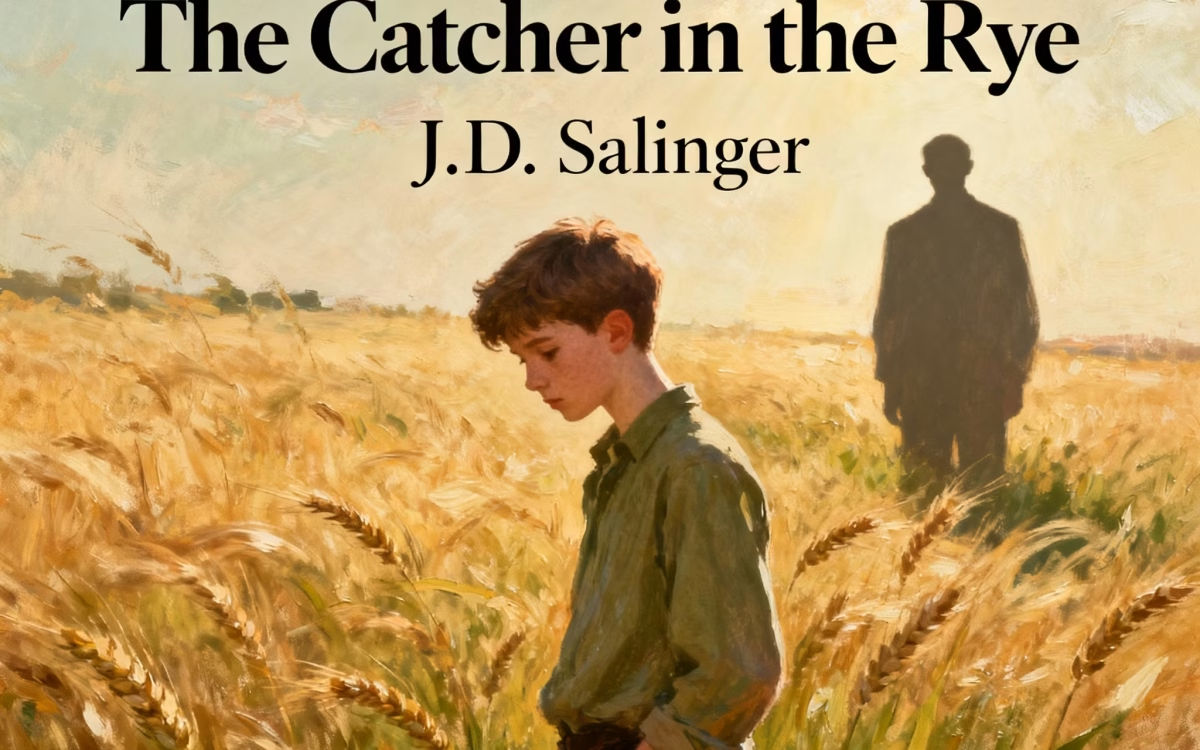
Salinger’s The Catcher in the Rye, published in 1951, is widely regarded as a landmark in American literature. It captures the poignant, often turbulent experience of adolescence with extraordinary authenticity and insight. The novel centres on Holden Caulfield, a sixteen-year-old boy expelled from his prep school, whose journey through New York City unfolds over two days filled with encounters that reveal his profound alienation and search for identity.
More than just a coming-of-age story, The Catcher in the Rye dives deep into themes such as the loss of innocence, mental health struggles, and societal hypocrisy. Holden’s cynical view of adulthood as a “phoney” world contrasts sharply with his desire to protect childhood purity—a conflict symbolised through his fantasy of being the “catcher in the rye”, someone who saves children from falling off a cliff into the corrupt adult world. This protective innocence is further complicated by his unresolved grief over the death of his younger brother Allie, adding emotional layers to his narrative.
Salinger’s narrative style is distinctive, employing a first-person, confessional tone that immerses readers in Holden’s psyche. This makes Holden both compelling and unreliable, inviting interpretations that range from psychological breakdown to a broader critique of postwar American society. The novel’s rich symbolism—the red hunting hat, the Museum of Natural History, and the carousel—adds depth, illustrating Holden’s inner conflicts and resistance to change.
In this critical analysis, we will examine the novel’s major themes, character development, and literary devices. We will also explore the cultural and historical context that has made The Catcher in the Rye a touchstone of teenage rebellion and existential angst.
Salinger’s The Catcher in the Rye: Plot Overview
The novel begins just after Holden Caulfield has been expelled from Pencey Prep, a prestigious boarding school. Disillusioned and disconnected, Holden decides to leave school early and spend a few days in New York City before facing his parents, who are unaware of his expulsion.
Holden’s wandering through New York forms the bulk of the narrative. With his signature red hunting hat perched askew, he drifts from one experience to another, struggling to make meaningful connections. He visits old acquaintances, attempts dates, and grapples with memories—especially those of his younger brother, Allie, whose death profoundly affected him.
Throughout the novel, Holden’s thoughts are infused with deep cynicism towards the “phoney” adult world, yet he simultaneously yearns for innocence, particularly in children. This contradiction propels the story forward, culminating in his fantasy of becoming the “catcher in the rye”, a protector of youth from the fall into adulthood’s superficiality and pain.
The plot is episodic and non-linear, emphasising Holden’s fractured mental state and the tumultuous nature of adolescence. The novel closes ambiguously, with Holden in some form of institutional care, suggesting ongoing struggles but also hinting at hope for recovery. FULL TEXT
Salinger’s The Catcher in the Rye: The Narrative Voice
One of The Catcher in the Rye’s greatest strengths lies in its distinctive narrative voice. Written as a personal confession from Holden Caulfield, the novel’s conversational, colloquial style captures the authenticity of adolescent speech. This makes Holden feel like a real person rather than a fictional character.
However, this narrative comes with complexity—Holden is an unreliable narrator, shaped by his emotional pain and mental distress. His judgements of others as “phoney” are reflective more of his internal turmoil than objective reality, inviting readers to read between the lines. This dynamic makes analysing the novel not just a literary exercise but a psychological exploration.
Salinger’s The Catcher in the Rye: Themes
Alienation is a core theme that reverberates throughout Holden’s narrative. He chooses isolation over connection as a defence mechanism against the world that he perceives as corrupt and hypocritical. His scepticism extends broadly—to teachers, peers, and even strangers—which underscores his deep loneliness.
Holden’s alienation is symbolic of adolescent disillusionment, marking him as both a product and a critic of his time. This theme connects with readers universally, as the sense of being misunderstood or out of place resonates across ages and cultures.
Innocence Lost
Holden’s fantasy of catching children before they fall off a cliff represents his desperate wish to preserve innocence—his own and that of others. This metaphor is one of the most powerful literary images of the novel and carries profound emotional weight.
The “catcher” symbolises a resistance to adulthood’s corruptions and challenges. It speaks to a universal reluctance to let go of childhood simplicity and purity. Holden’s red hunting hat further epitomises individuality and vulnerability, standing out vividly in a conformist society.
Identity and Self-Discovery
Holden’s journey is also one of identity crisis. His constant critique of others reflects his own attempts to define himself in an often confusing and contradictory world. As he oscillates between wanting to belong and rejecting societal norms, Holden embodies the quintessential adolescent struggle.
This theme adds psychological depth to the narrative and invites readers to reflect on their own experiences with self-definition and societal expectations.
Salinger’s The Catcher in the Rye: Literary Style
Salinger’s writing style is deceptively simple yet deeply effective. His use of colloquial language and stream-of-consciousness narrative technique offers an immersive reader experience, making the emotional complexity accessible.
Symbolism enriches The Catcher in the Rye beyond its surface story. The Museum of Natural History represents a world frozen in time, contrasting with Holden’s chaotic emotions. The recurring presence of death, especially through the memory of his brother Allie, adds layers of poignancy and tragedy.
Salinger’s The Catcher in the Rye: Coming-of-Age Tradition
While The Catcher in the Rye is widely considered a landmark coming-of-age novel, it subverts traditional narrative arcs by embracing ambiguity and resistance rather than resolution. Holden’s journey does not end with maturity but lingers in limbo, reflecting the real uncertainty of adolescence.
This departure from convention redefined the genre and has influenced countless works, marking the novel as a pivotal moment in literary history. EXPLORE
CONCLUSION
The Catcher in the Rye remains one of the most powerful explorations of adolescence and identity in modern literature. This novel offers more than just a coming-of-age story—it reveals the deep struggles of loneliness, innocence lost, and the search for authenticity. Through Holden Caulfield’s distinctive voice and complex inner world, J.D. Salinger captures universal themes that continue to resonate with readers across generations.
Understanding The Catcher in the Rye invites us to reflect on our own experiences with growth, alienation, and the challenge of staying true to oneself amid societal pressures. Its rich symbolism and narrative style make it a timeless text worthy of ongoing study and discussion.
Frequently Asked Questions
What is The Catcher in the Rye about?
The Catcher in the Rye is a novel by J.D. Salinger that follows the story of Holden Caulfield, a teenage boy navigating the difficulties of adolescence. The book explores themes like identity, alienation, and the loss of innocence through Holden’s experiences and inner struggles.
Who is Holden Caulfield in The Catcher in the Rye?
Holden Caulfield is the protagonist and narrator of the novel. He is a complex character dealing with grief, confusion, and a sense of isolation. His critical perspective on the adult world and his protective desire toward childhood innocence are central to the novel’s themes.
What are the main themes in The Catcher in the Rye?
The novel tackles themes such as teenage rebellion, alienation, the quest for identity, mental health, and the preservation of innocence. These themes are conveyed through Holden’s narrative and the symbolic elements throughout the book.
Why is The Catcher in the Rye considered a coming-of-age novel?
It’s considered a coming-of-age novel because it focuses on Holden’s emotional and psychological growth. Rather than a simple transition to adulthood, the novel portrays the ambiguity and challenges faced in the journey of self-discovery.
How does J.D. Salinger use symbolism in The Catcher in the Rye?
Salinger uses powerful symbols such as Holden’s red hunting hat, the Museum of Natural History, and the “catcher in the rye” metaphor. These symbols reveal deeper insights into Holden’s fears, desires, and resistance to growing up.