INTRODUCTION
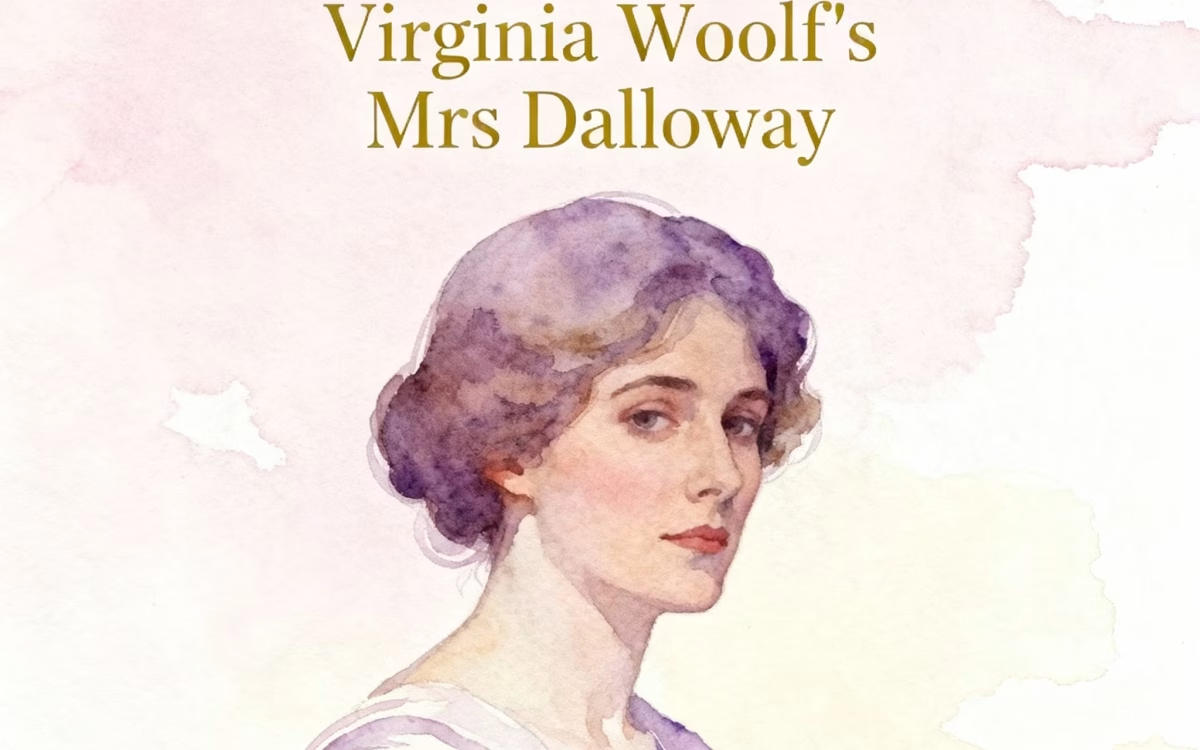
Virginia Woolf’s Mrs Dalloway stands as a towering pinnacle of modernist literature. This novel transcends traditional storytelling by venturing deeply into the intricate web of human consciousness. Published in 1925, it captures a single day in the life of Clarissa Dalloway, a London socialite preparing for an evening party. Yet beneath this seemingly ordinary day, Woolf masterfully unravels complex themes such as time, memory, identity, and mental health.
Unlike the linear, cause-and-effect narratives typical of the 19th century, Mrs Dalloway delves into the psychological interiors of its characters with great depth. Woolf presents their thoughts, memories, and sensations through a fluid stream-of-consciousness style. This mirrors the fragmented, multifaceted nature of human experience. As a result, readers gain intimate and immediate access to the protagonists’ inner lives, moving beyond surface actions to understand their emotional realities.
Moreover, Woolf’s narrative challenges the very scaffolding of traditional novels. Rather than adhering to strict chronological order, she explores time as subjective and fluid. Past and present, memory and reality blend to portray the complexity of consciousness. This approach reflects modernism’s fascination with fragmentation and its quest for new modes of representation.
In this analysis, the discussion will cover the plot overview, key themes, character analysis, narrative techniques, and personal reflections. Together, these elements reveal why Mrs Dalloway remains an enduring masterpiece. Nearly a century after publication, Woolf’s novel continues to challenge and enrich readers. It transcends conventional storytelling to pose a profound inquiry into what it means to be human in an increasingly complex and fragmented world.
Virginia Woolf’s Mrs Dalloway: Plot Overview
Virginia Woolf’s Mrs Dalloway unfolds over a single day in June 1923 in London. The novel centers on Clarissa Dalloway, an elegant upper-class woman preparing to host a party that evening. As she moves through the city buying flowers, she reflects on her youth and past choices. Early in the day, Clarissa is visited by Peter Walsh, an old lover recently returned from India. His visit rekindles memories and unresolved feelings. In parallel, the story follows Septimus Warren Smith, a traumatized World War I veteran suffering from shell shock. Septimus struggles with haunting hallucinations and emotional numbness, showing the lasting scars of trauma.
Despite medical efforts, his despair leads to a tragic suicide. Meanwhile, Clarissa continues her day, encountering family, friends, and society figures, culminating in the party where diverse lives converge. The party scene highlights themes of social connection, isolation, and the search for meaning in a post-war world. Woolf’s use of stream of consciousness immerses readers in her characters’ minds, exploring the fragile line between public appearances and private struggles. This narrative style deepens the portrayal of time, memory, and identity, making Mrs Dalloway a groundbreaking exploration of human consciousness. FULL TEXT
Virginia Woolf’s Mrs Dalloway: Themes
Mrs Dalloway is rich with themes that vividly reflect Virginia Woolf’s modernist vision and incisive social critique. One of the most prominent themes is Time and Memory. Woolf treats time not as a rigid chronological sequence but as a fluid, subjective experience. Throughout the novel, the past continuously intrudes upon the present, revealing how memories fundamentally shape identity. For instance, the recurring motif of Big Ben’s chimes underscores the relentless march of time, eloquently juxtaposing public, measured time with the intimate rhythms of personal experience.
Moreover, Mental Health and Trauma form a critical thematic pillar in the novel. Woolf addresses the lasting scars of war through the character of Septimus Warren Smith, whose shell shock symbolizes not only individual suffering but also the broader societal neglect of psychological wounds. Through Septimus, Woolf empathetically explores the fine line between sanity and madness, raising important questions about how society responds to mental illness.
Social Class and Identity is another significant theme that Woolf critiques with subtlety and depth. Clarissa, as an upper-class woman, embodies the tensions inherent in social stratification and gender roles. Her reflections expose the conflicting pressures of societal expectations and personal freedom, especially for women navigating the early 20th century. This theme illuminates the constraints imposed by class and gender, while also exploring individual agency within those confines.
Finally, the novel grapples with Life and Death as a universal meditation. The characters’ ongoing reflections on mortality and existence converge to reveal life’s fragility, yet simultaneously highlight moments of connection and meaning that make life valuable. This duality imbues the novel with a poignant awareness of human vulnerability and resilience.
Together, these themes weave a complex tapestry that challenges readers to confront the multifaceted nature of human experience, enriching Mrs Dalloway with enduring literary significance.
Virginia Woolf’s Mrs Dalloway: Character Analysis
Virginia Woolf’s characters in Mrs Dalloway are exquisitely crafted, capturing the depth and nuance of human consciousness with remarkable subtlety and insight.
Beginning with Clarissa Dalloway, the titular character embodies both grace and complexity. On the surface, she appears as a poised and elegant socialite, meticulously orchestrating the details of her party. However, beneath this composed exterior lies a woman grappling with profound internal conflicts. She wrestles with deep regrets and harbors a longing for authentic human connection, setting her apart from the superficial social world she inhabits. Moreover, her party preparations symbolize far more than mere social duty; they represent her fragile attempt to impose order and meaning onto the chaos and uncertainties of her life.
In stark contrast, Septimus Warren Smith personifies the psychological and emotional aftermath of war. Haunted by hallucinations and emotional detachment, Septimus’s struggles highlight the invisibility of mental suffering in society. His tragic end—suicide—serves as a poignant critique of the rigid and often inadequate societal responses to trauma. Through him, Woolf sensitively portrays mental illness, illuminating issues of sanity, identity, and societal alienation.
Then there is Peter Walsh, who stands as an embodiment of passion, restlessness, and unfulfilled desire. His return to Clarissa’s life acts as a catalyst, prompting both characters to reflect on past decisions and lost opportunities. Peter functions as a foil to Clarissa, enriching her character by revealing the emotional and existential dimensions of her past relationships, and exposing the tension between personal freedom and societal expectation.
Finally, Sally Seton symbolizes youthful rebellion and unrestrained freedom. In Clarissa’s memories, Sally represents a life of possibility beyond conventional social norms, especially regarding gender and sexuality. Her boldness and independence contrast sharply with the more constrained lives her contemporaries lead. However, Woolf also shows the constraints of time and society as Sally herself eventually conforms to traditional roles, adding a bittersweet layer to Clarissa’s reminiscences.
Together, these characters create a complex tapestry that explores human consciousness, social expectation, and the search for meaning with extraordinary empathy and precision. EXPLORE MORE
Virginia Woolf’s Mrs Dalloway: Narrative Technique
Woolf’s narrative technique is revolutionary, pioneering the stream-of-consciousness style that captures the flow of thoughts and perceptions in real time. Key features include:
Stream of Consciousness: The narrative shifts seamlessly between characters’ consciousnesses, collapsing time and space to reveal the fluidity of thoughts, sensations, and emotions.
Multiple Perspectives: The novel eschews a single, authoritative viewpoint, allowing diverse perspectives to co-exist, enhancing the complexity of the social world Woolf presents.
Free Indirect Discourse: Woolf blends the narrator’s voice with the characters’ thoughts, creating intimacy and immediacy without traditional dialogue or exposition.
Symbolism and Imagery: Recurrent symbols such as Big Ben, flowers, and the sea enrich the text’s emotional and thematic layers, inviting reflective reading.
Virginia Woolf’s Mrs Dalloway: Personal Reflection
Reading Mrs Dalloway is a profound journey that takes readers through the labyrinth of human experience. It invites us to slow down and pay attention—not only to the events happening around us but also to the quieter voices within ourselves. Woolf’s detailed portrayal of Clarissa’s struggles with identity, memory, and societal roles resonates deeply. This reminds us that beneath outward appearances lie rich, often contradictory inner worlds. Particularly in the context of the Indian subcontinent, Mrs Dalloway opens up important reflections on traditional social roles, mental health stigmas, and the universal search for meaning amid rapid change. Woolf’s nuanced psychology and her delicate use of time encourage mindfulness and empathy—qualities invaluable in today’s fast-paced digital age. Ultimately, the novel does more than tell a story; it challenges us to rethink how we perceive time, memory, and our connections with one another and ourselves.
Conclusion
Virginia Woolf’s Mrs Dalloway presents a profound meditation on the complexities of life. It weaves themes of time, memory, identity, and social consciousness into a single day in London. The novel ends at Clarissa’s party. Here, her thoughts on Septimus’s suicide reveal Woolf’s exploration of freedom and confinement. Clarissa’s empathy highlights the tension between societal expectations and personal suffering. She chooses life outwardly, yet internally feels trapped.
At the party, characters converge. This shows how human experiences connect despite isolation. Woolf affirms that life holds joy and meaning even amid pain. Through stream of consciousness, readers are drawn deep into characters’ minds. This technique invites personal reflection and empathy.
Ultimately, Mrs Dalloway is timeless. It challenges readers worldwide, including India, to rethink time, mental health, and social roles. Woolf goes beyond storytelling. She probes what it means to be human in a fractured world.
Therefore, Mrs Dalloway stands as a cornerstone of modernist literature. It offers rich insights for study and personal reflection. Its lessons on empathy, resilience, and life’s fleeting beauty resonate deeply with readers today.
FAQs
What is the main plot of Mrs Dalloway?
Mrs Dalloway follows a day in the life of Clarissa Dalloway as she prepares for a party in post–World War I London. The novel explores her memories, relationships, and internal reflections, juxtaposed with the story of Septimus Warren Smith, a traumatised war veteran.
What are the central themes of Mrs Dalloway?
Key themes include the passage of time, memory, mental health and trauma, social class and identity, life and death, and the social roles of women. Woolf’s narrative highlights how personal experiences intersect with broader societal pressures.
How does Virginia Woolf use stream of consciousness in Mrs Dalloway?
Woolf’s use of stream of consciousness merges characters’ thoughts and sensory experiences into a flowing narrative, blurring the lines between past and present. This technique allows intimate psychological insights, making the reader feel inside the characters’ minds.
Why is Septimus Warren Smith important in the novel?
Septimus represents the psychological wounds of war and societal neglect of mental health. His tragic story complements Clarissa’s, expanding the novel’s exploration of sanity, freedom, and societal expectations.
How does Mrs Dalloway reflect modernist literature?
The novel’s fragmented structure, multiple perspectives, emphasis on inner psychological states, and experimental narrative style embody modernist traits, challenging traditional storytelling conventions.