Introduction
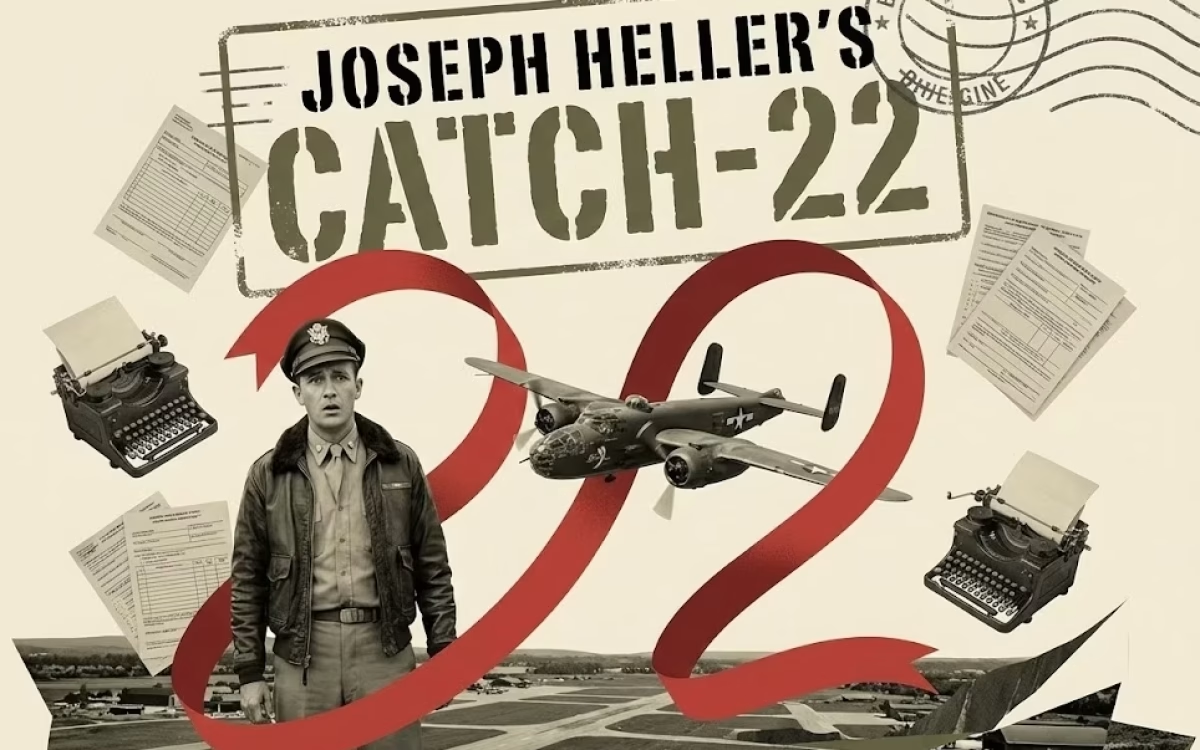
A Catch-22 is a “no-win situation”—a paradox where escaping a problem is impossible because of conflicting rules or conditions. The term itself has become part of everyday language, symbolising life’s frustrating contradictions. Interestingly, it originated not from a dictionary but from the title of Joseph Heller’s groundbreaking 1961 novel Catch-22.
Published in the post–World War II yet pre-Vietnam era, Catch-22 reshaped how Americans viewed war. Instead of portraying soldiers as heroic figures, Heller exposed the absurdity, bureaucracy, and psychological toll of military life. His novel made readers laugh, shudder, and think deeply about the machinery of war and the madness of survival.
It’s worth noting that Catch-22 is often confused with J.D. Salinger’s The Catcher in the Rye—but make no mistake, Heller’s Catch-22 is its own satirical beast, far darker and more chaotic in its critique of institutional logic.
Quick Summary: Catch-22
Catch-22 (1961) is a satirical war novel by Joseph Heller set during World War II. It follows Captain Yossarian, a U.S. Army Air Forces bombardier stationed in Italy who is desperate to survive the war. The novel is famous for its nonlinear storytelling and the concept of the “Catch-22″—a paradoxical bureaucratic rule that states a pilot is considered insane if he keeps flying combat missions, but if he asks to stop, he is proven sane and therefore must keep flying.
Joseph Heller’s Catch-22: Plot Summary
Catch-22 unfolds in a deliberately chaotic, non-linear narrative that jumps back and forth in time. This fragmented structure mirrors the confusion and absurdity of war itself. Readers are often thrown between flashbacks and current events, slowly piecing together the grim puzzle of Captain John Yossarian’s life in the U.S. Air Force.
The novel is set on the small Italian island of Pianosa during World War II. Yossarian’s squadron is tasked with bombing enemy targets across Italy and beyond. However, their commanding officer, Colonel Cathcart, keeps raising the number of missions required before the men can go home. Each time they get close to finishing, the bar moves higher—a perfect real-world example of the “Catch-22” trap.
At the heart of it all is Yossarian, whose only goal is simple: stay alive. He feels surrounded by threats—enemy fire from the Germans and suffocating bureaucracy from his own officers. In a world where logic fails and the system feeds on madness, survival becomes an act of rebellion.
The story builds toward the haunting “Snowden” scene, revealed near the end of the novel, where Yossarian witnesses the brutal, senseless death of a fellow airman. In that moment, he fully grasps the horrific truth of war: it is not noble but monstrously indifferent.
In the novel’s conclusion, Yossarian makes a radical choice. Instead of continuing the war or conforming to insanity, he deserts his post, leaping into a raft bound for Sweden. His escape marks both a rejection of institutional madness and a desperate affirmation of life.
“The only way to understand the trap is to read the book. (But once you read it, you’ll see the trap everywhere.)” [Buy on Amazon]
Joseph Heller’s Catch-22: Character Analysis
Joseph Heller’s Catch-22 is filled with soldiers, officers, and opportunists who together create a darkly comic portrait of war’s insanity. Each character reflects a different form of irrationality—whether it’s greed, fear, or sheer incompetence.
Yossarian: The Anti-Hero
Captain John Yossarian is far from the traditional war hero. He’s not brave or patriotic in the expected sense; instead, he’s terrified and self-preserving. His only ambition is to stay alive. Paranoid yet perceptive, Yossarian understands the futility of the missions and the madness of military logic. In a world where everyone else seems blind to absurdity, his fear becomes a form of sanity. Yossarian ultimately represents the individual’s struggle to remain humane when surrounded by institutional chaos.
Milo Minderbinder: The War Profiteer
Perhaps the most absurd figure in the novel, Milo Minderbinder turns war into a business. As an entrepreneurial mess officer, he creates a vast syndicate where “everyone has a share”. His obsession with profit reaches satirical extremes—he even bombs his own squadron because it’s economically beneficial. Through Milo, Heller exposes the exploitation and moral bankruptcy of capitalism when applied to warfare.
Major: The Bureaucratic Blunder
Major Major’s life is defined by a joke—his name and his meaningless promotion. He becomes a major merely because of his unfortunate name, not his ability. Overwhelmed by the absurdity of his position, he avoids human contact and spends his time hiding in his office. Major Major personifies Heller’s critique of bureaucratic incompetence and the dehumanising structures of power.
Snowden: The Dying Truth
Snowden appears briefly, yet his death carries the novel’s most haunting message. During a mission, Yossarian tries to save him, only to discover the horrifying fragility of the human body beneath the uniform. “Man is matter,” Snowden’s secret reveals—a stark reminder that beneath ideology, politics, and absurd heroism lies raw, mortal flesh. His death crystallises Yossarian’s disillusionment with war and fuels his rejection of its madness.
Joseph Heller’s Catch-22: Critical Themes
Joseph Heller’s Catch-22 explores the chaos of war not through glory or heroism, but through absurd contradictions that expose the darker side of logic, authority, and faith. Each theme challenges the reader to see the insanity behind systems that claim to make sense.
The “Catch-22” Paradox
At the heart of the novel lies the famous Catch-22—a paradox that traps its victims in circular reasoning. The rule says: you have to be crazy to keep flying dangerous combat missions. But if you refuse to fly because you fear for your life, that proves you’re sane. Therefore, you must fly. There’s no escape.
This twisted logic perfectly mirrors modern life. We see “Catch-22s” everywhere—from corporate policies that punish initiative to government systems that bury people under contradictory forms and red tape. Heller’s paradox isn’t just military satire—it’s a timeless critique of how human institutions preserve their own madness under the guise of order.
The Absurdity of Bureaucracy
In Catch-22, bureaucracy reduces men to mere names on paper. Officers obsess over reports, missions, and numbers while ignoring human realities. The tragedy becomes farcical when Doc Daneeka is declared dead in official records and can’t convince anyone he’s alive. Meanwhile, truly dead men continue to exist in files and statistics.
Heller exposes how bureaucracy does more than create confusion—it erases identity. By prioritising forms over lives, it turns morality into a checkbox exercise, replacing empathy with efficiency.
Loss of Religious Faith
Yossarian’s moral and spiritual disillusionment deepens as he questions the logic of divine creation. His bitter debates about a God who invented tooth decay, disease, and phlegm reveal an anguished awareness of life’s randomness. In Heller’s world, faith offers no comfort—only irony.
This loss of belief parallels Yossarian’s rejection of all institutions—military, governmental, or religious. He discovers that survival depends not on obedience or faith, but on the courage to defy a system built on contradictions.
“Joseph Heller isn’t the only author to challenge the American Dream.
Compare this with our analysis of [Death of a Salesman] to see different sides of the American experience.”
Joseph Heller’s Catch-22: Literary Style
Joseph Heller’s Catch-22 stands out not only for what it says about war but also for how it says it. His literary style blends biting satire, dark humour, and deliberate repetition to capture the absurdity of military life and human contradiction.
Satire and Dark Humour
The novel’s trademark is its unsettling humour—moments that make readers laugh and then immediately reconsider why they are laughing. Heller’s satire targets the mindless bureaucracy and moral detachment of war. A striking example is the “man in white”, a hospital patient completely bandaged, anonymous, and forgotten—both tragic and absurd. Through such scenes, Heller uses comedy as a mirror reflecting the cruelty and emptiness hiding behind official heroism.
Repetition and Circular Logic
Heller’s repetitive style reinforces the theme of entrapment. Phrases, conversations, and situations loop endlessly, mimicking the military’s circular thinking. Characters repeat nonsensical rules until they sound logical, trapping readers in the same confusion as Yossarian. Also, this stylistic repetition makes the narrative itself feel like a Catch-22—no escape, only reentry into the same madness.
With irony as his weapon and structure as his trap, Heller crafts a story that is as stylistically chaotic as the world it portrays.
Conclusion
Joseph Heller’s Catch-22 leaves readers with a haunting truth: in a world governed by madness, sanity itself becomes rebellion. Yossarian’s final act—paddling away toward freedom—symbolises the courage to refuse participation in a system built on absurdity.
Heller reminds us that sometimes the bravest thing a person can do is to say no—to step outside the rules, reject blind obedience, and choose life over conformity. Moreover, his message still resonates today in every workplace, government, or institution that values order over humanity. Refusing the madness, as Yossarian does, becomes not cowardice, but clarity—the only sane response to an insane world.
FAQS
What does the phrase Catch-22 mean today?
Today, Catch-22 describes any situation where you’re trapped by contradictory rules—no matter what you do, you can’t win. It’s used far beyond the military context, often to describe workplace bureaucracy, government red tape, or everyday paradoxes where logic defeats itself.
Why does Yossarian go to Sweden?
At the end of the novel, Yossarian chooses to desert and paddle to Sweden rather than keep flying missions. His decision symbolises moral courage—the refusal to participate in a deadly, senseless system. Sweden represents escape, sanity, and the possibility of freedom from the endless wartime loop.