Introduction
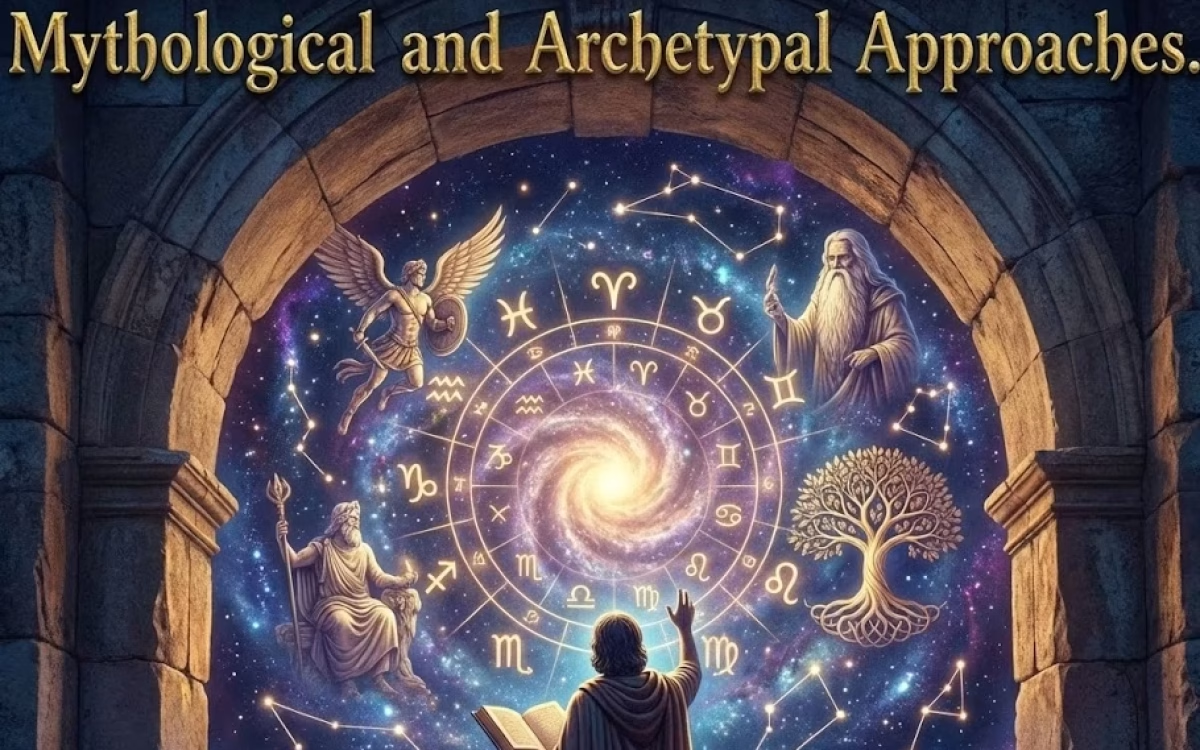
Mythological and Archetypal Approaches help us understand why we never tire of the same stories—whether it’s Harry Potter, Star Wars, or Greek myths. These tales may seem different on the surface, but they share universal patterns that speak to the human experience. Their power lies in repeating symbols and archetypes that reflect our deepest emotions and truths.
In Wilfred L. Guerin’s chapter on this approach, the word “myth” doesn’t mean a “fake story”. Instead, it refers to a timeless truth that connects literature to life. Myths reveal recurring themes—like the hero’s journey, the struggle between good and evil, or the search for identity—that resonate across cultures and generations.
This perspective builds a meaningful bridge between literature, anthropology, and psychology. It shows that stories are more than entertainment; they’re mirrors of the human psyche and the collective memory of civilisation. By studying these patterns, we discover how ancient myths continue to shape modern storytelling.
Quick Summary: Mythological & Archetypal Approach
The Mythological and Archetypal Approach looks for universal patterns, symbols, and characters that recur across literature from all cultures and eras. Heavily influenced by the psychology of Carl Jung and the anthropology of James Frazer, it argues that all great literature stems from the “Collective Unconscious”—a shared reservoir of human memory. Unlike Freud (who focuses on the individual), this approach focuses on the Archetype (e.g., The Hero, The Quest, The Scapegoat) that speaks to all of humanity.
The Roots of the Theory (Key Thinkers)
The Mythological and Archetypal Approaches draw their foundation from early thinkers who explored how myths and symbols reflect human thought and cultural evolution. Two of the most influential figures in this development are James Frazer and Carl Jung.
James Frazer, in his monumental work The Golden Bough, studied ancient and primitive rituals across cultures. He discovered that almost every society shares a recurring myth—the idea of a “Sacrificial King” or “Scapegoat.” This figure is ritually sacrificed to ensure fertility, good harvest, or renewal. Frazer’s research revealed that these symbolic acts were not isolated customs but manifestations of a universal human pattern linking myth, religion, and nature.
Carl Jung, a pioneering psychologist, deepened this understanding by turning myth into a tool for studying the human mind. He introduced the concept of the Collective Unconscious, a kind of inherited racial memory shared by all humans. According to Jung, this unconscious layer contains Archetypes—recurring symbolic images or figures such as the Mother, the Wise Old Man, or the Hero. These archetypes appear in dreams, myths, and stories, expressing the shared emotional experiences of humanity.
Together, Frazer and Jung provided the intellectual roots of the mythological approach, linking ancient rituals with modern psychology. Their insights show that myths are more than old tales; they are reflections of the collective human soul.
“To truly master this approach, you need to read the book that defined the structure of literature. Northrop Frye’s Anatomy of Criticism is a dense but essential read for any serious scholar. [Buy Anatomy of Criticism on Amazon].”
Common Archetypal Characters
The Mythological and Archetypal Approaches identify several recurring character types, or archetypes, that appear across cultures and stories. These figures represent universal patterns of human behaviour and emotion.
The Hero: The central figure who undertakes a journey or quest, faces trials, and achieves transformation. Examples include Frodo Baggins in The Lord of the Rings and Arjuna in the Mahabharata.
The Scapegoat: A character who must suffer or die to cleanse the sins of the community. This archetype appears in the story of Jesus Christ and in Shirley Jackson’s “The Lottery.”
The Earth Mother: A nurturing symbol of fertility, growth, and compassion. She provides emotional and spiritual nourishment to others.
The Temptress: A seductive or distracting figure who leads the hero away from his path, as seen in Circe and Calypso from The Odyssey.
The Shadow: The darker aspect of the human psyche that embodies inner fears, guilt, and repressed desires—a key concept in Jungian psychology.
Each archetype plays a critical role in shaping narrative structure and emotional meaning. Understanding them helps readers see why certain characters—and their struggles—feel timeless.
Common Archetypal Images
The Mythological and Archetypal Approaches also focus on recurring images and symbols that carry deep cultural and psychological meanings. These archetypal images give stories emotional depth and spiritual resonance across time and tradition.
Water: Symbol of purification, birth, and renewal. It often represents the cycle of death and rebirth, as seen in rituals like baptism or in mythic floods that cleanse and recreate the world.
Sun: A source of creative energy and enlightenment. It embodies the Father principle, standing for vitality, clarity, and the triumph of light over darkness.
Colors: Each color holds symbolic power. Red suggests blood, passion, and vitality. Green conveys growth, hope, and renewal. Black symbolises chaos, mourning, or death.
The Circle (Mandala): A universal symbol of wholeness and unity. It reflects the harmony of the self and the unending cycle of life, often used in spiritual and psychological imagery.
These recurring images function as a shared symbolic language across myth, religion, and literature. Recognising them allows readers to uncover hidden meanings and emotional connections within texts.
Northrop Frye and the Seasonal Cycle
Within the Mythological and Archetypal Approaches, Northrop Frye provides one of the most influential frameworks for understanding how literature mirrors natural and human cycles. In his work Anatomy of Criticism, Frye connects literary genres to the four seasons of nature, showing how each reflects a stage in the eternal rhythm of life, death, and renewal.
Spring – Comedy: Associated with birth, revival, and renewal. Spring represents the triumph of life over the sterility of winter. In literature, comedies often end with reconciliation, marriage, or communal harmony, symbolising new beginnings.
Summer – Romance: The season of maturity, fulfillment, and heroic quests. Summer embodies vitality and power, often seen in adventure tales or idealized worlds where good conquers evil.
Autumn – Tragedy: A time of decline, decay, and loss. Tragedy mirrors the fall of the hero, the fading of strength, and the inevitability of death. It reveals the fragility of human greatness.
Winter – Irony and Satire: The season of coldness, death, and disillusionment. In this phase, literature turns critical and realistic, exposing chaos, corruption, or moral decay.
Frye’s seasonal cycle shows that stories move in harmony with natural rhythms, reflecting the psychological and spiritual patterns of human life. According to Guerin, understanding these symbolic correspondences is essential for interpreting literature through the mythological lens.
Difference Between Psychological (Freud) and Archetypal (Jung)
Students often confuse the Psychological and Archetypal approaches because both link literature to psychology—but they focus on very different levels of the human mind.
Freud’s Psychological Approach examines literature as an expression of an individual author’s neuroses and subconscious desires. It is micro-level, interpreting symbols as projections of personal guilt, repression, or wish-fulfillment. For example, a character’s fear or obsession might reflect the writer’s unresolved emotions. Freud’s analysis centres on the personal unconscious—unique to each human being.
Jung’s Archetypal Approach, on the other hand, expands this view to a macro level. Carl Jung argued that beneath the personal psyche lies the Collective Unconscious, a shared psychic inheritance common to all humans. Here, recurring symbols—like the Hero, the Mother, or the Shadow—express universal human experiences rather than personal conflicts. Literature, therefore, becomes a bridge between individual imagination and humanity’s shared mythic memory.
In short, Freud focuses on the personal, while Jung focuses on the universal.
“While Jung looks at the collective history, [Sigmund Freud’s Psychological Approach] focuses on the individual’s hidden desires.”
Example Analysis: The Rime of the Ancient Mariner
Samuel Taylor Coleridge’s The Rime of the Ancient Mariner beautifully illustrates the Archetypal Approach.
The Albatross functions as the Scapegoat, carrying the burden of sin and guilt for the sailor’s community.
The voyage itself represents the Hero’s Quest, a journey of sin, suffering, realisation, and spiritual rebirth.
The vast water surrounding the Mariner symbolises the subconscious mind, where guilt and redemption unfold through deep emotional struggle.
Through Jung’s lens, the poem reflects universal patterns of fall and redemption rather than merely Coleridge’s personal anxieties.
Conclusion
The Mythological and Archetypal Approach helps us see literature not as a collection of isolated works, but as part of a unified human story. It reminds us that all great narratives—ancient myths or modern novels—grow from the same symbolic roots. These shared patterns reveal the emotional and spiritual connections that bind humanity across time and culture.
This approach also explains why certain stories move us so deeply, even when they come from worlds far different from our own. We respond because the symbols and archetypes within them—of love, loss, death, and rebirth—speak directly to the collective human experience. By studying these universal truths, we not only understand literature more fully but also discover something timeless about ourselves.
FAQS
What is the Collective Unconscious?
The Collective Unconscious, a concept introduced by Carl Jung, refers to the shared layer of the human psyche that stores universal symbols, images, and experiences. It is not individual memory but a common psychic inheritance that explains why people across cultures create similar myths and symbols.
What is the difference between myth and archetype?
A myth is a traditional story that expresses a society’s beliefs about the world, the divine, or human experience. An archetype, on the other hand, is a recurring symbol, character, or theme found within those myths.