Introduction
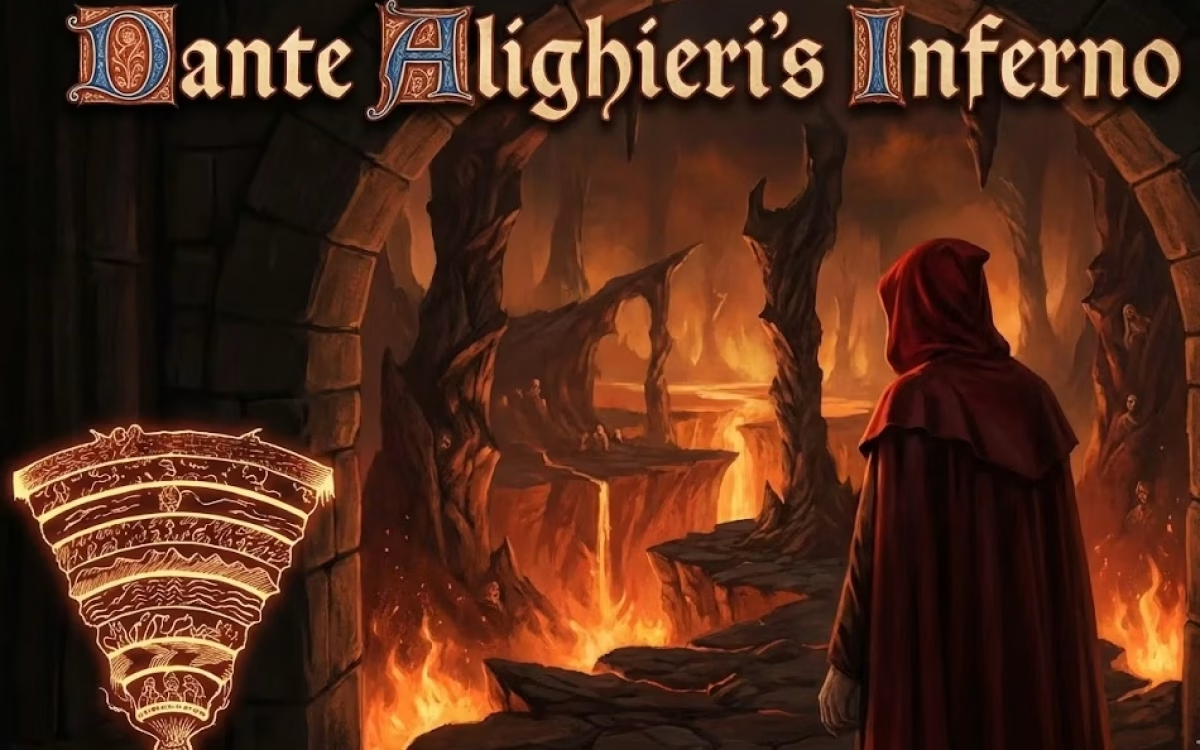
Dante Alighieri’s Inferno begins with one of the most haunting lines in world literature: “Abandon all hope, ye who enter here.” This chilling inscription welcomes readers into the gates of Hell, setting the tone for Dante’s journey through sin, punishment, and redemption.
Written during his exile from Florence, Inferno is both a spiritual quest and a deeply personal work of political revenge. Dante does not hesitate to place his real-life enemies in Hell, using poetic justice as his weapon. Each sinner’s torment reflects a divine logic, where punishment mirrors moral failure.
Yet, Dante Alighieri’s Inferno is not merely a tale of torture and suffering; it is a profound meditation on justice and divine order. Through vivid imagery and structured symbolism, Dante transforms his personal anguish into a universal vision of moral balance — reminding us that every act, good or evil, finds its rightful place in the grand scheme of eternity.
Quick Summary: Dante’s Inferno
The Inferno (Hell) is the first part of Dante Alighieri’s epic poem, The Divine Comedy (c. 1308–1320). It tells the story of Dante (the Pilgrim) who finds himself lost in a dark wood and is guided through the nine circles of Hell by the Roman poet Virgil. The poem is an allegory of the soul’s journey towards God, recognising and rejecting sin along the way. It is famous for the concept of Contrapasso—the idea that the punishment in Hell perfectly fits the crime committed on Earth.
The Concept of Contrapasso
Dante Alighieri’s Inferno introduces one of the most important ideas in the poem: the concept of contrapasso, which literally means “counter-suffering” or “suffering in return.” This term describes how every punishment in Hell is carefully designed to reflect, mirror, or perversely echo the sin committed during life.
“Dante wrote in medieval Italian, so the translator you choose changes everything. For students, I recommend the Allen Mandelbaum translation—it preserves the poetry but is easy to read. [Buy The Divine Comedy (Mandelbaum Edition)].”
What is contrapasso?
Contrapasso means “counter-suffering.” For example, the punishment mirrors or contrasts the sinner’s crime. Often, it does so in an ironic way. Importantly, it fits perfectly. Thus, random cruelty plays no role here. Instead, a moral law operates. Specifically, it ensures justice matches earthly choices.
In Dante Alighieri’s Inferno, this creates impact. For instance, Hell becomes a moral landscape. Every torment detail reveals the sin itself. Moreover, for exams, remember this key point. Contrapasso centres on divine justice. In short, it goes far beyond a stylistic device.
The logic: punishment mirrors sin
The logic of contrapasso follows a simple but powerful pattern: the soul’s eternal state is a continuation or revelation of its inner moral condition. In other words, the punishment “fits” the crime, either by imitating it, exaggerating it, or inverting it in a symbolic way.
This symmetry makes Dante’s Hell feel both harsh and ordered, showing that divine justice is precise rather than chaotic. For exams, you can phrase it as: in Inferno, the punishment is a symbolic extension of the sin, making Hell a pedagogical and ethical map of the human soul.
Example 1: The Lustful
In the second circle of Hell, the Lustful are blown forever by a dark, violent whirlwind. In life, they allowed themselves to be swept away by uncontrolled passions and desires; in death, they are literally swept away by an endless storm, never able to rest or control their movement.
This is a classic example of contrapasso because the storm dramatises the inner turbulence and lack of self-mastery that marked their earthly love. Famous figures like Francesca da Rimini and Paolo Malatesta are trapped in this wind, unable to anchor their love or their souls.
Example 2: The Fortune Tellers
In the eighth circle, among the fraudulent, the Fortune Tellers and false seers walk with their heads twisted backwards so that they can only see behind them. In life, they claimed to see too far ahead, pretending to know the future and violating the proper limits of human knowledge.
Their contrapasso makes this sin visible on their bodies: since they abused sight by looking forward unlawfully, they are now forced to look only backward for eternity. Their physical distortion teaches that trying to see what belongs only to God results in a permanent spiritual disfigurement.
The Geography of Hell (The 9 Circles)
Dante Alighieri’s Inferno depicts Hell as a meticulously structured funnel descending through nine circles, each punishing specific sins with increasing severity. This geography reflects divine justice, progressing from lesser failings to the gravest betrayals. Teacher’s tip: Memorise the progression for exams using this clear bulleted breakdown.
Vestibule: The Indecisive
Souls who never took a moral stand in life chase a meaningless banner eternally, stung by wasps and hornets while maggots feed on their blood. Their punishment fits their sin of neutrality—endless, purposeless pursuit without commitment.
Circle 1: Limbo (Virtuous Pagans)
Unbaptised but virtuous figures like Virgil, Homer, and Plato reside here in a dim castle of light, free from torment but sighing in eternal hopelessness. No physical pain exists, only the longing for God’s presence they never knew in life.
Circles 2-5: Sins of Incontinence
These upper circles punish lack of self-control:
Circle 2 (Lust): The lustful whirl in a violent storm, mirroring their surrender to passion.
Circle 3 (Gluttony): Gluttons lie in icy slush under ceaseless rain, like beasts wallowing in excess.
Circle 4 (Greed): Hoarders and spendthrifts clash massive boulders, divided by their obsession with wealth.
Circle 5 (Anger): Wrathful fight in the muddy River Styx; sullen gurgle beneath its surface.
City of Dis: Gateway to Lower Hell
A fortified city marks the transition to deeper sins, guarded by demons and the Furies. Here, infernal law hardens against those who knowingly reject God.
Circle 6: Heretics
Epicureans and doubters burn eternally in flaming tombs within Dis’s walls. Their denial of the soul’s immortality traps them in fiery denial of the afterlife.
Circle 7: Violence (Divided into Three Rings)
This jagged, ringed circle punishes harm to others, self, or God:
Ring 1 (Against Neighbours): Murderers boil in a river of blood; tyrants endure it deepest.
Ring 2 (Against Self/Suicide): Suicides twist as gnarled trees, torn by Harpies; prodigals race chased by hounds.
Ring 3 (Against God/Blasphemy): Blasphemers burn in a fiery desert; sodomites and usurers run on hot sands under falling flames.
Circles 8-9: Sins of Fraud and Malice
Malebolge (Circle 8) features ten ditches for fraudsters using intellect to deceive—panderers, flatterers, simoniacs, thieves, and liars face tailored torments like pitch baths or serpentine transformations. These sins corrupt God’s gift of reason.
Circle 9: Treachery (Cocytus)
The frozen lake at Hell’s bottom encases traitors in ice, the coldest punishment for perverted love:
Traitors to kin, country, guests, and lords occupy deepening zones.
At the centre, Satan chews Judas (betrayer of Christ), Brutus, and Cassius (betrayers of Caesar), his massive wings freezing the lake further. This icy core inverts Hell’s expected fire, symbolising ultimate lovelessness.
“Dante fills his Christian Hell with Greek monsters like Minos and Medusa. Check out our guide on [Mythological Approaches to Literature].
Key Characters
The key characters embody universal human experiences and philosophical ideas, guiding the narrative’s exploration of sin and redemption.
Dante (The Pilgrim)
Dante himself serves as the protagonist, representing Everyman or the wandering human soul on a journey of moral awakening. He begins terrified and pitying the damned but gradually hardens against sin, symbolising personal growth through confrontation with evil.
Virgil
The Roman poet Virgil acts as Dante’s guide through Hell, embodying human reason and classical wisdom. He leads Dante with authority and insight but cannot ascend to Purgatory or Heaven, limited by his pre-Christian status.
Beatrice
Beatrice Portinari, Dante’s idealised love, represents divine love and revelation from Heaven. She initiates the journey by sending Virgil to rescue Dante from his “dark wood,” highlighting grace’s role in transcending reason alone.
Literary Devices
Dante Alighieri’s Inferno masterfully employs literary devices that elevate its moral and structural depth, making it a cornerstone of allegorical poetry.
Allegory
Every character, place, and event in Inferno functions as an allegory, representing abstract ideas like sin, virtue, or divine justice. Dante the Pilgrim embodies the struggling human soul; Hell’s circles symbolise the soul’s descent into moral corruption; and figures like Virgil stand for human reason guiding imperfect mortals.
Terza Rima
Dante invented terza rima, a interlocking rhyme scheme (ABA BCB CDC DED), to propel the narrative forward while mirroring the Holy Trinity’s unity-in-three. This flexible form creates momentum through Hell’s descent, with each tercet linking to the next, symbolising the interconnectedness of sin, justice, and redemption.
Conclusion
Dante Alighieri’s Inferno culminates in a triumphant exit. For instance, Dante and Virgil climb down Satan’s massive, hairy body. They emerge on the opposite side of the globe. Meanwhile, Satan stays frozen and oblivious. He chews eternally on his victims. In contrast, the travellers see the stars again. This moment symbolises hope. It also signals the dawn of Purgatorio. Ultimately, this harrowing journey through darkness ends with light. Therefore, it underscores redemption’s possibility.
However, Inferno forces readers to confront harsh truths. Specifically, it reveals the ugly consequences of unchecked actions. Thus, Dante transforms personal failings into a mirror. This mirror reflects universal moral reckoning. Moreover, through contrapasso and divine order, justice prevails. As a result, the poem urges self-examination. In short, it warns us before eternity claims its due.
FAQS
Who guides Dante through Hell?
Virgil, the ancient Roman poet and author of the Aeneid, guides Dante as the embodiment of human reason and classical wisdom. Sent by Beatrice, Virgil leads him through the infernal circles but cannot proceed beyond Hell due to his pagan status.
What does the Dark Wood symbolise?
The Dark Wood at Inferno's opening represents the soul's entanglement in sin, moral confusion, and spiritual lostness. Dante awakens midway through life, lost in this tangled wilderness, symbolizing the crisis that prompts his redemptive journey.