Introduction
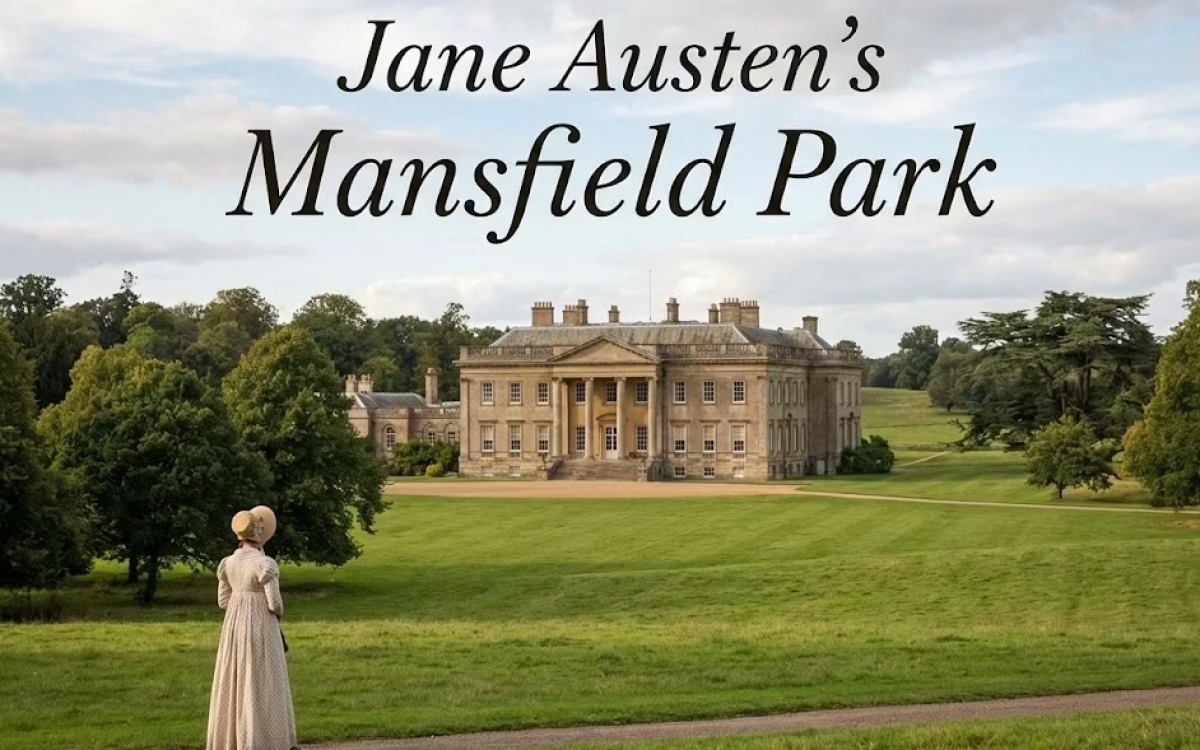
Jane Austen’s Mansfield Park divides readers like no other of her novels. Most people adore Pride and Prejudice for its sparkling wit and confident heroine, yet they struggle with Mansfield Park because Fanny Price seems the very opposite—a quiet, morally rigid observer rather than a charming rebel. This stark contrast is no accident. Austen crafted Fanny as an “anti‑Elizabeth”, a moral compass in a world that prizes charisma over conscience.
Written during a period of deep moral anxiety in early nineteenth‑century England, the novel marks Austen’s shift from romantic storytelling to ethical exploration. Instead of simply celebrating marriage or social success, she confronts readers with questions of integrity, virtue, and moral steadiness. Mansfield Park is not a tale about finding the perfect husband; it is about finding one’s moral centre amidst temptation, vanity, and societal confusion.
Quick Summary: Mansfield Park
Published in 1814, Mansfield Park is Jane Austen’s most serious and mature novel. It tells the story of Fanny Price, a poor girl sent to live with her wealthy relatives, the Bertrams, at their estate, Mansfield Park. Unlike other Austen heroines, Fanny is shy, physically weak, and morally rigid. The novel contrasts the quiet, traditional values of Mansfield Park with the sparkling but shallow modernity of the London visitors, the Crawfords. It is a study of moral integrity, the corruption of city life, and the stability of the English home.
Plot Summary: The Three Acts
Act I – The Arrival
Jane Austen’s Mansfield Park opens with young Fanny Price’s arrival at the grand Mansfield Park estate. Taken in by her wealthy relatives, the Bertrams, she quickly learns her lowly status. Her Aunt Norris, embodying the “evil aunt” archetype, constantly reminds her of her inferiority, while her cousin Edmund alone treats her with kindness and compassion. This early bond between Fanny and Edmund becomes the moral and emotional core of the story.
Act II – The Disruptors and Theatricals
The quiet moral order of Mansfield Park begins to falter with the arrival of two new figures from London—Mary and Henry Crawford. The Crawfords are witty, cosmopolitan, and subtly corrupting influences in the genteel Mansfield circle. Their charm unsettles established relationships and tempts even Edmund’s principles. The crisis deepens when the younger residents decide to stage a risqué play, Lovers’ Vows, while Sir Thomas Bertram is away. The theatricals act as a moral turning point, exposing hidden desires and testing Fanny’s quiet integrity against a wave of impropriety.
Act III – The Scandal and Resolution
When Sir Thomas returns, the play is abruptly halted, but the moral cracks remain. Henry Crawford’s flirtations lead to ruin when he runs away with the married Maria Bertram, shocking society and disgracing the Bertram family. Through the chaos, Fanny’s steadfast morality becomes the novel’s anchor. She alone resists Henry’s advances and remains true to her conscience. In time, Edmund recognises Fanny’s quiet strength and marries her, restoring both moral and emotional balance to Mansfield Park.
Character Analysis
Fanny Price: The Christian Heroine
At the heart of Jane Austen’s Mansfield Park stands Fanny Price, one of Austen’s most misunderstood heroines. Unlike the vibrant Elizabeth Bennet, Fanny is quiet, observant, and morally steadfast. Her power lies not in action but in resistance. She refuses to bend when others around her chase pleasure, vanity, or social approval. In a world obsessed with charm and status, Fanny’s strength is spiritual. She embodies the “Christian heroine” ideal, finding dignity and meaning through conscience rather than charisma.
Mary and Henry Crawford: Style over Substance
Mary and Henry Crawford bring wit, allure, and the seductive glow of urban sophistication to the rural world of Mansfield Park. They are as entertaining as they are dangerous. Like Elizabeth Bennet, they sparkle in conversation and thrive on social excitement—but unlike her, they lack a moral compass. Their cleverness masks emotional emptiness, and their eventual downfall underscores Austen’s critique of charm unanchored by virtue.
Sir Thomas Bertram: The Flawed Patriarch
Sir Thomas is the stern head of the Bertram household—a man more concerned with order, property, and duty than emotional warmth. His long absences and moral blindness allow corruption to seep into his home. Yet, by the novel’s end, he comes to recognise the moral worth of Fanny and the failure of his own authority, symbolising a restoration of true order grounded in conscience rather than appearances.
Mrs Norris: The Cruel Guardian
If there is a true villain in Mansfield Park, it is Mrs. Norris. Cloaked in the guise of family responsibility, she delights in cruelty and manipulation. Her treatment of Fanny exposes the hypocrisy of “moral” superiority built on social hierarchy. Through her, Austen critiques the self-righteousness of those who preach virtue but practise meanness—a timeless warning about moral hypocrisy within polite society.
“Is Fanny a weak woman or a strong resister of patriarchy? See how [Feminist Approaches to Literature] would analyse her refusal to marry for money.”
Major Themes
The Theatricals: The Morality of Acting
One of the most misunderstood episodes in Jane Austen’s Mansfield Park is the attempted amateur play, Lovers’ Vows. Modern readers often wonder why acting was considered so scandalous. In Austen’s world, “acting” did not mean simple performance—it meant pretending to be someone else, expressing emotions inappropriate to one’s station or relationship. The young people use the play as an excuse for flirtation and moral boundary‑breaking. For Austen, this becomes a powerful symbol: when truth is replaced by appearance, the moral order collapses. The theatricals expose the characters’ inner weaknesses and test whether they can maintain sincerity in a world of pretence.
City vs. Country: Corruption and Tradition
A major moral contrast runs throughout Mansfield Park: London versus the countryside. London, represented by the Crawfords, embodies glamour, wit, and ethical instability. The city distracts through performance, pleasure, and self‑interest. Mansfield Park, meanwhile, represents the traditional English estate—a world of stability, duty, and moral continuity. Yet Austen does not idealise the country entirely; she instead uses the tension between city and country to explore how external refinement often masks internal decay.
Ordination and the Role of the Clergy
Religion and morality lie at the heart of the novel’s debates. Mary Crawford mocks the idea of Edmund becoming a clergyman, dismissing it as dull and socially insignificant. For Austen, however, the clergy represents the moral backbone of English life—anchoring community through sincerity, service, and restraint. Edmund’s ordination symbolises his moral integrity, while Mary’s scorn reflects a society drifting from spiritual values toward worldly ambition.
The “Antigua” Controversy: A Postcolonial Reading
For advanced readers, one of the most striking silences in Jane Austen’s Mansfield Park concerns Sir Thomas Bertram’s business in Antigua. His wealth—and Mansfield’s elegance—depend on slave plantations in the British West Indies. This detail is mentioned only briefly, yet it has inspired extensive postcolonial critique.
Edward Said, in Culture and Imperialism, argues that the calm moral world of Mansfield Park rests on the violence and exploitation of the colonial system. The silence of both Fanny and the narrator reflects the silence of English society about its links to slavery. In this way, the novel’s moral order stands on fragile ground. The peace of Mansfield Park is bought at the cost of suffering far beyond its tranquil estate.
“To fully understand the ‘Antigua’ controversy and the historical context of the slave trade, I recommend the Norton Critical Edition. It includes the text plus essays by Edward Said and other critics. [Buy Mansfield Park (Norton Critical Edition)].”
Conclusion
Jane Austen’s Mansfield Park is not an easy novel, and that is precisely its strength. It forces readers to question their instincts. Do we prefer the “fun” and charming Crawfords, or the quiet, principled Fanny Price? Through this moral test, Austen shows how easily we confuse liveliness with virtue and brilliance with goodness.
*Mansfield Park* is far more than a love story. It stands as Austen’s boldest experiment in moral fiction. The novel challenges readers to look beyond wit, romance, and social grace to something deeper. It asks for the courage to act rightly, even when virtue is unfashionable. In Fanny’s quiet integrity, Austen reveals a powerful truth. Real strength lies not in rebellion or charm but in moral steadiness amid chaos.
FAQS
What is the significance of the play Lovers’ Vows?
The play Lovers’ Vows is more than a pastime; it represents the moral disintegration of the Mansfield household. By agreeing to “act,” the young characters symbolically blur the lines between performance and reality, propriety and indulgence. The play becomes a moral litmus test—showing how easily self‑restraint collapses when virtue is treated as a role rather than a principle.
Who is the outsider in Mansfield Park?
Fanny Price is the novel’s true outsider. Brought from a poor background into a world of privilege, she never fully belongs to either class. Her difference, however, gives her a sharper moral vision; standing on the margins allows her to see what others cannot. Through Fanny, Austen critiques the moral blindness of the comfortable elite and elevates humility as the seat of true virtue.