Introduction
WB Yeats’ The Second Coming: A Prophecy of Chaos and Rebirth
“Things fall apart; the centre cannot hold.” Why does every writer quote this haunting line from WB Yeats ‘The Second Coming’ whenever the world plunges into crisis?
Published in 1920, the poem captured the nightmare of 1919—a world reeling from the carnage of World War I, the deadly Spanish Flu pandemic that killed millions, and violent political revolutions from Russia to Ireland. Society felt like it was ending, with old certainties crumbling everywhere.
Yet WB Yeats ‘The Second Coming’ isn’t a doomsday dirge. Yeats draws on Christian apocalyptic imagery—the Book of Revelation’s rough beast slouching toward Bethlehem—not to herald the world’s destruction, but to foresee the violent birth of a new historical era, one shaped by anarchy and profound change.
Quick Summary
Written in 1919 in the aftermath of World War I, the Russian Revolution, and the dawn of the Irish War of Independence, “The Second Coming” is W.B. Yeats’ prophetic vision of a world collapsing. Instead of the Christian return of Jesus bringing peace, Yeats imagines a terrifying, Sphinx-like “rough beast” waking up in the desert to bring an era of chaos. The poem introduces Yeats’ mystical theory of the Gyre—a 2,000-year cycle of history that expands until it loses control and collapses, making way for a dark, new age.
The Concept of the “Gyre” in WB Yeats’ The Second Coming
What is Yeats’ Mystical Gyre?
In WB Yeats’ The Second Coming, the “gyre” forms the core of Yeats gyre theory—a mystical geometry drawn from his esoteric philosophy in A Vision. Picture a gyre as an interlocking spiral or widening cone, like two funnels spinning in opposite directions. Yeats saw these shapes as the blueprint of reality, governing everything from personal lives to vast historical cycles in Yeats poetry.
History’s 2,000-Year Cycles
Yeats believed history unfolds in roughly 2,000-year cycles, each marked by a gyre’s expansion and collapse. The Christian era, beginning with Jesus Christ around 1 AD, represented one such cycle—a narrowing spiral of faith and unity. By 1919, amid post-WWI devastation, that gyre had widened to its breaking point. Society’s spiral stretched too far, fracturing the old order and signalling the end of Christianity’s dominance in this Second Coming analysis.
The Falcon Metaphor: Chaos Unleashed
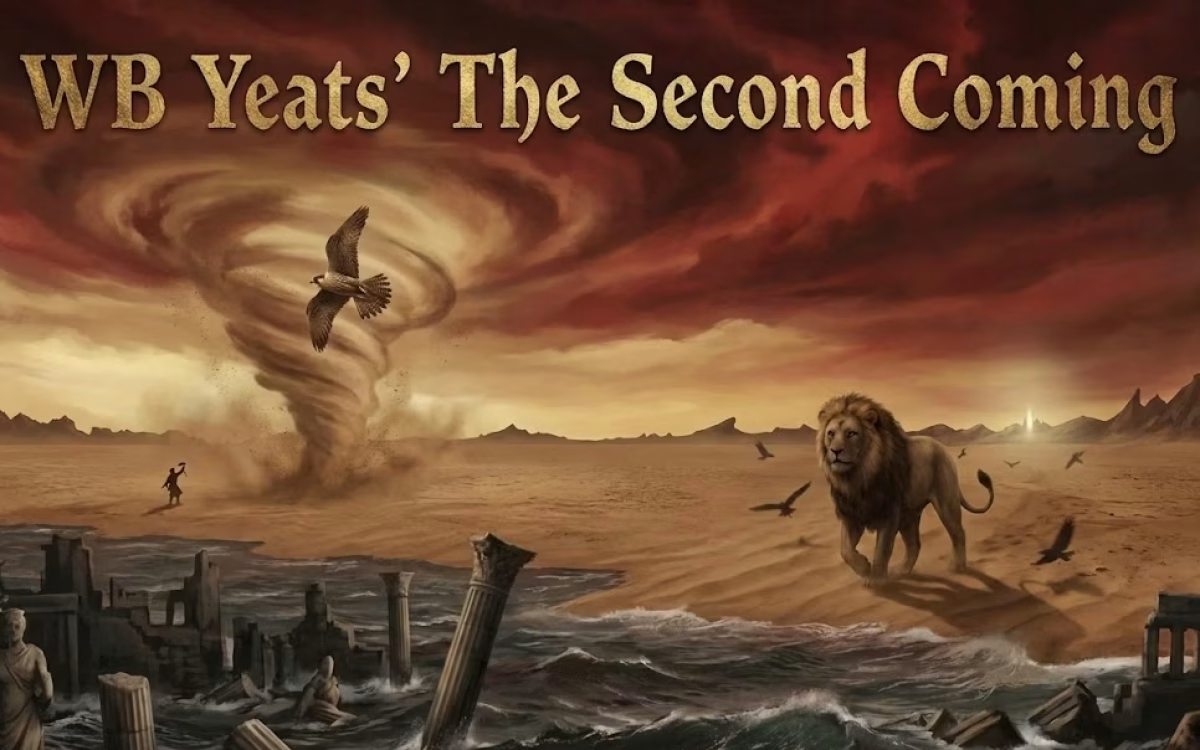
This gyre imagery explodes in the poem’s opening: “Turning and turning in the widening gyre / The falcon cannot hear the falconer.” The falcon symbolises humanity or society spiralling wildly out of control. The falconer—representing divine order, God, or authority—loses his grip as the bird flies too far. It’s a vivid metaphor for modern anarchy: when cycles peak, innocence shatters, and a new, rough beast emerges from the chaos.
“Yeats’ mystical theories are fascinating but complex. If you want to dive deeper into the poetry of this era, the [Norton Anthology of Modern Poetry on Amazon] is an essential resource for students.”
Stanza 1 Analysis: The Collapse of Order
Imagery of Chaos and WWI Horror
Stanza 1 of WB Yeats ‘The Second Coming’ plunges us into visceral chaos. “Mere anarchy is loosed upon the world, / The blood-dimmed tide is loosed, and everywhere / The ceremony of innocence is drowned.” These lines evoke a world unravelling—blood-soaked tides swallowing purity. Yeats channels the trenches of World War I, where mechanised slaughter drowned 1910s idealism. In this stanza 1 analysis, Yeats’ Second Coming imagery mirrors the Spanish Flu’s carnage and revolutionary bloodshed, painting a post-war nightmare where order dissolves.
The Loss of Morality: Best vs. Worst
Yeats sharpens his critique with this iconic line—
“The best lack all conviction, while the worst / Are full of passionate intensity.”
The “best” (thinkers, leaders, the refined) slump into apathy, drained by trauma. Meanwhile, the “worst”—fanatics, demagogues—surge with zeal, fueling extremism. This reversal captures 1919’s rise of totalitarianism, from Bolsheviks to fascists. Students, quote this in exams to dissect how Yeats anticipates 20th-century tyrants born from moral vacuum.
This stanza sets the gyre’s fracture, priming the poem’s apocalyptic turn.
Stanza 2 Analysis: The Rough Beast
The False Messiah – Subverting Expectations
Stanza 2 twists the title “The Second Coming”, priming readers for Christ’s return. Instead, Yeats unleashes a monstrous false messiah. “A vast image out of Spiritus Mundi / Troubles my sight,” he writes. This shift from salvation to horror marks the gyre’s inversion—Christianity’s end births something savage in this stanza 2 analysis.
Spiritus Mundi: Tapping Universal Memory
Spiritus Mundi—Latin for “Spirit of the World”—is Yeats’ term for a collective psychic reservoir, akin to Jung’s Collective Unconscious. It’s an ancient, shared memory bank of archetypes that floods the poet’s vision amid 1920s turmoil. Yeats draws from this well to foresee history’s next phase, blending mysticism with modern psychology in Yeats poetry.
“Yeats’ concept of the Spiritus Mundi—a giant vault of universal memories and symbols—is incredibly similar to theories developing in psychology at the exact same time. Read our guide to [Carl Jung and Archetypal Criticism] to understand this connection.”
The Sphinx Awakens: Pitiless and Blank
From desert sands emerges “a shape with the body of a lion and the head of a man”—a sphinx-like rough beast Yeats, slouching with “lion body” strength and human intellect. Pitiless eyes, “blank and pitiless as the sun,” it stirs from 2,000 years of slumber. This symbol evokes Egyptian antiquity, signalling pagan forces reclaiming a Christian world grown slack.
Bethlehem’s Dark Inversion
The beast slouches “towards Bethlehem to be born.” Jesus’ peaceful birthplace now hosts this terrifying force. Peace’s era crumbles; the beast’s violent reign dawns, fulfilling the gyre’s prophecy of cyclical upheaval.
Key Themes in WB Yeats’ The Second Coming
WB Yeats’ The Second Coming’packs profound ideas into its 22 lines. These key themes in The Second Coming capture modernist anxieties, blending history, society, and mysticism. Perfect for essays on Yeats cyclical history or 20th-century poetry.
Cyclical History vs. Linear Progress: Yeats rejects the Enlightenment myth of steady forward march. History spins in gyres—2,000-year cycles of birth, peak, and destruction. Christianity rose and widened to collapse; now a rough beast cycles in. Contrast this with linear optimism shattered by WWI.
Breakdown of Society and Lost Centre: “The centre cannot hold” diagnoses civilisation’s fracture. Traditional values—faith, morality, order—fail amid anarchy. The blood-dimmed tide drowns innocence, leaving the best passive and the worst fervent. Yeats warns of societal implosion without a binding core.
Prophecy and Mysticism as Visionary Warning: Yeats positions himself as seer, channelling Spiritus Mundi to prophesy. His occult system (A Vision) fuels this poem’s eerie foresight, predicting fascism, total war, and cultural shifts. In modernist poetry themes, it elevates the poet from observer to oracle.
These themes resonate today—from political polarisation to global crises—making Yeats timeless for analysis.
The Second Coming’s Massive Pop Culture Legacy
WB Yeats ‘The Second Coming’ transcends poetry—its lines echo across books, music, film, and news. This viral staying power drives endless searches for The Second Coming pop culture references; here’s why it endures:
Chinua Achebe’s Things Fall Apart: The Nigerian author’s 1958 masterpiece borrows “Things fall apart; the centre cannot hold” as its title. It mirrors Yeats’ chaos in colonial Igbo society, blending postcolonial themes with Yeats’ gyre for a global lit classic.
Joan Didion’s Slouching Towards Bethlehem: Didion’s 1968 essay collection nods to the “rough beast” slouching to birth. Her Haight-Ashbury dispatches capture 1960s counterculture’s dark underbelly, echoing Yeats’ prophetic warning of innocence drowned.
“This poem inspired the title of one of the most important post-colonial novels ever written. Read our summary and analysis of [Chinua Achebe’s Things Fall Apart].”
Conclusion
What makes WB Yeats’ The Second Coming so enduringly terrifying? It never names the “rough beast”. Fascism’s shadow in the 1930s? World wars’ mechanised horror? Technology’s cold advance? Or anarchy’s pure void? Yeats leaves this void blank, mirroring the sphinx’s pitiless gaze. This ambiguity, woven from gyre cycles and Spiritus Mundi visions, ensures the poem defies time—relevant from 1920 trenches to today’s polarised crises.
Yet amid dread, Yeats offers insight: history spirals, not progresses linearly. Societies fracture when centers fail, birthing extremes. As visionary poet, he warns us to reclaim conviction before beasts slouch nearer.
FAQS
What does the falcon represent in The Second Coming?
The falcon symbolises humanity or society spiralling out of control in Yeats' widening gyre. It flies too far from the falconer (God, order, or tradition), illustrating the breakdown of control in stanza 1.
What is the meaning of 'Spiritus Mundi'?
Spiritus Mundi means Spirit of the World—Yeats' collective unconscious, a universal memory of archetypes. In stanza 2, it births the rough beast vision, linking personal insight to historical prophecy.
Why does the beast slouch towards Bethlehem?
Bethlehem, Jesus' birthplace, ironically hosts the new era's monstrous birth. It signals Christianity's 2,000-year cycle ending, with the sphinx-like beast ushering cyclical destruction and rebirth.