
Introduction
Some plays land like a raindrop; others rumble in the landscape. Roots, the powerful heart of Arnold Wesker’s celebrated Wesker Trilogy, rolled onto the British stage in 1959 and has echoed in literary circles ever since. Born to a working-class Jewish family in London, Wesker’s pen never wandered far from the daily grind and emotional tumult he experienced firsthand: arguments at the dinner table, the scraping together of change, the relentless push for dignity. His dramas, especially Roots, aren’t mere stories—they’re windows thrown open onto the soul of working Britain in the throes of change.
Wesker’s plays, forged in the fires of his experience, burn with an authenticity that academic study can’t quite bottle. His trilogy—Chicken Soup with Barley, Roots, and I’m Talking About Jerusalem—charts the course of ordinary people struggling for purpose against a clattering world. Roots is often called the “kitchen sink” centerpiece, but that label only hints at the profound depth and subtle tenderness woven into its story.
Arnold Wesker’s Roots: The Play’s Genesis and Key Motifs
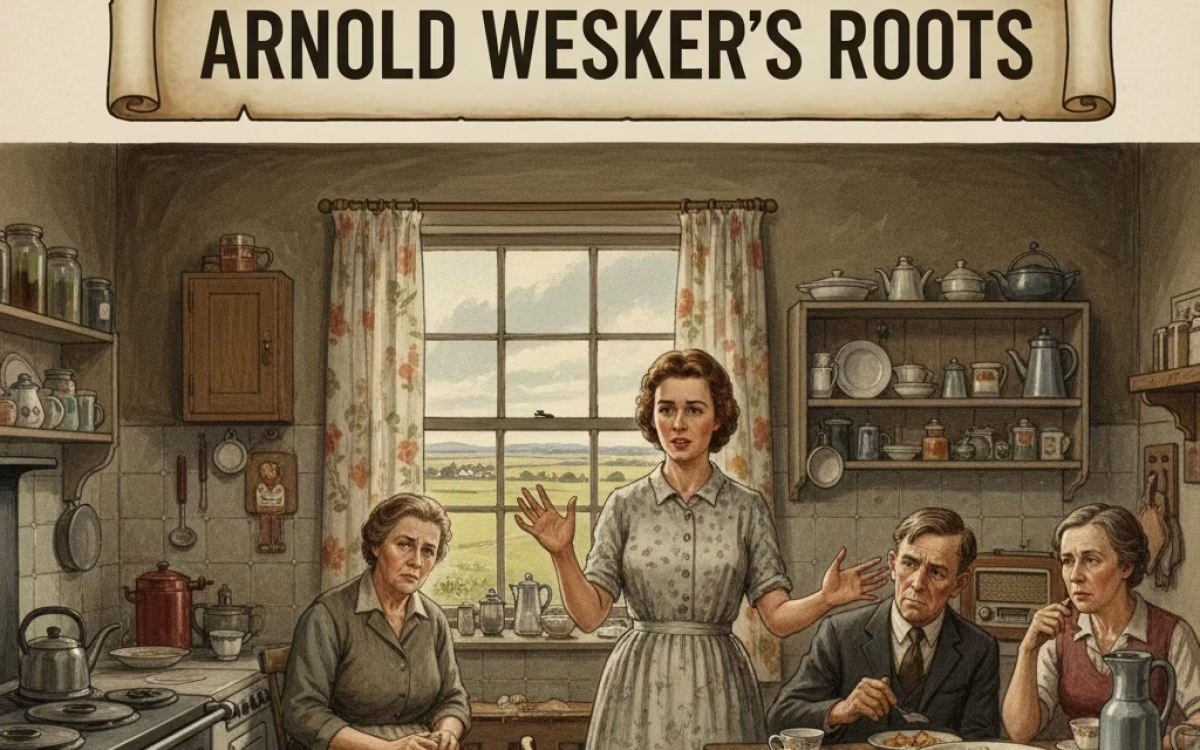
“Nothing grows in this house. Nothing but washing and talking and children and dirt and … nothing!” Wesker’s characters often lament their stagnation, trapped by their social surroundings as much as by physical walls. Roots lands in Norfolk, far from London’s dizzying lights, and zooms in on Beatie Bryant—a robust, vibrant young woman straddling the chasm between rural simplicity and urban aspiration. Her voice, uncertain and yearning, mirrors the voice of a generation desperate to matter.
The play brims with questions: Can art save us? Can education lift us beyond our class? What does it mean to find one’s voice when the world wishes you silent? Wesker threads these queries through the ordinary chatter and silent spaces of his characters’ lives. He sees drama in peeling potatoes and in the laughter shared around a battered kitchen table. FULL TEXT
The Working-Class Experience: Not Just Grit, but Poetry
Wesker’s love—sometimes exasperated, often fiercely protective—of the working class is evident in every line of Roots. He prescribes no grand revolutions, just slow, evolutionary change through education and dialog. Beatie’s awakening is as much intellectual as emotional, prompted by the influence of Ronnie, her London boyfriend, whose radical ideals unsettle her family’s complacency.
Modern Realist Drama: Shifting the Stage
The “kitchen sink” description is more than set dressing; it’s a manifesto. Wesker refuses to sugar-coat the daily grind or sentimentalize poverty. Instead, Roots shines a light on mundane heroism—the mother folding shirts, the father staring at the rain—and discovers poetry in these humble acts. This wasn’t just a new subject for English theatre; it was a new language—a Norfolk dialect full of turns, hesitations, and the flavor of real life.
Arnold Wesker’s Roots Analysis: Plot and Structure
Arnold Wesker Roots analysis must begin with Beatie Bryant—whose journey is as much about finding her own tongue as it is about reconciling her rural past with her future. The play’s three acts chart Beatie’s evolving relationship with her family, their traditions, and the absent yet omnipresent Ronnie.
Act One: Coming Home
Beatie, after a year in bustling London, returns home to Norfolk brimful of ideas and uncertainties. She finds her family unchanged, sunk in routines and wry acceptance. The gap between Beatie’s new ambitions and her family’s contentment is awkward and unspoken. Wesker captures it all with a string of subtly barbed conversations, heavy with things unsaid. Here’s a world where feeling too deeply or speaking too plainly is its own kind of rebellion.
Act Two: Education and Alienation
Beatie’s effort to “bring” London to Norfolk isn’t just comic fodder. She clutches at Ronnie’s ideals, awkwardly parroting big ideas to a skeptical family. The sense of alienation crackles—the more Beatie presses, the more her kin double down on their familiar silences. There’s wisdom in routine, her parents seem to say, but also a stifling dullness.
Act Three: Voice and Disappointment
The climax comes not in a dramatic explosion, but with a letter: Ronnie is leaving Beatie. The ground shifts under her feet. For the first time, Beatie speaks for herself, not as someone else’s mouthpiece. Her closing monologue—a blend of pain, shame, and newfound resolve—stands among modern drama’s most stirring declarations. Wesker’s talent glimmers here: transforming domestic heartbreak into something close to the epic.
Arnold Wesker’s Roots Themes: Personal and Political
The Fight for Voice
At its heart, Roots is about voice—how it’s found, lost, inherited, and forged afresh. Beatie’s journey from stammer to steady speech mirrors Wesker’s belief that real change is personal before it is political. Every conversation in the play is a tug-of-war for understanding—a microcosm of larger class struggles in post-war Britain.
Class, Culture, and Change
Wesker never lets the audience forget the play’s context. The Bryants’ kitchen is crammed with economic anxiety, cultural pride, and more than a little generational angst. The intrusion of fashionable “big city” ideas, often via Ronnie, challenges rural conservatism but also exposes its limits.
Gender and Family
The women of Roots are quick-witted, formidable, and quietly rebellious. Wesker gifts Beatie and her mother moments of sly humor and tenderness, but also sorrow. The play scrutinizes not only class oppression, but the ways tradition and society clip women’s wings.
The Kitchen as Battleground
Chores and chatter become sites of quiet resistance. The kitchen is a theatre—every pot scrubbed, every remark about “outsiders’ ideas” a skirmish in ongoing battles for respect and self-worth.
The Wesker Trilogy
While each play in the Wesker Trilogy stands alone, Roots is special for its focus on the interior life of a single character, filtered through Wesker’s own fond but critical eye. Unlike Chicken Soup with Barley‘s sweeping family politics or I’m Talking About Jerusalem‘s grander historical scale, Roots hones in on private transformation. EXPLORE MORE AUTHORS
Personal Insight
There’s a certain ache that settles in after reading Roots. The play has a stubborn relevance, not just as a document of its era but as a living, breathing portrait of how change takes root slowly—sometimes painfully—in family soil. Wesker, who saw drama as a pulpit for the ordinary, never forgets that beneath every political theory is a woman peeling potatoes and hoping for more.
What resonates most isn’t Beatie’s triumph (her road ahead is as uncertain as ever), but her refusal to slouch back into silence. Anyone who’s returned home, bursting with new ideas, only to find old chairs and old arguments, will find a bit of themselves in Beatie’s journey. Wesker, in his wry but compassionate way, makes that ache almost celebratory.
And can we talk about the dialogue? Natural, idiomatic, sometimes so close to everyday speech it feels eavesdropped rather than scripted. Roots doesn’t declaim its message; it lets it seep in, line by line, during the quiet moments between shouts. That technique—rare in any era—remains electrifying today.
Impact and Modern Relevance
Arnold Wesker’s Roots remains essential reading, not only for drama students and literature scholars but for anyone keen to understand how big ideas find purchase in small spaces. The realism, emotional heft, and radiant ordinariness of the play continue to spark stagings, discussions, and debates across the world.
Influence on Theatre
“Kitchen sink drama” might sound unglamorous, but Wesker and his contemporaries remade British theatre by centering real people’s problems, dreams, and disappointments. Roots showed that the struggles of ordinary women like Beatie could be just as dramatic—and just as vital—as kings and heroes.
Conclusion
Arnold Wesker’s Roots lingers in the mind not just for what it says, but for how it says it. The play is stubbornly local, yet endlessly universal; drab at first glance, yet shot through with poetry and fire. It’s a homage to all the Beaties who might never make history but who quietly, bravely, insist on mattering anyway.
In a time when the world shouts for big change, Roots whispers that revolution often starts at the kitchen table, over a cup of tea, with an ordinary woman daring—finally—to speak up.
Frequently Asked Questions
What is Arnold Wesker’s Roots about?
Roots follows Beatie Bryant, a young woman from rural Norfolk, as she returns home transformed by her experiences in London. The play dramatizes her awakening—from an uneducated, self-doubting daughter to an articulate woman who begins to challenge her family’s apathy and class limitations.
Why is Roots considered important in British theatre?
Roots is a cornerstone of the British “kitchen sink” movement. Through naturalistic dialogue and detailed domestic setting, it brought real working-class voices and concerns onto the stage, helping to redefine mid-century British drama by making the ordinary both vivid and meaningful.
Who are the main characters in Roots?
The key characters include Beatie Bryant (the protagonist), her boyfriend Ronnie (who does not appear but exerts profound influence), Beatie’s family members (Jenny, her sister; and her mother and father), all vividly drawn to underscore the play’s themes of class, gender, and generational change.
What are the main themes in Roots?
Major themes include class struggle, social disconnection, gender roles, the quest for self-expression, and the power of education. The play interrogates how ordinary people can become agents of change, even when facing economic hardship or family skepticism.
How does Roots fit into Arnold Wesker’s trilogy?
Roots is the second play in Wesker’s seminal trilogy, preceded by Chicken Soup with Barley and followed by I’m Talking about Jerusalem. While the other two plays focus more on family politics and social activism, Roots provides an intimate exploration of personal and collective discovery.