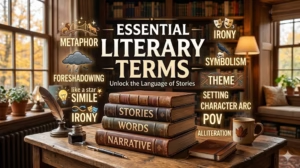
Introduction
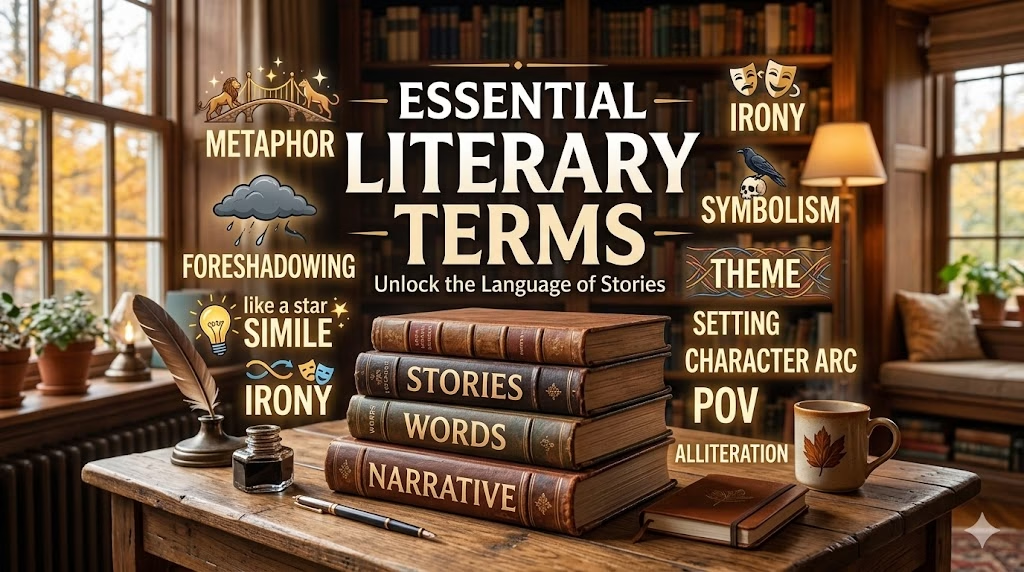
Every discipline has its own vocabulary. For instance, medicine uses complex Latin terms. Similarly, the law relies heavily on historical precedents. Likewise, literature demands its own essential literary terms. Consequently, without them, you cannot precisely analyse any text.
However, these terms are not simply boring exam jargon. Instead, they are powerful tools for deep textual analysis. Unfortunately, many students struggle with traditional academic glossaries. Typically, those lists are dry, scattered, and lack real examples.
Fortunately, this comprehensive guide completely solves that exact problem. Below, you will find the most essential literary terms. Specifically, we organised them clearly by category and function. Additionally, we provided concrete examples for each definition. Furthermore, each term connects directly to major literary movements. Ultimately, this glossary is perfectly prepared to help you for the UGC NET.
Quick Summary
Fundamentally, literary terms give readers the exact vocabulary to analyse complex texts. Specifically, these tools help students decode hidden meanings within any novel. For example, metaphors and similes directly compare two seemingly unrelated objects. Consequently, authors use them to create vivid, unforgettable imagery for their audience.
Furthermore, devices like foreshadowing actively build intense suspense throughout a narrative. Meanwhile, irony creates a sharp contrast between expectation and stark reality. Additionally, symbolism allows writers to represent profound ideas using physical objects. Ultimately, mastering these essential concepts transforms a casual reader into a critical scholar.
How to use this glossary:
|
Figures of Speech:
Figures of speech are the most fundamental of all essential literary terms. They appear in poetry, prose, and drama alike. Furthermore, they are the most frequently tested category in UGC NET’s direct-definition questions.
- Metaphor: An implicit comparison where one thing is described as being another, without using ‘like’ or ‘as’. Example: “All the world’s a stage” (Shakespeare, As You Like It).
- Simile: An explicit comparison using ‘like’ or ‘as’. Example: “My mistress’ eyes are nothing like the sun” (Shakespeare, Sonnet 130).
- Personification: Giving human qualities to non-human things, objects, or ideas. Example: “The wind whispered through the trees.”
- Hyperbole: Deliberate exaggeration for emphasis or effect, not meant literally. Example: “I’ve told you a million times.”
- Irony: A gap between what is expected and what actually happens, or between what is said and what is meant. Example: In Oedipus Rex, Oedipus seeks to escape a prophecy that he is already fulfilling – dramatic irony.
- Oxymoron: A figure of speech combining two contradictory terms. Example: “Sweet sorrow” (Shakespeare, Romeo and Juliet).
- Synecdoche: A figure of speech where a part represents the whole, or the whole represents a part. Example: “The White House announced…” (the building stands for the administration).
- Metonymy: Substituting the name of an object for something closely associated with it. Example: “The pen is mightier than the sword” (pen = writing; sword = military force).
- Alliteration: Repetition of initial consonant sounds in successive words. Example: “Peter Piper picked a peck of pickled peppers.”
- Assonance: Repetition of vowel sounds within nearby words. Example: “The rain in Spain stays mainly in the plain.”
- Onomatopoeia: Words that imitate the sound they describe. Example: “Buzz”, “hiss”, “clang”.
- Apostrophe (figure of speech): Addressing an absent person, abstract idea, or inanimate object as if it could respond. Example: “O Death, where is thy sting?” (1 Corinthians, echoed throughout the elegy).
Poetic Devices and Forms
Poetry has its own specialised vocabulary. These terms describe structure, sound, and form. Consequently, they appear constantly in UGC NET questions on poetry units.
- Iambic Pentameter: A line of verse with five feet, each an unstressed syllable followed by a stressed one (da-DUM). Example: Shakespeare’s sonnets and most blank verse drama use this metre.
- Enjambment: When a sentence or phrase runs over from one line of poetry to the next without a pause. Example: Common in Milton’s Paradise Lost and much of Romantic poetry.
- Caesura: A pause or break in the middle of a line of verse, often marked by punctuation. Example: “To be, or not to be: that is the question” (Hamlet) — the colon creates a caesura.
- Enjambed vs End-stopped Lines: An end-stopped line has a natural pause at its end (often punctuation); an enjambed line flows into the next. Example: Most Augustan couplets are end-stopped; Romantic blank verse is often enjambed.
- Sonnet: A 14-line poem, typically in iambic pentameter, in either Petrarchan (octave + sestet) or Shakespearean (three quatrains + couplet) form. Example: Shakespeare’s 154 sonnets; Wordsworth’s “The World Is Too Much With Us.”
- Elegy: A poem of mourning, typically for someone who has died. Example: Milton’s “Lycidas”; Tennyson’s “In Memoriam.”
- Ode: A formal, often ceremonious lyric poem addressing and often celebrating a person, place, thing, or idea. Example: Keats’s “Ode to a Nightingale”; Shelley’s “Ode to the West Wind.”
- Dramatic Monologue: A poem in which a single speaker, who is not the poet, addresses a silent listener, revealing their character. Example: Browning’s “My Last Duchess.”
- Free Verse: Poetry without a regular metre or rhyme scheme. Example: Walt Whitman’s “Song of Myself”; much of modernist poetry.
- Blank Verse: Unrhymed iambic pentameter. Example: Most of Shakespeare’s plays; Milton’s Paradise Lost.
Narrative Techniques and Fiction Terms
These essential literary terms describe how stories are told — who narrates, how time moves, and how perspective shapes meaning. They are crucial for analysing the novel and short story. Fundamentally, these essential literary terms describe how authors tell their stories. Specifically, they define who narrates the plot and how time moves. Furthermore, this vocabulary explains how narrative perspective completely shapes textual meaning. Consequently, mastering these concepts is absolutely crucial for your academic success. Ultimately, they help you deeply analyse any complex novel or short story.
- Stream of Consciousness: A narrative technique that presents a character’s continuous, unfiltered flow of thoughts and impressions. Example: Virginia Woolf’s Mrs Dalloway; James Joyce’s Ulysses.
- Unreliable Narrator: A narrator whose credibility is compromised, leading readers to question the accuracy of their account. Example: Salman Rushdie’s Saleem Sinai in Midnight’s Children.
- Stream of Time / In Medias Res: Beginning a narrative in the middle of the action, rather than at the chronological start. Example: Homer’s Odyssey begins years after the Trojan War ends.
- Foreshadowing: Hints or clues about events that will occur later in the narrative. Example: The witches’ prophecies in Macbeth foreshadow the entire plot.
- Bildungsroman: A novel that traces the moral and psychological growth of its protagonist from youth to adulthood. Example: Charles Dickens’s Great Expectations; James Joyce’s A Portrait of the Artist as a Young Man.
- Epistolary Novel: A novel written as a series of letters, diary entries, or documents. Example: Samuel Richardson’s Pamela; Bram Stoker’s Dracula.
- Frame Narrative: A story that contains another story (or stories) within it. Example: Chaucer’s The Canterbury Tales; Mary Shelley’s Frankenstein.
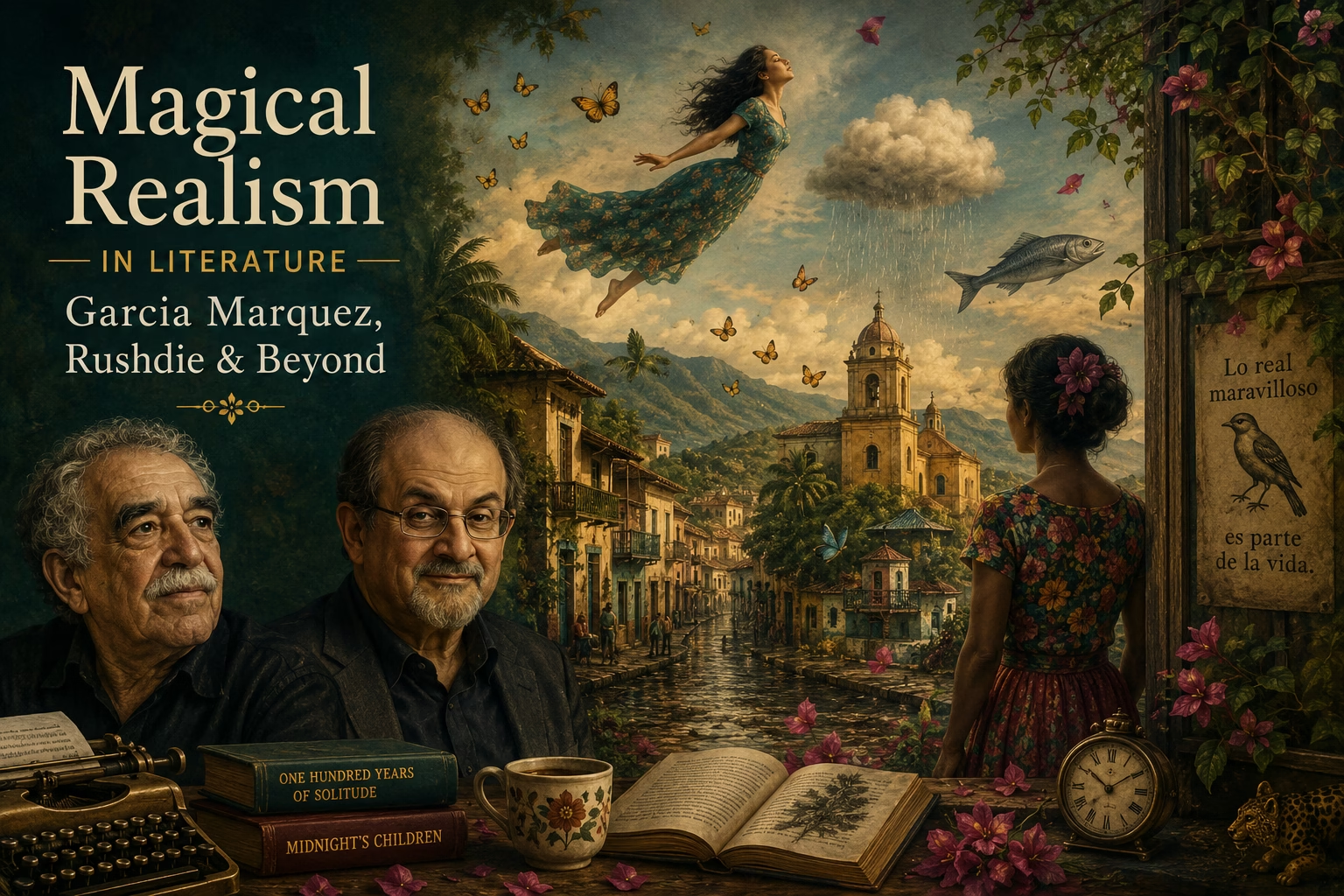
- Magical Realism: A narrative mode where magical events are presented as a normal part of an otherwise realistic world. Example: Gabriel García Márquez’s One Hundred Years of Solitude.
- Metafiction: Fiction that self-consciously draws attention to its own status as a constructed work. Example: Salman Rushdie’s Midnight’s Children; Laurence Sterne’s Tristram Shandy.
- Deus Ex Machina: An unexpected, contrived plot device that suddenly resolves a seemingly unsolvable problem. Example: A god descending to resolve the plot in classical Greek tragedy.
Drama and Theatre Terms
Drama has its own technical vocabulary, much of it inherited from Greek tragedy. These terms appear consistently across British, American, and World Drama units in UGC NET. Specifically, scholars inherited much of this foundation directly from Greek tragedy. Consequently, mastering these dramatic concepts unlocks a much deeper analysis of theatre. Furthermore, examiners consistently test these exact terms across multiple syllabi. For instance, they appear heavily throughout the British and American Drama sections. Additionally, World Drama units frequently feature this exact same vocabulary. Therefore, understanding these definitions guarantees higher marks on the UGC NET.
- Tragic Flaw (Hamartia): A character trait that leads to the protagonist’s downfall. Example: Othello’s jealousy; Macbeth’s ambition.
- Catharsis: The emotional release or purification experienced by the audience through pity and fear, as theorised by Aristotle. Example: The audience’s relief and reflection at the end of Oedipus Rex.
- Hubris: Excessive pride or self-confidence that leads to a character’s downfall. Example: Creon’s hubris in Sophocles’s Antigone.
- Dramatic Irony: When the audience knows something that the characters on stage do not. Example: The audience knows Oedipus has killed his father, long before he does.
- Soliloquy: A speech in which a character, alone on stage, reveals their inner thoughts to the audience. Example: “To be, or not to be” (Hamlet, Act 3, Scene 1).
- Aside: A short remark made by a character directly to the audience, unheard by other characters on stage. Example: Iago’s asides in Othello reveal his manipulative plans.
- Comic Relief: A humorous scene or character that provides a break from tension in an otherwise serious work. Example: The Porter scene in Macbeth, immediately after Duncan’s murder.
- Tragicomedy: A work that combines elements of tragedy and comedy, often with a bleak or ambiguous tone. Example: Samuel Beckett’s Waiting for Godot.
- Anti-hero: A central character who lacks the conventional qualities of a hero, such as morality or courage. Example: Look Back in Anger’s Jimmy Porter.
- Verisimilitude: The quality of seeming real or true, even within a fictional work. Example: Ibsen’s realist dramas aim for verisimilitude in depicting domestic life.
Critical Theory Terms
Critical theory is the highest-weightage unit in UGC NET English Paper 2. These essential literary terms come from major theoretical frameworks. Therefore, mastering these specific concepts is absolutely essential for your success. Specifically, these essential literary terms come directly from major theoretical frameworks. For instance, they form the foundational vocabulary for structuralism and postmodernism. Furthermore, each term links directly to a broader literary movement. Consequently, understanding this vocabulary helps you tackle complex exam questions effortlessly. Ultimately, you can explore these connected movements deeply in our other comprehensive guides.
- Defamiliarisation (Ostranenie): A technique, theorised by Russian Formalist Viktor Shklovsky, that presents familiar things in an unfamiliar way to renew perception. Example: Modernist fragmentation in T.S. Eliot’s The Waste Land.
- Intertextuality: The way texts reference, respond to, or are shaped by other texts. Example: Rushdie’s Midnight’s Children draws on Tristram Shandy and The Tin Drum.
- The Gaze: A concept describing how looking and being looked at involves relations of power, particularly explored in feminist and postcolonial theory. Example: Sartre’s concept of ‘the Other’s gaze’ in No Exit; Laura Mulvey’s ‘male gaze’ in film theory.
- Subaltern: A term from postcolonial theory, popularised by Gayatri Spivak, referring to populations excluded from structures of power and representation. Example: Spivak’s essay ‘Can the Subaltern Speak?’
- Double Consciousness: W.E.B. Du Bois’s concept describing the psychological experience of viewing oneself through the eyes of a society that devalues you. Example: Central to Harlem Renaissance literature; The Souls of Black Folk (1903).
- Bad Faith: Sartre’s term for the self-deception of denying one’s own freedom by hiding behind social roles. Example: Explored throughout Sartre’s Being and Nothingness and dramatised in No Exit.
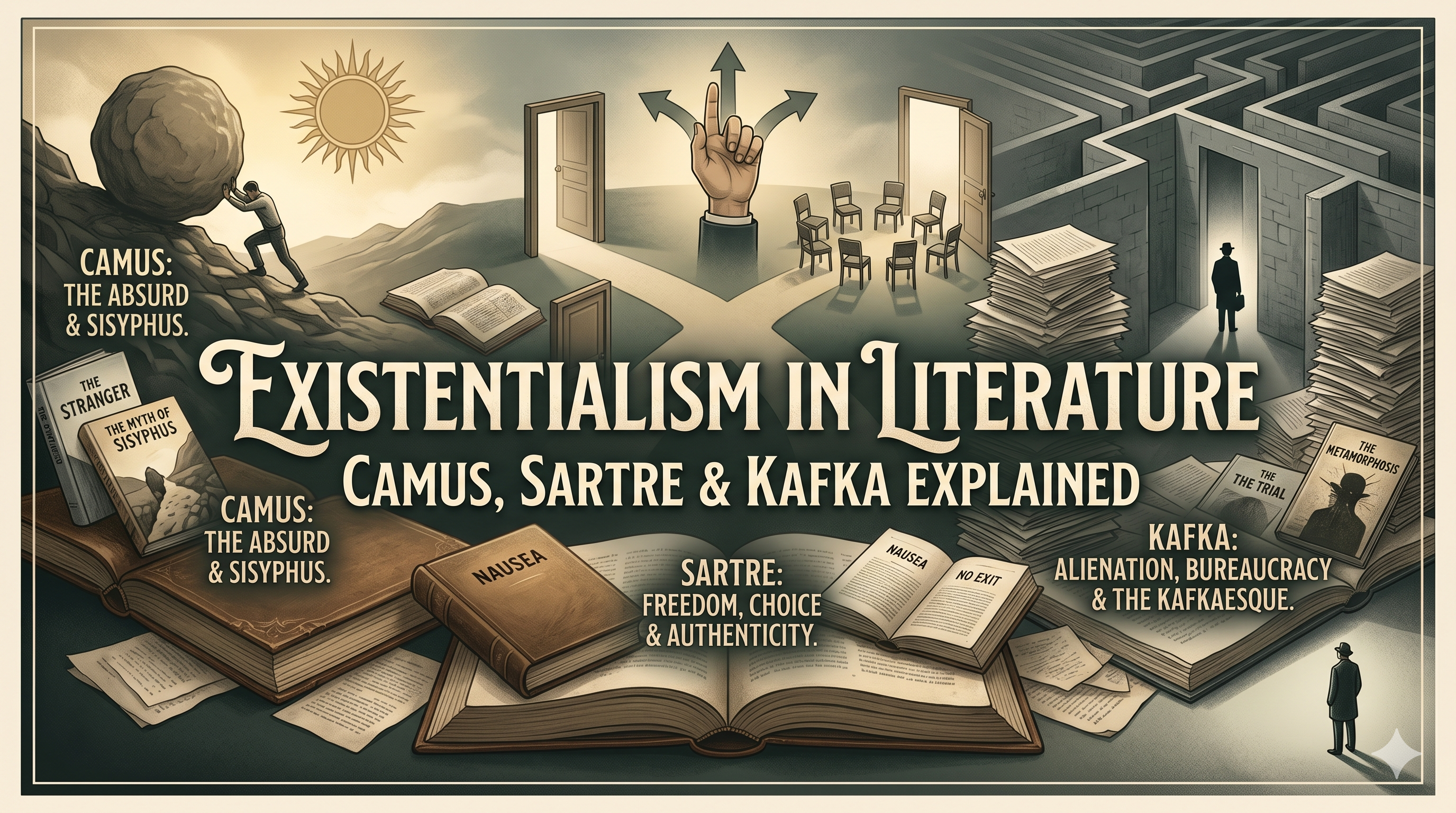
- The Absurd: Camus’s concept of the collision between the human need for meaning and the universe’s silence. Example: Camus’s The Stranger and The Myth of Sisyphus.
- Hegemony: Antonio Gramsci’s concept describing how a dominant group maintains power through cultural consent rather than force alone. Example: Used widely in postcolonial and Marxist literary criticism.
- Binary Opposition: A pair of related terms that are opposite in meaning, often structuring how meaning is produced (e.g., self/other, civilised/savage). Example: Central to structuralist and post-structuralist criticism; deconstructed by Derrida.
- Gynocriticism: Elaine Showalter’s term for the study of women as writers — their themes, genres, and literary traditions. Example: Applied to readings of Kamala Das and Shashi Deshpande.
What separates a casual reader from a top-tier literature scholar? 💡 It all comes down to the exact vocabulary you use to decode a text. If you want to confidently analyse complex narratives and uncover hidden meanings, you need these specific literary tools in your arsenal.
Dive into our complete, easy-to-read guide right here.
Commonly Confused Literary Terms: Side-by-Side Comparison
Some essential literary terms are frequently mixed up. UGC NET often tests these pairs directly. Therefore, the table below clarifies the most commonly confused terms side by side. Specifically, these subtle differences easily confuse even the most prepared scholars. Consequently, the UGC NET often tests these exact pairs directly. Furthermore, examiners use these tricky definitions to challenge your critical reading skills. Therefore, we created the detailed comparison table below for your convenience. Ultimately, this side-by-side breakdown clarifies the most commonly confused terms perfectly.
| Term Pair | Term 1 | Term 2 |
| Simile vs Metaphor | Simile: an explicit comparison using ‘like’ or ‘as’ — “Her eyes were like stars.” | Metaphor: an implicit comparison stating one thing IS another — “Her eyes were stars.” |
| Irony vs Sarcasm | Irony: a gap between expectation and reality, often unintentional or structural | Sarcasm: a deliberate, often cutting verbal remark intended to mock |
| Allegory vs Symbol | Allegory: an entire narrative where characters/events represent abstract ideas systematically | Symbol: a single object or image that represents an idea within a larger work |
| Connotation vs Denotation | Connotation: the emotional or cultural associations a word carries beyond its definition | Denotation: the literal, dictionary definition of a word |
| Tone vs Mood | Tone: the author’s attitude toward the subject, conveyed through word choice | Mood: the emotional atmosphere the reader experiences while reading |
| Stanza vs Verse | Stanza: a grouped set of lines in a poem, separated by space (like a paragraph) | Verse: a single line of poetry, or poetry in general as opposed to prose |
| Protagonist vs Antagonist | Protagonist: the central character whose goals drive the narrative | Antagonist: the character or force that opposes the protagonist |
Essential Literary Terms and UGC NET English: Exam Strategy
| UGC NET English — Exam Focus: Literary terms appear as direct MCQs across every unit of UGC NET English Paper 2 — not just literary theory. They test definitions, ‘match the following’ pairings, and applications to passages. Here is how to prepare: Most repeated terms in past papers:
Three-step preparation strategy:
Quick recall tip: group terms by category — figures of speech, poetic devices, narrative techniques, drama terms, and theory terms — rather than memorising an alphabetical list. Categories are easier to recall under exam pressure. |
You cannot decode complex narratives without the right dictionary. 📖 Stop relying on fragmented online definitions and get the definitive guide to literary terms. This exact reference book has been the secret weapon for top-scoring scholars for decades. Click here to reveal the title and grab your physical copy today.
Conclusion:
Essential literary terms are not a hurdle between you and literature. They are the language through which literature becomes legible. Without them, a poem is just words on a page. With them, you can see exactly how those words create meaning, feeling, and argument.
Ultimately, mastering these essential literary terms is absolutely crucial for your academic success. Specifically, this specialised vocabulary allows you to analyse complex texts with total confidence. Furthermore, you will easily recognise the hidden layers within any classic novel. Therefore, do not treat these devices as mere memorisation tasks for your exams. Instead, view them as powerful keys that unlock the true depth of literature. Finally, consistent practice with these tools will completely transform your critical reading skills.
Enjoyed this guide? Explore more on a2zliterature.com — including our complete guides on Modernism vs Postmodernism, Existentialism in Literature, Magical Realism, Theatre of the Absurd, Dystopian Literature, the Harlem Renaissance, and Feminism in Indian English Literature — where many of these terms come alive in full context.
Frequently Asked Questions
What is the difference between a metaphor and a simile?
A simile makes an explicit comparison using ‘like’ or ‘as’ — for example, “her eyes were like stars.” A metaphor makes an implicit comparison by stating that one thing is another — for example, “her eyes were stars.” Both create comparisons. However, a metaphor asserts identity, while a simile signals likeness.
What is the difference between tone and mood in literature?
Tone refers to the author’s attitude toward the subject, conveyed through word choice and style. Mood, by contrast, refers to the emotional atmosphere the reader experiences while reading.