Introduction
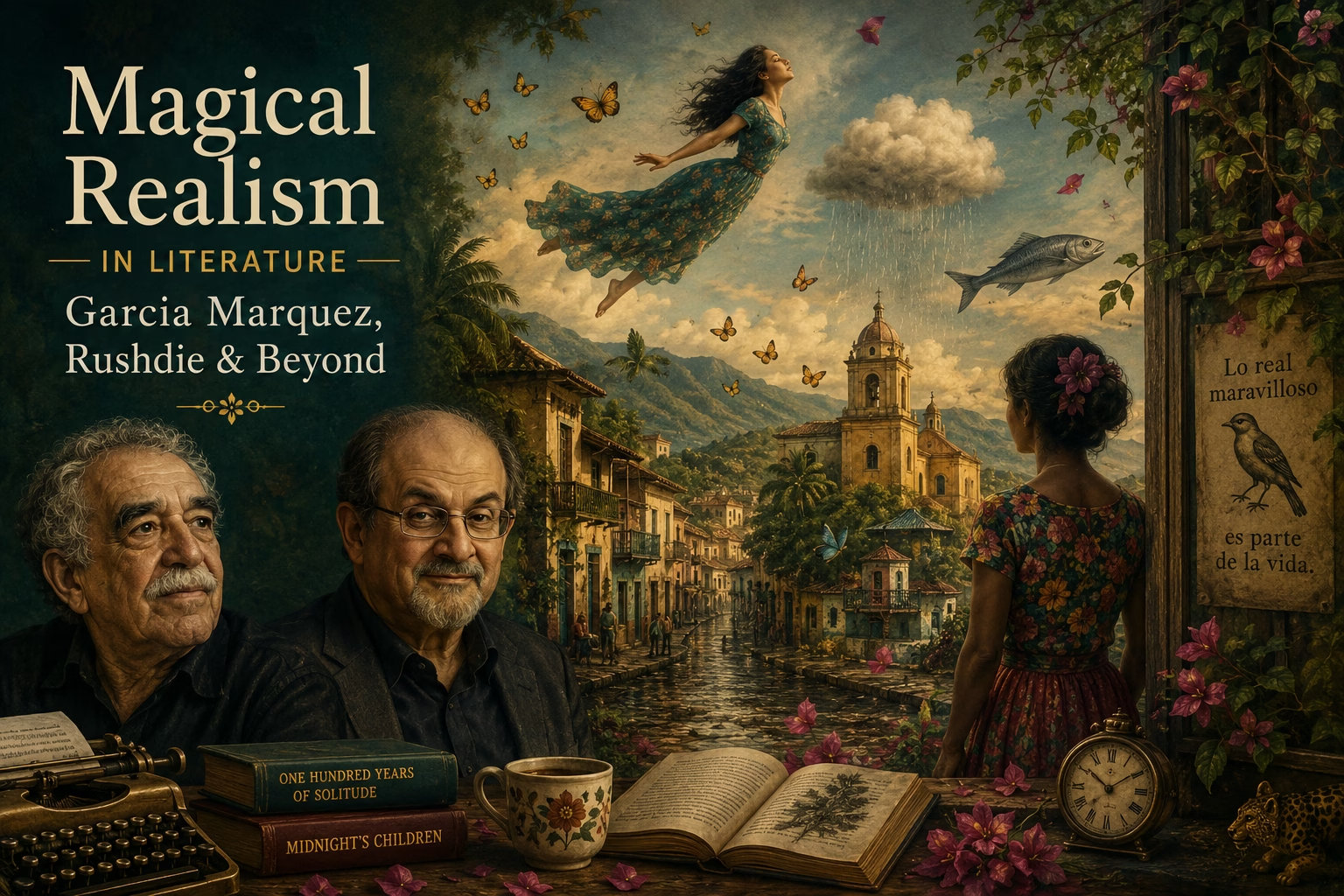
Imagine a woman so beautiful that men die around her without meaning to. Or a child born with the power to hear a thousand minds at once. In the world of magical realism, neither of these events causes surprise. They simply happen — calmly, matter-of-factly, woven into the fabric of everyday life.
Magical realism is one of the most globally influential literary movements of the twentieth century. It was born in Latin America. However, it quickly travelled to South Asia in Salman Rushdie’s hands, to the American South in Toni Morrison’s, and to Nigeria in Ben Okri’s. As a result, it became one of the defining modes of postcolonial and world literature.
In this complete guide, we define magical realism and its key features. We then explore its greatest writers and texts in depth. Furthermore, we compare it clearly with fantasy and surrealism. Finally, we explain exactly what UGC NET English students need to know.
Quick Summary
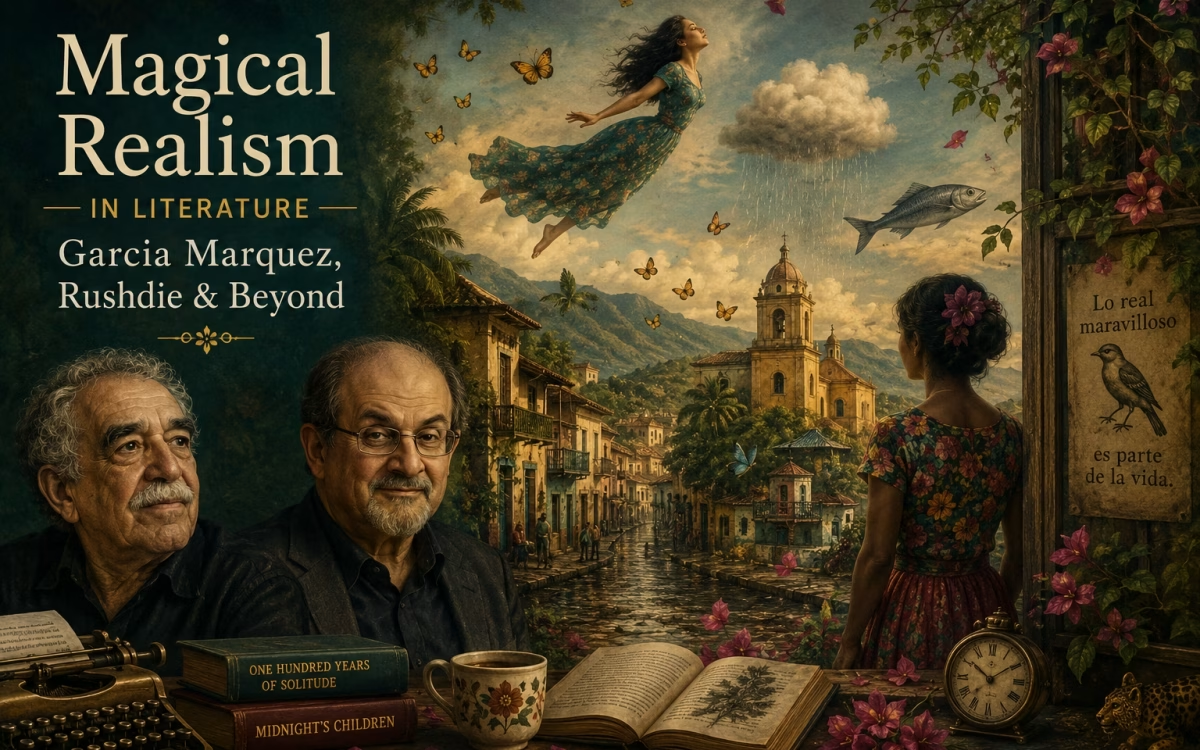
Fundamentally, magical realism seamlessly blends ordinary life with fantastical elements. Specifically, authors treat extraordinary events as completely normal daily occurrences. For example, Gabriel García Márquez defined this captivating genre with One Hundred Years of Solitude. In his work, ghosts and miracles coexist casually with historical tragedies.
Similarly, Salman Rushdie uses magic to explore complex postcolonial identities. Crucially, his masterpiece Midnight’s Children connects supernatural powers directly to India’s independence. Beyond these giants, the genre allows marginalised voices to rewrite dominant historical narratives. Ultimately, magical realism is not just fantasy; it is a profound political tool.
What is Magical Realism? Definition and Key Features
Magical realism is a literary mode in which magical events appear as a completely normal part of everyday life. The term was first used by German art critic Franz Roh in 1925. However, it was the Cuban writer Alejo Carpentier who gave it literary definition. In 1949, he described Latin American reality as lo real maravilloso” — “the marvellous real”. He argued that the extraordinary was already embedded in the ordinary fabric of Latin American life.
Above all, the defining quality of magical realism is the narrator’s specific attitude toward the magical. For context, in traditional fantasy fiction, magic is treated as rare and special. In magical realism, however, magic is simply part of the everyday furniture. For instance, a character who suddenly discovers that her dead grandmother has returned treats the event the exact way you might treat a forgotten umbrella. As a result, there is absolutely no horror and astonishment. Instead, there is only a mild, highly practical adjustment to the situation.
This matter-of-fact approach is by no means a sign of naivety. In fact, it is a profound political statement. Specifically, magical realism directly challenges Western scientific rationalism, which historically labels magic and myth as “primitive”. Therefore, by privileging folk belief and indigenous cosmology, it performs a quiet but powerful act of cultural decolonisation. Consequently, it is clear that the mode is deeply rooted in postcolonial literary traditions worldwide.
Key features of magical realism:
|
Gabriel García Márquez: The Master of Magical Realism
Background and context
Gabriel García Márquez (1927–2014) is the writer most responsible for bringing magical realism to global attention. He was born in Aracataca, a small Caribbean town in Colombia. His grandmother told stories of the miraculous with the same calm she used to describe the weather. As a result, the boundary between the natural and the supernatural was never quite solid for him.
He belonged to the Latin American Boom – the literary explosion of the 1960s and 1970s. This movement brought writers like Mario Vargas Llosa and Julio Cortázar to international prominence. However, it was García Márquez who defined the movement for global readers. He won the Nobel Prize in Literature in 1982, and the committee praised his creation of a world where the fantastic and the realistic combine.
One Hundred Years of Solitude (1967)
In addition to being a masterpiece, One Hundred Years of Solitude is the foundational text of magical realism as a global movement. Specifically, the novel follows seven generations of the Buendía family in the fictional town of Macondo. For instance, it opens with one of the most celebrated sentences in world literature. Moreover, the entire narrative is set against the sweeping backdrop of Colombian and Latin American history.
To begin with, the novel is completely full of magical events. For example, a priest levitates after drinking hot chocolate, while a woman suddenly ascends into heaven while folding sheets. Similarly, yellow butterflies follow a man wherever he goes. Importantly, however, none of this causes the characters any surprise. Instead, these events simply happen, calmly and without explanation, as a regular part of Macondo’s ordinary life.
Beneath the magic, nevertheless, lies a devastating political history. Over time, Macondo moves through civil war, foreign exploitation by a banana company, a horrific massacre, and final destruction. Ultimately, this tragic arc mirrors the history of Latin America itself. Consequently, the magical realism is by no means a form of escapism. Rather, it is the precise vehicle through which a traumatic history — one that official documents actively deny — can be told at all.
Salman Rushdie: Magical Realism and Postcolonial History
Background and context
Salman Rushdie (born 1947) translated magical realism from Latin American soil to South Asian ground. In doing so, he transformed it into a defining mode of postcolonial English literature. Rushdie has openly acknowledged García Márquez’s influence on his work. However, his use of magic serves a specifically Indian political purpose.
For Rushdie, official history is a construction. It is partial, interested, and controlled by those in power. Therefore, magical realism allows him to challenge official history. He places it in dialogue with myth, rumour, personal memory, and the stories ordinary people carry in their bodies.
Midnight’s Children (1981)
Not only did Midnight’s Children win the Booker Prize in 1981, but it was also later named the Booker of Bookers – celebrating it as the best winner of the award’s first twenty-five years. Essentially, the novel’s core premise is both deeply magical and historical. Specifically, it explores how the 1,001 children born in the first hour of Indian independence all possess unique supernatural powers.
Among these children, the narrator, Saleem Sinai, can simultaneously hear the thoughts of everyone else born in that hour. Consequently, his personal life runs in a precise, ironic parallel with the wider history of post-independence India. He is, as he famously puts it, “handcuffed to history”. Furthermore, Saleem is an explicitly unreliable narrator because he openly admits to chronological errors, contradictions, and memory lapses. As a result, the novel powerfully challenges the idea of any single, authoritative account of the past.
Ultimately, Rushdie uses this magical premise for several distinct purposes at once. First, he dramatises the profound violence of Partition and the Emergency. Second, he asserts the validity of myth and oral tradition as legitimate ways of understanding history. In addition, and perhaps most importantly, he shows that the “facts” of official history are always just someone’s constructed story — and never the whole truth.
Magical Realism Beyond Latin America: A Global Movement
Magical realism did not remain a Latin American phenomenon. Writers across the postcolonial world adopted and adapted it. They found in it a mode perfectly suited to expressing histories that conventional realism could not fully hold. Here are the key global voices every student should know.
Toni Morrison — African American Magical Realism
Toni Morrison (1931–2019) is the most important practitioner of magical realism in the American tradition. Her 1987 novel Beloved centres on a ghost — the spirit of a murdered child who returns as a young woman. However, the ghost is not a Gothic device. She is a materialisation of historical trauma — specifically the trauma of American slavery.
Morrison argued that conventional realism could not fully confront the horror of slavery. Therefore, she used the magical as a way to speak the unspeakable. She won the Nobel Prize in Literature in 1993. Furthermore, Beloved was voted the greatest American novel of the previous twenty-five years by a New York Times survey.
Isabel Allende — Latin American Women’s Tradition
Isabel Allende’s debut novel The House of the Spirits (1982) follows four generations of a family in an unnamed Latin American country. Clara, the central figure, has the gift of clairvoyance and telekinesis. Her magical perception of reality runs alongside a narrative of political repression and military dictatorship. In addition, Allende’s magical realism is explicitly feminist. It is the women of the family who possess magical gifts, preserve memory, and bear witness to history.
Ben Okri — African Magical Realism
Ben Okri’s The Famished Road (1991) won the Booker Prize. It centres on Azaro, an abiku — a Yoruba spirit-child caught between the living world and the spirit world. Okri draws on Yoruba cosmology rather than Western narrative conventions. As a result, the spirit world is as present and consequential as the physical one. The novel demonstrates that magical realism is not a Western import but a global literary resource.
Haruki Murakami — Japanese Urban Magical Realism
Haruki Murakami brings magical realism into the contemporary urban landscape. In Kafka on the Shore (2002), fish rain from the sky over a Japanese town. A teenage boy shares a body with the spirit of Oedipus. An old man converses with cats. However, Murakami’s magic is not rooted in folk tradition as García Márquez’s is. Instead, it emerges from pop culture, jazz, mythology, and the solitary interiority of his characters.
Magical Realism in Literature: Key Writers at a Glance
The table below offers a clear, exam-ready overview of the key writers in magical realism from across the globe:
| Writer | Tradition | Key Work | Signature MR Technique | UGC NET Weight |
| Gabriel García Márquez | Latin America (Colombia) | One Hundred Years of Solitude (1967) | Matter-of-fact magic; multigenerational myth | Very High |
| Salman Rushdie | South Asian / Postcolonial | Midnight’s Children (1981) | History as myth; unreliable narrator | Very High |
| Toni Morrison | African American | Beloved (1987) | Ghost as historical trauma | High |
| Isabel Allende | Latin America (Chile) | The House of the Spirits (1982) | Family saga; clairvoyance + politics | High |
| Günter Grass | European (Germany) | The Tin Drum (1959) | Grotesque magic; WWII trauma | High |
| Ben Okri | African (Nigeria) | The Famished Road (1991) | Abiku spirit-child; Yoruba cosmology | Moderate |
| Haruki Murakami | East Asia (Japan) | Kafka on the Shore (2002) | Urban magic; pop culture + myth | Moderate |
Magical Realism vs Fantasy vs Surrealism: Key Differences
Students frequently confuse magical realism with fantasy and surrealism. All three modes involve the non-realistic. However, they are fundamentally distinct in purpose, technique, and cultural grounding. The table below makes these differences clear:
| Feature | Magical Realism | Fantasy | Surrealism |
| World setting | Real, recognisable world | Fully imagined alternate world | Dream-distorted version of reality |
| Role of magic | Woven into everyday life; no surprise | Central to plot and world-building | Disrupts reality; exposes the unconscious |
| Characters react by | Accepting magic as completely normal | Feeling wonder, fear, or excitement | Finding that reality itself is unstable |
| Narrative tone | Calm, matter-of-fact, straight-faced | Adventurous; sense of wonder | Fragmented, dreamlike, disorienting |
| Cultural roots | Folk myth, indigenous cosmology | Self-contained secondary world | Freudian psychology; anti-bourgeois art |
| Political dimension | Almost always present | Optional | Often present; anti-war, anti-bourgeois |
| Key example | One Hundred Years of Solitude | The Lord of the Rings | Dali’s paintings; early Kafka |
The most important distinction to remember is this. First, in magical realism, the magic is ordinary — it belongs to the same world as the realistic elements. In contrast, in fantasy, magic is special — it governs a constructed alternate world. Meanwhile, in surrealism, magic is disruptive — it destabilises reality to expose the unconscious. Consequently, only magical realism carries a consistent political and postcolonial dimension.
How do postcolonial authors use literal magic to rewrite history? ✨ If you are preparing for the UGC NET English exam, understanding this specific narrative technique is absolutely non-negotiable. We just broke down the most important authors of the magical realism movement on the blog. To protect our students’ competitive edge, we keep the exact texts hidden here. Click through to discover the definitive guide and ace your next mock test.
Key Themes: Magical Realism in Literature
Across the global tradition of magical realism, a set of recurring themes defines the mode. Understanding these cross-cutting concerns helps you write comparative analyses. Furthermore, it equips you to answer UGC NET passage-based questions with precision.
- Colonialism and the postcolonial imagination: Both García Márquez and Rushdie use magic to challenge official colonial histories. They privilege subaltern perspectives and indigenous ways of knowing over European rationalism. As a result, magical realism is inherently a postcolonial mode.
- History, memory, and trauma: The magic in magical realism frequently marks the site of a history too painful to narrate in conventional realist terms. Morrison’s Beloved is the clearest example. The ghost is the unspeakable trauma of slavery, given form because no other form is sufficient.
- Cyclical and non-linear time: In contrast to the linear chronology of conventional realism, magical realist narratives move in cycles and spirals. Past and present coexist. The dead return. Prophecies are fulfilled by the very acts taken to avoid them.
- Folk tradition and oral culture: Magical realism elevates oral storytelling to the same status as written documentary history. This is a deliberate challenge to the Western hierarchy that privileges the written over the oral and the scientific over the mythological.
- Political critique and social violence: The magic in magical realism rarely floats free of political meaning. Yellow butterflies and ascending women all occur in a Macondo shaped by civil war and corporate exploitation. Consequently, magical realism uses the fantastic to say what plain statement might not survive.
- Identity, diaspora, and belonging: For Rushdie, Okri, and Morrison, magical realism provides a mode for exploring identities fractured by colonialism and migration. The magic marks the spaces where official categories of identity — national, racial, religious — break down and more complex realities emerge.
Summaries will only get you so far—to truly understand magical realism, you have to read the foundational texts. 📚 I have paired a universally required syllabus classic with a highly unique, postcolonial masterpiece to give you the ultimate edge in your university papers. Click the link to reveal these mystery texts and add them to your personal literature library: Gabriel García Márquez’s One Hundred Years of Solitude and Salman Rushdie’s Midnight’s Children.
Conclusion:
Magical realism endures because it answers a question that literary realism alone cannot fully address. Specifically, how do we tell the stories of histories and cultures for which Western empirical realism was never designed? For example, from the yellow butterflies of Macondo to the midnight children of Bombay, from the ghost called Beloved to the spirit-child wandering the roads of colonial Nigeria, these works insist on something vital. In particular, they insist that the full reality of human experience — particularly in societies shaped by colonialism, slavery, and violent history — cannot be captured without myth, folklore, and the marvellous.
Therefore, the magic is not decoration; rather, it is the truth that realistic documentation cannot hold. Moreover, magical realism has also proved to be one of the most adaptive literary modes of the modern era. It has consequently travelled from Latin America to South Asia, West Africa, Japan, and the American South. In each location, it has found new cultural grounding and new political urgency. As a result, it is not a fixed style but instead a living, dynamic relationship between the ordinary and the extraordinary.
Enjoyed this guide? Explore more on a2zliterature.com — including our complete guides on Existentialism in Literature, Dystopian Literature, Feminism in Indian English Literature, and the Harlem Renaissance.
Frequently Asked Questions:
What is the difference between magical realism and fantasy?
The key difference lies in the setting and the attitude toward magic. In fantasy, the story takes place in a fully imagined alternate world, and magic is special and central to the plot. In magical realism, however, the story is set in the real, recognisable world. Magic is simply part of everyday life. It is presented without surprise, without rules, and without wonder. Furthermore, the magic in magical realism always serves cultural, historical, or political purposes rather than primarily escapist ones.