Introduction
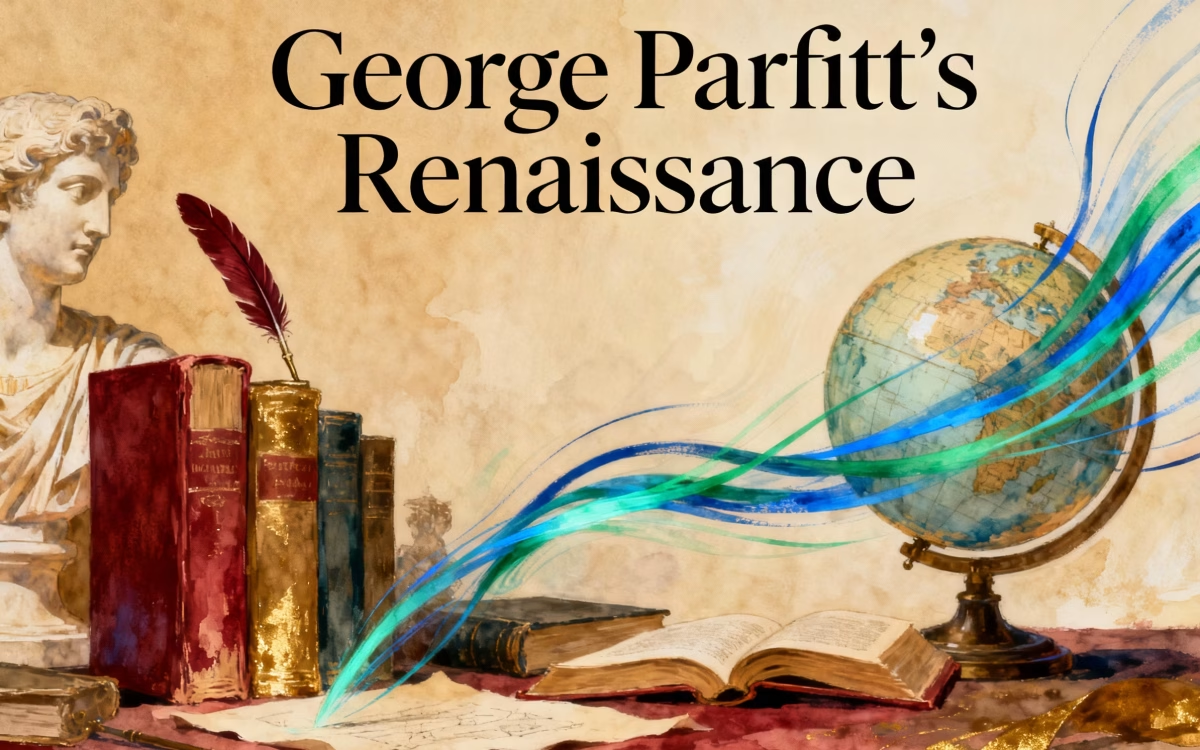
George Parfitt’s Renaissance challenges the traditional classroom narrative. The Renaissance is not simply a golden age of rebirth. It is not just about Europe rediscovering classical learning after medieval darkness. Parfitt urges readers to see the term differently. He sees it not as a fixed period. Instead, it is a dynamic, recurring tendency. This tendency shapes—and is shaped by—our cultural anxieties and aspirations.
Parfitt’s approach is refreshing and necessary. It is especially relevant for students and scholars in India and the Global South. Questions of canon, power, and inclusion are central there. Parfitt dismantles the idea that the Renaissance is just a chapter in European history. He argues that “Renaissance” is better understood as a movement or tendency. This tendency appears whenever there is a surge of classical revival, secular energy, scientific curiosity, and faith in human agency. This shift opens up the Renaissance to broader, more inclusive readings. We can trace its echoes in different cultures, periods, and social movements.
The Renaissance is often taught as a triumph of Western humanism. It is celebrated in the works of Spenser, Shakespeare, and Donne. Parfitt invites us to question who is included in this story. He asks whose voices are silenced. The traditional Renaissance often privileges the elite. It marginalizes women, the poor, and colonized peoples. This critical stance resonates in contexts where caste, class, and exclusion remain central.
Parfitt tracks the evolution of Renaissance studies. He shows how later critics moved beyond the “High Renaissance.” They focus on fragmented, conflicted, and contradictory voices. This shift values complexity over harmony. It values dissent over consensus.
In this introduction, we will explore Parfitt’s central arguments. We will consider their relevance for contemporary readers. His approach helps us read the Renaissance not as a finished monument. Instead, it is a living, contested field of ideas. This perspective will engage students, scholars, and anyone interested in the ongoing relevance of the Renaissance. FULL TEXT
George Parfitt Renaissance: Tendency not a Period
George Parfitt’s essay shifts how we understand the Renaissance. He sees it not as a neatly bounded period. Instead, it is a dynamic and recurring tendency. This tendency appears when certain cultural conditions arise. For Parfitt, “Renaissance” is less about a specific European era. It is more about the spirit of revival, renewal, and critical engagement. This spirit involves classical learning, secular energies, scientific discovery, and faith in human potential. The tendency is not confined to Italy or England. It can appear in any age or culture where these impulses meet older traditions.
Parfitt argues that treating the Renaissance as a fixed period leads to a narrow view. This view often celebrates only the achievements of elites. It ignores the voices of the marginalized, the poor, and the colonized. Seeing the Renaissance as a tendency opens up broader, more inclusive readings. This perspective helps us recognize moments of “rebirth” beyond Europe. It shows how ideals of innovation, enlightenment, and rationality can be both liberating and problematic. Who benefits and who gets left out matters.
Questions of canon, power, and inclusion are central there. Parfitt’s approach encourages us to see the Renaissance as a living, contested field of ideas. It continues to evolve and challenge our assumptions about cultural renewal and progress.
Rebirth, Humanism, and the Problem of “Revival”
Rebirth, humanism, and the problem of “revival” lie at the heart of George Parfitt’s critical essay on the Renaissance. Writers and historians traditionally celebrate the Renaissance as a “rebirth” of classical learning, secular energy, and faith in human potential. They often contrast this vibrant era with the supposed darkness and stagnation of the medieval period. Parfitt, however, challenges this neat binary, arguing that the very idea of “rebirth” is both powerful and problematic. He points out that to speak of rebirth is to imply that something was dead, and that death is often cast as negative, while rebirth is always seen as positive. This perspective raises uncomfortable questions: Who decides what was “dead”? Whose revival counts as progress?
Parfitt draws on Collins’ definition of the Renaissance, which highlights four key strands: classical scholarship, the predominance of active and secular life over religious and contemplative, scientific and geographical discoveries, and a belief in individual human potential. These themes come alive in the literature of the period, especially in Marlowe’s Dr. Faustus and Shakespeare’s Hamlet, both of which dramatize the struggle to realize individual potential amid conflicting beliefs and new worldviews. The Renaissance, then, is not just a historical moment but a complex set of cultural values and aspirations.
Yet, Parfitt insists that the celebration of humanism and classicism often masks deeper contradictions. The literature and philosophy of the Renaissance explore the meaning of life, human nature, justice, and love, but these themes are never neutral—they reflect the interests of the elite, the court, and the gentry. Works like Spenser’s The Faerie Queene celebrate humanist ideals, yet they also reinforce social hierarchies and marginalize voices that fall outside the dominant narrative.
The problem of “revival,” then, is not just about what is being reborn, but also about who benefits from that rebirth. Parfitt’s essay encourages readers to question the orthodox view of the Renaissance, to recognize its biases, and to consider alternative readings that include the perspectives of the marginalized and silenced. This critical approach makes the Renaissance not just a period of revival, but a site of ongoing debate and contestation, where the meaning of “rebirth” is always up for grabs.
English Renaissance and the Court
One of Parfitt’s most influential interventions concerns the English Renaissance, especially the myth that the court of Elizabeth I represents the single, central flowering of English culture. In this familiar story, a brief “high Renaissance” at court gathers poetry, music, and drama into a triumphant narrative that makes England look comparable to France and Spain.
Parfitt summarises and then quietly dismantles this view by tracing two critical “shifts” in Renaissance studies. Both shifts react against the idea of an exclusively court‑centred, aristocratic high point, and both question the assumption that Spenserian epic stands as the unchallenged model of Renaissance achievement.
Spenser’s The Faerie Queene and High Renaissance Ideals
For Parfitt, Edmund Spenser’s The Faerie Queene is a near‑perfect symbol of what “High Renaissance” means in orthodox literary histories. The poem embodies classical ambition, elaborate allegory, the ideal of the gentleman, and a strong sense of national destiny, all packaged in a refined, highly organized artistic structure.
At the same time, Parfitt draws attention to the limits built into this vision. The epic’s chivalric and moral universe assumes a narrow social frame, idealizing the gentry and often instrumentalizing women and lower‑status characters as figures that serve elite moral narratives rather than independent subjects. This recognition allows readers—from Coventry to Chandigarh—to see that while The Faerie Queene remains central to Renaissance studies, it also encodes ideological work that later critics and students must confront rather than simply celebrate.
George Parfitt’s Renaissance: From Spenser to Donne
The next shift Parfitt tracks is the movement away from Spenserian epic towards the lyric experiments of writers such as John Donne and his contemporaries. Instead of expansive allegorical architecture and harmonious design, this later Renaissance moment emphasizes intense, often conflicted individuality, intellectual daring, and a more unstable relation to inherited religious and philosophical certainties.
Parfitt links this shift not only to the sixteenth and seventeenth centuries themselves but also to modern criticism, which increasingly prefers Donne’s jagged, questioning voice to Spenser’s courtly steadiness. The fact that T. S. Eliot could both draw on and parody Spenserian elements in The Waste Land underscores how later writers use Renaissance forms to dramatize twentieth‑century fragmentation rather than early modern confidence. EXPLORE MORE WRITINGS
Humanism Under Pressure: Marxist and Social Critiques
A key strength of Parfitt’s Renaissance essay lies in the way it pulls in Marxist and socially oriented criticism to unsettle the smooth story of humanist progress. Engaging with figures like Raymond Williams, he notes that country‑house poetry and other elite genres often functioned as propaganda for the gentry, naturalizing class privilege under the cover of beauty and order.
This brings into focus the power structures behind canonical Renaissance texts: country estates appear as timeless, harmonious spaces while labourers, tenants, and women hover in the background, largely mute. In a South Asian context—where questions of caste, land, and agrarian labour are central—such analysis resonates strongly, inviting students to see parallels between English Renaissance representations of hierarchy and their own regional histories of exclusion and resistance.
Margins, Silence, and the “Deconstructive” Renaissance
Parfitt concludes by gesturing towards a “new” sense of Renaissance that actively critiques humanist ideology and the institutional structures that canonized a narrow version of rebirth. This means revealing how certain texts became standard while others were ignored, how specific class and gender identities were idealized, and how the language of individual potential often masked systemic exclusions.
This deconstructive turn does not mean simply discarding Renaissance humanism; rather, it means reading it with double vision—appreciating its liberating energies while refusing to forget its blind spots. For students in India, Africa, or the broader Global South, this approach opens space to read Renaissance writers alongside Dalit narratives, postcolonial texts, and decolonial theory, allowing a comparative perspective on what counts as “rebirth” and whose voices signify cultural renewal.
Table: Key Ideas in George Parfitt’s Renaissance
| Aspect | Traditional Renaissance View | George Parfitt’s Perspective |
|---|---|---|
| Definition of Renaissance | Fixed historical period of European “rebirth” in art and learning. | Recurrent tendency or movement, not confined to one era or geography. |
| Humanism | Celebrated as pure liberation of the individual and reason. | Seen as enabling but also complicit with class, gender, and imperial power. |
| English High Renaissance | Centred on Elizabethan court culture and Spenserian epic. | Critiqued as narrow, court‑bound, and socially exclusive. |
| Canonical Texts | The Faerie Queene as pinnacle of Renaissance epic and harmony. | Acknowledged as major but read for ideological limits and exclusions. |
| Critical Method | Linear literary history and aesthetic appreciation. | Historically aware, Marxist‑inflected, and open to deconstruction. |
Conclusion
George Parfitt’s essay on the Renaissance offers a powerful insight. The Renaissance is not a closed chapter of history. Instead, it is an open, evolving conversation about cultural, intellectual, and social rebirth. Parfitt treats the Renaissance as a tendency, not just a period. Moreover, he urges readers to question who benefits from revival and which voices get silenced. His essay dismantles the orthodox view of the Renaissance as a golden age of elite achievement. As a result, he makes us recognize the biases and exclusions in traditional narratives.
Furthermore, Parfitt critiques the ideals of humanism and classicism. These values can be liberating, but they often reinforce social hierarchies. Consequently, they marginalize those outside dominant circles. In addition, he highlights the importance of listening to dissenting and marginalized voices. He sees the Renaissance as a contested, dynamic field, not a fixed monument. Therefore, this approach makes the Renaissance relevant for scholars of European history. Similarly, it also matters to anyone interested in inclusion, justice, and cultural renewal.
In conclusion, Parfitt’s essay challenges us to read the past critically. We should question the stories we tell about cultural rebirth. The meaning of “renaissance” is always up for debate. By doing so, he opens new possibilities for understanding literature, history, and society. He encourages us to see the Renaissance not as a finished era, but as a living, evolving conversation about humanity in a changing world.
FAQS
1. What is George Parfitt’s main argument about the Renaissance?
George Parfitt argues that the Renaissance is not a fixed historical period, but a recurring tendency or movement marked by revival, secularism, scientific discovery, and belief in human potential. He emphasizes that this tendency appears in different cultures and times, challenging the traditional Eurocentric view of the Renaissance as a closed era.
2. How does Parfitt define “Renaissance” differently from traditional definitions?
Parfitt distinguishes two meanings of the Renaissance. One is a specific historical period in European history. The other is a broader tendency of cultural and intellectual renewal. He draws on Collins’ definition. Collins includes classical scholarship, secular life, scientific progress, and faith in individual potential. However, Parfitt also highlights how these ideals often exclude marginalized groups.
3. Why does Parfitt critique the idea of the English Renaissance as a “High Renaissance”?
George Parfitt critiques the idea that the English Renaissance was centred on the court of Elizabeth I and poets like Spenser, arguing that this view is narrow and elitist. He shows how this perspective marginalizes other voices and overlooks the diversity of literary and cultural developments beyond the court.
4. How does Parfitt address the problem of humanism and revival in the Renaissance?
Parfitt points out that while the Renaissance celebrates humanism and revival, these ideals often reinforce social hierarchies and exclude the poor, women, and colonized peoples. George Parfitt encourages readers to question whose revival counts as progress and which voices the process silences.
5. What is the contemporary relevance of Parfitt’s essay on the Renaissance?
Parfitt’s essay remains relevant today. It challenges readers to see the Renaissance as an open, evolving conversation. This conversation is about cultural renewal and inclusion. Parfitt questions orthodox narratives. He highlights marginalized perspectives. His work encourages a more inclusive and critical approach. This approach benefits literary and historical studies.