INTRODUCTION
Few works in world literature have captured the imagination like Herman Melville’s Moby Dick. To begin with, first published in 1851, it remains a cornerstone of American literature. Moreover, this epic novel is studied, debated, and reimagined far beyond its original era. The story begins with the famous invitation—“Call me Ishmael”—which, consequently, draws readers swiftly into a world of seafaring adventure and philosophical reflection. Indeed, this phrase isn’t just a casual call; rather, it invites readers to join a deeper quest for meaning on the vast ocean. Remarkably, this quest still resonates with modern readers.
Furthermore, Melville centers the story on Captain Ahab, a man obsessed with hunting the mythical white whale, Moby Dick. This relentless pursuit forms one of literature’s greatest explorations of obsession and revenge. Yet, despite the thrilling adventure, the novel deeply transcends mere plot. Across 135 chapters blending action with reflective essays, Melville turns a whaling voyage into a thoughtful meditation. Specifically, he explores the limits of human knowledge, the dangers of pride, the complex nature of good and evil, and the struggle to impose order on chaos.
In addition, the rich historical context adds layers to the narrative. Melville draws from his own sailing experiences and extensive reading in whaling literature. Notably, the character of Moby Dick takes inspiration from the real-life albino whale, Mocha Dick. Meanwhile, Ahab’s doomed quest mirrors the tragic sinking of the whaling ship Essex by a sperm whale in 1820. Thus, these real elements blend seamlessly with mythic and symbolic resonance.
What finally cements Moby Dick as “one of the strangest and most wonderful books in the world,” to quote D.H. Lawrence, is its profound depth. Melville dives into themes like social class, spirituality, and humanity’s place within nature. Indeed, his vivid passages overflow with symbolism—from the whiteness of the whale to the multicultural crew aboard the Pequod. This duality makes the story both intensely personal and richly philosophical.
Despite mixed reviews upon its release and near obscurity by Melville’s death, Moby Dick was rediscovered in the 20th century. Consequently, it emerged as the archetype of the “Great American Novel.” Today, it forms an essential part of literature syllabi and exams worldwide—including in India—challenging readers to wrestle with life’s uncertainties, interpretative complexity, and the consequences of obsession.
Herman Melville’s Moby Dick: Plot Overview
Melville opens his masterpiece with the unforgettable line: “Call me Ishmael.” Initially, Ishmael is a restless soul, seeking freedom from city life, who ends up in New Bedford, Massachusetts. There, at the Spouter Inn, he becomes friends with Queequeg, a skilled harpooner from the Pacific Islands. Consequently, their friendship quickly deepens, and Ishmael agrees to work alongside Queequeg on a whaling voyage.
Next, they sign on to the whaling ship, the Pequod, managed by Peleg and Bildad. Meanwhile, Captain Ahab, though absent at first, quickly becomes shrouded in myth—known for his missing leg, which was bitten off by a dangerous white whale named Moby Dick. Undeterred by dire warnings and ominous prophecies, Ishmael and Queequeg join the crew and set sail on Christmas Day, seeking fortune, adventure, and answers on the open sea.
As they journey across oceans, the crew—comprised of a strikingly international group of sailors—hunts whales, faces storms, and bonds over common labor. However, Ahab’s single-minded obsession with revenge against Moby Dick dominates the voyage’s purpose. Indeed, the captain reveals his plan to hunt down and kill the legendary white whale, whom he regards as evil incarnate.
Tension rises. Throughout the voyage, Ishmael narrates philosophical musings, everyday routines, and wild adventures of shipboard life. At the same time, Starbuck, the thoughtful first mate, often struggles with Ahab’s fanaticism, recognizing its danger. Similarly, Queequeg demonstrates his courage and loyalty during multiple crises, exemplifying the strength of human fellowship.
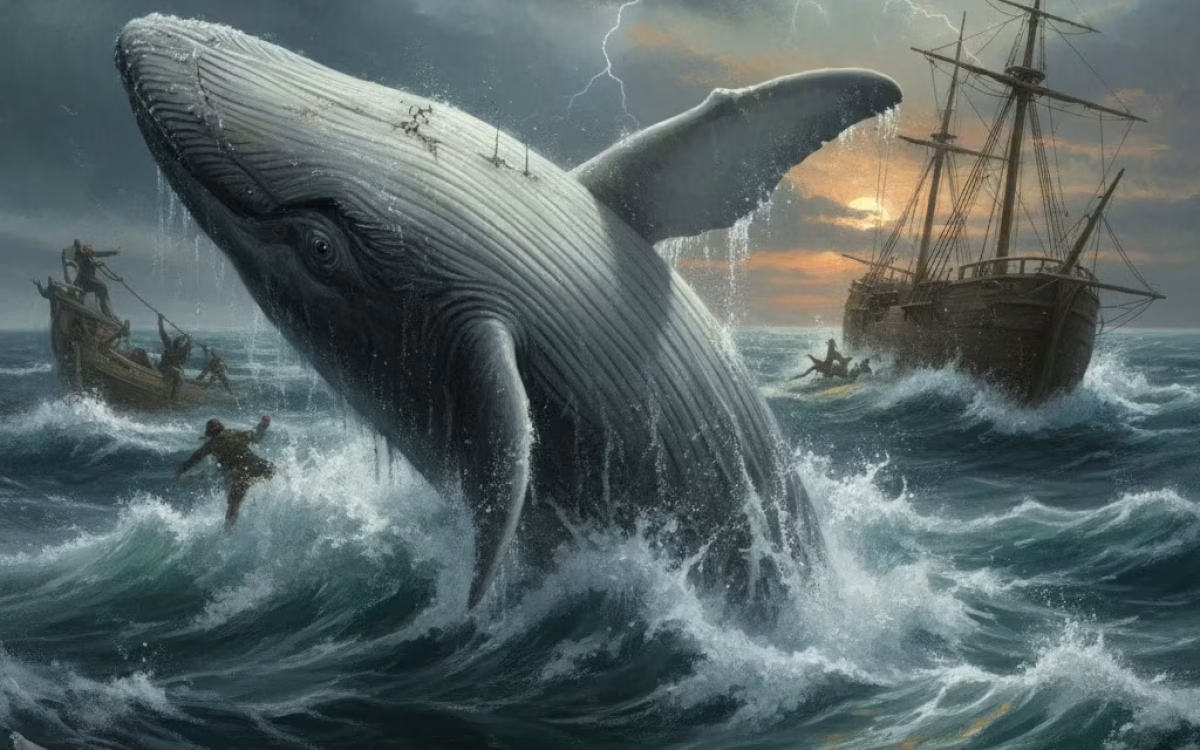
Finally, in the gripping climax, after months at sea, the Pequod encounters Moby Dick. As a result, the hunt turns catastrophic—Ahab’s pursuit leads to the destruction of the Pequod and the loss of nearly all its crew. Ultimately, only Ishmael survives, rescued by a coffin converted into a lifeboat, left to reflect on both tragedy and the depths of human ambition. FULL TEXT
Herman Melville’s Moby Dick: Main Characters
Ishmael: Our narrator, philosophical, wide-eyed, and the lone survivor.
Captain Ahab: Monomaniacal captain of the Pequod, fixated on vengeance.
Queequeg: Harpooner from the Pacific Islands; symbol of multicultural fellowship.
Starbuck: First mate; calm and rational, the voice of caution.
Fedallah: A mysterious harpooner and Ahab’s confidant, often linked with prophecies.
Pip: Young cabin boy; represents innocence and tragic madness.
Each character is meticulously rendered, symbolising rival perspectives on fate, knowledge, and morality.
Herman Melville’s Moby Dick: Themes
The Limits of Knowledge
At its core, Moby Dick questions the very nature of understanding. Ishmael tries to define the whale using every tool—science, mythology, art—but comes to realize that no system truly captures reality. Knowledge has its boundaries. This lesson applies just as much to today’s quest for certainty in science or philosophy as it did in Melville’s era.
Obsession: Ahab’s Fatal Flaw
Captain Ahab stands as literature’s quintessential obsessed figure. His fanatical desire to kill Moby Dick to avenge his lost leg pulls the entire ship—and its innocents—into disaster. Ahab’s obsession demonstrates how unchecked fixation can destroy not just one life, but many. For modern readers, his character prompts reflection on the consequences of letting any passion override all reason.
Man vs. Nature
The relentless sea, epic storms, and the terrifying power of the whale set up an elemental conflict. Melville masterfully shows that nature is indifferent to human ambition, neither cruel nor kind. The whalers’ struggle against the forces of the ocean is both thrilling and philosophical—a reminder of humanity’s place in the cosmos.
The Deceptiveness of Fate
Prophecies, omens, and foreboding signs occur throughout the voyage. Ishmael and other crew members often interpret these as evidence of destiny, but Melville hints that fate is never truly knowable. Human beings are prone to projecting meaning onto random events, sometimes resulting in self-delusion or catastrophe.
Race, Fellowship, and Enslavement
Moby Dick explores multicultural fellowship, racial tension, and equality. Queequeg and Ishmael’s friendship challenges prejudices of the time; the diverse crew symbolises global brotherhood. Pip’s story, meanwhile, highlights the painful realities of enslavement—enriching the novel’s depiction of human solidarity and suffering.
Madness
Ahab’s insanity is contrasted with moments of clarity from Ishmael and Starbuck, as well as Pip’s tragic descent. Madness is both a personal curse and a social force, transforming the ship’s destiny. The novel invites readers to discern the thin boundary between reason and obsession.
Religion
Ishmael’s reflections and Father Mapple’s sermons infuse the narrative with religious questions, drawing on biblical tales like Jonah and the whale. Melville explores the tension between divine will and human action, often leaving answers open-ended. Themes of sin, punishment, and redemption echo through the story.
Herman Melville’s Moby Dick: Symbolism
The novel is saturated with symbols:
The White Whale: Represents mystery, nature’s power, evil, or even God—its ambiguity keeps scholars debating.
The Sea: Infinity, danger, possibility.
Ahab’s Leg: Human vulnerability, loss, and the cost of obsession.
Queequeg’s Coffin: Death transformed to survival—a paradoxical salvation.
Melville’s use of symbolism places Moby Dick on par with great mythic texts—from the Mahabharata to Shakespeare. EXPLORE OTHER AUTHORS
Herman Melville’s Moby Dick: Cultural Context
Melville crafts a world where American, Pacific, and African cultures collide. The Pequod’s crew comes from every continent—a microcosm of human society. For Indian readers, this global context resonates with our own traditions of storytelling, migration, and pluralism.
The novel’s publication in the mid-19th century aligns it with debates about authority, democracy, and race—issues still deeply relevant today.
Conclusion
In conclusion, Moby Dick remains one of literature’s most powerful and enigmatic novels, captivating readers across generations. Not only does it tell a gripping story of adventure and revenge, but it also invites profound reflection on timeless themes like obsession, knowledge, and the human condition. Moreover, Melville’s richly symbolic narrative challenges us to confront the mysteries of fate, identity, and nature.
Furthermore, the novel’s relevance has only grown with time. For readers in India and around the world, Moby Dick offers an opportunity to explore complex social, spiritual, and philosophical questions through the lens of an unforgettable maritime epic. Its layered characters and vivid imagery allow multiple interpretations, making each reading a new journey.
Therefore, whether you approach the book as a student preparing for exams, a blogger seeking fresh insights, or simply a curious reader eager for intellectual adventure, Melville’s masterpiece rewards your engagement richly. Ultimately, this whale of a story pushes us beyond the surface to discover deeper meanings about ourselves and the world.
Thus, embracing Moby Dick means embracing uncertainty, perseverance, and the pursuit of truth—an eternal call that continues to resonate in literature and life alike.
Frequently Asked Questions
Q1: What is Moby Dick about?
Moby Dick narrates the journey of Ishmael aboard the whaling ship Pequod, captained by the obsessed Ahab who seeks revenge against the giant white whale, Moby Dick. The novel explores themes of obsession, fate, and humanity’s struggle against nature.
Q2: Who is Ishmael in the novel?
Ishmael is the story’s narrator and the only survivor of the Pequod. Portrayed as a thoughtful outsider, he provides philosophical reflections alongside the adventure narrative.
Q3: Why does Captain Ahab want revenge on Moby Dick?
Ahab wants revenge because Moby Dick bit off his leg on a previous voyage. His monomaniacal quest symbolizes destructive obsession and the human struggle against fate.
Q4: What does the white whale symbolize?
Moby Dick symbolizes many things: the unknowable forces of nature, fate, evil, or even God. Its ambiguity allows readers to interpret it in diverse ways, making it a powerful literary symbol.
Q5: How many chapters are in Moby Dick?
The novel contains 135 chapters plus an epilogue, mixing narrative storytelling with philosophical digressions and detailed whaling information.