Introduction
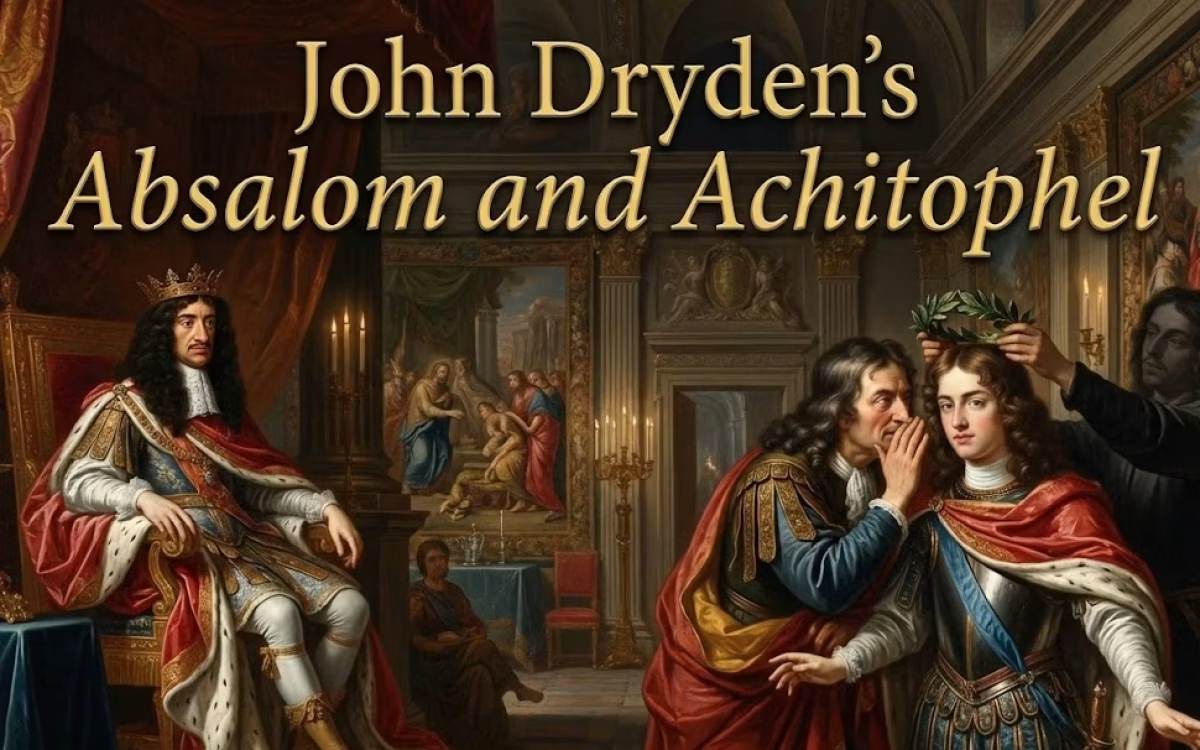
John Dryden’s Absalom and Achitophel proves that politics never really changes. Ambition, betrayal, and even fake news—Dryden wrote about them in 1681, yet his themes still feel modern today. The poem was composed during the Exclusion Crisis, a time when Parliament sought to exclude James, the Catholic brother of King Charles II, from inheriting the throne. Many politicians and citizens instead backed the king’s illegitimate Protestant son, the Duke of Monmouth, hoping he would continue Protestant rule.
In this tense political atmosphere, Dryden turned poetry into persuasion. Absalom and Achitophel is not just a story drawn from the Bible—it is a work of royalist propaganda created to defend the crown and prevent another civil war. Through clever satire and moral argument, Dryden transformed political conflict into lasting literary art.
Quick Summary: Absalom and Achitophel
Published anonymously in 1681, Absalom and Achitophel is arguably the greatest political satire in the English language. John Dryden uses a Biblical story from 2 Samuel (King David and his rebellious son Absalom) as an allegory for the contemporary political crisis in England: the Popish Plot and the Exclusion Crisis. The poem defends King Charles II (David) against the Earl of Shaftesbury (Achitophel), who manipulates the King’s illegitimate son, the Duke of Monmouth (Absalom), into rebellion.
The Decoder Key
| BIBLICAL CHARACTER | HISTORICAL FIGURE | DESCRIPTION |
|---|---|---|
| King David | King Charles II | The indulgent and forgiving father figure. |
| Absalom | Duke of Monmouth | The handsome, ambitious, but weak rebel son. |
| Achitophel | Earl of Shaftesbury | The cunning villain and political tempter. |
| Zimri | Duke of Buckingham | The inconsistent and foolish courtier. |
| Israel | England | Represents the nation under King Charles II. |
| The Jebusites | Roman Catholics | Symbolise the religious “outsiders” in England. |
Plot Summary
John Dryden’s Absalom and Achitophel opens with a vision of peace in Israel, which represents England. King David, a symbol of King Charles II, rules wisely and lovingly. Yet, the people—portrayed as fickle and restless—begin to crave change, setting the stage for political unrest.
Achitophel, modelled on the Earl of Shaftesbury, notices Absalom’s growing ambition and cleverly manipulates it. He tempts the young prince by telling him, “You are the people’s hope—your father’s time is passing.” Flattered and uncertain, Absalom begins to believe that God and the nation both want him as king.
Driven by pride and persuasion, Absalom travels through Israel, winning the hearts of the people with his beauty, charm, and promises of renewal. His growing popularity mirrors the Duke of Monmouth’s real-life appeal among Protestant supporters who opposed the Catholic succession.
In the final section, King David breaks his silence. He boldly defends his right to rule, invoking both divine authority and legal legitimacy. Absalom’s rebellion collapses under the weight of David’s moral strength. Dryden ends the poem abruptly, reflecting how the actual political trial of Shaftesbury was still unfolding when the work was published.
“Dryden is best studied alongside his contemporaries like Alexander Pope. I recommend the Norton Anthology of English Literature (Vol C)—it contains the full text with excellent footnotes to explain the history. [Buy The Norton Anthology on Amazon].”
Character Analysis
Achitophel (The Great Villain)
Achitophel, Dryden’s portrait of the Earl of Shaftesbury, stands as one of literature’s most intelligent villains. He is not driven by brute force but by brilliant cunning. Dryden describes him as a man whose sharp intellect turns destructive—a genius used for evil. The famous line, “Great wits are sure to madness near allied, / And thin partitions do their bounds divide,” captures this dangerous closeness between brilliance and insanity.
Achitophel’s power lies in persuasion. He understands human weakness, especially Absalom’s vanity and desire for praise. Instead of wielding a sword, he manipulates minds. Dryden turns him into a warning figure: intelligence without morality becomes treason. That makes Achitophel not just a political schemer but a symbol of corrupted genius.
Zimri (The Comic Relief)
Zimri, a thinly veiled caricature of the Duke of Buckingham, serves as comic relief in Absalom and Achitophel. Dryden’s tone shifts here—from political anger to biting mockery. The poet famously sums him up in the line, “A man so various, that he seemed to be / Not one, but all mankind’s epitome.” Zimri is everything and nothing at once: a musician, chemist, politician, and clown, all within a single hour.
Through Zimri, Dryden ridicules inconsistency and vanity. The character’s restlessness mirrors the chaos of Restoration politics, where shifting loyalties and empty ambition often replaced real leadership. Dryden’s personal dislike for Buckingham turns the satire savage—making Zimri both ridiculous and unforgettable.
Satirical Techniques
Dryden’s Absalom and Achitophel is not just a political poem—it is a masterclass in satire. He combines biblical allegory and the heroic couplet to turn political commentary into enduring art.
Biblical Allegory
Dryden uses the Bible as his political shield and sword. By retelling the rebellion of Absalom against King David, he transforms contemporary figures into sacred symbols. The technique makes King Charles II appear as God’s chosen ruler, while those who oppose him become enemies of divine order. This moral framing turns political rebellion into a spiritual sin. The Bible gives Dryden’s satire both authority and emotional power, making his arguments hard to dismiss.
The Heroic Couplet
The entire poem is written in rhyming pairs (AA, BB) known as heroic couplets. This strict form gives the poem a sense of balance, clarity, and control—qualities that mirror Dryden’s defence of lawful monarchy. The couplets create rhythm and harmony, projecting dignity even when the subject is deceit and chaos. Each polished pair of lines delivers a complete, sharp thought, allowing Dryden’s wit to strike cleanly and memorably.
“Decades later, T.S. Eliot would praise Dryden as the master of English verse.
See [T.S. Eliot’s The Waste Land].”
Conclusion
John Dryden’s Absalom and Achitophel closes with a powerful political message: change can be dangerous when it threatens stability. Through his biblical allegory and sharp satire, Dryden urges readers to support the rightful king—even if he is imperfect—rather than risk the chaos of rebellion.
For Dryden, loyalty to lawful authority is wiser than chasing ideals that lead to disorder. His poem becomes a plea for peace, moderation, and trust in divine order. In a time when England stood on the edge of civil strife, Absalom and Achitophel defended monarchy not just as a political system but as a safeguard against moral and national collapse.
FAQS
Who represents King Charles II in the poem?
King Charles II is represented by King David, the wise yet indulgent ruler of Israel. Dryden uses this biblical figure to portray Charles as a merciful and divinely appointed monarch, emphasizing his right to rule even when faced with rebellion.
What is the “Popish Plot”?
The Popish Plot was a 1678 conspiracy theory that falsely claimed Catholics planned to kill King Charles II and place his Catholic brother James on the throne. Although entirely fabricated, the rumor spread panic, fueling anti‑Catholic sentiment and leading directly to the Exclusion Crisis, which inspired Dryden’s poem.