Introduction
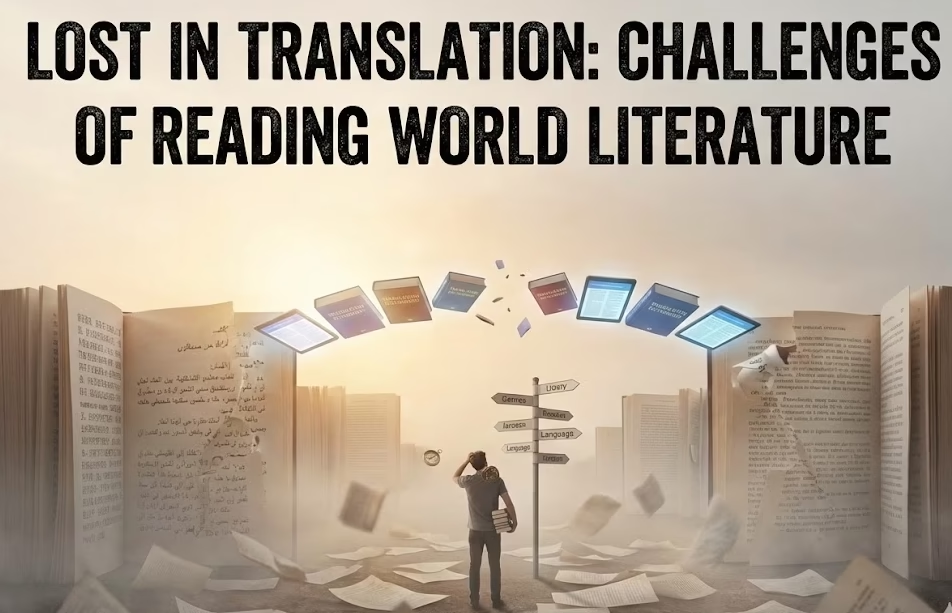
Lost in Translation: The Hidden Art of Literary Interpretation
Imagine Michelangelo’s statue of Moses, sprouting horns from a biblical mistranslation of “qeren” as “horn” instead of “ray of light.” Hilarious? Yes. Revealing? Absolutely.
We adore world literature gems like Murakami’s surreal dreams, Kafka’s eerie bureaucracies, or Tolstoy’s epic battles. But we often forget something crucial. We read a translator’s voice, not just the author’s raw words.
Translation demands a tough negotiation. Fidelity chases accuracy to the original text. Beauty pursues smooth, flowing English. You rarely get both perfectly.
Quick Summary
Translation is never a simple word-for-word swap; it is an act of interpretation. The Italian phrase “Traduttore, traditore” (Translator, traitor) captures the dilemma: to translate a text is inevitably to betray it. Theorist Lawrence Venuti argues that translators must choose between domestication (making the text smooth and easy for the target reader) or foreignisation (keeping the text “weird” to preserve the original culture). Reading World Literature requires understanding that we are always reading a “cover version” of the original song.
The Problem of “Untranslatable” Words: Lost in Translation
Some words slip through language cracks. They embed cultural specificity no English equivalent matches. Translators stare down this abyss.
Portuguese saudade haunts fado songs and Fernando Pessoa’s poetry. It blends profound nostalgia with a sweet, irreplaceable ache for the lost. “Sadness” or “melancholy” skim the surface. They skip the warm longing beneath.
German schadenfreude savours others’ downfall with a wicked gleam. Thomas Mann weaves it into human flaws. Plain “joy” erases the moral twinge—the guilty pleasure of it all.
Japanese wabi-sabi finds transient beauty in cracks and fades. Haruki Murakami nods to it in imperfect teacups amid surreal tales. “Imperfect beauty” approximates, but misses zen impermanence.
Why does this matter? Translators often default to weak glosses.
Culture evaporates: A Brazilian novel loses its emotional core.
Nuance flattens: Kafka’s precision dulls without exact terms.
Readers skim: World literature feels generic, not vivid.
This loss echoes postcolonial critiques—English dominates, diluting voices. Yet bold translators footnote or coin hybrids, preserving the soul.
“If you love language, you must read [Is That a Fish in Your Ear? by David Bellos]. It is a hilarious and brilliant look at how translation works.”
Syntax and Rhythm: The Music of Prose
Every language pulses to its own beat. Syntax crafts that rhythm—the rise, fall, and pause of meaning. Translators play conductor, rebuilding the score.
German and Latin hoard verbs at sentence ends. Readers hover in suspense, payoff delayed. Kafka masters this in The Trial: “Gregor Samsa awoke one morning… transformed.” The wait amplifies dread. English demands subject-verb-object upfront. Punchy, but it snaps tension short.
Romance languages like French meander with clauses. Verbs weave midstream. English’s rigidity jars them.
This syntactic clash murders momentum. Literal translations stutter; the prose’s heartbeat flatlines.
Proust’s In Search of Lost Time epitomises it. French sentences spiral for pages, mimicking memory’s flood—a breathless, hypnotic ramble. Choppy English versions (early hacks) hack them into fragments. The trance evaporates.
C.K. Scott Moncrieff triumphs. His 1920s rendition stretches sentences, echoing Proust’s swell. Readers drown in sensation, as intended. Lydia Davis’s modern take goes literal—crisper, but less immersive.
German suspense → English rush: Kafka loses menace.
French flow → Rigid lines: Proust’s reverie breaks.
Master translators adapt. They tweak word order or add clauses. Rhythm lives, even reshaped.
Domesticating vs. Foreignising: Lawrence Venuti’s Debate
Translation isn’t neutral. It decides a book’s “foreignness”. Lawrence Venuti, in his seminal The Translator’s Invisibility (1995), split strategies into two camps. They reveal power dynamics in global lit.
Domesticating sands down edges. It moulds foreign texts into fluent English, invisible as imports. Example: Murakami’s characters “eat on the tatami” becomes “dine on the floor”. Tolstoy’s samovar? Just “teapot”.
Pros: Effortless immersion; broad appeal.
Cons: Erases cultural texture—postcolonial voices flattened.
Foreignising thrusts otherness forward. It keeps raw terms: ‘sensei’ for teacher and ‘monsieur’ untouched, even arcane idioms footnoted. d. Kafka’s Kafkaesque stays prickly.
Pros: Authentic jolt; honours source culture.
Cons: Jars readers; demands effort.
| Strategy | Example in Practice | Impact on Reader |
|---|---|---|
| Domesticating | “Windmills” for Quixote’s giants | Smooth, but sanitised |
| Foreignising | Retain saudade in Brazilian novels | Immersive, culturally rich |
Venuti championed foreignising. It fights “cultural erasure”, echoing feminist and postcolonial theory—don’t let English colonise narratives. Yet domestication sells books.
Case Study: Dante’s Inferno (The Rhyme Problem)
Dante Alighieri engineered Inferno as sonic propulsion. Terza rima interlocks rhymes—aba bcb cdc—like infernal chains dragging you deeper into Hell. Each tercet surges forward, mirroring the pilgrim’s descent.
Italian’s vowel-heavy lexicon fuels it. Words like amore (love), dolore (pain), fuoco (fire) cascade endlessly. Rhyme feels organic, relentless.
English? A desert. Consonants dominate; perfect rhymes scarce. “Hell” pairs poorly with “fell” or “yell”—options dwindle fast.
Translators confront the abyss:
| Choice | Approach | Outcome | Example |
|---|---|---|---|
| Keep Rhyme | Force English pairs, tweak syntax | Playful energy, but meanings warp | Ciardi: “Thus I descended out of the first circle / Down to the second pit of that dark Hell.” (Charming, yet stretched) |
| Drop Rhyme | Blank verse for fidelity | Accurate terror, but prose-like | Mandelbaum: “So I went down from the first circling deep / Into the second circle of those shadows.” (Faithful, flat rhythm) |
John Ciardi’s 1954 version gambols with slant rhymes. It charms casual readers but twists Dante’s precision—Virgil quips funnily off-key.
Allen Mandelbaum (1980) opts for blank. Inferno’s horrors land true, yet the “music” fades—no propulsive chant.
Longfellow tried full rhyme in 1867; it sparkled archaically. Moderns like Hollander hybridise.
Dante’s visceral terror dims regardless. Rhyme’s loss proves poetry’s fragility, fuelling Venuti’s foreignising call—preserve form’s foreign pulse.
“Dante’s rhyme scheme is the perfect example of this struggle. See how different translators handle the Circles of Hell in our analysis of [Dante’s Inferno].”
Case Study: Don Quixote (The Humour Problem)
Cervantes’ brilliance ignites in laughter. Sancho Panza, the earthy squire, fires rapid puns, rustic proverbs, and idioms. His 17th-century Spanish crackles—wordplay on brazo (arm/weapon/limb)—skewers knightly delusions.
English crushes it. That brazo pun wilts; modern ears miss the layered jest. Idioms like “poner los puntos sobre las íes” (dot the i’s, meaning clarify) demand reinvention.
Translators pivot to “free” strategies. They invent equivalent gags, prioritising comic vibe over literals. Fidelity flexes for joy.
| Original Spanish Flavour | Example Pun/Proverb | English Adaptations |
|---|---|---|
| Brazo (arm/weapon) | Don Quixote’s “armed” folly | Edith Grossman: “Knight of the Rueful Countenance” (playful title twist) |
| “Entre el sí y el no” | Sancho’s hedging wisdom | John Rutherford: “Between yes and no, there’s a no-yes” (folksy pun) |
| Proverbial barrages | “A quien madruga, Dios le ayuda” (early bird) | Tobias Smollett (18thC): “God helps those who rise early.” + barnyard joke |
It revives Cervantes’ satire on illusion. Yet purists cringe: Straying invites ” domestication” critiques (per Venuti). Does adapted fun betray, or save, the text?
Readers roar regardless. Humor demands betrayal for survival.
“Humor is the hardest thing to translate. To understand the complexity of Sancho Panza’s puns, read our guide to [Don Quixote: A Critical Analysis].”
Conclusion: Lost in Translation
Lost in translation? Not anymore. You’ve navigated the frontlines: untranslatable cultural souls, syntactic rhythms that clash, Venuti’s domestication wars, Dante’s shattered rhymes, Cervantes’ reinvented laughs.
World literature beckons brighter. Don’t abandon Murakami’s dreams or Tolstoy’s steppes. Read with eyes wide open. Celebrate translators as co-authors. Their negotiations—fidelity versus fluency—infuse classics with new breath. Dante roars; Sancho guffaws anew.
Pro Tip: Master Literature by Comparing Translations
Choose wisely: Pick Kafka’s Metamorphosis—Murdoch’s fluid take vs. Brevda’s literal grit.
Spot battles: Track rhythm (German suspense?), words (Ungeziefer as “vermin” or “beetle”?), and tone (absurd or horrific?).
Reflect critically: Which honours culture? Apply Venuti—foreign or tame?
Discuss: What shifts your read? Postcolonial lenses reveal power plays.
This method sharpens analysis. It bridges theory and text—like feminist rereadings of Inferno‘s Beatrice. Dive in. What gems do you unearth?
Share your comparisons below!
FAQS: Lost in Translation
What is the difference between literal and free translation?
Literal translation sticks word-for-word to the original. It prioritises fidelity but often sounds awkward in English. Free translation focuses on natural flow and meaning. It adapts idioms or puns for readability. Literal keeps accuracy; free chases beauty. Most world literature blends both.
Why is poetry lost in translation?
Poetry relies on rhyme, rhythm, and wordplay tied to its language. English lacks matches for Italian terza rima or Japanese haiku brevity. Translators choose: force rhymes (risking silliness) or drop them (losing music). Cultural nuances vanish too. Dante's Inferno proves it—form fractures across tongues.