INTRODUCTION
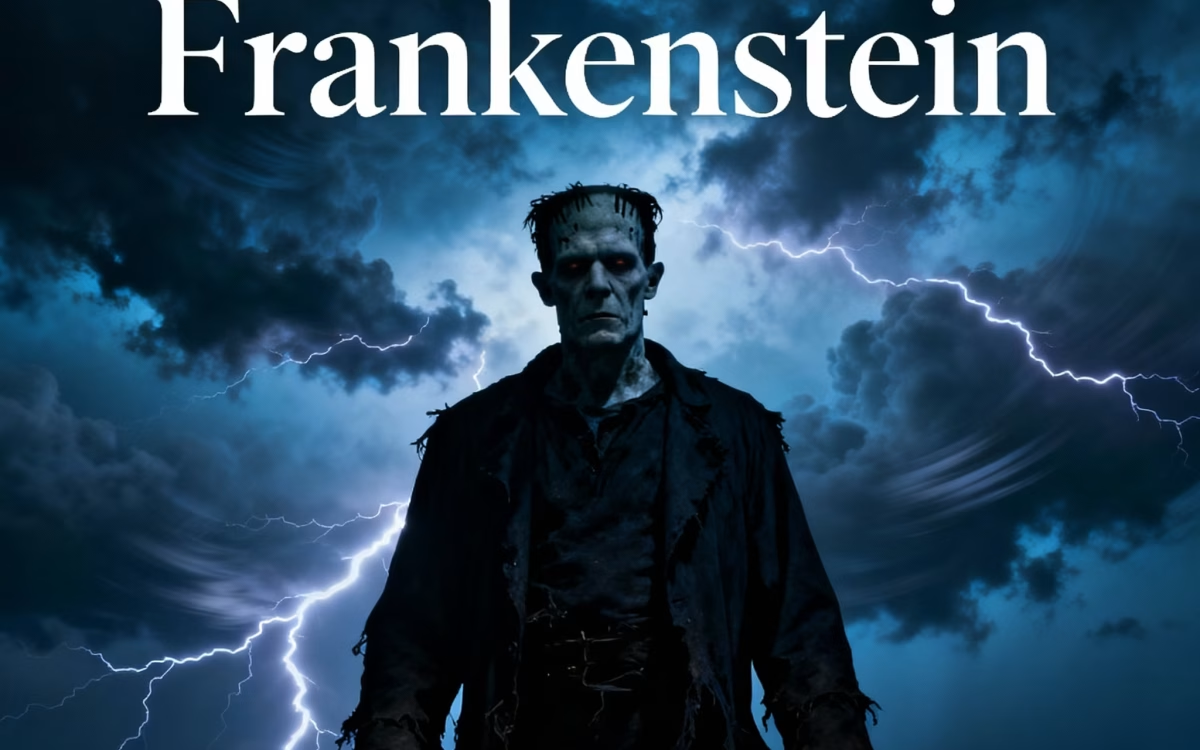
Few literary works have captured the imagination and provoked profound questions about human nature, creativity, and ethics quite like Mary Shelley’s Frankenstein. Since its first publication in 1818, Frankenstein has transcended its Gothic roots to become an enduring cultural and philosophical touchstone. Indeed, this novel is far more than a simple horror story about a monstrous creation; it is a rich exploration of ambition, responsibility, and the consequences of playing god. Moreover, the name “Frankenstein” has seamlessly woven itself into the fabric of literary scholarship, pop culture, and ethical debates surrounding scientific progress—resonating vividly with readers worldwide, from Western universities to classrooms across India.
Written on a tempestuous summer night amid a rainy retreat with literary figures like Percy Shelley and Lord Byron, Shelley’s tale reflects the zeitgeist of an era grappling with industrial innovation and its moral dilemmas. Victor Frankenstein’s obsessive quest to conquer death and bestow life brings into focus timeless concerns about the boundaries of human knowledge and the price of unchecked ambition. Just as relevant today, Frankenstein serves as a critical mirror reflecting modern anxieties about technological advancements such as artificial intelligence, genetic engineering, and environmental stewardship.
By highlighting Frankenstein’s enduring themes—such as creation and responsibility, nature versus nurture, and alienation—this analysis also embraces contemporary perspectives, including postcolonial and feminist readings that resonate strongly within India’s diverse sociocultural landscape. Thus, this article provides not only historical and critical insights but also relatable reflections that inspire readers to consider the novel’s lessons in modern contexts.
Mary Shelley’s Frankenstein: Plot Overview
The Beginning
Mary Shelley’s Frankenstein begins with Victor Frankenstein, a gifted young man born into a wealthy family in Geneva. From a young age, Victor exhibits an intense curiosity about science and the secrets of life. After the death of his mother, he travels to the University of Ingolstadt to pursue his studies in natural philosophy and chemistry. It is here that Victor discovers a method to animate lifeless matter, setting him on a path toward a dangerous and obsessive scientific breakthrough.
The Creation of the Creature
Driven by ambition and a desire to conquer death, Victor assembles a giant humanoid being from collected body parts. However, upon bringing the Creature to life, Victor is immediately horrified by its monstrous appearance and abandons it. The Creature, left alone and rejected, escapes into the wilderness, unaware of its origins but burdened by immense loneliness.
The Creature’s Awakening and Education
The newly animated Creature initially possesses a childlike innocence and kindness. He secretly observes a poor peasant family, learning language, social behavior, and human emotions by watching them. Through this self-directed education, which includes reading works like Paradise Lost, the Creature gains profound self-awareness but also experiences painful rejection when the family, like the outside world, reacts with fear and hostility to his appearance.
The Tragedy of William and Justine
Seeking to confront his creator and demand justice for his suffering, the Creature travels to Geneva. There, he encounters Victor’s young brother William, whom he kills in an act of vengeance against Victor. The Crime is falsely pinned on Justine Moritz, a family servant, who is wrongfully accused and executed. Victor, tormented by guilt, remains silent while these tragic events unfold.
The Creature’s Demand and Victor’s Hesitation
The Creature confronts Victor on a glacier, recounting his sorrowful story and requesting a female companion—another being like himself to cure his isolation. Victor reluctantly agrees and travels to England with his friend Henry Clerval to gather materials for this endeavor.
The Creation and Destruction of the Female Creature
Victor isolates himself on a remote Orkney island to build the female Creature. However, overwhelmed by fears of unforeseen consequences—such as the female rejecting the Creature or the pair reproducing uncontrollably—Victor destroys the unfinished female. Enraged by this betrayal, the Creature vows revenge, warning Victor he will be with him on his wedding night.
The Escalation: Murders and Mental Decline
Following the destruction of the female Creature, Henry Clerval is found murdered, a crime Victor’s Creature commits to punish his creator. Victor is wrongfully imprisoned but eventually released with his father’s help. On returning to Geneva, Victor marries Elizabeth Lavenza, but during their wedding night, the Creature murders Elizabeth, crushing Victor’s remaining happiness.
The Final Pursuit and Arctic Framing
Grieving and vowing vengeance, Victor pursues the Creature northwards into the Arctic. The story is framed by letters from explorer Robert Walton, who rescues a dying Victor and learns his tragic tale. As Victor dies aboard Walton’s ship, the Creature appears to mourn his creator, reflecting on the misery their fates have wrought. The Creature vows to end his own life, disappearing into the Arctic wasteland to die. FULL TEXT
Mary Shelley’s Frankenstein: Major themes
Ambition and the Dangers of Overreaching
One of the most central and powerful themes in Frankenstein is unchecked ambition. Victor Frankenstein’s relentless quest to unlock the secret of life embodies Romantic ideals that celebrate scientific progress, yet his failure to foresee the consequences reveals the dangers of overreaching. Shelley uses Victor’s tragic downfall to caution readers about the ethical responsibilities that come with knowledge and creation. This theme resonates deeply in today’s world, where technological innovation pushes boundaries, raising urgent questions about responsibility and moral limits.
Creation and Responsibility
Closely tied to ambition is the theme of creation and the creator’s responsibility toward their creation. Victor’s horror and subsequent abandonment of his Creature highlight a profound moral failure. Shelley raises essential questions: What obligations does a creator have to their creation? How does neglect affect both creator and created? The Creature’s descent into violence is not innate evil but a product of rejection and loneliness—a narrative that invites reflection on parenthood, stewardship, and ethical accountability.
Isolation and Alienation
Isolation permeates the novel on multiple levels. Victor isolates himself from family and society in pursuit of scientific discovery, suffering from the emotional consequences of his obsession. Meanwhile, the Creature experiences forced alienation due to his grotesque appearance, enduring profound loneliness and societal rejection. This dual isolation constructs a tragic parallel that explores the human need for connection and the pain of exclusion. In contemporary contexts, especially in India and other diverse societies, this theme speaks to experiences of marginalization and the search for belonging.
The Nature of Prejudice and Beauty
Shelley critiques society’s shallow definitions of beauty and acceptance. The Creature, despite his intelligence, sensitivity, and desire for companionship, is shunned solely due to his outward deformity. This theme challenges readers to reconsider the true nature of monstrosity—not in physical form, but in social rejection and cruelty. The novel’s portrayal of prejudice remains relevant as it reflects ongoing issues of discrimination based on appearance, caste, and social identities.
Revenge and the Destructive Cycle
The theme of revenge drives much of the plot’s tragic momentum. After suffering rejection and loss, both Victor and the Creature become consumed with vengeance, resulting in a deadly cycle of violence that destroys families and lives. Shelley explores how grief and anger, when left unchecked, perpetuate suffering rather than resolve it. This theme underlines the novel’s broader moral about forgiveness and the consequences of hatred.
The Conflict Between Nature and Science
Frankenstein juxtaposes the power and beauty of nature with the artificial, uncontrolled force of science. Romantic ideals praise the natural world as sublime and healing, contrasting sharply with Victor’s cold scientific experiments that disrupt natural order. This tension highlights the consequences when human ambition seeks to dominate or bypass nature, a concern especially relevant amid ongoing environmental crises and debates over genetic manipulation.
Mary Shelley’s Frankenstein: Feminist Perspectives
Though largely male-centered, the novel implicitly critiques patriarchal structures by illustrating the absence of female agency. Female characters such as Elizabeth and Justine possess little narrative power and suffer the consequences of male actions. Critics often interpret the destruction of potential female life—the female Creature’s aborted creation—as symbolic of the suppression of women’s roles in science and society. This provides an important feminist reading that enriches understanding of Frankenstein today.
Mary Shelley’s Frankenstein: Knowledge, Education
Education is a double-edged sword in Frankenstein. The Creature’s self-education humanizes him and fosters empathy, yet the knowledge he gains also intensifies his awareness of his outcast status, amplifying his despair. Victor’s pursuit of forbidden knowledge results in tragedy, highlighting the conflicting consequences of enlightenment and the ambivalence toward new knowledge characteristic of the Romantic period.
Mary Shelley’s Frankenstein: Narrative Technique
Use of Literary Devices
The novel abounds with rich literary devices that contribute to its enduring Gothic atmosphere and intellectual rigor:
Foreshadowing: Shelley hints at tragic outcomes early on, creating suspense and a sense of inevitable doom.
Imagery: Vivid descriptions of icy landscapes, dark laboratories, and desolate settings intensify the novel’s mood and symbolize isolation and emotional turmoil.
Metaphor and Symbolism: The Creature embodies larger themes of social alienation, unchecked ambition, and the “other.” Light and fire repeatedly symbolize knowledge and destruction.
Irony: The tragic irony of Victor’s quest for glory resulting in devastation punctuates the narrative, underscoring the limits of human control.
Allusions: References to classical mythology (Prometheus), religious texts (Paradise Lost), and contemporary science enrich the novel’s thematic layers.
Frame Narrative Structure
Mary Shelley employs a sophisticated frame narrative consisting of several embedded stories. First, the letters of Robert Walton introduce and conclude the novel. Within these letters, Victor Frankenstein narrates his life story. Nested inside Victor’s account is the Creature’s own narrative. This “story within a story” technique creates a layered perspective that challenges readers to question the reliability and bias of each narrator. Furthermore, it heightens the novel’s thematic complexity by juxtaposing the viewpoints of creator and creation. This structure emphasizes their shared humanity while blurring the lines between monster and man.
Gothic and Romantic Influences
Shelley’s style amalgamates Gothic tradition with Romantic sensibilities. The novel embraces Gothic tropes—dark settings, supernatural overtones, and intense emotional states—while integrating Romantic emphasis on individual emotion, the sublime power of nature, and critique of Enlightenment rationalism. This fusion creates a dramatic and evocative narrative that probes both psychological depths and ethical questions with a poetic sensibility. EXPLORE MORE
Mary Shelley’s Frankenstein: Character Analysis
Victor Frankenstein: The Tragic Creator
Victor Frankenstein is the novel’s protagonist and a figure defined by his obsessive ambition and intellectual curiosity. Hailing from a privileged family in Geneva, Victor’s early passion for natural philosophy drives him to unlock the secret of animating lifeless matter. However, his reckless pursuit of knowledge blinds him to the ethical and emotional consequences of his creation. Victor’s initial pride and excitement swiftly turn to horror and guilt when his Creature comes to life. His abandonment of the Creature sowed the seeds of tragedy, leading to the loss of his family and his own psychological downfall. Victor’s story is a cautionary tale about the limits of human ambition and the moral responsibilities inherent in creation.
The Creature: More Than a Monster
Often mistakenly called “Frankenstein,” the Creature is a complex character who embodies themes of alienation, suffering, and humanity’s capacity for both good and evil. Composed of assembled human parts, the Creature initially possesses innocence and a desire for connection. His eloquence, self-education, and moral reflection stand in sharp contrast to his grotesque appearance, which causes universal rejection and fear. This paradox makes the Creature one of literature’s most poignant outcasts, provoking readers to question societal definitions of monstrosity and the consequences of neglect and prejudice. His tragic transformation from gentle seeker to vengeful figure highlights the destructive effects of isolation and social exclusion.
Elizabeth Lavenza: The Ideal Woman
Elizabeth, Victor’s cousin, adopted sister, and eventual wife, represents the Romantic ideal of feminine purity and domestic virtue. She embodies compassion, innocence, and unwavering loyalty, serving as a symbol of the normal life Victor sacrifices. Elizabeth’s tragic death on the wedding night marks the final destruction of Victor’s hopes for happiness and family. Though a seemingly passive character, her role underscores themes of victimization and the costs of Victor’s unchecked ambition.
Henry Clerval: Victor’s Loyal Friend
Henry Clerval provides a moral and emotional counterpoint to Victor Frankenstein. His compassionate, lively, and optimistic nature balances Victor’s obsessive intensity. Clerval’s dedication to humanistic values and friendship offers moments of respite for Victor but tragically also makes him a victim of the Creature’s vengeance. His death serves as a sobering reminder of the far-reaching consequences of Victor’s actions.
Alphonse and Caroline Frankenstein
Victor’s parents, Alphonse and Caroline Frankenstein, represent love, stability, and societal norms. Their nurturing environment shapes Victor’s early moral framework, emphasizing education and responsibility. Caroline’s death and Alphonse’s grief highlight the familial costs of Victor’s scientific hubris. Their characters deepen the novel’s exploration of parental duty and loss.
Robert Walton: The Frame Narrator
Robert Walton, an Arctic explorer writing letters to his sister, frames the main narrative. His ambition and thirst for discovery parallel Victor’s, serving as a cautionary mirror. Walton’s encounter with Victor and the Creature invites readers to reflect on the dangers of obsession and the importance of human connection. Through Walton’s letters, Shelley invites contemplation on the limits of knowledge and the value of companionship.
Conclusion
Mary Shelley’s Frankenstein remains a powerful and timeless work that continues to captivate readers. Its profound exploration of ambition, responsibility, and the human condition resonates deeply. Indeed, the novel’s tragic conclusion—with Victor Frankenstein’s demise and the Creature’s mournful vow to end his own life—underscores the devastating consequences of unchecked scientific pursuit and social rejection. Moreover, Shelley leaves readers with a haunting meditation on creation and destruction, inviting ongoing reflection on ethical boundaries in innovation.
As Victor’s relentless quest for revenge ends in his death aboard Walton’s ship, the narrative frames a cautionary tale about the dangers of obsession and isolation. Furthermore, the Creature’s sorrowful appearance over Victor’s lifeless body, along with his decision to disappear into the Arctic ice, highlights the theme of loneliness and the longing for connection. This serves as a powerful reminder of the human need for empathy.
In today’s rapidly evolving technological world, Frankenstein continues to resonate deeply with readers. It confronts similar ethical questions surrounding artificial intelligence, genetic engineering, and the limits of human control over nature. Notably, its themes are particularly relevant within diverse cultural contexts such as India’s, where issues of social alienation, identity, and modernization provoke critical dialogues.
Ultimately, Frankenstein offers more than a Gothic horror story; it is a profound reflection on the human spirit and the moral complexities of creation. Therefore, this novel challenges us to consider the costs of our ambitions and the compassion we owe both to our creations and to each other. Thus, its lasting legacy firmly establishes it as a cornerstone of literary study and ethical contemplation.
Frequently Asked Questions
1. Why does Victor Frankenstein create the Creature?
Victor is driven by an intense ambition to conquer death and achieve scientific glory. He becomes obsessed with the idea of animating lifeless matter, striving to surpass natural limits and become a creator of life. His motivations are a complex mix of intellectual curiosity, personal glory, and a desire to overcome human mortality.
2. Is the Creature in Frankenstein evil by nature?
No, the Creature is not inherently evil. Initially innocent and curious, he seeks companionship and acceptance like any human. His malevolence develops as a response to relentless rejection, isolation, and cruelty from society and his creator, which fuels his bitterness and quest for revenge.
3. What are the main themes of Frankenstein?
Key themes include unchecked ambition and its consequences, creation and responsibility, isolation and alienation, nature versus nurture, prejudice and beauty, revenge, and the ethical limits of scientific exploration. These themes explore both personal and societal conflicts that remain relevant today.
4. Who is the real monster in Frankenstein?
The novel invites readers to question who the true “monster” is—Victor Frankenstein for irresponsibly abandoning his creation, or the Creature for his violent actions. In many ways, both exhibit monstrous traits shaped by their choices and circumstances, highlighting the blurred lines between monster and man.
5. How does the narrative structure of Frankenstein work?
Frankenstein employs a frame narrative: the story is told through letters from explorer Robert Walton, who encounters Victor Frankenstein in the Arctic. Victor narrates his tragic story to Walton, and within Victor’s tale, the Creature also tells his own experiences. This layered storytelling adds complexity and multiple perspectives to the novel.