Introduction
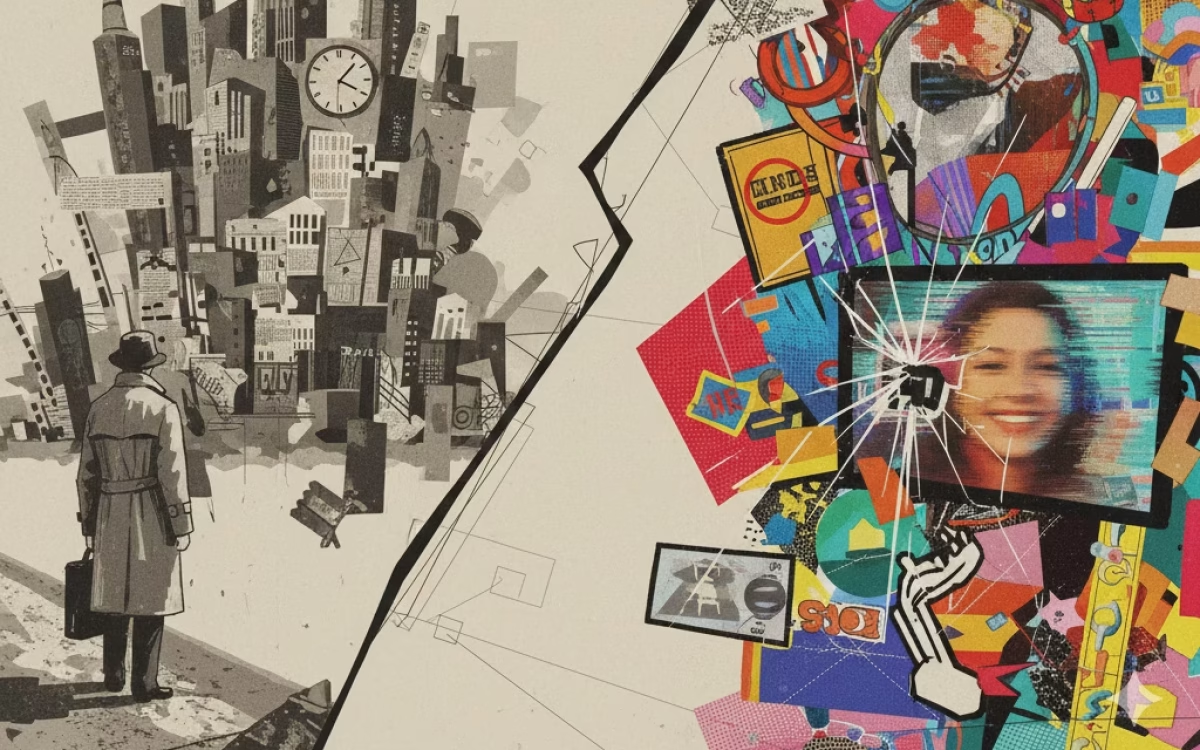
Modernism and Postmodernism are two of the most influential literary movements that have shaped the landscape of literature and culture since the late 19th and mid-20th centuries, respectively. To begin with, these movements arose as responses to rapid societal changes, world wars, technological advances, and cultural shifts, thereby questioning established beliefs and artistic conventions in distinct yet interconnected ways.
Specifically, Modernism emerged in the early 20th century as a bold break from traditional literary and artistic forms. Moreover, influenced by thinkers who doubted the certainty of established truths and narratives, modernist writers experimented with style, form, and content to capture the fractured experiences of a rapidly changing, often chaotic world. Modernist literature often emphasizes themes of alienation, fragmentation, and a search for meaning amidst disorientation. For instance, writers like James Joyce, T.S. Eliot, and Virginia Woolf embraced techniques such as stream of consciousness and symbolism to explore inner consciousness and the complexities of human perception.
On the other hand, Postmodernism, which gained prominence after World War II, builds on modernism’s challenges but pushes further into skepticism and relativism. In contrast, it rejects the grand narratives and universal truths that modernism still sought, instead embracing ambiguity, irony, and a playful questioning of reality itself. Postmodern literature frequently employs metafiction, unreliable narrators, pastiche, and intertextuality, thus revealing the constructed nature of storytelling. Furthermore, influenced by the information age and the rise of consumer culture, postmodern works often reflect themes of chaos, uncertainty, and the breakdown of clear distinctions between high and low culture. Notably, prominent postmodern authors include Kurt Vonnegut, Thomas Pynchon, and Gabriel García Márquez, who often highlight the absurdity and fragmentation of contemporary existence.
Therefore, understanding these movements is essential for a deeper appreciation of 20th and 21st-century literature, as they offer contrasting yet overlapping lenses through which to interpret the human condition and the evolving narrative techniques that shape modern literary expression. FULL TEXT
Modernism and Postmodernism: The Beginnings
Modernism and Postmodernism in literature both have distinct beginnings, which are rooted in the cultural, social, and intellectual upheavals of their respective eras. To start with, Modernism began in the late 19th and early 20th centuries, arising as a reaction to the profound transformations brought by industrialization, urbanization, and the horrors of World War I. During this period, the late Victorian certainties were crumbling, and the rapid pace of change created a collective sense of disillusionment. Consequently, thinkers and artists felt that traditional forms of art, narrative, and representation were inadequate to capture the complexities of modern life. For example, philosophers like Friedrich Nietzsche questioned absolute truths, while psychoanalysis, especially Freud’s theories of the unconscious, opened new dimensions of human experience.
Furthermore, literature embraced these shifts by experimenting with new styles—fragmented narratives, stream of consciousness, and symbolism—to reflect a fractured reality and intense inner psychological states. Writers such as T.S. Eliot with his poem The Waste Land, James Joyce’s Ulysses, and Virginia Woolf’s Mrs. Dalloway became emblematic of this modernist break with the past. Thus, the movement sought to uncover deeper truths beneath surface realities, even as it embraced complexity and ambiguity.
In contrast, Postmodernism began to take shape after World War II, particularly from the 1950s onward, reaching prominence in the 1960s and beyond. It developed in a world vastly changed by yet another devastating global conflict, the atomic age, and the rise of mass media and consumer culture. Whereas Modernism sought to find meaning in chaos, Postmodernism questioned whether such meaning was even possible or desirable. It was marked by skepticism toward grand narratives, ideologies, and the very notion of objective truth. Moreover, the post-war cultural landscape, shaped by rapid technological advances and an increasingly pluralistic society, fostered a playful, often ironic approach to art and literature.
Consequently, Postmodern writers rejected Modernism’s earnest search for universal truth and instead embraced pastiche, metafiction, and self-referentiality to expose the artificiality of storytelling and the instability of meaning. Influential figures like Thomas Pynchon and Kurt Vonnegut challenged conventions by blending genres and blurring boundaries between reality and fiction.
Modernism’s beginnings are deeply rooted in the desire to respond innovatively to a rapidly changing world marked by crisis and transformation, seeking new forms to express fragmented realities. Postmodernism’s origins lie in a more radical questioning of those very attempts, emphasizing uncertainty, multiplicity of meanings, and skepticism about progress and coherence in the post-war era. Together, these beginnings set the stage for two of the most dynamic and challenging literary movements of the 20th century.
Modernism and Postmodernism: Key Themes
Modernist Literature
Modernist literature, flourishing generally from the late 19th century to the mid-20th century, primarily explores the deep anxieties and upheavals caused by rapid societal change, war, and technological advances. In particular, its major themes often revolve around the fractured human experience in a disjointed, uncertain world. Moreover, Modernist works frequently delve into feelings of alienation and isolation, the fragmentation of self and society, and a profound search for meaning amidst chaos. Furthermore, many modernist authors employ experimental narrative techniques such as stream of consciousness to explore psychological depth and subjective reality. Consequently, Modernist literature challenges traditional storytelling and reflects the complexities of modern existence.
Alienation and Isolation: Modernist works frequently portray characters disconnected from society, grappling with loneliness and estrangement. This reflects broader social fragmentation and the individual’s quest to find place amid upheaval. For example, T.S. Eliot’s The Waste Land evokes a spiritually barren civilization marked by decay.
Fragmentation and Dislocation: Modernist narratives are often non-linear and fragmented, mirroring the fractured realities of modern life. The disruption of traditional narrative structures conveys the instability of human experience and perception.
Search for Meaning and Truth: In the absence of grand, unifying narratives, modernist characters wrestle with existential questions and the ambiguity of truth. This quest frequently leads to uncertainty or despair, showcasing the crisis of faith in established values.
Subjectivity and Psychological Introspection: Influenced by Freud’s psychoanalysis, modernist literature explores the inner workings of the mind, employing techniques like stream of consciousness to reveal complex psychological depths.
Disillusionment with Progress and Tradition: Modernists challenge the promises of progress and the stability of traditional institutions such as religion, nationalism, and social hierarchies, questioning their relevance in a changing world.
Exploration of Time and Memory: Time is depicted as subjective and fluid rather than fixed, with an emphasis on memory’s role in shaping individual consciousness, as seen in Virginia Woolf’s works.
Critique of Social Norms and Inequality: Social hierarchies, class struggles, and gender roles come under scrutiny, reflecting growing awareness of systemic injustice and societal transformations.
Postmodernist Literature
Postmodernism, emerging prominently after World War II, markedly takes a more skeptical and playful approach to literature and culture. Specifically, it deconstructs the search for objective meaning and challenges traditional boundaries in art and thought. Moreover, Postmodern literature frequently embraces fragmentation, unreliable narration, and metafiction to reveal the constructedness of storytelling. Consequently, it blurs genres and questions reality through intertextuality and self-referentiality. In addition, this movement reflects the deep disillusionment and sense of meaninglessness that arose from the war’s devastation and rapid technological changes. Therefore, Postmodernism not only extends but also radically transforms the literary experiments of Modernism, offering a profound critique of established narratives and opening up new ways to explore identity and reality.
Skepticism Toward Grand Narratives: Postmodernism rejects overarching universal truths or ideologies, emphasizing the relativity of knowledge and the multiplicity of perspectives. It questions claims of objective reality or certainty.
Irony, Playfulness, and Parody: Postmodern literature often uses irony and humor to expose the constructed, artificial nature of stories and cultural products, highlighting the fluid boundaries between truth and fiction.
Metafiction and Self-Reflexivity: A key postmodern technique where texts self-consciously acknowledge their status as artifacts, calling attention to their own creation and narrative artifice.
Pastiche and Intertextuality: Postmodern works blend styles, genres, and references from multiple sources, often combining “high” and “low” culture to challenge cultural hierarchies and celebrate diversity and hybridity.
Fragmentation and Paradox: Similar to modernism, postmodernism also embraces fragmentation, but with an acceptance of paradox and contradiction rather than attempted coherence.
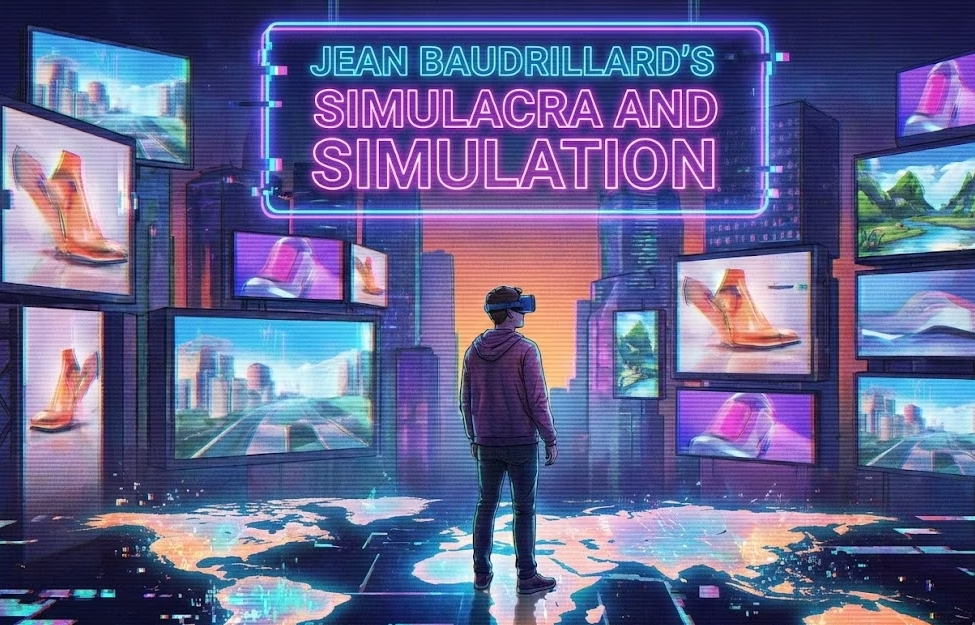
Hyperreality and Simulation: Explored by theorists like Baudrillard, postmodern literature reflects the blurred lines between reality and media simulation in contemporary society.
Cultural and Identity Fluidity: Postmodernism explores themes of fragmented identities, multiculturalism, and the instability of concepts like gender and ethnicity, emphasising the pluralistic nature of experience.
Modernism and Postmodernism: Major Writers
Modernist Writers
James Joyce: Often hailed as a master of stream of consciousness, Joyce’s works like Ulysses and A Portrait of the Artist as a Young Man exemplify Modernism’s focus on subjective experience, fragmented narratives, and linguistic innovation. His dense, allusive style challenges readers to engage deeply with the text’s multiple layers of meaning.
T.S. Eliot: A leading Modernist poet, Eliot’s The Waste Land is a landmark poem depicting cultural decay and disillusionment after World War I. His use of fragmentation, myth, and allusion captures the fractured modern psyche and the search for spiritual renewal.
Virginia Woolf: Woolf’s novels, including Mrs. Dalloway and To the Lighthouse, explore the fluidity of time and consciousness through interior monologues and shifting perspectives. Her work embodies Modernism’s psychological depth and experimentation with narrative form.
Franz Kafka: Kafka’s surreal and often nightmarish stories such as The Metamorphosis reflect Modernism’s alienation and existential anxieties, exploring themes of bureaucracy, absurdity, and the ineffable struggles of human existence.
Marcel Proust: Known for his monumental work In Search of Lost Time, Proust investigates memory, time, and perception, employing intricate, introspective prose to uncover the nuances of lived experience.
Postmodernist Writers
Thomas Pynchon: An exemplary postmodern novelist, Pynchon’s sprawling works like Gravity’s Rainbow blend high art with pop culture, conspiracy theories, and a fragmented narrative style that reflects postmodern skepticism and complexity.
Kurt Vonnegut: Blending dark humor with social critique, Vonnegut’s novels such as Slaughterhouse-Five use bizarre, non-linear storytelling and metafictional techniques to challenge traditional narrative authority and address the absurdities of history and human nature.
Don DeLillo: His works, including White Noise and Underworld, dissect contemporary culture, media saturation, and technological influence, often highlighting the blurred lines between reality and simulation in postmodern life.
Margaret Atwood: Atwood’s novels like The Handmaid’s Tale explore gender, identity, and dystopia, combining speculative fiction with postmodern concerns about power, language, and social constructs.
Gabriel García Márquez: A key figure in magical realism, García Márquez’s One Hundred Years of Solitude employs postmodern elements such as non-linear time, intertextuality, and a blending of myth and reality, questioning historical and narrative certainties.
These authors not only defined their respective movements but also expanded literary possibilities through innovative techniques, profound thematic concerns, and radical approaches to storytelling, leaving lasting legacies that continue to influence literature today.
This table captures the essence of each writer’s contribution to Modernism and Postmodernism, highlighting their stylistic innovations and thematic concerns that significantly shaped literary history.
| Writer | Important Works | Publication Year | Key Details |
|---|---|---|---|
| James Joyce | Ulysses | 1922 | Pioneer of stream of consciousness; explores consciousness and fragmented narrative style. |
| T.S. Eliot | The Waste Land | 1922 | Symbolic and allusive poetry reflecting cultural decay and disillusionment post-WWI. |
| Virginia Woolf | Mrs. Dalloway, To the Lighthouse | 1925, 1927 | Psychological introspection and fluid narrative time; explores inner consciousness. |
| Franz Kafka | The Metamorphosis | 1915 | Themes of alienation, absurdity, and existential anxiety with surreal narratives. |
| Marcel Proust | In Search of Lost Time | 1913-1927 | Detailed exploration of memory, subjective time, and introspection. |
| Thomas Pynchon | Gravity’s Rainbow, The Crying of Lot 49 | 1973, 1966 | Postmodern complexity, paranoia, and blending of high and low culture with fragmented narratives. |
| Kurt Vonnegut | Slaughterhouse-Five, Cat’s Cradle | 1969, 1963 | Satirical and metafictional style; explores absurdity of war and human nature. |
| Don DeLillo | White Noise, Underworld | 1985, 1997 | Postmodern critique of media culture, technology, and hyperreality. |
| Margaret Atwood | The Handmaid’s Tale, Oryx and Crake | 1985, 2003 | Feminist dystopian narratives; explores power, language, and identity in postmodern contexts. |
| Gabriel García Márquez | One Hundred Years of Solitude | 1967 | Magical realism, non-linear time, and blending myth with history reflecting postmodern elements. |
FAQS
What is Modernism in literature?
Modernism is a literary movement from the late 19th to mid-20th century that fundamentally breaks with traditional forms and primarily focuses on fragmented narrative, psychological depth, and exploring alienation in a changing world. Specifically, Modernist literature rejects linear storytelling and neat conclusions, instead opting for complex, often ambiguous narratives. Furthermore, it emphasizes subjective experience and interiority, employing techniques such as stream of consciousness to delve into characters’ minds. Consequently, Modernism reflects the disjointed and rapidly transforming society of its time, grappling with themes of isolation, identity crises, and the breakdown of established norms. In addition, Modernist writers sought innovation in form and style, pushing literary boundaries to capture the complexity of modern existence.
2. What defines Postmodernism in literature?
Postmodernism is a mid-20th-century literary movement that is distinctively marked by skepticism towards grand narratives, while embracing irony, metafiction, fragmentation, and questioning the nature of reality and truth. In particular, postmodern literature often challenges traditional storytelling by using unreliable narrators and non-linear plots. Furthermore, it engages in self-reflexivity and intertextuality, thus blurring the boundaries between genres and realities. As a result, Postmodernism unsettles established conventions and encourages readers to question the stability of meaning itself. Overall, it presents a playful yet critical examination of knowledge, identity, and cultural constructs.
3. How do Modernism and Postmodernism differ?
Modernism seeks new meanings and universal truths through fragmented forms, while Postmodernism denies absolute truths, emphasizing ambiguity, playfulness, and self-referentiality.
4. Who are some key Modernist writers?
James Joyce, T.S. Eliot, Virginia Woolf, Franz Kafka, and Marcel Proust are pivotal Modernist authors known for their innovative styles and thematic depth.
5. Who are notable Postmodernist writers?
Thomas Pynchon, Kurt Vonnegut, Don DeLillo, Margaret Atwood, and Gabriel García Márquez are leading figures in Postmodern literature.
6. What are common themes in Modernist literature?
Themes include alienation, fragmentation, the search for meaning, psychological introspection, disillusionment with progress, and subjective experiences of time.
7. What themes dominate Postmodern literature?
Postmodern themes involve skepticism, irony, the rejection of grand narratives, metafiction, intertextuality, cultural hybridity, and fragmented identities.
8. What is stream of consciousness?
A narrative technique popularized by Modernists like Joyce and Woolf that depicts the continuous flow of a character’s thoughts and feelings.
9. What role does irony play in Postmodernism?
Irony is used to highlight contradictions, question serious themes, and undermine traditional assumptions about truth and reality.
10. How does Postmodernism treat historical facts?
Postmodern literature often questions historical objectivity, blending fact and fiction to show the subjectivity of narratives.
11. What is metafiction?
A Postmodern technique where a work self-consciously comments on its own fictional status, blurring the line between reality and storytelling.
12. Why is fragmentation important in both movements?
Fragmentation reflects disjointed realities and challenges linear storytelling, emphasizing the complexity and uncertainty of human experience.
13. How did World War I influence Modernism?
WWI’s devastation fueled Modernist themes of disillusionment, alienation, and a break with optimistic traditions.
14. How did World War II impact Postmodernism?
Post-WWII skepticism about truth, authority, and progress inspired Postmodernism’s playful, critical stance towards narratives and culture.
15. What is pastiche in Postmodern literature?
Pastiche is a blending of multiple styles, genres, and cultural references, often used to question authenticity and originality.
16. How do these movements approach the concept of truth?
Modernism pursues deeper truths beneath surface realities, while Postmodernism argues that truth is relative, constructed, and plural.
17. Can a text be both Modernist and Postmodernist?
Yes, some late 20th-century works blend elements of both, reflecting transitions in literary style and cultural thought.
18. How do Modernist authors portray time?
Time is subjective, often nonlinear, focusing on memory and psychological perception rather than chronological order.
19. What is hyperreality in Postmodernism?
Hyperreality refers to the condition where simulation or media images replace or distort true reality.
20. What role does cultural critique play?
Both movements critique social norms; Modernism challenges established values, and Postmodernism critically examines power structures and cultural assumptions.
21. How accessible are Modernist and Postmodernist texts?
Modernist texts can be dense and complex, requiring active interpretation. Postmodern texts can be playful but also subversive, often challenging conventional reading practices.
22. What is the significance of unreliable narrators?
Common in Postmodernism, unreliable narrators challenge the reader’s trust in the story’s truth, highlighting subjectivity and multiple perspectives.
23. How have these movements influenced contemporary literature?
They have expanded narrative experimentation, blurred genre boundaries, and deepened explorations of identity and reality.
24. Are there global perspectives in these movements?
While initially Western-centric, both movements now encompass diverse voices incorporating varied cultural experiences.
25. Why is it important to study Modernism and Postmodernism?
Understanding these movements provides insight into how literature reflects and shapes changing cultural and philosophical ideas about reality, meaning, and art.
Modernism and Postmodernism vs Other Ages
This table reflects how Modernism and Postmodernism contrast with earlier literary ages in their characteristics, thematic preoccupations and narrative innovations, highlighting their unique positions in literary history. EXPLORE OTHER AGES
| Literary Age | Age/Period | Characteristics | Genres | Themes | Key Literary Writers |
|---|---|---|---|---|---|
| Romanticism | Late 18th – Mid 19th Cent. | Emphasis on emotion, nature, individualism, imagination | Poetry, Novel, Drama | Nature, individual heroism, emotion | William Wordsworth, Mary Shelley, Byron |
| Victorian | Mid – Late 19th Century | Realism, social critique, moral earnestness | Novel, Poetry | Social reform, industrialization, class | Charles Dickens, Thomas Hardy, George Eliot |
| Modernism | Early 20th Century (1890-1940s) | Fragmentation, stream of consciousness, experimental form | Novel, Poetry, Drama | Alienation, disillusionment, psychological depth | James Joyce, T.S. Eliot, Virginia Woolf, Franz Kafka |
| Postmodernism | Mid 20th Century – Present | Irony, metafiction, pastiche, skepticism of grand narratives | Novel, Drama, Flash fiction, Mixed media | Relativism, hyperreality, fragmentation, identity | Thomas Pynchon, Kurt Vonnegut, Don DeLillo, Margaret Atwood |
| Realism | Mid 19th Century | Detailed depiction of everyday life, objective narration | Novel, Short story | Social issues, morality, human behavior | Gustave Flaubert, Leo Tolstoy, Henry James |
| Naturalism | Late 19th Century | Determinism, pessimism, influence of environment and heredity | Novel, Drama | Survival, fate, social conditions | Émile Zola, Stephen Crane, Frank Norris |
| Renaissance | 14th – 17th Century | Revival of classical learning, humanism, balanced style | Poetry, Drama, Essay | Human potential, nature, classical myths | William Shakespeare, John Milton, Petrarch |
Conclusion
Modernism and Postmodernism represent two pivotal literary movements that have profoundly shaped 20th-century literature and continue to influence contemporary writing. Initially, Modernism emerged as a response to the rapid social, cultural, and technological changes of the early 20th century, marked by a deep quest for meaning, formal experimentation, and psychological introspection. Specifically, it sought to break away from traditional narrative structures to capture the fragmented, often disorienting nature of modern life.
Conversely, Postmodernism arose as a reaction to Modernism’s limitations, particularly after the upheavals of World War II. It fundamentally challenges the very foundations of truth, objectivity, and narrative authority that Modernism still sought, embracing irony, playfulness, and skepticism. Postmodern literature blurs boundaries between genres, questions reality through metafiction and intertextuality, and highlights the constructed nature of knowledge and identity.
While Modernism strives for coherence and deeper understanding despite disruption, Postmodernism accepts ambiguity, paradox, and multiplicity as inherent to human experience. Together, they reflect the evolving landscape of modern thought—Modernism’s earnest search for meaning giving way to Postmodernism’s provocative dismantling of certainty.
Therefore, understanding these movements is essential not only for appreciating their landmark works and authors but also for grasping broader cultural and philosophical shifts regarding art, identity, and reality. Their rich thematic and stylistic legacies continue to inspire and challenge readers and writers, thus ensuring their relevance in ongoing literary discourse.
In conclusion, the study of Modernism and Postmodernism in literature offers valuable insights into how writers negotiate the complexities of their times and push the boundaries of storytelling to engage readers in new ways.