

Introduction
Have you ever read a novel where time jumps without warning, the narrator cannot be trusted, and nothing seems to mean anything — and yet somehow, you cannot stop reading? Or perhaps you have come across a poem that is fragmented, full of mythological references, and deeply serious about the collapse of meaning? These two very different experiences point to two of the most important literary movements of the twentieth century: modernism and postmodernism.
Understanding modernism vs postmodernism in literature is essential for every student of English — whether you are preparing for UGC NET, pursuing a BA or MA in English, or simply trying to make sense of contemporary fiction. In this guide, we break down the key differences, explore major authors and examples, and explain why this distinction matters for literary studies today.
Quick Summary: Modernism vs. Postmodernism
The primary difference between Modernism and Postmodernism lies in their approach to truth and authority. Modernism (c. 1890–1945) was characterised by a search for objective truth, a belief in progress, and the use of logic to find meaning in a fragmented world. In contrast, Postmodernism (c. 1945–present) rejects “universal truths” in favour of relativism and irony. It suggests that reality is a social construct, blurring the lines between high and low culture while celebrating chaos and ambiguity rather than trying to solve it.
What is Modernism in Literature?
Modernism in literature emerged roughly between the 1890s and the 1940s, in direct response to the sweeping changes brought by industrialisation, urbanisation, and two devastating World Wars. Writers of this period were deeply shaken by the collapse of traditional values, the decline of religious certainty, and the psychological discoveries of Sigmund Freud. As a result, modernist literature turned inward — away from the outer world of events and toward the inner world of individual consciousness.
At its core, modernism is a search for new meaning in a world that has lost its old certainties. Modernist writers believed that reality was subjective — that the truth of an experience depended on who was experiencing it. This made traditional, omniscient storytelling feel dishonest to them. So they broke it.
Key modernist technique: Stream of consciousness — a narrative method that mimics the unfiltered flow of a character’s thoughts, famously used in Virginia Woolf’s Mrs Dalloway and James Joyce’s Ulysses.
The defining characteristics of modernist literature include:
- Experimentation with form, structure, and narrative perspective
- Rejection of Victorian realism and linear storytelling
- Focus on subjective, individual experience over social events
- Use of symbolism, allusion, and mythological reference
- A tone that is earnest, serious, and often melancholic
Major modernist authors include Virginia Woolf, T.S. Eliot, James Joyce, Ezra Pound, William Faulkner, and Franz Kafka. Their works — from The Waste Land to Mrs Dalloway to The Trial — remain cornerstones of the literary canon.
What is Postmodernism in Literature?
Postmodernism followed modernism, emerging in the aftermath of the Second World War and gaining momentum through the 1960s, 70s, and beyond. If modernism was a crisis of meaning, postmodernism went one step further — it questioned whether meaning was possible at all.
Postmodern writers were deeply sceptical of what French philosopher Jean-François Lyotard called grand narratives — the big, overarching stories (religion, progress, nationalism, science) that societies use to explain themselves. For postmodernists, these narratives were not truths but constructions. History was not a record of facts; it was a story told by those in power.
This scepticism led to an entirely different set of literary techniques:
- Metafiction — fiction that draws attention to its own fictional nature
- Intertextuality — weaving references to other texts, cultures, and histories into the narrative
- Unreliable narrator — a storyteller whose account cannot be fully trusted
- Pastiche and parody — borrowing and mixing styles from different eras
- Dark humour — using comedy to confront absurdity and death
- Non-linear, fragmented timelines — taken further than modernism, often to deliberate incoherence
Key postmodern authors include Thomas Pynchon, Don DeLillo, Kurt Vonnegut, Salman Rushdie, Angela Carter, John Barth, and Paul Auster. In the Indian context, Rushdie’s Midnight’s Children is the defining postmodern text.
Key Differences Between Modernism and Postmodernism in Literature
Now that we understand both movements individually, let us look at how modernism vs postmodernism in literature compares across key parameters. The table below offers a clear, exam-ready summary:
Parameter | Modernism | Postmodernism |
Time Period | 1890s–1940s | 1950s–present |
Central Concern | Search for new meaning and order | Rejection of fixed meaning; relativism |
View of Truth | Subjective but earnestly sought | No absolute truth exists |
Narrative Style | Experimental but purposeful | Radically fragmented and self-aware |
Tone | Serious, earnest, melancholic | Ironic, playful, self-referential |
Key Technique | Stream of consciousness, symbolism | Metafiction, pastiche, intertextuality |
View of History | Fragmented but real | A constructed narrative, not objective |
Role of Author | Visionary guide to meaning | One voice among many; not authoritative |
| Representative Work | Mrs Dalloway, The Waste Land | Midnight’s Children, Slaughterhouse-Five |
The single most important distinction to remember is this: modernism still believes that truth and meaning exist — they are simply harder to reach. Postmodernism, by contrast, is not sure that truth and meaning exist at all.
Modernism vs Postmodernism: Examples from Literature
Abstract definitions only go so far. The best way to understand modernism vs postmodernism in literature is through concrete examples. Here are four landmark works that illustrate each movement clearly.
Modernist Example 1: Mrs Dalloway — Virginia Woolf (1925)
Set entirely within a single day in post-WWI London, this novel follows Clarissa Dalloway as she prepares for a party. Woolf uses stream of consciousness to move fluidly between characters’ inner thoughts, capturing the texture of lived experience rather than external plot. The novel’s deep seriousness about time, memory, and the trauma of war makes it a quintessential modernist text.
Modernist Example 2: The Waste Land — T.S. Eliot (1922)
Arguably the most famous modernist poem, The Waste Land is a fragmented, allusion-heavy work that mourns the spiritual emptiness of post-WWI Europe. Its fragmentation is not playful — it is a symptom of genuine existential despair. Eliot still believes in the possibility of cultural and spiritual renewal; he is searching, not abandoning the search.
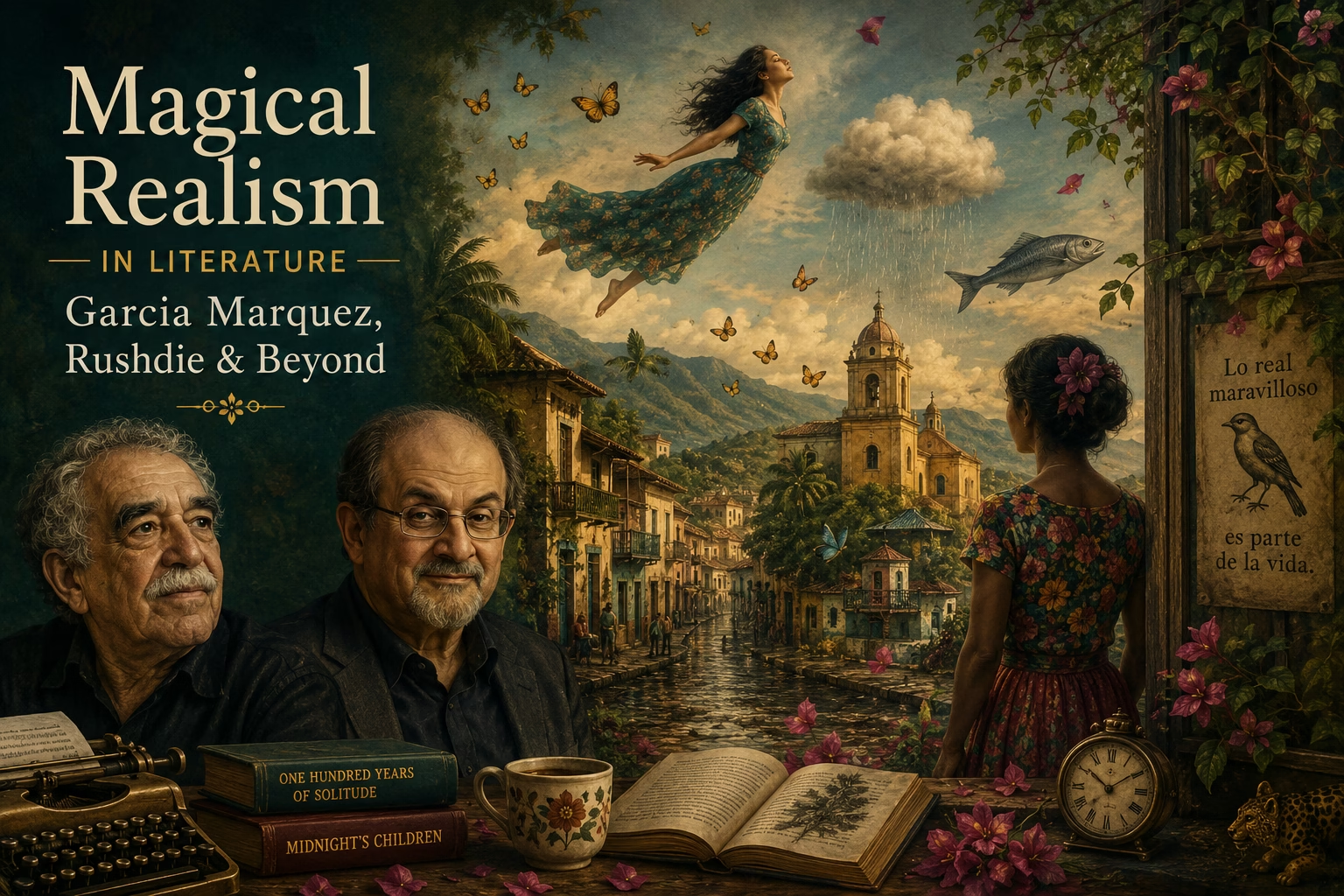
Postmodern Example 1: Midnight’s Children — Salman Rushdie (1981)
Rushdie’s masterpiece is one of the defining works of postcolonial postmodernism. The narrator, Saleem Sinai, is explicitly unreliable — he admits to errors, contradictions, and the partiality of his account. History (India’s independence and Partition) is presented not as objective fact but as a story told from one fragmented, subjective position. The novel’s magical realism, dark humour, and intertextual richness are all hallmarks of postmodern fiction.
Postmodern Example 2: Slaughterhouse-Five — Kurt Vonnegut (1969)
Vonnegut’s anti-war novel is a masterclass in postmodern technique. Time is non-linear — protagonist Billy Pilgrim becomes “unstuck in time,” moving randomly between different moments of his life. The novel’s famous refrain, “So it goes,” responds to every death with flat, ironic acceptance — a postmodern refusal of tragedy, heroism, and grand narrative. The author himself appears in the text, breaking the fiction deliberately.
Similarities Between Modernism and Postmodernism
Despite their differences, modernism and postmodernism share important common ground — and understanding this is what separates a good literary analysis from a great one.
- Both movements reject Victorian realism and the idea that a story should mirror the external world
- Both value subjectivity and individual experience over collective, authoritative accounts
- Both use fragmentation and non-linear time as narrative tools
- Both blur the line between high culture and low culture
- Both were shaped by historical trauma — the World Wars for modernism, the Cold War and colonial aftermath for postmodernism
In fact, many scholars describe postmodernism as modernism taken to its logical extreme — a radicalisation of what modernism began, rather than a clean break from it.
Modernism didn’t happen in a vacuum. Read more about the Other Ages’ impact on art here.
Why Does This Matter for UGC NET and Literary Studies?
Modernism and postmodernism together form one of the highest-weightage units in UGC NET English Paper 2. Questions regularly appear on:
- Identifying modernist vs postmodern techniques in unseen passages
- Placing authors (Woolf, Rushdie, Eliot, Pynchon) in the correct movement
- Defining terms: stream of consciousness, metafiction, intertextuality, pastiche
- Distinguishing modernism’s “search for meaning” from postmodernism’s “rejection of meaning”
Quick recall tip: Think of modernism as asking the question and postmodernism as rejecting the premise of the question.
Beyond examinations, understanding modernism vs postmodernism in literature gives you a framework for reading almost any twentieth-century text intelligently. These movements shaped not just fiction and poetry but film, architecture, philosophy, and cultural theory.
Want to master the theory? Grab the essential reading list on Amazon.
BUY Modernism: A Very Short Introduction ON AMAZON
Conclusion:
The debate around modernism vs postmodernism in literature ultimately comes down to a single, profound question: is meaning possible? Modernism says yes — with great difficulty. Postmodernism says it is not so sure, and it would rather laugh at the question than agonise over it.
Both movements transformed literature forever. Together, they gave us some of the most ambitious, challenging, and rewarding works ever written — from the stream-of-consciousness interiors of Virginia Woolf to the metafictional playfulness of Salman Rushdie.
Understanding these two movements does not just help you pass exams. It helps you read more deeply, think more critically, and appreciate why literature matters in a world that is always wrestling with the question of what is real, what is true, and who gets to tell the story.
Did you enjoy this guide? Explore more on a2zliterature.com — including our deep dives on postcolonialism, Indian Writing in English, and UGC NET preparation.
Frequently Asked Questions
What is the main difference between modernism and postmodernism in literature?
The key difference is their attitude toward meaning. Modernism seeks new forms of meaning after the collapse of tradition. Postmodernism goes further — it questions whether stable meaning exists at all, using irony, fragmentation, and self-referential techniques to highlight the constructed nature of all narratives.
Who are the key authors of modernism and postmodernism?
Major modernist authors include Virginia Woolf, T.S. Eliot, James Joyce, and William Faulkner. Key postmodern authors include Salman Rushdie, Kurt Vonnegut, Thomas Pynchon, Don DeLillo, and Angela Carter.
How is postmodernism different from realism?
Realism aims to represent the external world accurately and objectively. Postmodernism rejects this entirely — it argues that any representation is a construction, never a neutral reflection of reality. Where realism hides its artifice, postmodernism deliberately exposes it.