Introduction
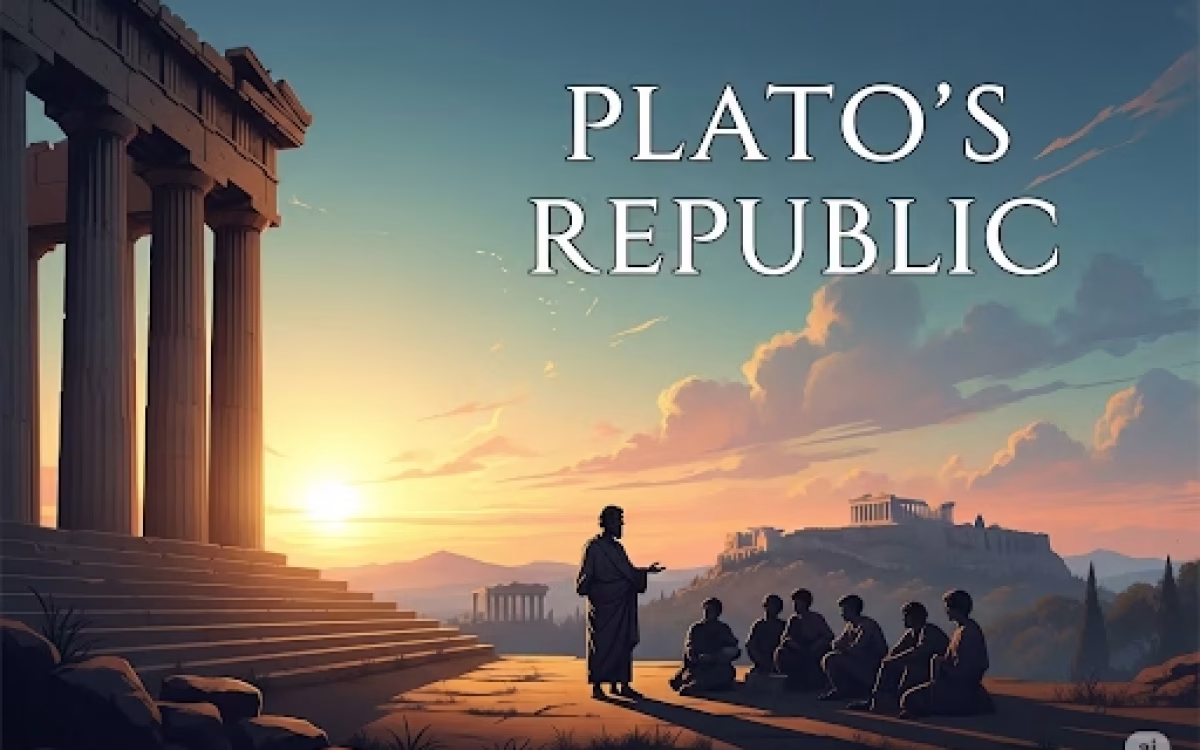
Few philosophical works have shaped the intellectual landscape of Western civilization as profoundly as Plato’s The Republic. Written around 375 BC, The Republic stands both as a foundational treatise in philosophy and as an enduring literary masterpiece. It grapples with fundamental questions about ethics, political order, the nature of reality, and the ultimate purpose of human life.
Reading Republic is analogous to embarking on a dialectical journey—one led by Socrates and his interlocutors, but ultimately inviting readers into the discourse. My encounters with this text have evolved with each reading; what once seemed a remote ancient dialogue now feels urgently contemporary, especially amid growing debates about justice, governance, and education. This article aims to offer not only a scholarly analysis but also a personal perspective, illuminating why Republic remains compulsory reading in philosophy, politics, and literature.
- Understanding Plato’s The Republic: Legacy and Central Themes
Plato’s The Republic is structured as a Socratic dialogue, primarily featuring Glaucon, Adeimantus, and other characters. The text’s central focus is the definition of justice and its manifestation both in the individual soul and in the body politic. From this focus emerge its most prominent themes: the theory of forms, the Allegory of the Cave, the nature of the ideal ruler, and the structure of the ideal state.
The text interrogates the prevailing notions of justice and seeks to transcend mere conventional morality. Plato’s genius lies not only in the intensity of his arguments but also in his literary artistry—he crafts a philosophical drama that challenges readers to reconsider their inherited certainties. FULL TEXT
Justice in Plato’s The Republic
The Socratic Search for Justice
The dialogue opens with Socrates methodically dissecting unreflective definitions of justice. Thrasymachus’s infamous assertion—”Justice is the advantage of the stronger”—serves as a foil to Socratic reasoning. Plato, through Socrates, artfully refutes moral relativism and instead constructs a vision where justice harmonizes the needs of the individual with those of the wider community.
Justice, for Plato, is not simply obedience to law or custom. Rather, it arises when every part—both in the city and within the soul—performs its appropriate function. This analogy between the just city and just soul forms the crux of the Republic’s moral psychology.
The Structure of the Ideal State
Republic presents three classes within the city: the rulers (philosopher-kings), the auxiliaries (warriors), and the producers (artisans, farmers, merchants). Justice is achieved when each class fulfills its role, uninfluenced by the encroachments of the others. This tripartite social framework mirrors the tripartite model of the soul, composed of reason, spirit, and appetite.
Plato’s insistence on specialization is sometimes interpreted as undemocratic or even totalitarian. However, his underlying concern is with the realization of the good, not the maintenance of petty power. The philosopher-king, guided by true knowledge rather than opinion or popular sentiment, is the embodiment of ideal rule. While Plato’s schema is frequently critiqued for its stringency, it also demands intellectual honesty: those who govern must be lovers of wisdom, not seekers of self-interest.
The Allegory of the Cave: Epistemology and Enlightenment
Shadows and Reality
Among the most celebrated passages in the Republic is the Allegory of the Cave, staged in Book VII. Plato imagines humanity as prisoners, confined to a subterranean cave, perceiving reality only as shadows cast upon the wall. Liberation entails an arduous ascent—not merely physical, but intellectual—from ignorance to knowledge of the true forms.
For Plato, the visible world is a domain of mere appearances. Only philosophical reasoning can lead one out of the cave and into the bright light of truth. This allegory is not simply a myth but a model for education and the transformative potential of philosophical inquiry.
The Philosopher-King: Rule by Reason
The Just Ruler
Plato’s most contentious proposal is that rulership should be entrusted to philosophers, those most capable of apprehending the forms and directing the city toward the good. The philosopher-king is not a mere technocrat but a moral visionary, compelled by deep knowledge and a sense of responsibility toward the polis.
The Republic’s governance model, often criticized for its elitism, nonetheless highlights the importance of intellectual virtue in public life. In my own experience teaching political philosophy, contemporary parallels abound: debates about expertise, meritocracy, and the dangers of mob rule echo Plato’s concerns.
Utopia?
Scholars dispute the practicality of Plato’s ideal city. Some read it as a blueprint for utopia; others view it as a cautionary satire on the impossibility of perfect rule. Yet the Republic endures because it refuses to settle for ideological simplicities. Plato draws us into the complexities of politics, demanding that both rulers and citizens examine the foundations of legitimacy and authority.
Education, Poetry, and Censorship in Plato’s The Republic
The Formation of Character
Education is central to the Republic’s vision. Plato proposes a rigorous system whereby guardians are trained to discern truth from falsehood, rationality from mere opinion. He is deeply wary of the influence of popular poetry and myth, arguing for their censorship to safeguard the moral health of the citizenry.
At first glance, this strikes modern readers as autocratic; yet Plato’s intentions are reformative, not repressive. He recognizes the power of narrative in shaping individual and civic ethos—a recognition still relevant in current debates about media influence.
Artistic Critique
Plato’s critique of poetry and drama reveals his anxiety about art’s capacity to corrupt. He privileges philosophy over mimetic art, positing that only reason can lead the soul toward truth. My encounters with students often return to this tension: is art an obstacle to wisdom, or is it a vehicle for the highest forms of insight?
Gender, Guardianship, and Equality
Women in the Republic
Plato’s proposals regarding the education and inclusion of women among the guardian class are strikingly progressive for his era. He asserts that capacity, not gender, should determine one’s role within the city. All individuals, regardless of sex, are judged by their aptitude and dedication to the common good.
Principles such as communal child-rearing and the abolition of the traditional family in the guardian class challenge prevailing norms. While these proposals remain controversial, they are indicative of Plato’s willingness to radically question social conventions in pursuit of justice. EXPLORE OTHER AUTHORS
The Tripartite Soul: Reason, Spirit, and Appetite
Psychological Harmony
Plato’s psychological theory divides the soul into three faculties: rational, spirited, and appetitive. Just as the city is harmonious when each class fulfills its role, so too is the individual just when reason governs, spirit supports, and appetite is regulated.
This model offers a proto-psychological account of virtue—one that anticipates later theories in ethical and moral philosophy. It proposes that personal justice mirrors social justice, with internal order fostering external harmony.
Democracy and Tyranny: Plato’s Critique of Political Extremes
Democracy’s Perils
Drawing on the historical turmoil of Athens, Plato critiques democracy for its tendency toward instability and susceptibility to demagogic manipulation. For him, unchecked freedom can quickly devolve into chaos, setting the stage for tyranny—the rule of passion over reason.
His skepticism is not borne of contempt for participation but of a conviction that wisdom should be the guiding principle of governance. As contemporary societies confront polarization and populism, these ancient critiques become strikingly relevant.
Tyranny and the Fall of the Ideal
Plato describes tyranny as the ultimate corruption of both the individual and the state. Here, unchecked desire annihilates rational order, leading to misery for ruler and ruled alike. Republic is thus both a warning and a guide—a text that charges us to cultivate internal and external balance.
Reception and Critique: Republic’s Enduring Influence
Historical and Contemporary Impact
The influence of Plato’s Republic is nearly incalculable. It has shaped political thought, educational theory, psychology, and literature for over two millennia. Figures such as Aristotle, Augustine, Rousseau, Marx, and Popper have engaged with its ideas, sometimes as supporters, often as critics.
The Republic’s rigorous demands for rationality and virtue have been both lauded and condemned. Some accuse Plato of advocating “benevolent despotism”; others see in the Republic the birth of the search for perfect justice. Despite these debates, no major tradition of Western thought has failed to engage with its core arguments, and its central questions endure.
Reflective Appraisal
From my vantage as a reader and teacher, the Republic stands as a challenge. It warns that to seek justice requires continual critical reflection—not just of institutions, but of the self. Its lessons reverberate through contemporary debates: How can we build societies worthy of our highest ideals? What sacrifices are we prepared to make for truth, for justice, for a better world?
Conclusion: Plato’s The Republic
Plato’s Republic is neither a mere utopia nor a dry philosophical abstraction. It is a living document of perpetual inquiry—a call to examine life, order, and value anew. Its dialectic demands participation, self-scrutiny, and, above all, courage—the courage to confront shadows, ascend to light, and rethink assumptions.
Reading Republic is to be drawn into a community of seekers, past and present, united in the quest for meaning and justice. I have found, time and again, that the real value of the Republic lies not in definitive answers, but in the richness of its questions. Plato’s invitation is as relevant now as it was twenty-four centuries ago: to be vigilant, reflective, and open to the possibility of both individual and collective transformation.
FAQs: Plato’s The Republic
1. What is Plato’s The Republic about?
Plato’s The Republic is a philosophical dialogue that explores the nature of justice, the ideal structure of society, and the role of the philosopher in governance. The text presents a vision of a just city ruled by philosopher-kings and introduces influential metaphors such as the Allegory of the Cave.
2. Why is the Allegory of the Cave important in Plato’s The Republic?
The Allegory of the Cave illustrates Plato’s theory of knowledge. It portrays humanity’s common condition as limited by ignorance, describing enlightenment as a challenging journey from illusions to the recognition of deeper truths. The metaphor captures the transformative power of education and philosophy.
3. What does Plato mean by “justice” in the The Republic?
Plato defines justice as each individual (and each class in society) performing their proper function harmoniously, without interfering with others. Justice is both a personal virtue and a social principle, achieved through order, balance, and adherence to reason.
4. Who are the philosopher-kings in the Republic?
Philosopher-kings are wise and virtuous rulers proposed by Plato to lead the ideal state. These individuals possess a love of wisdom, display moral character, and are trained to understand the Forms—the true realities behind appearances. They are uniquely qualified, in Plato’s view, to govern justly.