Introduction
In the vast canvas of Indian literature, few stories have achieved the enduring impact of Premchand’s ‘The Holy Panchayat’. First published in the early 20th century, this tale isn’t just a simple village anecdote; it’s a deep reflection on justice, impartiality, and the resilience of the Indian rural spirit. With themes echoing across generations, ‘The Holy Panchayat’ embodies the enduring moral conflicts that ripple through the fabric of our villages even today.
Whether you grew up hearing Panchayat tales from grandparents or encountered Premchand in an academic syllabus, there’s something about this story that sticks. Perhaps it’s the way the characters struggle between personal loyalties and the higher call of collective justice. Or maybe it’s the unmistakable glimpse into India’s heartland—where faith in this ancient form of governance holds steady despite societal change.
Premchand’s The Holy Panchayat: Plot Overview
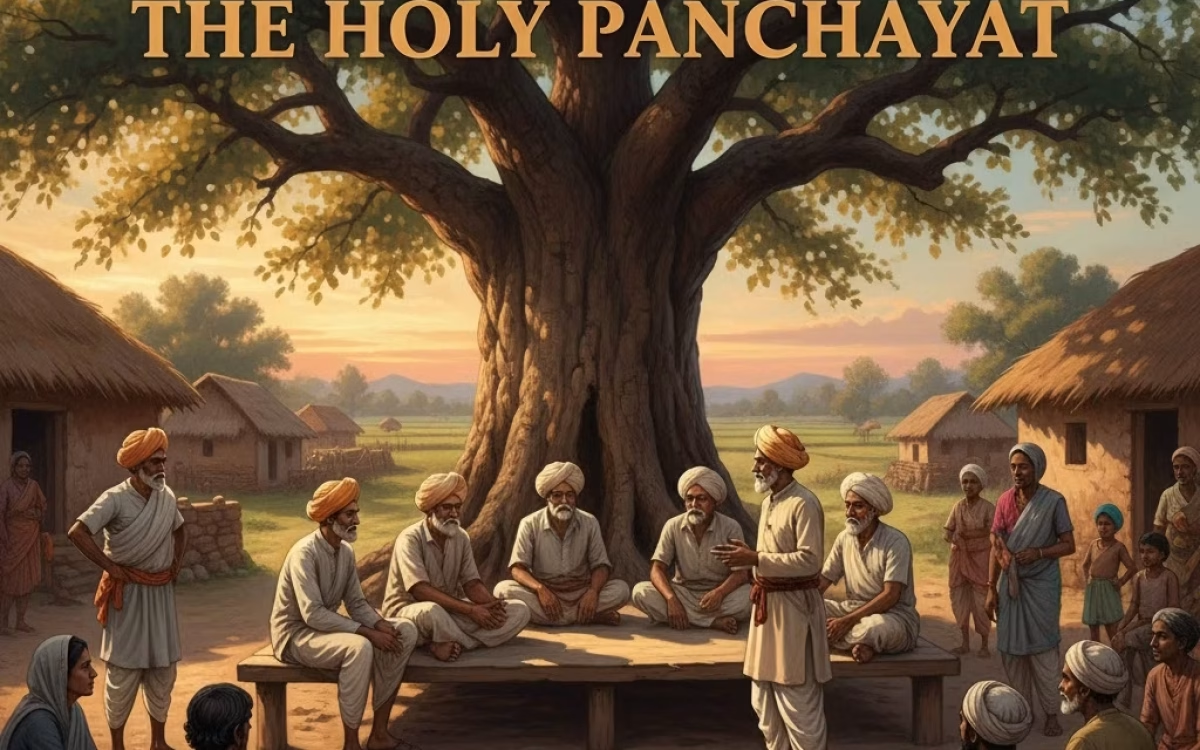
Set against the backdrop of a quintessential Indian village, ‘The Holy Panchayat’ revolves around two friends—Jumman Sheikh and Algu Chaudhary. When Jumman’s elderly aunt, who once transferred her property to him under the promise of lifelong care, feels oppressed and neglected, she seeks justice from the Panchayat—the village council revered for dispensing unbiased resolutions.
The narrative unfolds in two major arcs:
First, Algu must judge a dispute between Jumman and his aunt. Despite their close friendship, Algu sides with the wronged aunt, believing clean conscience to be above personal loyalty.
Bitterness ensues, ending their friendship. But fate soon puts Algu on the receiving end, forced to seek justice from the same Panchayat when a merchant overworks his ox and refuses to pay.
Jumman, now in the council, fights feelings of revenge. Yet, when he assumes the sacred responsibilities of a Sarpanch, he can’t help but rule fairly—vindicating Algu and rediscovering the true meaning of justice beyond personal ties.
The story closes with renewed friendship and firm belief in the Panchayat’s inherent fairness—a testament to the Indian village’s faith in their own system despite frailties and social pressures. FULL TEXT
Premchand’s The Holy Panchayat: Themes
Premchand’s genius lies in weaving universal themes through simple rural tales. Let’s explore the main ideas:
Justice and Impartiality
The recurring proverb, ‘Panch mein Parameshwar’ (God resides in the Panch), sets a sacred tone for justice. The council’s authority is painted as almost divine, demanding impartiality regardless of relationships.
Both Algu and Jumman experience intense inner conflict as council judges. Personal ties crack under the weight of collective conscience. Perhaps, in today’s hyper-partisan world, this remains a lesson for all of us—truth must triumph over bias.
Breakdown of Tradition and Social Values
As the story unfolds, we catch glimpses of the gradual erosion of idealised village unity. Greed and property disputes surface, hinting at growing cracks and friction between social classes—especially visible in the merchant’s dealings and Jumman’s initial behaviour.
Rural Governance and the Panchayat Ethos
The Panchayat functions as the backbone of Indian village society, offering a model of governance parallel to urban legal systems. Premchand’s story is an ode, but with a cautionary undertone: every system can be undermined by personal ambition. Nonetheless, the enduring power of the Panchayat lies in its rootedness in community ethics and the faith of villagers in its justice.
Premchand’s The Holy Panchayat: Influence and Relevance
Historical analysis reveals Premchand’s alignment with Gandhi’s doctrine of Gram Swaraj—the idea that India lives in her villages and true self-rule must start at the grassroots. Village panchayats symbolize self-governance, secularism, and truth—values central to Gandhi’s vision for a united, just India.
The story brings alive:
The emotional tension felt by Hindus and Muslims living as neighbours, facing the same struggles regardless of faith. The Indian ethos of secularism finds strong narrative support here, placing ‘The Holy Panchayat’ among the most representative works of inclusive rural literature.
The farmer’s plight, feudal oppression, and realism made Premchand the voice of rural India. In the Panchayat’s judgements, one glimpses the social structure’s challenges, hopes, and conflicts found in every Indian village.
Premchand’s The Holy Panchayat: Analysis
1. Setting the Stage: Opening Lines
Premchand opens with subtle scenery—dusty lanes, cattle grazing, and conversations under banyan trees. The tranquil setting counterbalances the storm brewing between Jumman and his aunt, amplifying the emotional stakes. The old aunt’s confidence in the Panchayat isn’t just idealism: it’s a desperate hope, a faith that community justice will prevail over private interests.
2. Character Motivations and Psychological Depth
Premchand doesn’t rush character development; he lets readers sit with Jumman’s bitterness and Algu’s inner turmoil. When Algu must decide the aunt’s case, he struggles between loyalty and truth—his agony is palpable and deeply human.
Jumman, meanwhile, is sure he can manipulate the system. Yet, when judgement day comes, the narrative pivots powerfully. Human frailty and integrity meet at the crossroads—echoing dilemmas as old as civilisation itself.
3. The Turning Point: Panchayat’s Power
“Panch mein Parameshwar” isn’t just a phrase; it’s a collective belief. When either friend sits in the Sarpanch’s chair, both are surprised by the solemnity and strange power of the post—almost as if the role itself invites an invisible burden of justice. Neutrality takes precedence over personal history, and the narrative sings with hope that perhaps justice, after all, is more than a social illusion.
4. Resolution: Beyond Friendship
Both men’s fairness eventually restores their friendship, reinforcing the Panchayat’s symbolic sanctity as a forum for truth over personal gain.
Personal Reflection:
Reading this, one can’t help but reflect: Does our modern society possess such mechanisms where roles can transcend personal grudges? Often, institutions buckle under pressure, but Premchand’s Panchayat stands tall—a living embodiment of justice rooted in conscience and community. EXPLORE OTHER WRITERS
Conclusion
With every rereading, ‘The Holy Panchayat’ feels more timely. From the moral dilemmas of individual judges to the secular ideals of village governance, its insights refuse to age. Justice, in Premchand’s vision, is a living, breathing force that transcends friendships, social class boundaries, and even generations.
If you are searching for a powerful story that captures what Indian rural life is truly about—and want analysis that goes beyond summaries—this is where you’ll find it. Premchand’s ‘The Holy Panchayat’ remains the beating heart of the Indian village, calling readers, leaders, and students alike to pursue justice with unwavering courage and humility.
FAQs
Q1: What is the main theme of “The Holy Panchayat” by Premchand?
A1: The primary theme revolves around justice and impartiality in the village Panchayat system, emphasising that truth and fairness must prevail over personal relationships and biases.
Q2: Who are the key characters in “The Holy Panchayat”?
A2: The story mainly features Jumman Sheikh and Algu Chaudhary, two friends whose relationship is tested by a dispute that brings them before the village Panchayat.
Q3: How does “The Holy Panchayat” reflect Indian village life?
A3: The story captures the ethos of rural India through its depiction of Panchayat justice, social relationships, and the tensions between tradition and changing values within a village setting.
Q4: What role does the Panchayat play according to Premchand’s story?
A4: The Panchayat is portrayed as a sacred institution where justice is supposed to be impartial and divine, hence the phrase “Panch mein Parameshwar” (God resides in the Panch).
Q5: How is friendship tested in “The Holy Panchayat”?
A5: Friendship is put to the test when Algu Chaudhary has to judge a dispute involving his close friend Jumman Sheikh, highlighting the moral dilemma between loyalty and justice.