Romantic Age in English Literature: Introduction
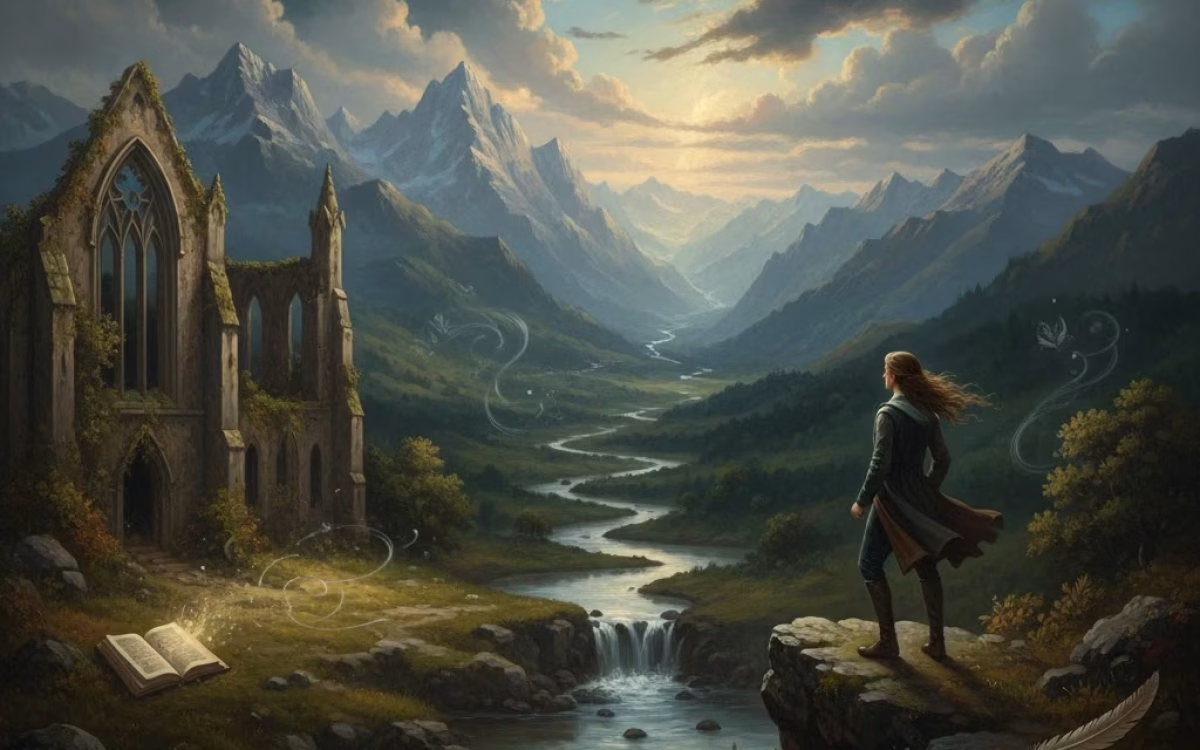
The Romantic Age in English Literature wasn’t just a fleeting trend—it was a profound cultural earthquake that reshaped the way people thought about art, emotion, and society. Born in the late 18th century, this era marked a dramatic departure from the cold rationality of the Enlightenment and the rigid formalism of Neoclassicism. Instead, the Romantics championed the heart over the head, imagination over logic, and the individual over the collective. In fact, poetry stopped being a mere mirror of society and became a lamp, illuminating the depths of human experience and the mysteries of the natural world.
Moreover, the official starting point of the Romantic Age is often traced to 1798, the year William Wordsworth and Samuel Taylor Coleridge published Lyrical Ballads. This collection wasn’t just a book of poems—it was a manifesto for a new way of writing and thinking. Wordsworth’s famous declaration that poetry is “the spontaneous overflow of powerful feelings” set the tone for an entire generation of writers who sought to express their inner worlds with honesty and passion. Indeed, the Romantics weren’t interested in the polished, artificial language of earlier poets; rather, they wanted to capture the raw, unfiltered emotions of everyday people, using simple, direct language that anyone could understand.
However, the Romantic Age was more than just a literary movement—it was a response to the sweeping changes of its time. For instance, the Industrial Revolution was transforming England, and the French Revolution had shaken the foundations of European society. In the face of these upheavals, the Romantics turned to nature, the past, and the imagination for solace and inspiration. Specifically, they saw nature not just as a backdrop, but as a living, breathing force that could heal, inspire, and reveal the deeper truths of existence. Additionally, the medieval past, the supernatural, and the exotic became sources of fascination, offering an escape from the harsh realities of the modern world.
Furthermore, the Romantic Age also celebrated the individual, elevating the artist to the status of a visionary and a rebel. Poets like Wordsworth, Coleridge, Keats, Shelley, and Byron saw themselves as unique, creative geniuses, capable of shaping their own destinies and challenging the conventions of their time. As a result, their work explored the full range of human emotion—from joy and love to despair and longing—offering readers a window into the depths of the human soul.
The Romantic Age in English Literature was a revolution of the heart and mind. Above all, it was a time when writers dared to feel deeply, think freely, and imagine boldly, leaving behind a legacy that continues to inspire and move readers to this day. FULL TEXT
Romantic Age in English Literature: The Beginnings
The Romantic Age in English Literature officially began around 1798 with the publication of William Wordsworth and Samuel Taylor Coleridge’s Lyrical Ballads. Indeed, this collection was revolutionary, not just for its content but for its manifesto: Wordsworth’s Preface to the second edition declared poetry to be “the spontaneous overflow of powerful feelings.” In fact, this wasn’t just a new style—it was a new philosophy. As a result, poets started to see themselves as individuals with unique inner worlds, rather than just mouthpieces for society. Moreover, the publication of Lyrical Ballads marked a clear break from the formal, artificial poetry of the past, paving the way for a more personal, emotional, and imaginative approach to literature.
Publication of Lyrical Ballads (1798)
The Romantic Age is widely recognized to have begun with the 1798 publication of Lyrical Ballads, a collection of poems by William Wordsworth and Samuel Taylor Coleridge. Indeed, this collection broke away from the formal, sophisticated style of 18th-century poetry and signaled a fresh literary movement. In fact, it marked a clear departure from the rigid conventions of the past, introducing a new emphasis on everyday language, rural subjects, and emotional authenticity. As a result, Lyrical Ballads became a landmark in English literature, paving the way for a more personal and imaginative approach to poetry.
Collaboration Between Innovators
Wordsworth and Coleridge, living as neighbors in Somerset, collaborated deeply, sharing ideas about poetry’s purpose and audience. Indeed, their mutual admiration allowed them to experiment confidently with form, language, and subject matter. In fact, their friendship and frequent discussions led to a fruitful exchange of creative energy, inspiring each other to push the boundaries of poetic expression. As a result, their partnership produced not only groundbreaking works but also set a new standard for literary collaboration in the Romantic Age.
Manifesto for a New Poetry: The Preface
Wordsworth’s Preface to the second edition (1800) became the chief manifesto of Romanticism. In fact, he argued that poetry should be “the spontaneous overflow of powerful feelings: it takes its origin from emotion recollected in tranquility.” Moreover, this preface set out to justify the use of everyday language and to explain the new poetic philosophy. As a result, Wordsworth’s ideas not only challenged the artificial diction and grand themes of classical poetry but also laid the foundation for a more personal, emotional, and accessible approach to literature.
Use of Everyday Language and Subjects
The poets deliberately chose the ordinary language of “middle and lower classes” instead of artificially elevated diction. In fact, they focused on humble, rural people and their daily experiences, believing that such subjects revealed deep truths about humanity. Moreover, this shift in language and subject matter allowed poetry to connect more authentically with readers, making it accessible and emotionally resonant. As a result, the Romantics not only challenged the elitist traditions of earlier poetry but also opened up literature to a broader audience, emphasizing the value of everyday life and the universal experiences of ordinary people.
Emphasis on Nature and the Inner World
Nature was a central theme, not just as physical landscape but as a source for imagination, spiritual renewal, and emotional insight. In fact, through vivid description and symbolism, the poets explored how nature connects to the human psyche. Moreover, Wordsworth and Coleridge viewed nature as more than scenery—it was a living, spiritual force that inspired self-discovery, moral growth, and emotional healing. As a result, their poetry often portrays nature as a teacher, a healer, and a bridge between the material and the sublime, revealing its profound influence on both individual and collective experience.
Focus on the Individual and Imagination
Instead of seeing poets as mere narrators or recorders, Wordsworth and Coleridge regarded each poet as a unique individual with a rich inner life. In fact, this marked a philosophical turn from collective societal concerns to a celebration of uniqueness, personal emotion, and creativity. Moreover, their view challenged the Enlightenment’s focus on universal truths, placing the poet’s subjective experience and inner world at the heart of artistic creation. As a result, Romantic poetry became deeply personal, introspective, and reflective, emphasizing the value of individuality and the power of the creative imagination.
Challenge to Enlightenment Ideals
The Romantic approach was, at its heart, a reaction against Enlightenment rationalism, which prioritized logic and order. In fact, Romantics valued emotion, originality, and spontaneity, seeing them as the lifeblood of authentic poetry. Moreover, this shift marked a clear departure from the Enlightenment’s emphasis on reason and universal truths, placing personal feeling and creative freedom at the center of literary expression. As a result, Romantic poetry became a vibrant celebration of individual experience, imagination, and the unpredictable power of human emotion.
Popularization and Influence
While the initial critical response to Lyrical Ballads was modest, its impact grew rapidly. In fact, over time, it became clear that this collection had altered the landscape of English literature, paving the way for generations of poets and novelists to place emotion and individualism at the center of their art. Moreover, what began as a quiet experiment soon sparked passionate debate and inspired younger writers, gradually earning recognition as a landmark in literary history. As a result, Lyrical Ballads not only reshaped poetry but also redefined the very purpose and power of literature itself.
Romantic Age in English Literature: Key Themes
Nature as a Source of Inspiration
Romantic poets didn’t just write about nature—they saw it as a living, breathing force. In fact, for Wordsworth, nature was a source of spiritual renewal and emotional solace. In poems like “Lines Written a Few Miles Above Tintern Abbey,” he describes how the natural world offers comfort and insight, helping him reconnect with his inner self. Moreover, Coleridge, in “Frost at Midnight,” explores how nature shapes the mind and spirit, especially in childhood. As a result, the Romantics transformed nature from a mere backdrop into a profound teacher, healer, and guide, showing its lasting impact on both personal and poetic development.
Emotion Over Reason
One of the defining features of Romantic literature is its emphasis on emotion. In fact, the Romantics rejected the Enlightenment’s focus on logic and reason, instead championing the power of feeling. Moreover, poets like John Keats and Percy Bysshe Shelley explored intense emotions—love, despair, longing, and joy—in their work. As a result, Keats’s “Ode to a Nightingale” stands as a perfect example, capturing the bittersweet beauty of life and the pain of loss. By placing emotion at the heart of their poetry, the Romantics created works that continue to resonate with readers, making their legacy enduring and deeply human.
The Individual and the Imagination
The Romantic Age celebrated the individual. In fact, poets saw themselves as unique, creative geniuses, capable of shaping their own destinies. Moreover, this focus on the individual led to a new emphasis on the imagination. Samuel Taylor Coleridge believed that imagination was the highest poetic quality, a “quasi-divine creative force” that allowed poets to transcend the ordinary and create something truly original. As a result, Romantic literature became deeply personal and introspective, encouraging readers to value their own inner worlds and creative potential.
The Supernatural and the Mysterious
Romantic literature often delved into the supernatural and the mysterious. In fact, poets like Coleridge and Mary Shelley explored themes of the unknown, the eerie, and the otherworldly. Moreover, Coleridge’s “The Rime of the Ancient Mariner” is a classic example, blending elements of the supernatural with a deep moral message. Shelley’s Frankenstein is another landmark work, examining the boundaries between life and death, and the consequences of playing God. As a result, the Romantic fascination with the supernatural not only added depth and drama to their works but also challenged rationalist worldviews, inviting readers to question the limits of science and the mysteries of existence. EXPLORE MORE
Romantic Age in English Literature: Major Poets
William Wordsworth
Wordsworth is often considered the father of Romantic poetry. His work is characterized by its deep connection to nature and its focus on the individual’s emotional experience. Poems like “I Wandered Lonely as a Cloud” and “Tintern Abbey” are quintessential examples of Romantic themes.
Samuel Taylor Coleridge
Coleridge was a master of the supernatural and the mysterious. His poems, such as “The Rime of the Ancient Mariner” and “Kubla Khan,” are known for their vivid imagery and imaginative power. Coleridge’s work often explores the boundaries between reality and the supernatural.
John Keats
Keats’s poetry is celebrated for its sensuous beauty and emotional depth. His odes, including “Ode to a Nightingale” and “Ode on a Grecian Urn,” are masterpieces of Romantic literature, exploring themes of beauty, mortality, and the power of art.
Percy Bysshe Shelley
Shelley was a radical thinker and poet, known for his passionate advocacy of liberty and his exploration of the sublime. Also, poems like “Ozymandias” and “Mont Blanc” showcase his ability to blend political and philosophical themes with powerful imagery.
Lord Byron
Byron’s poetry is marked by its intensity and emotional power. His works, such as “Childe Harold’s Pilgrimage” and “Don Juan,” are known for their dramatic flair and exploration of individual freedom.
| Writer | Significant Work(s) | Publishing Year | Key Details |
|---|---|---|---|
| William Wordsworth | Lyrical Ballads (with Coleridge) | 1798 | Co-authored with Coleridge; marked the beginning of Romanticism; Preface became its manifesto. |
| Tintern Abbey | 1798 | Celebrates nature, memory, and spiritual renewal. | |
| I Wandered Lonely as a Cloud | 1807 | Famous for its vivid imagery of nature and emotional uplift. | |
| Samuel Taylor Coleridge | Lyrical Ballads (with Wordsworth) | 1798 | Co-authored with Wordsworth; includes “The Rime of the Ancient Mariner”. |
| The Rime of the Ancient Mariner | 1798 | Supernatural tale with moral and philosophical depth. | |
| Kubla Khan | 1816 | Dream-inspired poem exploring imagination and creativity. | |
| John Keats | Ode to a Nightingale | 1819 | Explores themes of beauty, mortality, and the power of art. |
| Ode on a Grecian Urn | 1819 | Celebrates art’s permanence and beauty. | |
| Endymion | 1818 | Epic poem blending myth and romance. | |
| Percy Bysshe Shelley | Ozymandias | 1818 | Reflects on the impermanence of power and legacy. |
| Mont Blanc | 1817 | Explores the sublime and the power of nature. | |
| Prometheus Unbound | 1820 | Philosophical drama on liberty and the human spirit. | |
| Lord Byron | Childe Harold’s Pilgrimage | 1812–1818 | Epic poem on travel, liberty, and the individual’s quest. |
| Don Juan | 1819–1824 | Satirical epic exploring love, society, and human nature. | |
| Mary Shelley | Frankenstein | 1818 | Gothic novel exploring creation, responsibility, and the supernatural. |
| Robert Southey | The Curse of Kehama | 1810 | Epic poem blending myth and imagination. |
| William Blake | Songs of Innocence and of Experience | 1789–1794 | Explores the duality of human experience and social criticism. |
| The Marriage of Heaven and Hell | 1790 | Philosophical work challenging conventional morality |
Romantic Age in English Literature: FAQS
When did the Romantic Age begin?
The Romantic Age began around 1798 with the publication of Wordsworth and Coleridge’s Lyrical Ballads, marking a shift from Enlightenment rationalism to emotional and imaginative expression.Who are the major poets of the Romantic Age?
The major poets include William Wordsworth, Samuel Taylor Coleridge, John Keats, Percy Bysshe Shelley, Lord Byron, and William Blake.What is the main theme of Romantic poetry?
Romantic poetry emphasizes emotion, imagination, nature, individualism, and the supernatural, reacting against the rationalism of the Enlightenment.Why is Wordsworth called the poet of nature?
Wordsworth celebrated nature as a source of spiritual renewal and emotional insight, making it a central theme in his poetry.What is the significance of Lyrical Ballads?
Lyrical Ballads marked the beginning of Romanticism, introducing the use of everyday language and focusing on ordinary people and their experiences.What does Wordsworth mean by “spontaneous overflow of powerful feelings”?
He meant that poetry should arise from genuine emotion and personal experience, not from artificial or formal rules.How did the Industrial Revolution influence Romantic literature?
The Industrial Revolution led Romantics to seek solace in nature and the past, reacting against urbanization and mechanization.What is the concept of the sublime in Romanticism?
The sublime refers to the feeling of awe and terror inspired by vast, powerful, or mysterious aspects of nature.Why is Coleridge called a poet of the supernatural?
Coleridge’s works, like “The Rime of the Ancient Mariner,” explore supernatural elements and moral lessons through imaginative storytelling.What is the difference between Romanticism and Neoclassicism?
Romanticism emphasizes emotion, imagination, and individualism, while Neoclassicism focuses on reason, order, and formal rules.What role did the French Revolution play in Romantic literature?
The French Revolution inspired themes of liberty, equality, and individual rights, influencing Romantic writers to advocate for social and political change.Why is Shelley called a poet of revolution?
Shelley’s works, such as “Ozymandias” and “Prometheus Unbound,” reflect his revolutionary ideals and critique of tyranny.What is the significance of the Lake District in Romantic literature?
The Lake District was home to Wordsworth, Coleridge, and Southey, and its natural beauty inspired much of their poetry.How did Byron influence Romantic poetry?
Byron’s works, like “Childe Harold’s Pilgrimage,” introduced the Byronic hero—a passionate, rebellious individual—into Romantic literature.What is the theme of Keats’s “Ode to a Nightingale”?
The poem explores the tension between the beauty of art and the pain of mortality, reflecting Romantic concerns with transience and emotion.What is the role of imagination in Romantic poetry?
Imagination is seen as a gateway to transcendent experience and spiritual truth, allowing poets to transcend reality.Why is Mary Shelley’s Frankenstein considered a Romantic novel?
Frankenstein explores themes of creation, responsibility, and the supernatural, reflecting Romantic interest in the boundaries of science and human ambition.What is the significance of folk culture in Romanticism?
Romantics valued folk culture, national origins, and the medieval era, seeking inspiration in traditional stories and customs.How did Romanticism influence prose?
Romantic prose, seen in writers like Charles Lamb and Thomas De Quincey, became more personal, emotional, and imaginative, reflecting the spirit of the age.Who are the Lake Poets?
The Lake Poets—Wordsworth, Coleridge, and Southey—were associated with the Lake District and known for their nature poetry.What is the Byronic hero?
The Byronic hero is a passionate, rebellious, and often melancholic figure, inspired by Byron’s own personality and works.How did Romanticism view childhood?
Romantics idealized childhood as a time of innocence, imagination, and closeness to nature, often contrasting it with the corruption of adulthood.What is the significance of the Gothic in Romantic literature?
Gothic elements—such as the supernatural, mystery, and horror—allowed Romantics to explore the darker aspects of human experience.How did Romanticism influence music and art?
Romanticism emphasized emotion, individualism, and the sublime in music and art, inspiring composers and painters to express personal feelings and dramatic themes.What is the legacy of Romanticism in modern literature?
Romanticism’s emphasis on emotion, imagination, and individualism continues to influence writers, poets, and artists, shaping the development of modern literature.
Romantic Age vs Other Ages
| Literary Age | Characteristics | Genres | Major Themes | Notable Writers |
|---|---|---|---|---|
| Romantic Age | Emphasis on emotion, imagination, nature; individualism; reaction against rationalism | Poetry, novel, drama, prose | Nature, emotion, imagination, individualism, supernatural, revolution | Wordsworth, Coleridge, Keats, Shelley, Byron, Blake, Mary Shelley |
| Neoclassical Age | Reason, order, formalism, balance; imitation of classical models | Poetry, drama, satire, essays | Reason, decorum, social order, wit, moral instruction | Alexander Pope, Samuel Johnson, Jonathan Swift, Joseph Addison |
| Victorian Age | Realism, social critique, moral earnestness; industrialization and progress | Novel, poetry, drama, essays | Social reform, morality, progress, faith, doubt, realism | Charles Dickens, George Eliot, Alfred Tennyson, Robert Browning, Thomas Hardy |
| Modern Age | Fragmentation, experimentation, subjectivity; disillusionment post-WWI | Poetry, novel, drama, essays | Alienation, existentialism, disillusionment, stream of consciousness | T.S. Eliot, Virginia Woolf, James Joyce, W.B. Yeats, D.H. Lawrence |
| Elizabethan Age | Flourishing of drama and poetry; exploration of human nature; Renaissance ideals | Drama, poetry, prose | Humanism, love, ambition, fate, exploration | William Shakespeare, Christopher Marlowe, Edmund Spenser, Ben Jonson |
Conclusion
The Romantic Age in English Literature was far more than a literary trend—it was a transformative movement that redefined the relationship between art, emotion, and society. By championing imagination, individualism, and a deep reverence for nature, the Romantics broke free from the constraints of rationalism and formalism that had dominated earlier periods. In fact, their works continue to resonate because they speak to the universal human experiences of longing, loss, joy, and wonder.
Moreover, this era gave voice to the common man, celebrated the sublime beauty of the natural world, and explored the depths of the human psyche. Poets and novelists of the Romantic Age dared to question established norms, to seek truth in emotion and intuition, and to imagine a world shaped by passion rather than reason. As a result, their legacy lives on, not only in the pages of classic literature but in the enduring influence of Romantic ideals on art, thought, and culture.
In the end, the Romantic Age reminds us that literature is not just a mirror of society, but a lamp that illuminates the inner landscapes of the human soul. Above all, its lessons about the power of imagination, the importance of individuality, and the beauty of nature remain as relevant today as they were two centuries ago.