Introduction
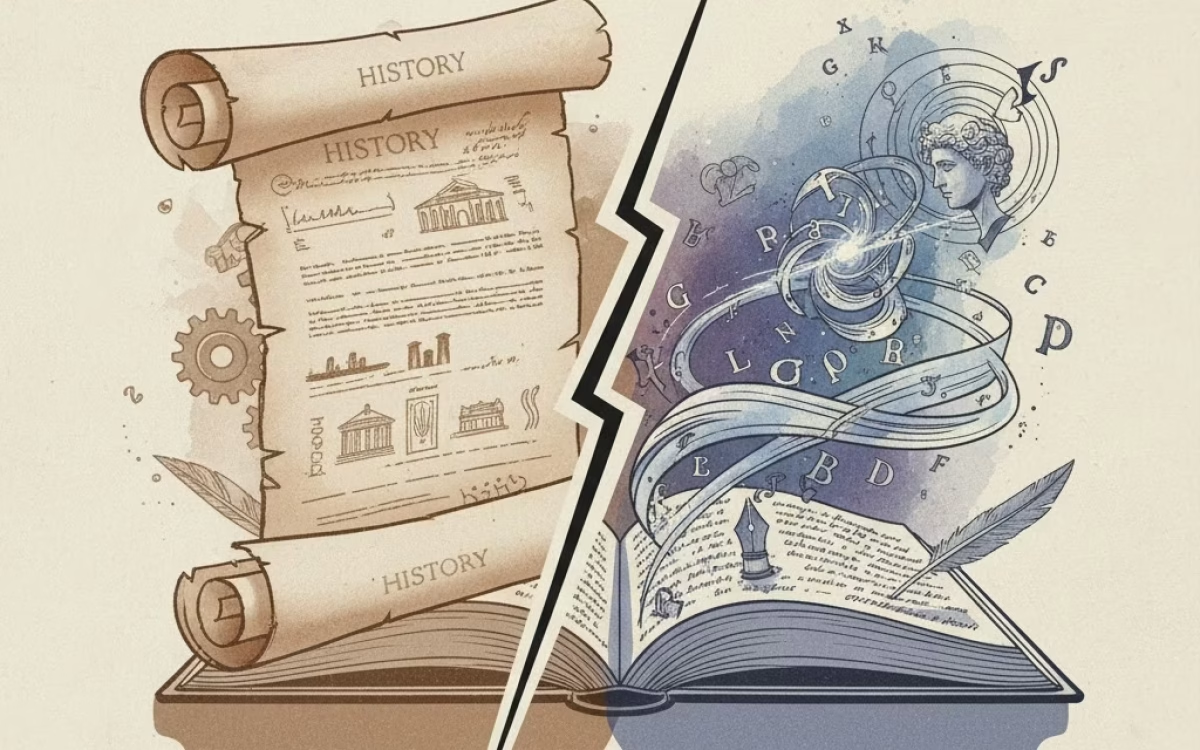
Terry Eagleton’s Literature and History stands as a landmark in Marxist literary criticism. It challenges readers to see literature not as an isolated art form, but as a reflection of social and historical realities. From the start, Eagleton dismantles the illusion that stories exist in a vacuum. He argues that every novel, poem, or play grows out of the material conditions and class struggles of its time.
His work invites us to look beyond the surface of literary texts. It urges us to uncover the ideologies, power structures, and historical forces shaping both the creation and interpretation of literature. At the heart of Literature and History is Eagleton’s conviction that literature is inseparable from history. He doesn’t just want us to appreciate a text’s beauty or emotional impact. He wants us to understand how it engages with the world around it.
For Eagleton, literature is not a passive mirror. It is an active participant in the drama of social change. His Marxist perspective reveals how literary works shape—and are shaped by—the conflicts and contradictions of their era. What makes his approach so compelling is its accessibility. He avoids abstract theory and jargon-heavy debates. Instead, he uses clear, engaging language to show how literature and history are intertwined.
Whether analysing Shakespeare’s plays or the Victorian novel, Eagleton’s framework helps us see the connections between literary form, social context, and historical change. In today’s world, questions of power, identity, and justice are more urgent than ever. Terry Eagleton’s Literature and History offers a vital perspective. It reminds us that literature is not just about escape or entertainment. It is about understanding the world and our place in it.
Author Introduction
Terry Eagleton is a towering figure in contemporary literary criticism and theory. Born in 1943 in Salford, England, he quickly became known for his Marxist perspective. Not only does he have a rare gift for making complex ideas accessible to a wide audience, but his work has also deeply influenced how literature is studied and understood. Indeed, literature, history, ideology, and social change are all central to his thinking.
Moreover, Eagleton studied English at Trinity College, Cambridge. There, Raymond Williams mentored him. His working-class background and Irish Catholic heritage shaped his early career. Both experiences left a strong mark on his approach to literature and culture. Afterward, he became a fellow and tutor at Oxford University. At Oxford, he ran a well-known seminar on Marxist literary theory and contributed to radical academic journals.
Furthermore, his most famous work, Literary Theory: An Introduction (1983), became a landmark text in English studies. It sold hundreds of thousands of copies worldwide. In this book, Eagleton argued that all literary theory is inherently political. He claimed that literature cannot be separated from its social and historical context.
Over the years, he has published more than fifty books. His topics range from ideology and postmodernism to religion and Irish culture.
In addition, Eagleton is also known for his sharp wit and polemical style. He has challenged academic orthodoxy and popular trends. His targets include postmodernism and New Atheism. Later works like After Theory (2003), Why Marx Was Right (2011), and How to Read Literature (2013) show his ongoing engagement with contemporary issues. Each book reflects his deep commitment to critical thinking and social justice.
Today, Eagleton is Distinguished Professor of English Literature at Lancaster University. Moreover, he remains a vital voice in literary studies. His ability to connect theory with real-world concerns is widely celebrated, and he continues to inspire scholars and students alike.
His legacy is not just in the books he has written; it is also in the way he has inspired generations of readers and scholars. Ultimately, Eagleton urges us to think critically about literature and its place in society. FULL TEXT
Text Overview
Literature as a Social Product:
Eagleton argues that literature does not emerge in isolation. Instead, social, economic, and historical conditions shape every literary work. For him, material realities and class struggles actively determine the form and content of literature in any given era. This perspective challenges the idea that literature is simply a product of individual genius or imagination.
The Role of Ideology:
A central theme in Eagleton’s work is the influence of ideology on literature. He contends that literary texts reflect and reinforce the dominant ideologies of their societies. At the same time, literature can also challenge and subvert these ideologies. Eagleton encourages readers to analyze how literary works participate in ideological debates and power struggles.
Class Struggle and Power Dynamics:
Eagleton emphasizes the connection between literature and class struggle. He shows how literary works often mirror the conflicts and tensions between different social classes. For Eagleton, understanding literature requires an awareness of the power dynamics at play in both the text and its historical context.
The Critique of Formalism:
Eagleton is highly critical of formalist approaches to literature, which focus solely on the aesthetic qualities of a text. He argues that formalism ignores the social and historical context in which literature is produced. For Eagleton, this approach is incomplete and misleading, as it fails to account for the material conditions that shape literary works.
The Importance of Historical Context:
Eagleton insists that readers cannot understand literature without considering its historical context. He examines how events, movements, and social changes shape literary works in each era. This historical perspective allows readers to see the connections between literature and the broader forces of history.
The Fluidity of Literary Value:
Eagleton challenges the notion of fixed literary value. He argues that what is considered “literature” changes over time and varies across cultures. Literary status does not exist inherently; instead, social and cultural practices construct it. This perspective highlights the subjective nature of literary valuation.
The Interplay of Fact and Fiction:
Eagleton blurs the distinction between fact and fiction, showing how literary texts often blend elements of both. He suggests that the boundary between these categories is context-dependent and can shift depending on the reader’s perspective. This approach encourages a more nuanced understanding of literary discourse.
The Role of Language and Form:
Eagleton explores how literary language deviates from ordinary speech, employing techniques that intensify and transform language. He discusses the significance of literary devices and the estrangement effect, emphasizing the materiality of language in literary texts. This perspective aligns with Russian formalist views but also highlights the limitations of formalist theories.
The Subjectivity of Interpretation:
Eagleton argues that all interpretations of literature reflect subjective values and societal contexts. He critiques the idea of “value-free” knowledge, emphasising the connection between interests, beliefs, and knowledge acquisition. This perspective underscores the importance of critical self-reflection in literary studies.
The Political Nature of Literary Theory:
Eagleton maintains that all literary theory is inherently political. He demonstrates how different theoretical approaches reflect and respond to the social and political concerns of their time. This perspective encourages readers to think critically about the assumptions and agendas underlying various literary theories.
Literature and History: Key Themes
The Dialectical Relationship Between Literature and History
One of the central themes of Literature and History is the dialectical relationship between literature and history. Eagleton argues that literature and history are not separate or independent domains, but are deeply intertwined. Literature reflects the historical conditions of its time, but it also shapes our understanding of history. For Eagleton, this relationship is not static or one-sided; it’s dynamic and reciprocal.
Class Struggle and Ideology
Another key theme is the role of class struggle and ideology in literature. Eagleton contends that literary works are not just expressions of individual creativity, but are also products of social and economic forces. He examines how literature reflects the interests and values of different social classes and can reinforce or challenge dominant ideologies. For Eagleton, the study of literature is not just an aesthetic or intellectual exercise; it’s a political act.
The Materialist Critique of Literary Form
Eagleton also offers a materialist critique of literary form. Eagleton argues that the form of a literary work is not just a matter of style or technique; instead, material conditions shape its form. For him, the form of a novel, poem, or play reflects not only the author’s creativity but also the social, economic, and historical context in which the work emerges.
Traditional Literary Theory
The Limits of Formalism
Eagleton is highly critical of traditional literary theory, particularly formalism. He argues that formalist approaches to literature tend to focus on the aesthetic qualities of a work, such as its style, structure, and language, while ignoring its historical and social context. For Eagleton, this approach is not only incomplete, but also misleading. Also, he contends that literature cannot be understood apart from its historical and social context.
The Problem of Value-Free Knowledge
Eagleton also challenges the idea of “value-free” knowledge in literary criticism. He argues that all readings of literature are shaped by subjective values and societal contexts. For Eagleton, there is no such thing as an objective or neutral interpretation of a literary work. Every reading reflects the reader’s own beliefs, interests, and social background.
Contemporary Literary Criticism
The Expansion of Literary Studies
Eagleton’s work has had a profound impact on contemporary literary criticism. He has helped to expand the scope of literary studies to include issues of gender, sexuality, race, and post-colonialism. For Eagleton, literature is not just a matter of aesthetics or form, but is also a site of political and social struggle.
The Challenge to Postmodernism
Eagleton is also a prominent critic of postmodernism. He argues that postmodernist approaches to literature tend to devalue objectivity and ethics, and that they often lead to a kind of intellectual and political quietism. For Eagleton, postmodernism is not just a theoretical problem, but a political one. He contends that postmodernism often justifies the status quo and fails to challenge dominant ideologies and power structures. EXPLORE MORE
Terry Eagleton’s Literature and History: Case Studies
Shakespeare and Society
One of Eagleton’s most famous case studies is his analysis of Shakespeare’s plays. Shakespeare’s works are not just timeless masterpieces; they grow out of the historical and social context of Elizabethan England.
For Eagleton, Shakespeare’s plays reflect the class struggles and ideological conflicts of their time. They continue to shape our understanding of history and society.
The Victorian Novel
Eagleton also offers a materialist critique of the Victorian novel. He examines how the form and content of Victorian novels are shaped by the social and economic conditions of the time. For Eagleton, the Victorian novel is not just a reflection of individual creativity, but is also a product of the material conditions of its production.
Conclusion
Terry Eagleton’s Literature and History leaves us with a powerful and lasting insight: literature is not just a mirror of history, but an active participant in shaping it. Indeed, his Marxist approach challenges the traditional view of literature as a neutral or purely aesthetic pursuit. Instead, Eagleton insists that every literary text grows out of the material conditions, class struggles, and ideological battles of its time. For him, literature is inseparable from history, and understanding one requires a critical engagement with the other.
Moreover, Eagleton’s work is a call to action for readers and critics alike. He urges us to look beyond the surface of literary texts, to uncover the hidden ideologies, power structures, and social forces that shape both the creation and interpretation of literature. Eagleton’s critique of formalism and “value-free” knowledge shows that interpretations always reflect subjective values and societal contexts. And, there is no such thing as a purely objective reading. Every act of interpretation reflects the reader’s own beliefs, interests, and social background.
Furthermore, one of the most important lessons of Literature and History is the fluidity of literary value. What is considered “literature” changes over time and varies across cultures. Literary status does not exist inherently; instead, social and cultural practices construct it. Moreover, this perspective highlights the subjective nature of literary valuation and encourages readers to think critically about the assumptions and agendas underlying various literary theories.
Similarly, Eagleton’s emphasis on the political nature of literary theory is particularly relevant in today’s world. He demonstrates how different theoretical approaches reflect and respond to the social and political concerns of their time. Consequently, this perspective encourages readers to think critically about the assumptions and agendas underlying various literary theories and to recognize the profound influence of societal values on our understanding of literature.
Finally, Terry Eagleton’s Literature and History is not just a book about literature; it is a book about the world. It reminds us that literature is not just about escape or entertainment; it is about understanding the world and our place in it. Eagleton’s insights continue to inspire and challenge readers around the globe, urging us to think critically about the stories we read and the histories we live.
FAQS
What is the main argument of Terry Eagleton’s Literature and History?
Eagleton argues that literature is not a neutral or isolated art form but is deeply shaped by historical, social, and ideological forces. He emphasizes that literary works reflect and participate in the class struggles and material conditions of their time, making literature inseparable from history.
Why is Terry Eagleton considered a Marxist critic?
Eagleton’s approach draws on Marxist theory, which emphasizes class struggle, ideology, and the material conditions of society. He uses this perspective to analyze how literature shapes—and is shaped by—social and historical realities.
How does Eagleton challenge traditional literary theory?
Eagleton critiques formalist and “value-free” approaches to literature, arguing that all literary theory is inherently political. Also, he insists that literature cannot be understood without considering its historical and social context.
What is the significance of ideology in Eagleton’s work?
For Eagleton, ideology plays a crucial role in shaping literary texts. Moreover, he shows how literature both reflects and challenges dominant ideologies, making it a site of ideological struggle.
How does Eagleton view the relationship between literature and history?
Eagleton sees literature and history as deeply intertwined. Also, he argues that literature is not just a reflection of history but an active participant in shaping historical consciousness and social change.