Introduction
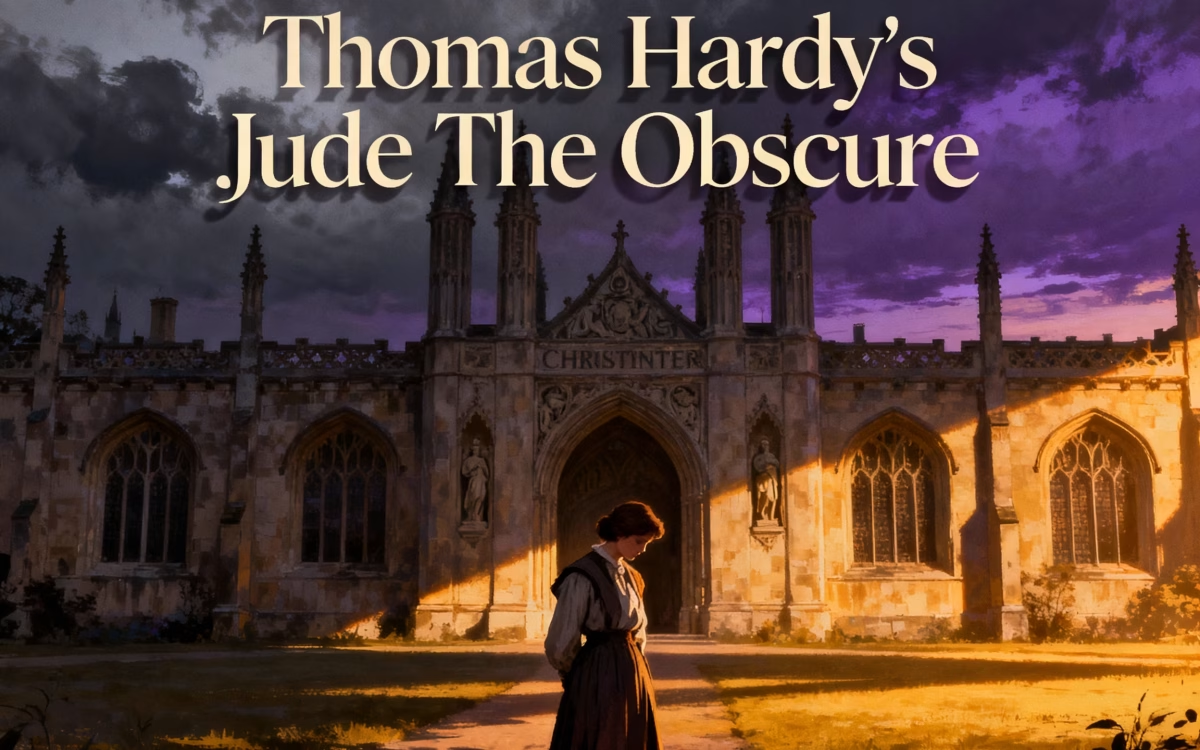
Thomas Hardy’s Jude The Obscure remains a powerful novel that unsettles readers even today. Jude Fawley, a poor orphan raised in Wessex, dreams of studying at Christminster, a city modelled on Oxford. His talent and discipline are evident from the start. He teaches himself classical languages while working as a stonemason. Education is a path to a better life. Yet, the university he admires silently rejects his ambitions. Society’s closed gates of class, marriage, and religion block his way. Hardy does not present these barriers as humane. Instead, he shows them as rigid institutions.
For many students, especially in exam-driven cultures like India, this story feels familiar. “Merit” is praised, but opportunity is often uneven. Jude’s struggles reflect the challenges faced by working-class individuals seeking upward mobility. Hardy links Jude’s personal journey to the larger social structures. His self-taught studies would open doors in a fair system. In reality, he is quietly excluded by respectable institutions. This repeated frustration turns the novel into more than a personal tragedy. It becomes a harsh critique of how ambition is suppressed by class.
The intertwined stories of Jude, Arabella, and Sue expose deeper issues. Marriage laws, sexual morality, and religious guilt are shown to destroy affection. Loveless marriages and broken partnerships are central. When readers encounter these relationships, questions arise. Is the “moral” order truly moral? For modern audiences, the mix of intimate emotion and systemic critique is key. Hardy anticipates debates about women’s autonomy, toxic respectability, and the cost of rigid belief. Whether approached as a literature student, teacher or general reader, an informed Jude The Obscure analysis reveals Hardy’s indictment of his age—and ours.
Thomas Hardy’s Jude The Obscure: Plot Overview
Thomas Hardy’s Jude The Obscure follows the tragic journey of Jude Fawley, a poor orphan raised by his great-aunt in the village of Marygreen. Jude dreams of studying at Christminster, a university city that represents knowledge and opportunity to him. He teaches himself classical languages and learns stonemasonry, but Arabella Donn, a local woman, quickly derails his ambitions by tricking him into marriage with a false pregnancy claim. Their marriage is unhappy, and Arabella soon leaves Jude to move to Australia.
After Arabella’s departure, Jude finally travels to Christminster. Jude is enchanted by Christminster, but his lack of wealth and social status keeps the university doors closed to him. In Christminster, he meets his intelligent cousin, Sue Bridehead. He falls deeply in love with her, but their relationship is complicated by Jude’s past marriage and Sue’s own ambivalence toward conventional marriage and intimacy.
Moreover, Sue marries the schoolteacher Phillotson, but she remains emotionally close to Jude. After her marriage fails, Sue leaves Phillotson and reunites with Jude. The couple, along with their children, face social ostracism for living together unmarried. Jude loses his job, and the family struggles to find work and housing. Their hardships culminate in the devastating act of Little Father Time, Jude’s melancholic son, who kills himself and his siblings, believing he is the cause of their troubles.
Furthermore, Sue, overwhelmed by guilt and religious doubt, returns to Phillotson, leaving Jude heartbroken. Jude, now ill and alone, is tricked into marrying Arabella again. His health declines, and he dies in Christminster, still longing for the education and love he was denied. Sue, meanwhile, lives a subdued life with Phillotson, while Arabella moves on without mourning Jude’s death.
This plot overview reveals the novel’s relentless focus on thwarted ambition, social exclusion, and the destructive power of rigid Victorian institutions.
Thomas Hardy’s Jude The Obscure: Major Themes
Each theme in Jude The Obscure connects to Hardy’s larger critique of Victorian society, showing how institutions and traditions can crush individual dreams and happiness:
Marriage as a Flawed Institution
Hardy offers a sharp critique of Victorian marriage, showing how it often traps people in loveless unions. Jude’s forced marriage to Arabella and Sue’s unhappy marriage to Phillotson highlight how social pressure and religious duty override personal happiness. Both characters regret their choices, revealing the emotional cost of rigid marital conventions.
Fate and Human Suffering
The novel is filled with unlucky coincidences and tragedies that feel like fate. Society, class, and even inherited “curses” shape Jude and Sue’s lives, forces beyond their control. Their suffering seems predestined, whether by supernatural design or by a society that crushes sensitive, independent souls.
Religion and Hypocrisy
Hardy questions organized religion, portraying it as life-denying and hypocritical. Jude’s early desire to join the clergy fades as he realizes Christianity suppresses natural desires. Sue starts out skeptical but later turns to religion in guilt after tragedy, showing how faith can become a tool for self-punishment rather than comfort.
Social Criticism: Class and Education
Jude’s struggle to access higher education exposes the rigid class system. Despite his intelligence and hard work, he is excluded from Christminster because of his background. Hardy criticizes how society blocks upward mobility, leaving ambitious working-class individuals like Jude hopeless.
Women in Society
Sue Bridehead is a complex portrayal of the “New Woman”—intelligent, independent, and resistant to traditional roles. Yet, she is ultimately broken by societal expectations, forced to return to her husband and accept submission. Hardy shows how Victorian society limits women’s freedom and punishes nonconformity.
Love, Sexuality, and Nonconformity
The novel explores the tension between personal desire and social norms. Jude and Sue’s unconventional relationship challenges Victorian ideals of love and sexuality. Their refusal to marry conventionally, and their tragic fate, reveal the high cost of defying social conventions.
Existential Isolation
Jude is portrayed as an existential outcast, unable to find belonging in his village, Christminster, or society at large. His isolation reflects the broader human predicament of feeling estranged in a world governed by rigid rules and indifferent institutions.
Thomas Hardy’s Jude The Obscure: Character Analysis
Jude Fawley
Jude is the novel’s protagonist, a working-class stonemason raised by his great-aunt in Marygreen. From childhood, he dreams of becoming a scholar and gaining entry to Christminster, the university city that represents knowledge and respectability to him. Jude is ambitious, idealistic, and deeply compassionate, often putting others before himself. His self-taught knowledge of classical languages reveals his intelligence and determination. However, Jude is also impulsive and emotionally vulnerable, making choices that are driven by passion rather than careful planning.
Moreover, Jude’s fatal flaw is his inability to reconcile his ideals with the harsh realities of Victorian society. He is repeatedly thwarted by social barriers, loveless relationships, and tragic losses. Nevertheless, despite his suffering, Jude never loses his sense of kindness and humanity. In fact, his journey reflects the pain of being ahead of one’s time, caught between the desire for personal fulfillment and the constraints of class, religion, and social convention.
Sue Bridehead
Sue is Jude’s cousin and intellectual soulmate, representing the “New Woman” of the late Victorian era. She is intelligent, independent, and deeply skeptical of traditional marriage and religion. Sue values intellectual companionship and emotional intimacy. She feels conflicted about physical love and social expectations. Moreover, her relationship with Jude is marked by emotional ambivalence. She constantly struggles between her ideals and her fears.
Furthermore, Sue’s refusal to conform to societal norms ultimately leads to her downfall. After her children’s deaths, Sue is overwhelmed by guilt. She returns to her former husband, Phillotson, sacrificing her autonomy as an act of religious penance. In fact, Sue’s character exposes the limits placed on women’s freedom and the emotional toll of defying convention in a rigid society.
Arabella Donn
Arabella is Jude’s first wife, a practical and sensual woman who approaches marriage as a means of social and economic advancement. She is manipulative, using a false pregnancy to trap Jude into marriage. Arabella lacks emotional depth and is primarily concerned with her own interests. When the marriage fails, she leaves Jude without regret and later marries again, showing little remorse for the pain she causes.
Arabella’s character highlights the limited options available to working-class women and the ways, in which they navigate a patriarchal society. Her pragmatism contrasts sharply with Sue’s idealism, providing a different perspective on female agency in the novel.
Richard Phillotson
Phillotson is a schoolteacher and Sue’s first husband. He is kind, tolerant, and intellectually open-minded, allowing Sue her independence even after their marriage breaks down. Phillotson’s willingness to let Sue leave him and later to remarry her after her return demonstrates his capacity for forgiveness and selflessness. However, his inability to adapt to changing social norms ultimately leaves him isolated and disillusioned.
Little Father Time
Little Father Time, Jude’s melancholic son, stands as a symbol of inherited despair and the crushing weight of adult failures on children. His tragic act—killing himself and his siblings—condenses the novel’s themes of fatalism, inherited suffering, and the destructive impact of social prejudice. Each character in Jude The Obscure embodies Hardy’s critique of Victorian society, showing the emotional and social costs of rigid institutions. Their struggles reveal the difficulty of seeking individual fulfillment in a world that often punishes ambition and nonconformity.
Thomas Hardy’s Jude The Obscure: Narrative Technique
Thomas Hardy’s narrative technique in Jude The Obscure blends realism, circular structure, and strategic use of contrast, foreshadowing, and coincidence. Hardy moves away from linear storytelling. Instead, he uses a circular structure that mirrors Jude’s repetitive struggles against social barriers. The novel is split into six parts, each named after a location in Wessex. This reflects Jude’s cyclical journey from hope to disillusionment as he moves between villages and Christminster.
Moreover, Hardy often uses short, episodic scenes. This keeps the plot moving and highlights the abruptness of life’s tragedies. He relies on coincidence to connect characters and advance the story. While some critics find his transitions abrupt, this technique strengthens the novel’s sense of fate and inevitability. Chance meetings and sudden events repeatedly alter the characters’ destinies, underscoring their lack of control over their lives.
Furthermore, the narrative is omniscient. Hardy sometimes aligns the narrator’s voice with Jude’s perspective, inviting readers to empathize with his suffering. He uses foreshadowing, such as epigraphs at the start of each section, to hint at the tragic outcomes awaiting Jude and Sue. Contrast is central: Jude’s idealism clashes with society’s harsh realities. Sue’s intellectual freedom stands against her eventual submission. The characters’ aspirations contrast with the limitations imposed by class and convention.
Additionally, Hardy’s technique is enriched by literary devices. Imagery, allusion, and metaphor deepen the story. The recurring window motif, for example, symbolizes thresholds and transitions in the characters’ lives, especially Jude and Sue’s movement from one phase to another. Hardy’s structure and narrative choices create a sense of claustrophobia and inevitability. This amplifies the novel’s tragic themes and critique of Victorian society.
Thomas Hardy’s Jude The Obscure: Tragedy
Thomas Hardy’s Jude The Obscure is a profound tragedy, charting the slow and inevitable destruction of Jude Fawley’s dreams, relationships, and spirit. Jude The Obscure follows the classic tragic arc: Jude Fawley, a man of noble aspirations, faces downfall as personal flaws, social forces, and the cruel hand of fate bring him low. Jude’s tragedy begins with his unyielding ambition to rise above his station. He is intelligent, hardworking, and full of hope, but the rigid class system, the hypocrisy of Victorian society, and the indifference of the universe repeatedly crush his aspirations.
Moreover, at every turn, society thwarts Jude’s desire for education. His attempts to find love and acceptance end in rejection and tragedy. The novel’s structure itself reinforces this sense of doom, as Jude’s life spirals downward through a series of misfortunes, culminating in the deaths of his children, the loss of Sue, and his own lonely, premature death.
Furthermore, at the heart of the tragedy is the conflict between individual desire and societal constraint. Jude’s passion for Sue, his intellectual curiosity, and his longing for a meaningful life are all punished by a society that values conformity over authenticity. Hardy presents this not as a personal failing but as a systemic injustice, making Jude’s suffering emblematic of the broader human condition in a world governed by arbitrary rules and indifferent powers.
Additionally, the novel’s most harrowing moment—the suicide of Little Father Time—epitomizes the crushing weight of inherited despair and the destructive impact of social prejudice. This act of tragedy is not just a personal loss but a symbolic indictment of a society that offers no hope or support to its most vulnerable members.
In the end, Jude The Obscure is not merely a story of one man’s downfall, but a sweeping tragedy that exposes the limitations and injustices of the Victorian world. Hardy’s portrayal of Jude’s suffering, his loss of hope, and his ultimate resignation to fate make the novel a timeless exploration of the tragic human condition.
Thomas Hardy’s Jude The Obscure: Symbolism
Thomas Hardy’s Jude The Obscure is rich in symbolism, with each symbol deepening the novel’s tragic and existential themes. Also, Hardy uses recurring images and characters to convey the limitations, disappointments, and emotional weight faced by Jude and Sue.
Christminster: The Elusive Ideal
Christminster is the most powerful symbol in the novel, representing Jude’s dreams of education, social mobility, and spiritual fulfillment. From his first glimpse of its distant spires, Jude imagines Christminster as a New Jerusalem—a place of enlightenment and opportunity. However, as Jude gets closer, he discovers that Christminster is not the ideal he imagined, but a closed, elitist institution. The city symbolizes both aspiration and disillusionment, measuring Jude’s hopes against the harsh realities of class and exclusion.
Little Father Time: Fate and Despair
Little Father Time, Jude’s melancholic son, acts as a living symbol of inherited despair and the crushing weight of adult failures on children. His pale, wizened face and gloomy demeanor make him seem less like a child and more like an oracle of doom. Moreover, his famous act—killing himself and his siblings—epitomizes the destructive impact of social prejudice and inherited suffering, reinforcing the novel’s fatalistic tone.
Samson and Delilah: Emotional and Intellectual Castration
Hardy repeatedly draws parallels between Jude and Samson, and Arabella and Delilah. Arabella’s manipulation undermines Jude’s emotional life, just as Delilah’s cunning strips Samson of his strength. This symbol shows how the very relationships meant to support Jude end up sabotaging his passions and ambitions.
The Trapped Rabbit and the Freed Pigeons
The incident of the trapped rabbit, which Jude kills to end its suffering, is symbolic of the characters’ own entrapment and despair. Sue’s action of setting her pigeons free at the poulterer’s shop further symbolizes her desire to break free from the shackles of social convention, yet her freedom is always fleeting and illusory.
The Window Motif
Windows appear throughout the novel as thresholds between Jude’s aspirations and the outside world. Jude often looks through windows at Christminster or at the lives of others, emphasizing his sense of isolation and exclusion. The window motif reflects the barriers—physical, social, and emotional—that Jude cannot cross.
Personal Reflections
Jude The Obscure is not just a story about one man’s tragedy, but a mirror reflecting the complexities and contradictions of human life. Also, the book stays with you, prompting questions and encouraging empathy long after the final page is turned. EXPLORE OTHER WRITERS
Conclusion
Thomas Hardy’s Jude The Obscure concludes with a profound sense of loss and resignation, leaving readers with a haunting reflection on the cost of nonconformity and the crushing weight of social expectations. Jude dies alone, his dreams of education, love, and a meaningful life unfulfilled, while Sue returns to a loveless marriage, surrendering her freedom and autonomy to religious guilt. Moreover, Arabella, ever pragmatic, moves on without mourning Jude, underscoring the novel’s bleak portrayal of human relationships and societal hypocrisy.
Furthermore, the ending is not redemptive; it offers no easy answers or moral comfort. Instead, Hardy forces us to confront the tragic consequences of rigid institutions, the destructive power of fate, and the emotional toll of living in a world that punishes ambition and difference. In fact, Jude’s death is not just the end of one man’s story, but a symbol of the countless lives crushed by systems that value conformity over compassion.
For modern readers, the novel’s conclusion remains deeply unsettling and relevant. In addition, it challenges us to question our own assumptions about success, love, and morality, and to consider the ways in which society still marginalizes those who dare to dream beyond its boundaries. Ultimately, Jude The Obscure stands as a powerful indictment of the social, educational, and religious structures that continue to shape—and often limit—our lives.
FAQS
Why is Jude The Obscure considered a tragic novel?
Jude The Obscure is tragic because it traces Jude Fawley’s downfall. Class barriers, societal expectations, and personal misfortunes repeatedly crush his dreams of education, love, and social mobility. The novel ends with his lonely death and the suffering of those around him. Also, this highlights the destructive power of rigid Victorian institutions.
What are the major themes in Jude The Obscure?
The major themes include the critique of marriage, the struggle for social mobility, the impact of class and education, the role of religion, and the limitations placed on women’s autonomy. Hardy uses these themes to expose the injustices and hypocrisies of Victorian society.
Who is Sue Bridehead, and what is her role in the novel?
Sue Bridehead is Jude’s intelligent and independent cousin, representing the “New Woman” of the late Victorian era. She challenges traditional gender roles and religious conventions, but her emotional ambivalence and eventual submission highlight the limits of female autonomy in a patriarchal society.
What is the significance of Christminster in the novel?
Christminster symbolizes Jude’s aspirations for education, respectability, and spiritual fulfillment. However, it also represents the unattainable nature of his dreams, as the city’s elite institutions remain closed to him due to his social background.
How does Thomas Hardy use symbolism in Jude The Obscure?
Hardy uses symbols like Christminster (aspiration and disillusionment), Little Father Time (inherited despair), and the trapped rabbit (entrapment and suffering) to deepen the novel’s tragic and existential themes. These symbols reinforce the emotional and social struggles faced by the characters.