Introduction
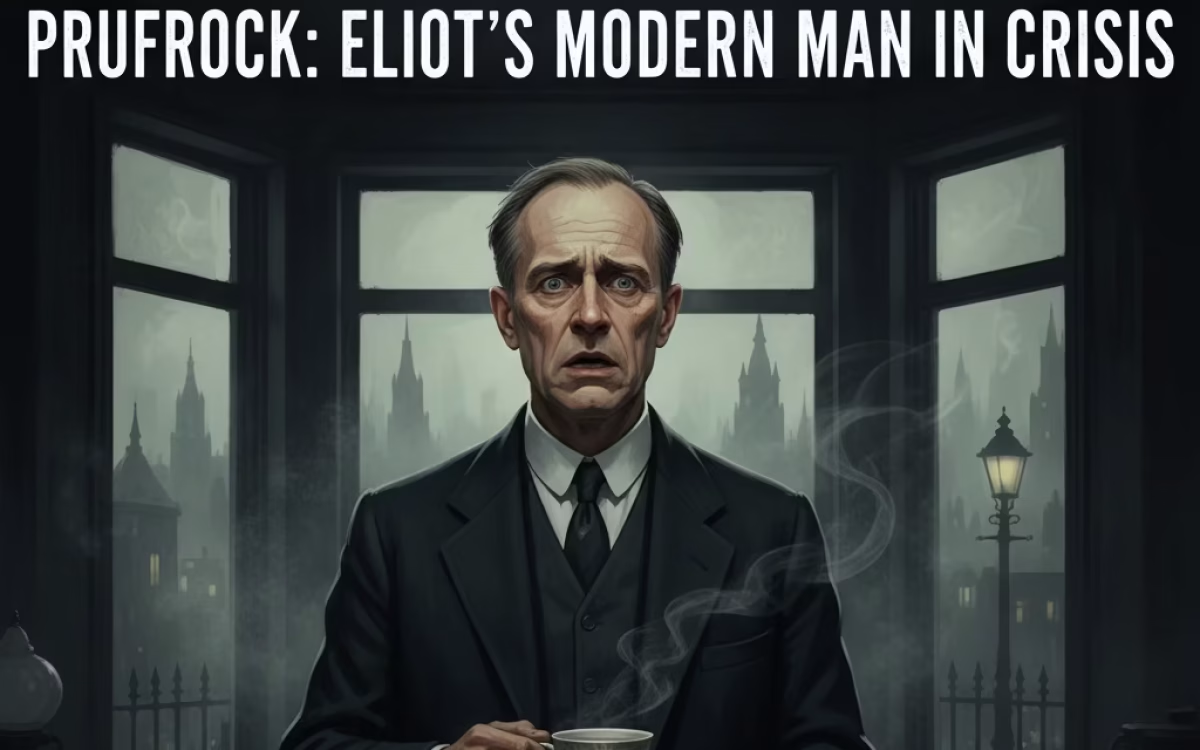
In “Prufrock: Eliot’s Modern Man,” T. S. Eliot crafts a haunting portrait of urban isolation and self-doubt, giving voice to a generation caught in the flux of modernity. This deeply personal and yet universally resonant poem, “The Love Song of J. Alfred Prufrock,” becomes the anthem of anyone who has ever questioned their place in a rapidly changing world. Whether wandering city streets or wrestling with silent anxieties, Prufrock’s predicament captures the spirit of the modern condition with eloquence and irony.
Prufrock: Eliot’s Modern Man Analysis
The Modern Man’s Loneliness
Eliot doesn’t simply sketch a lonely individual; he draws a silhouette for all modern men and women struggling to find connection amidst crowds. Prufrock’s lungs fill with self-doubt, and his corridors echo with the monotony of social expectation, much like modern office workers ferrying coffee through glass halls.
The poem’s cityscape, conjured in “half-deserted streets” and “one-night cheap hotels”, becomes a metaphor for interior emotional wastelands.
Prufrock’s repetition of “Do I dare?” reflects a whole generation’s uncertainty, stretched between yearning and inertia. FULL TEXT
Fragmented Identity in a Fragmented World
Prufrock’s speech and thoughts mirror the hallmark of modernism—fragmentation. The poem meanders, like a man who doubts every direction at a traffic signal, until even his sense of self is dispersed.
Eliot’s lines, rife with ellipses and hesitation, evoke the inner discord of someone who fears misinterpretation even more than rejection.
Personal anecdote: reading Prufrock years ago during a spell of postgraduate ennui, suddenly, the phrase “measured out my life with coffee spoons” struck with alarming clarity; it’s as though Prufrock was whispering what hadn’t yet surfaced in my own mind.
Prufrock: Eliot’s Modern Man: The Core of Prufrock’s Crisis
The Fear of Judgement
Prufrock’s paralysis is tied to a fear of the world’s gaze—”they will say: ‘How his hair is growing thin!'” Even reflecting on something as trivial as a bald spot, modern anxieties about self-presentation and inadequacy emerge.
Social media magnifies what Eliot saw—comparison and public gaze turn private quirks into inhibitions for millions.
Prufrock’s indecision resonates with anyone who’s second-guessed a social post or paused before voicing a question in a crowded room.
The Elusiveness of Authenticity
Despite the constant self-interrogation, Prufrock struggles to articulate his authentic self—”It is impossible to say just what I mean!” This inability, familiar to a digital age saturated with noise, reveals how elusive it is to express real desire or vulnerability.
Prufrock: Eliot’s Modern Man: Poem’s Urban Geography
Prufrock’s Setting: A Universal Cityscape
From Eliot’s London to the rush of Mumbai or Dubai, urban alienation is a global experience. Prufrock’s journey through foggy streets becomes the journey of every commuter, questioning the point of their routine.
The poem’s themes resonate across global cities—alienation and social fragmentation are not just Western concerns but play out vividly on the streets of Asian and Middle Eastern cities.
Regional Reflections
Prufrock’s self-doubt resonates with the pressure of competitive exams, arranged marriages, and the quest for parental approval. The poem’s labyrinth of decisions and regrets is as much about contemporary Indian life as it is about Eliot’s England.
Prufrock: Eliot’s Modern Man: Predicament
Masculinity and Vulnerability
Prufrock stands as an antihero, gentler and more hesitant than typical literary protagonists. In a culture where masculinity is often equated with decisiveness, his vacillation becomes revolutionary.
The poem was radical for its time—and remains so today, giving voice to male vulnerability, something still debated in many societies.
Personal reflection: Sometimes, Prufrock’s wry line—”I am no prophet”—feels more honest than outward bravado.
The Burden of Expectations
Family pressures, societal benchmarks, and class anxieties weigh on Prufrock’s mind—themes that transcend cultural boundaries. The poem’s universality lies in capturing that burden, whether it’s navigating marriage proposals or job interviews.
Prufrock: Eliot’s Modern Man: The Modernist Innovation
Crafting the Prufrockian Universe
Eliot’s use of stream-of-consciousness, coupled with allusions to Dante, Shakespeare, and the Bible, builds layers within the poem. But it is the tone—ironic, confessional, and gently mocking—that keeps Prufrock relevant.
By inventing the “drama of literary anguish”, Eliot paved the way for later poets and novelists to explore anxiety, detachment, and existential dread without melodrama.
The poem’s fragmentation and shifting imagery mimic a restless mind, long before psychology made such analysis commonplace.
Objective Correlative and Symbolism
Eliot’s demand for an “objective correlative” means the fog, coffee spoons, and yellow smoke stand in for moods and memories—making the abstract painfully concrete.
These symbols help Prufrock’s predicament transcend specifics, becoming a global metaphor for anyone lost amid modernity’s options. EXPLORE MORE
Prufrock: Eliot’s Modern Man: Themes
| Theme | Evidence from the Poem | Modern Relevance |
|---|---|---|
| Alienation | “lonely men in shirt-sleeves, leaning out of windows” | Urban loneliness, social isolation |
| Indecision | “Do I dare?/Do I dare?” | Career anxiety, life choices |
| Self-doubt | “They will say: ‘How his hair is growing thin!'” | Self-image, social media comparison |
| Temporal drift | “I have measured out my life with coffee spoons.” | Routine, the passage of time |
| Fear of rejection | “That is not it at all. That is not what I meant at all.” | Fear of misunderstandings, FOMO |
Conclusion
Eliot’s “The Love Song of J. Alfred Prufrock” stands undiminished by time—it is a mirror held up to the modern psyche, reflecting our collective anxieties, yearnings, and regrets. By empathising with Prufrock, readers find both companionship in their worries and the faint suggestion that voicing them is a first step toward meaning.
Whether in bustling metros or small towns, Prufrock’s lament continues to reverberate—a soft, honest song for anyone who has ever felt out of sync with the world they inhabit.
FAQs
Q1: What is the central message of T. S. Eliot’s ‘The Love Song of J. Alfred Prufrock’?
The poem explores the profound isolation, indecision, and uncertainty that define the modern experience, mirroring the struggles of the average individual to find meaning and connection in a rapidly changing world.
Q2: How does the poem reflect the anxieties of modern man?
Through Prufrock’s internal monologue, Eliot gives voice to the fear of judgement, social paralysis, and a relentless sense of inadequacy—issues that persist in urban, high-pressure environments worldwide.
Q3: Why is Prufrock considered a ‘modern’ character?
Prufrock embodies the fragmented psyche and existential uncertainty of twentieth-century individuals, representing a departure from traditional, decisive literary heroes in favour of nuance, doubt, and vulnerability.
Q4: How is the theme of alienation portrayed in the poem?
Alienation surfaces in Prufrock’s inability to connect with others or express his true feelings, underscored by the city’s impersonal atmosphere and the repetitive, mundane imagery.
Q6: What literary devices make the poem unique?
Eliot’s modernist techniques include stream-of-consciousness narration, allusion, symbolism, and fragmentation, all of which heighten the sense of psychological depth and disconnection.