Introduction
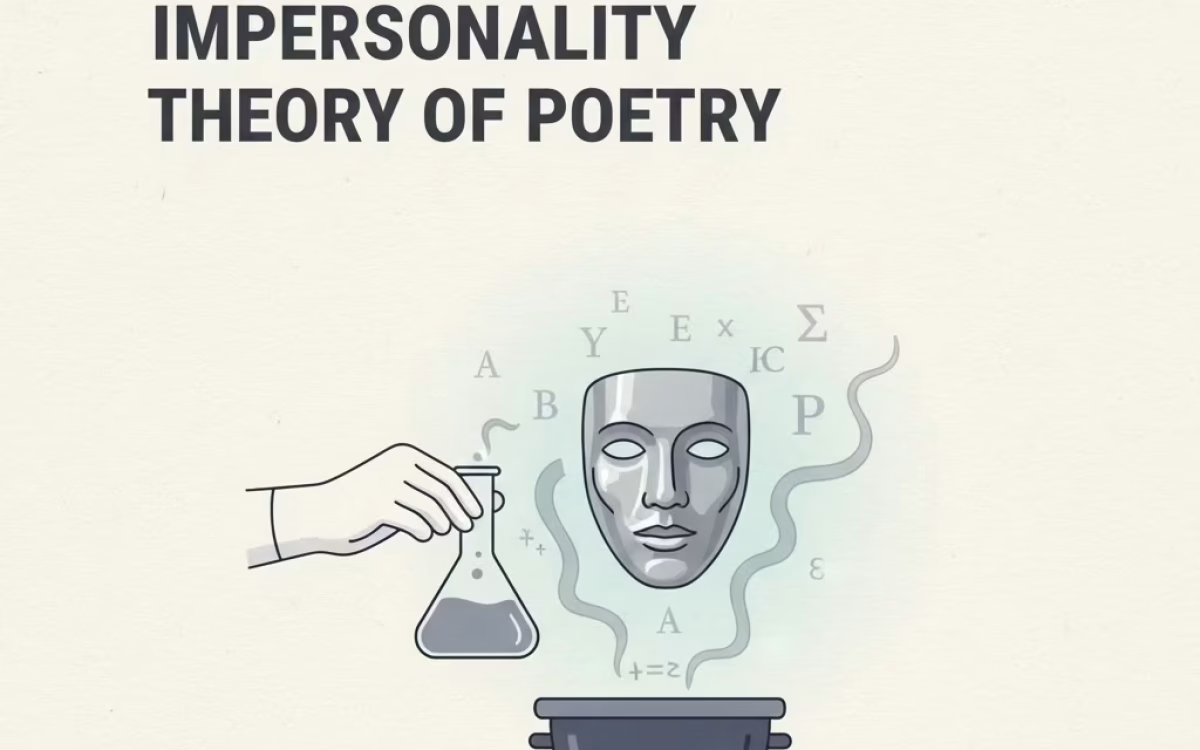
TS Eliot’s Impersonality Theory of Poetry marks a profound departure from the prevailing attitudes of the Romantic era. Consequently, it discards the notion that poetry springs from the personal emotions of its author. Instead of being a spontaneous overflow of feelings, Eliot contends that poetry is “an escape from emotion.” In fact, it is a deliberate act where the poet intentionally distances the self from the work. So, what does this mean in practice? Eliot’s approach is almost alchemical. Just as platinum in a chemical reaction allows new compounds to form yet remains unchanged, the poet’s mind serves as a catalyst. It ignites creative fusion without being personally altered in the process.
Furthermore, this theory, presented most famously in Eliot’s critical essay “Tradition and the Individual Talent”, challenges poets to relinquish egotistical self-expression. They are called to immerse themselves instead in the long tradition of literary art. For Eliot, the value of a poem rests not in private confessions or diary-like revelations. Rather, it lies in the ability to synthesise myriad influences, literary histories, and universal ideas into art that stands apart from its creator. Thus, the poet becomes a vessel—not a personality—whose role is to concentrate experiences, rework them into new combinations, and shape meaning that transcends personal boundaries.
As someone deeply invested in the power of literature, encountering Eliot’s impersonality theory often feels like wandering into a vast echo chamber, rich with voices from the past and possibilities for the future. Accordingly, there’s a certain humility required: one must set aside individual anxieties, choosing instead to channel broader truths, traditions, and human insight. Eliot’s vision is neither cold nor mechanical despite appearances; in fact, it brings poetry closer to lived reality, acknowledging not just beauty but also the full spectrum of human experience—the glory, the boredom, and even the horror.
Moreover, Eliot’s impersonality is not a rejection of emotion altogether but an invitation for poets to depersonalise their artistic responses. In doing so, poetry becomes a communal achievement, echoing the timeless problems, joys, and dilemmas shared by all ages. Ultimately, Eliot’s Impersonality Theory of Poetry invites creators and readers alike to look beyond the signature of the artist, seeking instead the vibrant, impersonal life of the poem itself. FULL TEXT
TS Eliot’s Impersonality Theory: An Understanding
What Is Eliot’s Impersonality?
Eliot’s theory argues that the poet’s individual personality should not contaminate the creative process. He likens the poet’s mind to a catalyst in a chemical reaction—essential for transformation, yet remaining untouched itself. Unlike poets who view their poems as personal diaries, Eliot believes poetic creation is a deliberate act where the poet surrenders their identity for the greater tradition of literature.
Key Elements
Escape from Emotion: Poetry should be an escape from emotion, not a “turning loose” of it.
Escape from Personality: It’s not the poet’s personality that matters, but the impersonality of the art.
Tradition as Anchor: True poetry exists within the continuum of literary tradition. Poets absorb, synthesize, and advance culture rather than singular feelings.
Eliot vs. Romanticism: Clash of Ideologies
Romantic poets like Wordsworth argued that “poetry is the spontaneous overflow of powerful feelings.” Eliot turns this on its head, insisting poetry is a “concentration” of numerous experiences, not recollected emotion. Eliot’s critique of romantic subjectivity forms the backbone of literary modernism, demanding a cool detachment and objective engagement with literary history.
TS Eliot’s Impersonality Theory: Literary Catalysis
How Does the Catalyst Work?
Eliot famously compared the poet’s mind to platinum in a chemical reaction: when sulfur dioxide and oxygen interact in the presence of platinum, a new compound forms, but platinum itself remains unchanged. This analogy reveals how the poet’s mind initiates the creative process while not imparting personal feelings—poetry becomes a product independent of the poet’s autobiography.
TS Eliot’s Impersonality Theory: The Objective Correlative
Emotional Precision
Eliot introduced the concept of the “objective correlative”—a set of objects, situations, or events that evoke particular emotions in readers. The poet achieves impersonality by mastering this technique, ensuring that feelings are conveyed through constructed symbols rather than confessional writing.
Personal Insight:
As a researcher, I find the objective correlative a fascinating bridge between emotional depth and artistic detachment. Eliot’s theory allows rich feelings to blossom in readers, even when the poet stands in the shadows—an elegant solution to the problem of subjectivity.
TS Eliot’s Impersonality Theory: Literary Tradition
A Continuum of Influence
Eliot teaches that no poet has meaning alone; their work is always part of an unbroken tradition. The poet absorbs past influences, entering into dialogue with prior texts and models. This collective consciousness shapes poetic creation, emphasising impersonality as central to originality.
Community Over Ego
By focusing on tradition and the “mind which creates”, Eliot elevates literary community and diminishes the solitary writer’s ego. Impersonality thus becomes a way for poets to transcend personal limitations and reach lasting greatness.
TS Eliot’s Impersonality Theory: Critiques
Problems in Practice
Eliot’s theory is not without critics. Some argue that attempts at impersonality can mask deep personal anxieties or unresolved psychological tensions. Others claim that complete objectivity is an illusion, and all art inevitably bears traces of the creator. Eliot himself sometimes refers to personality in his criticism, revealing tensions and contradictions within his theory.
Impersonality in Eliot’s Own Work
The Waste Land and Beyond
Eliot’s masterpiece, “The Waste Land”, exemplifies impersonality. Narration shifts between multiple voices, incorporating myths and traditions rather than individual confession. His poems often seem detached, observational, and woven from fragments of past literature—a hallmark of his theory in action.
Conclusion
T.S. Eliot’s theory of impersonality reshaped not only how poetry is written but also how it is read and valued. Specifically, he argues that poets must place tradition above individual expression. Consequently, they should immerse themselves fully in the lineage of past poets and allow those influences to refine their creative acts. Only by surrendering the ego to tradition can a poet reach artistic maturity and produce work that stands independent of personal confession or biographical details.
Moreover, a key to understanding Eliot’s vision is his analogy of the poet’s mind as a catalyst—like platinum in a chemical reaction. In this process, the poet’s presence brings together different elements—experiences, images, and emotions—yet it leaves no mark of personal identity. Hence, poetry becomes a fresh and autonomous creation, its life unfolding within the poem itself rather than as an extension of the poet’s consciousness.
Importantly, Eliot’s theory does not demand that poetry be devoid of feeling or imagination. Instead, it champions transforming personal emotion into an “art emotion” that is universal and accessible. This subtle artistry is exemplified by Eliot’s concept of the “objective correlative”. Specifically, poets encode their emotions in external situations, symbols, and images. Therefore, readers experience genuine emotional resonance without direct exposure to the poet’s subjectivity.
In addition, Eliot’s approach represents a clear rejection of Romantic subjectivism. He insists that accomplished poets achieve a delicate harmony between craft, tradition, and emotional truth. As a result, this balance requires both humility and rigorous self-effacement. Ultimately, through impersonality, poetry attains intellectual dignity, depth, and lasting universality—qualities Eliot deemed essential for the art’s survival and continued relevance. EXPLORE OTHER WORKS
FAQs
Q: What is Eliot’s impersonality theory in poetry?
Eliot’s theory proposes that poetry should escape personal emotion and identity, favouring impersonality and the influence of literary tradition.
Q: How does Eliot’s theory differ from Romantic poetry?
Unlike romantic poets, who emphasise confession, Eliot urges for detachment and objective emotional expression using the “objective correlative”.
Q: Is Eliot’s theory practical in real-life writing?
While ideal, some critics say complete impersonality is unattainable, as all writers leave traces of themselves in their work.
Q: Which of Eliot’s works best illustrates his theory?
“The Waste Land” is a prime example, blending multiple voices and traditions into a unified impersonality.