RK Narayan’s The Guide: Introduction
RK Narayan’s The Guide stands as a landmark in Indian English literature. Its captivating narrative draws readers in, but it’s the novel’s profound exploration of identity, transformation, and the human condition that truly sets it apart. Published in 1958, the story unfolds in Narayan’s fictional South Indian town of Malgudi—a place now synonymous with his storytelling.
At its heart, The Guide tells the story of Raju. His life takes an unexpected turn. From a simple tourist guide, he becomes a revered spiritual figure. This transformation is both dramatic and deeply symbolic. The novel’s enduring appeal lies in how it weaves together the personal and the universal. Raju’s journey is more than just a tale of one man’s rise and fall. It’s a reflection on the complexities of Indian society. It explores the clash between tradition and modernity, and the often-blurred lines between illusion and reality. Narayan’s subtle irony and nuanced characterisations invite readers to question the nature of truth, authenticity, and self-perception.
As Raju shifts roles—from guide to manager to spiritual guru—readers are drawn into a world where identity is fluid. Redemption is possible, even for those who have made mistakes. The narrative structure is non-linear, moving seamlessly between past and present. This technique adds suspense and mirrors the fragmented nature of memory and identity. Narayan’s language is simple, yet evocative. It captures the rhythms of everyday life in Malgudi while delving into deeper philosophical questions.
Beyond its literary merits, The Guide is a social commentary on post-colonial India. It explores the tensions between old values and new aspirations. Raju’s story resonates because it speaks to the universal quest for meaning and belonging. Whether viewed as a character study, a spiritual allegory, or a social critique, The Guide remains a rich and rewarding read. It offers new insights with each encounter.
RK Narayan’s The Guide: Plot Overview
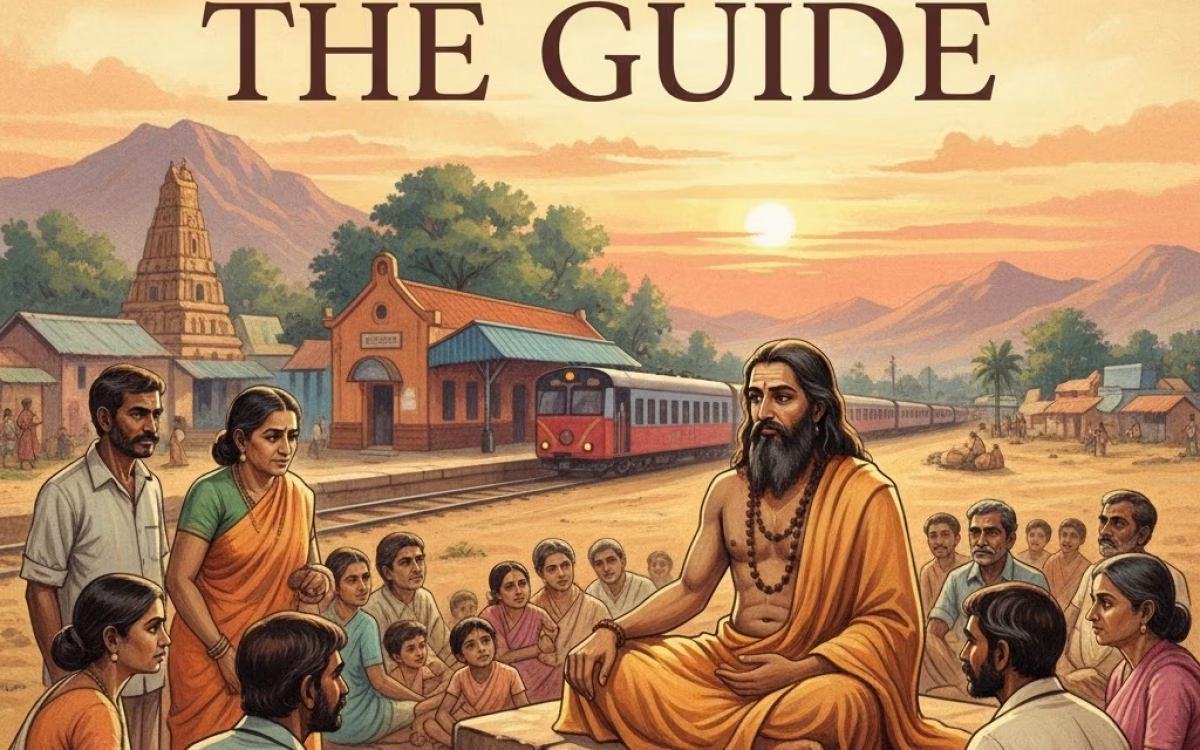
The Guide unfolds in the small, bustling town of Malgudi, where Raju, known as “Railway Raju,” begins his life as a shopkeeper and later reinvents himself as a tourist guide. His charm and knack for storytelling make him popular among visitors, but his life takes a dramatic turn when he meets Rosie, the wife of an archaeologist named Marco. Raju is captivated by Rosie’s passion for classical dance, and as he encourages her to pursue her dreams, a deep connection forms between them. Their relationship blossoms into an affair, leading to Rosie’s separation from Marco and her move to Raju’s home.
As Raju becomes Rosie’s manager, he helps her achieve fame as a dancer, but his growing greed and possessiveness eventually lead to his downfall. Accused of forgery related to Rosie’s signature, Raju is sentenced to two years in prison. Upon his release, he finds himself at a crossroads, unsure of his next steps. Seeking solitude, he retreats to a temple by the Sarayu River, where a villager named Velan mistakes him for a holy man. Raju, initially reluctant, decides to play along, and soon the villagers begin to revere him as a spiritual guide.
The novel’s climax centres on a severe drought that strikes the village. The villagers, believing Raju to be a true holy man, implore him to fast for their salvation. Raju, aware of his own deception, confesses his past to Velan, but Velan’s faith remains unshaken. Faced with the enormity of his role, Raju resolves to continue the fast, leaving readers to ponder the nature of truth, redemption, and the power of belief. FULL TEXT
RK Narayan’s The Guide: Thematic Analysis
RK Narayan’s The Guide is a treasure trove of thematic depth, offering readers much more than just a compelling story. At its core, the novel is a meditation on transformation, identity, morality, and the complex interplay between illusion and reality.
Transformation and Redemption:
Raju’s journey from shopkeeper to tourist guide, then stage manager, and finally spiritual guide forms the backbone of the novel. His transformation is more than just a change in profession. It’s a profound evolution of character. At first, Raju is driven by materialistic motives and a knack for deception. Over time, he undergoes a metamorphosis. This change culminates in his selfless act of fasting for the villagers. His arc shows the potential for personal growth and redemption. Even those who have strayed from virtue can find a way to atone. They can contribute positively to society. Narayan uses Raju’s story to affirm that transformation is possible. Redemption is within reach, no matter how far one has fallen.
Identity and Self-Perception:
One of the most compelling themes in The Guide is the exploration of identity. Raju’s multiple roles—shopkeeper, guide, manager, swami—highlight the fluidity of identity and the ways in which it is shaped by circumstance, perception, and performance. The novel challenges the notion of a fixed self, instead presenting identity as something constructed, performed, and constantly in flux. Raju’s struggle to reconcile his public persona with his private self underscores the complexity of human character and the internal conflicts that arise when one’s roles and reputations clash with personal truth. Narayan invites readers to ponder the extent to which identity is authentic and how much is a product of societal expectations and self-deception.
Illusion and Reality:
The theme of illusion versus reality is central to The Guide. Raju’s rise to prominence as a spiritual guide is based more on the villagers’ perceptions than on genuine spiritual enlightenment. The novel blurs the boundaries between what is real and what is perceived, drawing attention to the power of belief and the ways in which reality can be shaped by collective imagination. Raju’s journey from impostor to authentic spiritual leader is a testament to the transformative power of belief, both in oneself and in others. Narayan uses this theme to explore the nature of truth and the delicate balance between authenticity and artifice in shaping personal narratives.
Tradition vs. Modernity:
Narayan sets The Guide against the backdrop of a rapidly changing India, where traditional values and modern aspirations often come into conflict. Raju’s mother represents the old world, rooted in age-old beliefs and customs, while Rosie, with her unconventional career as a dancer, embodies the spirit of modernity. This clash of values adds depth to the narrative, showcasing the tensions between the old and the new, and the challenges faced by individuals navigating this cultural divide. Narayan’s portrayal of Malgudi as a microcosm of Indian society allows him to explore these tensions in a way that is both specific and universal.
Morality and Hypocrisy:
Morality and hypocrisy are recurring themes in The Guide. Raju’s actions—both good and bad—highlight the moral dilemmas faced by individuals in society. His initial deception and manipulation are contrasted with his eventual selflessness and sacrifice, raising questions about the nature of morality and the possibility of redemption. The novel also critiques societal hypocrisy, particularly in the way Raju is revered as a spiritual guide despite his questionable past. Narayan uses these themes to challenge conventional notions of right and wrong, inviting readers to reflect on their own beliefs and values.
Greed and Materialism:
Raju’s life is driven by a desire for material wealth and social status. His constant reinvention—from shopkeeper to guide to manager—is motivated by his pursuit of money and recognition. However, the novel ultimately suggests that true fulfillment comes not from material gains but from spiritual and moral growth. Raju’s transformation from a materialistic individual to a selfless spiritual guide underscores the limitations of greed and the importance of transcending material desires for a higher purpose.
Passion and Its Consequences:
Passion is a double-edged sword in The Guide. Rosie’s passion for dance leads to her liberation and independence, but it also brings her into conflict with societal norms. Raju’s passion for Rosie and his desire for success lead to both triumphs and tragedies, ultimately resulting in his downfall. Marco’s passion for his work and his rigid adherence to tradition cause him to lose Rosie and isolate himself. Narayan uses the theme of passion to explore its power to both elevate and destroy, highlighting the need for balance and self-awareness.
Karma and Spiritual Awakening:
The concept of karma drives the narrative, showing how actions have consequences. As the story unfolds, Narayan gives individuals opportunities for growth and transformation. Raju’s journey, for instance, moves from a life of deception and materialism to one of spiritual awakening and selflessness. This progression is a testament to the power of karma. Narayan uses this theme to suggest that spiritual fulfillment is possible—even for those who have made mistakes. In fact, the path to redemption remains open to all. Ultimately, karma acts as a guiding force, shaping the characters’ destinies and reinforcing the idea that every choice matters.
RK Narayan’s The Guide: Character Analysis
Raju:
The Reluctant Guide and Redeemed GuruRaju is the heart and soul of the novel, a character whose journey from a simple railway shopkeeper to a revered spiritual guide is nothing short of remarkable. Born into a modest family in Malgudi, Raju is charming, resourceful, and quick-witted. His talent for reinvention is his greatest asset—and his greatest flaw. As a tourist guide, Raju thrives on storytelling, often embellishing tales to please his clients. This knack for performance serves him well in his later roles, but it also leads him into morally ambiguous situations.
Raju’s relationship with Rosie, the dancer, marks a turning point in his life. He becomes her manager, helping her achieve fame, but his involvement in her life leads to scandal and imprisonment. In prison, Raju undergoes a period of introspection, a time when he begins to question his past actions and motivations. This transformation culminates in his role as a spiritual guide, where he finds a sense of purpose and redemption. Raju’s character is a study in contradictions—charismatic yet flawed, self-serving yet capable of selflessness. His journey from impostor to genuine spiritual leader is a testament to the potential for personal growth and the power of belief.
Rosie (Nalini):
The Passionate DancerRosie is a woman of independent spirit and immense talent. Her passion for dance sets her apart from the conventional expectations of an Indian wife. Married to Marco, a rigid and traditional scholar, Rosie feels stifled and unappreciated. Her relationship with Raju is both liberating and tumultuous. Raju’s encouragement allows her to pursue her dreams, but their affair brings her both fame and infamy.
Rosie’s character is marked by her complexity. She is intelligent, passionate, and fiercely independent, yet she is also torn between her love for dance and her loyalty to Marco. Her journey from a constrained wife to a celebrated dancer is a reflection of the changing roles of women in Indian society. Rosie’s inner conflicts and her struggle for self-fulfillment make her a compelling and sympathetic figure. She is not just a victim of circumstance, but an active agent in her own story, making choices that shape her destiny.
Marco:
The Scholar and HusbandMarco is Rosie’s husband, a scholar obsessed with his work and traditional values. He is stern, self-centered, and unable to understand or appreciate Rosie’s passion for dance. His rigid adherence to convention and his inability to support Rosie’s aspirations lead to the breakdown of their marriage. Marco’s character serves as a foil to Raju, highlighting the clash between tradition and modernity. His actions and attitudes reflect the conservative mindset that often stifles individuality and creativity.
Raju’s Mother:
The Traditional FigureRaju’s mother represents the old world, rooted in tradition and religious beliefs. She is a simple, devout woman who is deeply concerned about her son’s well-being. Her character adds depth to the novel’s exploration of tradition versus modernity. Her interactions with Raju reveal the generational gap and the challenges faced by families navigating changing social norms.
Velan:
The Faithful Disciple Velan is the villager who mistakes Raju for a holy man and becomes his devoted follower. Velan’s faith and unwavering belief in Raju’s spiritual powers play a crucial role in Raju’s transformation. Velan’s character highlights the power of belief and the ways in which perception can shape reality. His presence underscores the theme of illusion versus reality, as Raju’s status as a spiritual guide is largely a product of Velan’s faith.
RK Narayan’s The Guide: Personal Reflections
Reading The Guide feels like stepping into a world both familiar and foreign. It mirrors our everyday struggles, dreams, and contradictions. Yet, it unfolds in the vibrant, sometimes bewildering landscape of mid-century India. Narayan draws us effortlessly into Raju’s journey. He makes us not just observers, but participants in Raju’s moral and spiritual dilemmas. The novel never offers easy answers. Instead, it invites reflection. It asks us to consider our own choices, our capacity for transformation, and the masks we wear in different roles.
Raju’s story is a mirror held up to society, reflecting the fluidity of identity and the ease with which we reinvent ourselves. I found myself constantly questioning: How much of Raju is real, and how much is performance? And isn’t that true for all of us? We all play multiple roles—parent, friend, professional, citizen—and sometimes, the lines between authenticity and artifice blur. Narayan’s genius lies in making this ambiguity not just a literary device, but a profound commentary on the human condition.
Rosie’s journey, too, resonates deeply. Her struggle to balance her passion for dance with societal expectations is something many women still grapple with today. Her character reminds us that breaking free from tradition is never easy, but it is necessary for personal growth. Marco, on the other hand, embodies the rigidity of convention, a reminder that clinging too tightly to tradition can stifle individuality and creativity.
The ending of the novel, with Raju fasting for the villagers, is particularly thought-provoking. Is it redemption or punishment? Is Raju truly transformed, or is he simply playing the role one last time? Narayan leaves these questions open, inviting readers to interpret the ending in their own way. For me, it’s a testament to the power of belief and the possibility of change, even in the face of uncertainty. EXPLORE MORE
RK Narayan’s The Guide: Conclusion
The conclusion of RK Narayan’s The Guide is one of the most debated and thought-provoking endings in Indian English literature. Narayan does not offer a neat, tidy resolution; instead, he leaves readers with ambiguity, inviting them to ponder the true nature of Raju’s transformation and the meaning of his final act. As Raju sits by the river, fasting for the villagers, the novel reaches its emotional and philosophical peak. The villagers, believing him to be a holy man, look to him for salvation during a time of drought. Raju, once a master of deception, now finds himself caught in a web of his own making—his lies have become his reality, and his redemption hinges on the faith of others.
What makes the ending so powerful is its refusal to provide clear answers. Does it actually rain? Does Raju truly die as a martyr, or does he simply collapse from exhaustion? Narayan leaves these questions open, allowing readers to interpret the ending in their own way. This ambiguity is not a flaw, but a deliberate artistic choice that underscores the novel’s central themes: the fluidity of identity, the power of belief, and the complexity of human nature. Raju’s journey from a self-serving tour guide to a selfless spiritual guide is rendered credible, but it is also tinged with irony. His transformation is both real and illusory, a testament to the transformative power of belief and the human capacity for change.
Moreover, the conclusion highlights the dichotomy between illusion and reality, a theme that runs throughout the novel. Raju’s status as a spiritual guide is based more on the villagers’ perceptions than on genuine spiritual enlightenment. Yet, in the end, it is this perception that gives his life meaning. Narayan suggests that sometimes, the line between truth and illusion is not as clear as we might think. Raju’s final act, whether it is a genuine sacrifice or a performance, becomes a symbol of hope and redemption for the villagers.
The novel’s ending also reflects the broader social and cultural context of post-colonial India. Raju’s transformation from a tour guide to a spiritual guide can be seen as an allegory for the nation’s own journey from colonial subjugation to independence. Just as Raju reinvents himself, so too does India seek to redefine its identity in the wake of colonial rule. The villagers’ faith in Raju mirrors the collective hope and aspirations of a society in transition.
In conclusion, The Guide is much more than just a story about one man’s journey. Indeed, it is a profound exploration of the human condition. Narayan’s nuanced portrayal of Raju, Rosie, Marco, and the supporting cast creates a rich tapestry of themes and ideas. Moreover, the ambiguous ending is not a weakness; instead, it is a strength that elevates the novel beyond mere storytelling. As a result, readers are challenged to engage with the story on a deeper level. They are encouraged to reflect on their own lives and the choices they have made. Ultimately, the novel leaves a lasting impression, inviting us to ponder the complexities of identity, redemption, and the meaning of transformation. The Guide remains a timeless classic, a testament to the enduring power of literature to inspire, provoke, and transform.
RK Narayan’s The Guide: FAQS
What is the main theme of The Guide by RK Narayan?
The main theme of The Guide is transformation and redemption. The novel explores how the protagonist, Raju, evolves from a dishonest tourist guide to a spiritual figure, highlighting the fluidity of identity and the possibility of personal growth. Other major themes include the conflict between tradition and modernity, the nature of illusion versus reality, and the search for meaning in life.
Who is the protagonist of The Guide?
The protagonist of The Guide is Raju, a man who starts as a tourist guide in Malgudi and undergoes a remarkable transformation throughout the novel. His journey from a self-serving individual to a selfless spiritual guide is central to the story.
What is the significance of the title The Guide?
The title The Guide is significant because it reflects the multiple roles Raju plays in the novel. He begins as a tourist guide, then becomes a guide for Rosie in her pursuit of a dancing career, and finally transforms into a spiritual guide for the villagers. The title also suggests the idea of guidance in a broader sense—how individuals guide each other through life’s challenges.
How does Raju change throughout the novel?
Raju changes from a deceitful and self-serving tour guide to a spiritual guide who ultimately sacrifices himself for the villagers. His transformation is marked by a series of events, including his relationship with Rosie, his imprisonment, and his time in the village. Raju’s journey is one of self-discovery and redemption, as he learns to transcend his past mistakes and find a sense of purpose.
What is the significance of the ending of The Guide?
The ending of The Guide is ambiguous and thought-provoking. Raju’s final act of fasting for the villagers is left open to interpretation. Does it rain? Does Raju truly die as a martyr, or does he simply collapse from exhaustion? Narayan’s decision to leave the ending ambiguous underscores the novel’s themes of illusion versus reality and the transformative power of belief.