Introduction
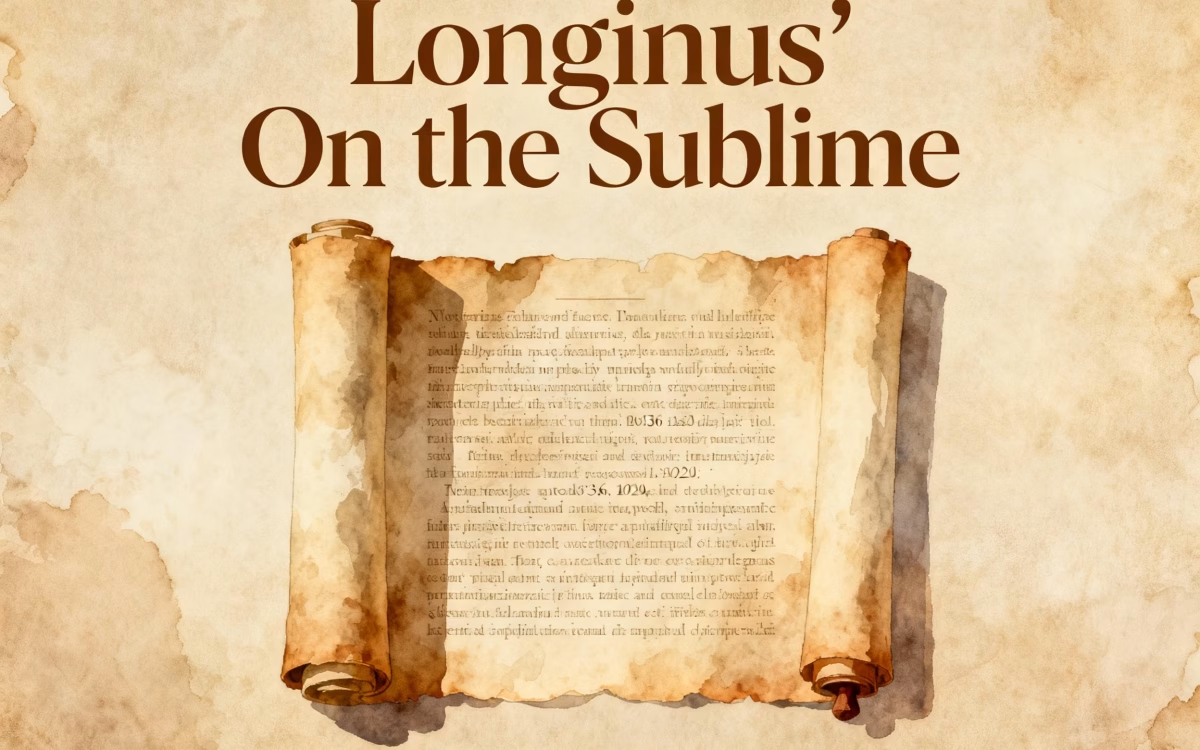
Longinus’ On the Sublime stands as one of the most influential works in the history of literary criticism. It offers a timeless exploration of what makes certain passages of literature truly unforgettable. At its heart, the treatise asks a simple yet profound question: why do some words, lines, and speeches have the power to lift us out of our ordinary selves, stir our souls, and leave us in awe? For students, teachers, and lovers of literature, Longinus’ answer is not just a theory—it’s an invitation to experience the heights of language and imagination.
The concept of the sublime, as Longinus defines it, is not about mere ornamentation or fancy words. Instead, it is about a certain “loftiness and excellence of language” that “sways every reader” and produces a sense of ecstasy, wonder, and elevation. When we encounter a sublime passage, we don’t just understand it—we feel it. Our minds are lifted, our spirits expanded, and we are left with a sense of something greater than ourselves. This is the power Longinus seeks to explain, and it is a power that resonates across cultures, centuries, and genres.
What makes On the Sublime especially relevant for Indian literature students is its focus on the emotional and spiritual impact of writing. In a syllabus that often moves between Western and Indian aesthetics, Longinus’ ideas offer a bridge. His emphasis on “greatness of soul,” “noble diction,” and “dignified composition” aligns with Indian concepts like (rasa), where art is valued for its ability to evoke deep emotional responses. Whether you’re analysing a Shakespearean soliloquy, a Tagore poem, or a political speech, Longinus’ framework helps you see how language can transcend the ordinary and touch the sublime.
Longinus doesn’t just theorise—he illustrates. His treatise is filled with examples from Homer, Demosthenes, and other great writers. These examples show how specific techniques and choices create moments of overwhelming power. This makes On the Sublime not just a critical text but a practical guide for anyone who wants to understand, appreciate, and even create literature that moves.
Longinus’ On the Sublime is more than a historical document. It is a living guide to the power of words, a testament to the enduring magic of literature, and a must-read for anyone who wants to go beyond the surface and discover what makes great writing truly great. FULL TEXT
Who was Longinus?
The author of On the Sublime is traditionally called “Longinus.” However, modern scholarship admits that the exact identity is uncertain. The text is often attributed to an unknown Greek critic from the 1st to 3rd century CE. The treatise survives in a damaged manuscript tradition and reaches us as a substantial fragment rather than a complete book. This is why some sections feel abrupt or incomplete.
Despite this, On the Sublime has had a long critical afterlife. It influenced European aesthetics from the 17th to the 18th century. It also shaped discussions of poetic greatness, style, and emotional effect. Modern critics value it for its combination of rhetorical analysis, close reading, and a persistent interest in the psychological and spiritual impact of language.
What does “the sublime” mean in Longinus?
For Longinus, the sublime in literature is a certain loftiness or excellence of language that “takes the reader out of himself.” It produces an elevation of the soul rather than mere pleasure or persuasion. The sublime is not simply about ornaments or fancy words. Instead, it is about a powerful effect that overwhelms the reader with awe, delight, or a sense of greatness.
He defines sublimity as the echo of greatness of spirit. True sublimity reflects the writer’s moral and imaginative power, not just technical skill. A sublime passage, therefore, is recognised less by external rules and more by the impact it leaves. If, on rereading, it still lifts us, expands our inner world, and resists forgetfulness, it likely possesses sublimity.
Five sources of sublimity in On the Sublime
Longinus famously identifies five principal sources of the sublime, which have become standard reference points in literary criticism. These five are not rigid rules but interacting elements that, in combination, create passages of extraordinary power.
1. Grandeur of thought
The first and most important source of sublimity is grandeur of thought, which Longinus links to greatness of soul. Writers achieve this when they engage with noble ideas, heroic actions, or universal questions, rather than trivial or purely decorative themes.
Grandeur of thought is not a matter of topic alone but of inner character: only minds that habitually think on a large scale can produce such elevation. For students, this pushes interpretation beyond “what happens” to “what kind of mind could write this, and what vision of life does it reveal?”
2. Strong and genuine emotion
The second source is vehement and inspired emotion, the capacity to feel intensely and to express that feeling sincerely. Longinus insists that forced or theatrical emotional display leads to bombast, while genuine passion gives writing a natural, irresistible energy.
This emphasis on authenticity anticipates later theories that link great literature to emotional truth rather than mere ornamentation. It also resonates with Indian discussions of rasa, where carefully shaped emotion leads to aesthetic relish and transcendence.
3. Figures of thought and speech
The third source consists of figures of thought and figures of speech, used boldly and purposefully rather than as mechanical devices. Longinus pays special attention to how certain figures—such as rhetorical questions, apostrophe, or hyperbole—can heighten emotional intensity and create dramatic elevation.
However, figures must emerge organically from the situation and feeling. Otherwise, they become empty tricks that sabotage sublimity. The challenge, then, is to recognise when a metaphor or exaggeration springs from genuine insight and when it is merely a showy flourish.
4. Noble diction
The fourth source is noble diction, which includes the choice of words, metaphors, and the order of phrases. Longinus notes that the right word at the right moment can electrify a passage. Conversely, poor diction, vulgarity, or misplaced ornament can flatten even a grand idea.
Importantly, noble diction does not always mean rare or high-sounding vocabulary. Sometimes, simple, well-chosen words carry the greatest force. For classroom practice in India, this provides a useful criterion for stylistic analysis. Students can be asked to trace how a poet’s vocabulary choices intensify or weaken the emotional impact.
5. Dignified composition (word arrangement)
The fifth source is dignified and elevated composition, the harmonious arrangement of words and clauses that gives form to all the earlier elements. Longinus is sensitive to rhythm, sentence structure, and the way clauses build towards a climax. He sees composition as the architectonic principle that unifies thought, emotion, figures, and diction.
He warns that even great thoughts and words can be wasted if composition is careless or disjointed. This leads to a broken or jerky style that disrupts the reader’s experience. For modern writers, this is a reminder that sublime writing is not just what is said, but how the whole passage moves and breathes.
The sublime versus its opposites: vices of style
Longinus carefully distinguishes the sublime from its counterfeits, such as bombast, tumidity, frigidity, and false sentiment. These vices emerge when writers chase grandeur without the foundation of genuine thought and feeling.
Bombast appears when language is inflated beyond the proportion of the subject, giving the effect of an overblown balloon rather than genuine greatness.
Frigidity results from strained conceits, trivial thoughts dressed up in elaborate phrasing that leaves the reader cold instead of moved.
Longinus’ method: examples and close reading
One remarkable feature of On the Sublime is its use of examples from many authors, including Homer, tragedians, historians, and orators. Longinus quotes or alludes to over fifty writers (in the original Greek environment). He uses them as case studies to illustrate both successful and failed attempts at sublimity.
His approach anticipates later close reading. He pauses over individual phrases, images, or structural choices to show how small stylistic decisions produce large aesthetic effects.
Longinus and Indian aesthetics: a note for geo‑context
Scholars have often compared Longinus’ concept of the sublime with the Indian theory of (rasa), especially in relation to aesthetic emotion and transcendence. Both frameworks focus on how art lifts the spectator or reader beyond ordinary experience. They produce joy, awe, or profound contemplative states.
While rasa theory is more systematically codified and oriented towards performance and reception, Longinus is more concerned with the writer’s greatness of soul and the stylistic means that trigger elevation.
Comparison with other classical critics
Longinus stands apart from classical critics like Aristotle because he focuses less on formal structure and more on spiritual and emotional elevation. Whereas Aristotle’s Poetics concentrates on plot, character, and catharsis within tragedy, On the Sublime asks why certain passages of various genres strike us as absolutely great, regardless of structural rules.
This emphasis on individual moments of overwhelming power makes Longinus a key figure for later discussions of the romantic and modern sublime. In these traditions, intensity and excess often matter more than balance or harmony. EXPLORE OTHER WRITINGS
Longinus’ On the Sublime: An Overview
To make this practically useful for your site’s readers (especially Indian English literature students), the following condensed points can be integrated as bullet notes or revision cards.
On the Sublime is an ancient Greek treatise on literary style and aesthetic greatness, attributed to Longinus, probably composed between the 1st and 3rd century CE.
Longinus defines the sublime as a loftiness and excellence of language that elevates the reader’s soul and reflects greatness of spirit in the writer.
He identifies five sources of sublimity: grandeur of thought, strong emotion, figures of thought and speech, noble diction, and dignified composition.
Two of these sources (grandeur of thought and strong emotion) depend mainly on innate genius, while the remaining three can be developed through art and practice.
Longinus warns against vices of style such as bombast, frigidity, and false sentiment, which imitate greatness but lack inner authenticity.
The treatise uses numerous examples from classical authors, making it an early model of close reading and detailed stylistic analysis.
Comparisons with Indian rasa theory highlight shared interest in how art produces transcendence and aesthetic joy in the sensitive reader or spectator.
| Aspect | Longinus’ On the Sublime | Aristotle’s Poetics | Indian Rasa Theory (Bharata) |
|---|---|---|---|
| Primary focus | Loftiness of style and elevation of soul | Structure of tragedy and plot elements | Aesthetic flavour and emotional relish |
| Key concept | Sublimity as echo of greatness of spirit | Catharsis through tragic action | Rasa as distilled emotional experience |
| Main sources/elements | Five sources of sublimity | Plot, character, diction, thought, song, spectacle | Determinants, consequences, and transmuted emotion |
| Method | Examples, close reading, stylistic analysis | Systematic classification, logical analysis | Performance‑centred, dramaturgical analysis |
| Relevance for students | Explains why some passages feel unforgettable | Offers frame-work for analysing dramatic structure | Helps understand emotional impact in drama and poetry |
Conclusion
Longinus’ On the Sublime remains a cornerstone of literary criticism. It offers timeless insights into what elevates language from mere words to a powerful force that can inspire, move, and transcend. Indeed, its focus on the intrinsic qualities of greatness—such as thought, emotion, diction, and composition—continues to resonate with writers, scholars, and students. Moreover, this resonance is especially strong in diverse cultural contexts like India, where the aesthetic value of art plays a central role.
By understanding and applying Longinus’ principles, readers can develop a deeper appreciation of the sublime in all forms of literature. In fact, they begin to recognise that true greatness lies in the ability of words to uplift the spirit and touch the soul. As a guide, On the Sublime invites us not only to analyse texts but also to aspire toward a higher, more profound engagement with language. Ultimately, it echoes the universal and enduring power of literature, reminding us of its capacity to connect, inspire, and transform.
FAQS
1. What is the sublime according to Longinus?
Longinus defines the sublime as a quality in literature that produces a sense of elevation, awe, and ecstasy in the reader. It is not just about grand words, but about the power of language to move the soul and reflect greatness of spirit in the writer.
2. What are the five sources of sublimity in Longinus’ theory?
The five sources are: grandeur of thought, strong and genuine emotion, figures of thought and speech, noble diction, and dignified composition. These elements work together to create passages that are truly sublime.
3. How does Longinus distinguish between sublimity and bombast?
Longinus warns that bombast is a counterfeit of sublimity—when language is inflated beyond the subject, it becomes empty and artificial. True sublimity comes from authentic thought and feeling, not just showy words.
4. Why is emotion important in achieving sublimity?
Emotion is crucial because only genuine, intense passion can move the reader. Forced or theatrical emotion leads to frigidity, while sincere feeling gives writing its power and authenticity.
5. How is Longinus’ concept of the sublime relevant for Indian literature students?
Longinus’ ideas connect with Indian aesthetics, especially the concept of rasa, where art aims to evoke deep emotional responses. His focus on the spiritual and emotional impact of language makes it useful for analysing all the literary works.