
Introduction
Have you ever sat alone and wondered why life feels so uncertain? That feeling is often the first step into existentialism in literature.
This literary movement explores freedom, choice, anxiety, and responsibility in a world that does not hand out ready-made meaning. Writers like Jean-Paul Sartre, Albert Camus, and Franz Kafka turned that uncertainty into powerful fiction and philosophy.
In this guide, you will learn what existentialism means, how it appears in literature, and why Camus, Sartre, and Kafka remain essential names for students and readers.
Quick Summary
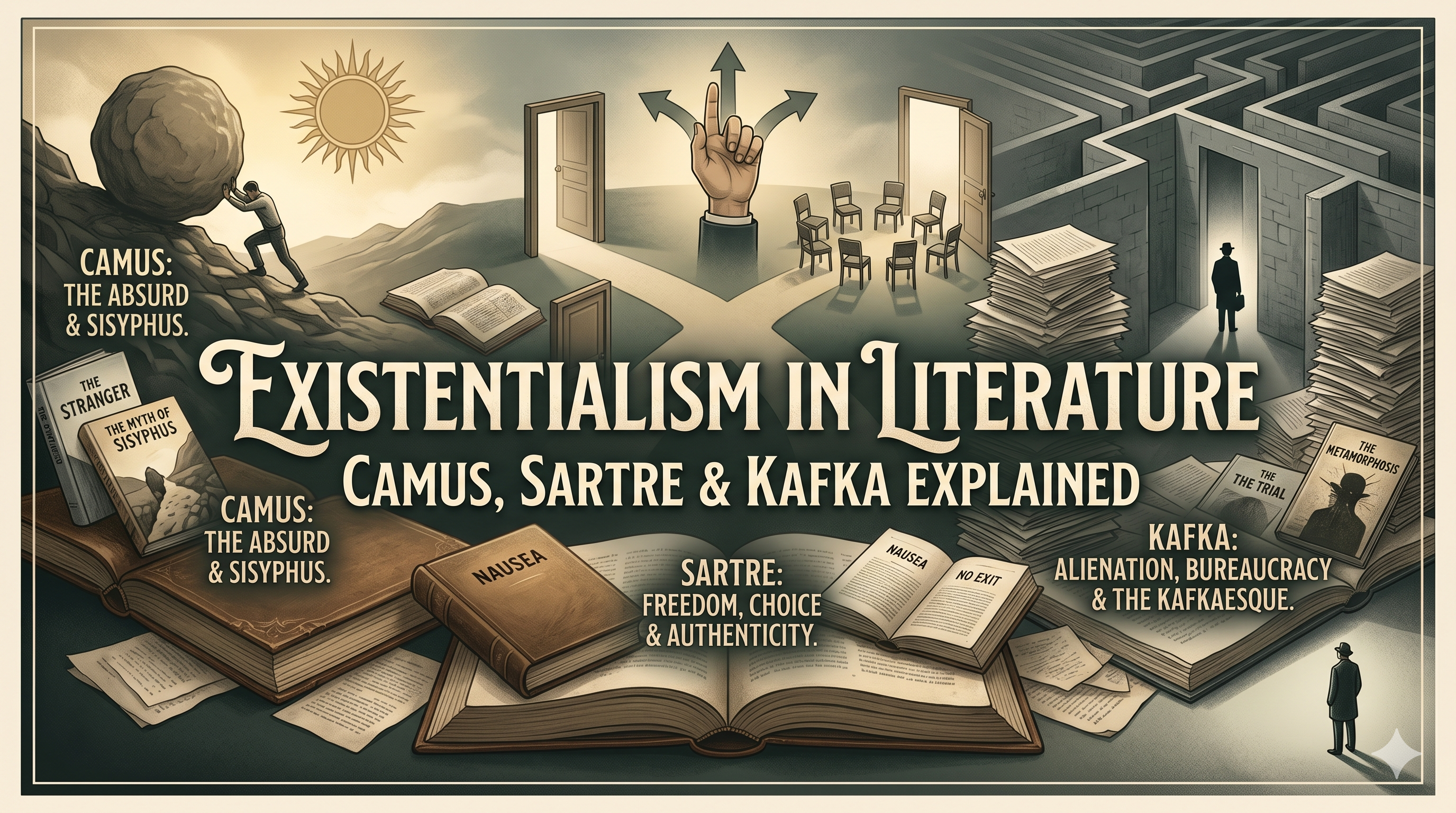
Fundamentally, existentialist literature forces readers to confront the terrifying freedom of human existence. Specifically, it explores profound meaninglessness within an irrational universe. For instance, Albert Camus perfectly illustrates the absurd through The Stranger. In this novel, the protagonist completely rejects society’s artificial rules.
Similarly, Jean-Paul Sartre fiercely argues that existence precedes essence. Therefore, individuals must take absolute responsibility for their own choices. Meanwhile, Franz Kafka captures the pure existential dread of modern bureaucracy. Ultimately, his characters face nightmarish, oppressive systems that defy all logical explanation. Together, these three authors challenge us to create our own authentic meaning.
What is Existentialism? Definition and Key Concepts
Existentialism in literature is a philosophical and literary movement that focuses on the individual. It argues that people are not born with a fixed purpose. Instead, they create meaning through the choices they make.
This idea grew from the work of thinkers such as Søren Kierkegaard, Friedrich Nietzsche, and Martin Heidegger. Kierkegaard stressed personal commitment, Nietzsche questioned older moral certainties, and Heidegger explored the human condition of being thrown into existence.
The movement became especially influential after World War II. After war, genocide, and political violence, many writers lost faith in a stable or moral universe. Existentialism responded with honesty rather than comfort.
Key existentialist concepts to know:
|
Jean-Paul Sartre: Existence Precedes Essence
The philosophy
Jean-Paul Sartre (1905–1980) is the defining figure of existentialism as a named intellectual movement. His 1945 lecture Existentialism is a Humanism — delivered to a packed Parisian audience hungry for meaning after the devastation of Nazi occupation — launched existentialism as a cultural phenomenon. His core claim is captured in a single, revolutionary phrase: “existence precedes essence.”
What does this mean? In traditional philosophy and theology, essence precedes existence — God creates a human being with a predetermined nature, purpose, and moral framework already built in. Sartre reverses this entirely. There is no God, no predetermined nature, no fixed human essence. We exist first — raw, undefined, thrown into the world — and through the choices we freely make, we create our own essence. We are, as Sartre puts it, “condemned to be free.” There is no authority, no tradition, no social role that can relieve us of the burden of choosing who we are.
In Being and Nothingness (1943), his massive philosophical treatise, Sartre develops this insight into a full system. He distinguishes between Being-in-itself — the mode of existence of objects, which simply are what they are — and Being-for-itself — the mode of existence of human consciousness, which is always in process, always becoming, never fixed. To be human is to be perpetually unfinished.
Bad faith (mauvaise foi)
If radical freedom is the human condition, why do most people live as though their choices are determined by their roles, their upbringing, and their circumstances? Sartre’s answer is bad faith — one of the most widely examined concepts in existentialist philosophy and literature.
Bad faith is a form of self-deception: the refusal to acknowledge one’s own freedom by pretending that one had no choice, that one is simply playing a role, or that external forces determined one’s actions. The waiter who performs his waiterliness so perfectly that he seems to have no existence outside of being a waiter is Sartre’s famous example. He is not a waiter in the way a stone is a stone. He chooses, in each moment, to be a waiter. Bad faith is the denial of that choice.
In literature, bad faith manifests whenever a character hides behind convention, social expectation, or determinism to avoid the terrifying weight of their own freedom. It is one of the most productive analytical tools in existentialist literary criticism.
No Exit (1944)
Sartre’s most celebrated literary work is No Exit (Huis Clos in French), a one-act play in which three dead characters — Garcin, Inès, and Estèlle — find themselves locked together in a single room that is, they eventually realise, hell. There are no flames, no instruments of torture. Just three people, three chairs, and eternity.
The play’s devastating insight is that each character needs the others to confirm a flattering self-image that their own conscience cannot sustain. Garcin needs to believe he is a hero; Inès sees through him mercilessly. Estèlle needs to feel desirable; Inès desires her but not in the way she wants. The torture is not physical. It is the perpetual, inescapable gaze of others who refuse to reflect back the self you wish to be. This gives us Sartre’s most famous line: “Hell is other people” — not a misanthropic statement but a precise philosophical claim about how the Other’s gaze can trap us in a fixed, objectified identity from which we cannot escape.
Nausea (1938)
Sartre’s novel Nausea (La Nausée) is the literary enactment of existential crisis. The protagonist, Antoine Roquentin, is a historian living alone in a provincial French town, and the novel is his diary as the familiar world around him begins to dissolve. Objects — a doorknob, a chestnut tree root, his own hand — suddenly reveal themselves as radically contingent: they exist, but there is no reason why they should, no essence that explains or justifies their presence in the world.
This sensation — of existence as gratuitous, inexplicable, and slightly nauseating — is what Sartre calls nausea: the existentialist’s version of enlightenment. It is not pleasant. But it is honest. And from that honesty, Roquentin eventually glimpses the possibility of a life lived authentically — as an artist, making things that, unlike contingent existence, have their own internal necessity.
Albert Camus: The Absurd and the Revolt
The Absurd
Albert Camus (1913–1960) is one of the most widely read writers of the twentieth century and also one of the most frequently misclassified. He is commonly grouped with the existentialists — and while his concerns overlap significantly with theirs, he explicitly rejected the label. The distinction matters and is frequently tested in literary theory examinations.
Camus’s central concept is not existentialism but the absurd – and he defines it with characteristic precision. The absurd is not simply the meaninglessness of the world. It is the collision between two things: the human being’s deep, ineradicable need for meaning, clarity, and order — and the universe’s complete, impassive refusal to provide any of these. Neither side of this equation alone is absurd. It is the gap between them, the confrontation, the divorce between human longing and cosmic silence, that constitutes the absurd.
The existentialist response to this — particularly Sartre’s — is to create meaning through radical freedom. Camus rejects this move as a philosophical “leap” — a form of dishonesty that pretends to resolve a tension that cannot be resolved. His answer is revolt: to live in full consciousness of the absurd, to refuse both despair and false hope, and to keep living and creating anyway. It is defiance without illusion.
The Stranger / The Outsider (1942)
Camus’s most celebrated novel — published in French as L’Étranger and translated into English as both The Stranger and The Outsider — is the literary embodiment of the absurd condition. Its protagonist, Meursault, is a French Algerian man of remarkable emotional flatness. His mother dies and he feels nothing, or at least nothing he can name. He shoots an Arab man on a beach, and when asked why, he can only say it was because of the sun.
The novel’s first half is a portrait of this radical indifference — Meursault simply observing the world without filtering it through the social emotions of grief, guilt, or moral calculation. The second half is his trial, in which French colonial society condemns him not primarily for the murder but for his failure to weep at his mother’s funeral. The real crime, the novel suggests, is the refusal to perform the expected emotions — the refusal to lie about one’s inner life in the way social convention demands.
In the novel’s final pages, awaiting execution, Meursault experiences a sudden, cathartic opening — he accepts the universe’s indifference and, in that acceptance, finds a strange peace. He is, Camus suggests, the absurd hero: the person who faces meaninglessness without flinching and without the comfort of illusion.
The Myth of Sisyphus (1942)
Published in the same year as The Stranger, The Myth of Sisyphus is the philosophical essay that provides the conceptual framework for Camus’s fiction. Sisyphus, condemned by the gods to roll a boulder to the top of a hill only to watch it roll back down forever, is Camus’s image of the human condition: an existence of endless, pointless repetition, devoid of any transcendent purpose.
Most readers would expect Camus to conclude that Sisyphus’s fate is tragic. Instead, he concludes with one of the most celebrated lines in twentieth-century philosophy: “One must imagine Sisyphus happy.” The reasoning is precise: Sisyphus knows his task is futile. He does not delude himself. And in that clear-eyed, undeceived awareness — in the lucid acceptance of the absurd without surrender to despair — lies a kind of freedom and even joy. Revolt is not victory. But it is the only honest form of living.
The Plague (1947)
In The Plague, Camus shifts his focus from the individual confronting the absurd to a community confronting it collectively. As a result, the town of Oran is sealed off by a devastating plague. The characters — a doctor, a journalist, a priest, and a smuggler — then respond to meaningless, indiscriminate death in different ways. The novel is Camus’s most politically engaged work: its argument, therefore, is that when faced with an indifferent catastrophe, the only meaningful response is human solidarity and practical care — not religious consolation, not political ideology, but simply showing up and doing what can be done.
Franz Kafka: Alienation, Bureaucracy and the Inexplicable
Kafka’s existentialism without a label
Franz Kafka (1883–1924) died fifteen years before Sartre named existentialism and twenty years before Camus published The Stranger. He never called himself an existentialist, never engaged with the French movement, and would not have recognised the label. And yet, of the three writers in this guide, Kafka may be the purest literary expression of the existentialist condition — precisely because he arrived at it without the consolation of any philosophical system.
Where Sartre offers a philosophy of freedom and Camus offers revolt, Kafka offers neither. His characters are not free agents consciously confronting meaninglessness. They are already inside a system they cannot comprehend, cannot exit, and cannot appeal. Also, they do not rebel — they petition. And they do not revolt — they wait. The darkness in Kafka’s fiction is not the bracing darkness of clear-eyed defiance. It is the suffocating darkness of total, inexplicable entrapment. That is what makes his work so philosophically distinctive — and so permanently unsettling.
The Metamorphosis (1915)
Gregor Samsa wakes one morning to find he has been transformed into a giant insect. From the outset, The Metamorphosis begins with one of the most famous opening lines in world literature, and it does not explain. There is no cause, no meaning, and no symbolic resolution of the transformation. Gregor simply is an insect, and the novel then tracks what happens to his family and his sense of self in the wake of this impossible fact.
The story is Kafka’s most direct allegory of alienation — specifically, the alienation of the modern worker. Before his transformation, Gregor was the family’s breadwinner, exhausted by a job he hated and sustaining a family that depended on him entirely but saw him primarily as a financial function. In other words, his transformation makes visible what was already true: he was never fully seen as a person. The family’s gradual revulsion and eventual relief at his death is, therefore, a devastating portrait of how capitalism reduces human beings to their utility and discards them when that utility fails.
The Trial (1925)
Josef K. is arrested one morning without explanation. First, no charge is specified or cited. Then, no accuser is named. He is simply told he is under arrest, allowed to go about his daily life, and yet subjected to an endlessly deferred legal process that consumes his existence without ever resolving into a verdict, an accusation, or a hearing. He is executed at the novel’s end “like a dog.”
The Trial is the definitive literary expression of bureaucratic absurdity — that is, the experience of confronting a system of authority so vast, so opaque, and so self-referential that the individual is entirely at its mercy without any avenue for rational appeal or self-defence. The Law in The Trial is not cruel in the way a tyrant is cruel. Rather, it is simply indifferent — to Josef K.’s guilt or innocence, his suffering, his arguments, his existence. It proceeds without him, around him, and ultimately through him. In this way, Kafka’s most terrifying insight is that the most effective form of oppression is not malevolent but impersonal.
“Kafkaesque” as a literary term
Kafka’s work gave the English language an adjective: Kafkaesque. It describes any situation characterised by nightmarish illogicality, impenetrable bureaucracy, inexplicable guilt, and the total powerlessness of the individual before an opaque institutional authority. In literary analysis, and especially in UGC NET examinations, the term is used not only for Kafka’s own work but also for any literary, cinematic, or political scenario that reproduces this structure. Therefore, knowing how to define and deploy it precisely is a key examination skill.
What happens when an individual completely refuses to accept society’s artificial rules? 💡 Our newest article explores the profound meaninglessness of the modern universe. Specifically, we dive into a groundbreaking 20th-century movement that changed literature forever. Discover the three authors who perfectly captured this dread. Read the full, easy-to-understand analysis right here
Existentialism in Literature: Camus vs Sartre vs Kafka — Key Differences
The table below provides a clear, exam-ready comparison of all three writers across the parameters most commonly tested in UGC NET English and MA examinations. Understanding the precise differences between these figures — particularly the distinction between existentialism, absurdism, and Kafka’s unclassifiable position — is what separates a strong literary analysis from a weak one.
| Parameter | Sartre | Camus | Kafka | UGC NET weight |
| Strand | Existentialism | Absurdism | Proto-existentialism / Absurdism | Very High |
| Core concept | Existence precedes essence | The absurd | Alienation, bureaucratic terror | Very High |
| Key works | No Exit, Nausea, Being & Nothingness | The Stranger, Myth of Sisyphus, The Plague | The Trial, The Metamorphosis, The Castle | Very High |
| Response to meaninglessness | Create meaning through radical freedom | Revolt — embrace absurdity without resolution | No response — characters are paralysed | High |
| Key literary term | Bad faith, condemned to be free | The absurd, revolt | Kafkaesque, alienation | Very High |
| Protagonist type | Conscious actor — chooses freely | Defiant witness — refuses false hope | Trapped victim — no agency, no exit | High |
| Tone | Philosophical, urgent | Clear-eyed, darkly luminous | Nightmarish, darkly comic | Moderate |
| Nobel Prize | Declined 1964 | Won 1957 | Never nominated (died 1924) | High |
The single most important distinction to hold onto: Sartre believes we can create meaning, Camus believes we cannot find meaning but can revolt against that fact, and Kafka’s characters can neither create nor revolt — they are simply, terrifyingly, trapped. Three different responses to the same fundamental problem.
Existentialism vs Absurdism:
This is the most frequently searched sub-question in this topic cluster, and it is genuinely important because existentialism and absurdism are not the same thing, even though they are often grouped together. So, here is the clearest way to understand the distinction.
Existentialism (primarily Sartre) holds that although life has no inherent meaning, individuals can and must create their own meaning through radical freedom and authentic choice. In other words, the absence of God or predetermined essence is not a tragedy — it is a liberation. Human beings are defined by what they do, not by any fixed nature. For Sartre, therefore, this is ultimately an empowering doctrine, however terrifying it may be.
Absurdism (Camus), by contrast, goes one step further and, in doing so, parts ways with Sartre. Camus argues that the attempt to create meaning is itself part of the absurd condition; that is, it becomes another form of the “leap” — a refusal to sit with the honest confrontation of meaninglessness. Instead of resolving the absurd by creating meaning, the correct response is to revolt — to continue living, loving, and creating in full, undeceived awareness that none of it adds up to a cosmic purpose. Sisyphus does not find meaning in pushing his boulder. Rather, he pushes it knowingly, and he is happy.
The Sartre–Camus rupture of 1952 is one of the great intellectual dramas of the twentieth century. Their public falling-out — conducted through essays, reviews, and open letters in the journal Les Temps Modernes — was ostensibly about politics: Camus refused to defend Stalinist violence, while Sartre would not condemn it. However, beneath the political argument lay a genuine philosophical disagreement about freedom, responsibility, and how to respond honestly to the absurd. For students of literary theory, then, it is a reminder that these are not merely academic categories — they were live, urgent, and bitterly contested positions.
| Quick recall — the three positions: Sartre = FREEDOM: existence precedes essence; create your own meaning through radical free choice Camus = REVOLT: the absurd cannot be resolved; live fully and honestly in its face, without illusion Kafka = TRAPPED: no freedom, no revolt, no resolution — only the inexplicable, impersonal system grinding on |
Key Themes of Existentialism in Literature
Across the work of Sartre, Camus, and Kafka — and the broader tradition of existentialism in literature — certain themes recur with striking consistency. Understanding these cross-cutting concerns enables you to write comparative analyses, answer passage-based questions, and connect existentialist literature to related movements including modernism, the Theatre of the Absurd, and dystopian fiction.
- Freedom and its terror: The existentialist insight into radical freedom is not straightforwardly liberating. Sartre’s phrase “condemned to be free” captures the weight of it: if no authority, no tradition, and no God can tell us what to do, then every choice is entirely ours — and so is every consequence. The terror of this freedom is one of existentialism’s most persistent themes.
- Alienation: The estrangement of the individual from society, from other people, from their work, and from their own identity runs through all three writers. Gregor Samsa’s transformation makes his alienation visible. Meursault’s emotional detachment enacts it. Roquentin’s nausea is its philosophical form. Each embodies a different dimension of the modern condition of not-belonging.
- Authenticity vs bad faith: The tension between living honestly — acknowledging freedom, choosing consciously, taking responsibility — and living in bad faith — hiding behind roles, excuses, and social scripts — is the central moral drama of existentialist fiction. Characters who achieve authenticity are rare, and the path to it is always difficult.
- The absurd and the silence of the universe: Whether framed as Camus’s “absurd” or Kafka’s impenetrable bureaucratic indifference, the experience of a universe that offers no explanation, no justice, and no comfort is the shared premise of all three writers. How one responds to that silence is the defining question of existentialist literature.
- Anxiety and angst: Not the fear of a specific, nameable danger but a diffuse, existential dread at the sheer contingency of existence — the fact that we exist, that we had no say in it, and that we will cease to exist without the universe registering the difference. This mood — what Kierkegaard called the “dizziness of freedom” — runs through Sartre’s Roquentin, Camus’s Meursault, and Kafka’s Josef K. alike.
- Death and the urgency of choice: Existentialist writers take mortality with extreme seriousness — not as a theological puzzle but as the absolute limit that gives every choice its weight. The awareness of death is not morbid but clarifying: it strips away the comfortable fictions that allow us to defer the question of how to live.
Existentialism in Literature and UGC NET English: Complete Exam Guide
| UGC NET English — Exam Focus: Literary Theory and Criticism is the highest-weightage unit in UGC NET English Paper 2. Existentialism appears regularly as a topic for definition, application, and passage-based analysis. Here is exactly what to focus on: Most examined Sartre concepts:
Most examined Camus concepts:
Most examined Kafka concepts:
Likely NET question formats:
Quick recall mnemonic: Sartre = FREEDOM | Camus = REVOLT | Kafka = TRAPPED |
Existential dread is not just a philosophical concept; it is an experience. 📖 Therefore, to truly understand the absurd, you need the primary texts right on your desk. I have curated a secret list of the most essential, mind-bending novels that define this genre. Ultimately, these are the books that will completely change how you view freedom and choice. Click here to unveil the titles and build your library
Conclusion:
Existentialism in literature began as a response to specific historical catastrophes — the World Wars, the Holocaust, and the collapse of European certainty. However, the questions it asks have not aged. Instead, they have become more urgent.
Moreover, in an era of artificial intelligence that threatens to automate not just labour but meaning-making itself, Sartre’s insistence that human beings create their own essence through free choice feels newly charged. Similarly, in a world of climate crisis — an indifferent physical process grinding on regardless of human suffering or aspiration — Camus’s revolt without illusion is a more honest model of engagement than either despair or false hope. Likewise, in the age of algorithmic platforms and impersonal institutional power that shapes our lives without accountability or comprehension, Kafka’s Josef K. is more recognisable than ever.
Sartre, Camus, and Kafka do not give us comfortable answers. Rather, they give us something more valuable: the intellectual tools to look at the human condition honestly, without flinching, and to keep asking what it means to live with freedom, with dignity, and with open eyes. Therefore, existentialism in literature remains not just a topic for examinations but a living tradition of thought — one that has not yet finished telling us what we need to hear.
Enjoyed this guide? Explore more on a2zliterature.com — including our complete guides on Dystopian Literature, Modernism vs Postmodernism, the Harlem Renaissance, and Feminism in Indian English Literature.
Frequently Asked Questions
What is existentialism in literature and what are its key features?
Existentialism in literature refers to a philosophical and literary movement emphasising individual existence, freedom, and responsibility in a world without inherent meaning. Its key features include: the assertion that existence precedes essence (we define ourselves through choices), the concept of bad faith (self-deception about one’s freedom), the experience of anxiety and alienation, and the challenge of living authentically in an indifferent universe.
What is the difference between existentialism and absurdism?
Existentialism (Sartre) holds that although life has no inherent meaning, individuals can create their own meaning through radical freedom. Absurdism (Camus) goes further — it argues that the attempt to create meaning is itself part of the absurd condition, and that the honest response is revolt: living fully in clear-eyed awareness of meaninglessness, without illusion.