
INTRODUCTION
Surveillance cameras on every corner. Social media algorithms that shape what you think. Governments that rewrite history. Bodies that the state claims to own. If any of these feel familiar, that is because dystopian literature spent the twentieth century warning us about them – and we did not entirely listen.
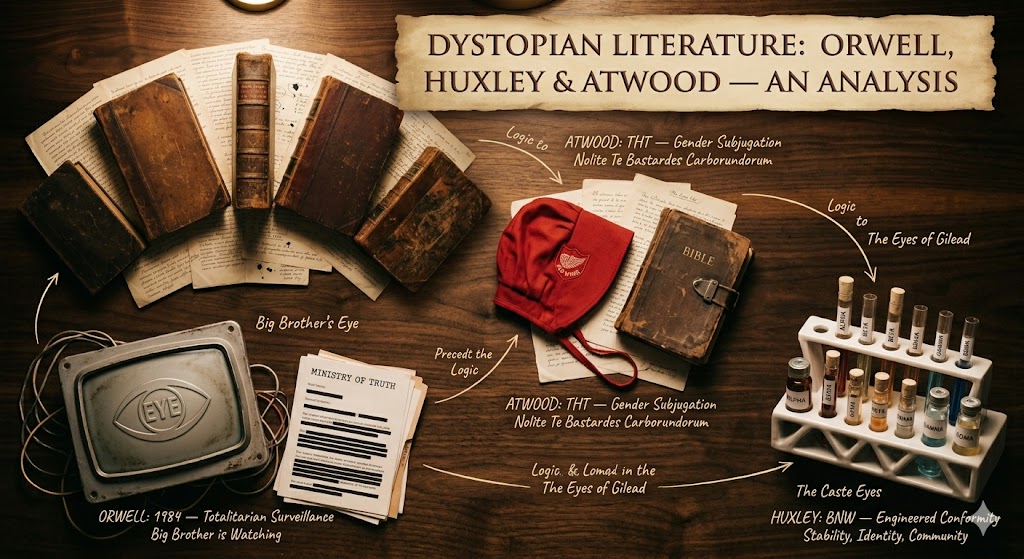
From George Orwell’s terrifying surveillance state in Nineteen Eighty-Four to Aldous Huxley’s sedated, pleasure-drug-drugged society in Brave New World to Margaret Atwood’s chilling patriarchal theocracy in The Handmaid’s Tale, the great works of dystopian literature are not just imaginative flights. They are diagnostic tools — precise, urgent analyses of how power corrupts, how freedom erodes, and how ordinary people become complicit in their own oppression.
In this complete guide to dystopian literature, we examine the genre’s definition and origins, explore its three most important texts in depth, compare their mechanisms of control, trace their major themes, and explain why every student of English literature — especially those preparing for UGC NET — needs to know them inside out.
Quick Summary
Dystopian literature explores dark, oppressive societies to warn us about dangerous modern trends. George Orwell’s 1984 focuses on totalitarianism, mass surveillance, and the complete destruction of truth. Aldous Huxley’s Brave New World takes a completely different approach to social control. He shows a society destroyed by endless pleasure, genetic engineering, and willing ignorance.
Decades later, Margaret Atwood’s The Handmaid’s Tale introduced a terrifying patriarchal theocracy. She brilliantly connects political power directly to the control of female bodies and reproduction. Together, these three authors define the dystopian genre. Their works remain essential for understanding the fragile nature of freedom and human rights.
What is Dystopian Literature? Definition and Origins
At its simplest, dystopian literature depicts a society that appears organised and functional on the surface but is, in reality, oppressive, dehumanising, and profoundly unjust. The word “dystopia” is the direct opposite of “utopia” — Thomas More’s 1516 coinage for an ideal, perfect society. A dystopia is a utopia turned inside out: a world that presents itself as perfected but conceals systemic cruelty beneath its ordered surface.
Dystopian fiction did not emerge fully formed. Its roots lie in the satirical tradition of Jonathan Swift and the scientific romances of H.G. Wells. However, the genre took its definitive modern shape in 1924. That year, Russian novelist Yevgeny Zamyatin published We. The novel depicts a mathematically regimented future state where citizens are known only by numbers. Furthermore, absolute privacy is abolished, and individuality is surgically removed. Zamyatin’s We directly influenced both Orwell and Huxley, and it remains the foundational text of the genre.
What distinguishes dystopian literature from science fiction more broadly is its political urgency. Ultimately, dystopian novels are not primarily interested in technology for its own sake. Instead, they focus entirely on the mechanics of power. Specifically, they explore how states, institutions, and ideologies control human beings. Furthermore, they examine exactly what humanity loses in the process.
Historically, the genre flourishes in times of political crisis. For instance, Orwell wrote 1984 in the shadow of Stalinist totalitarianism and Nazi fascism. Similarly, Huxley wrote Brave New World in response to Fordism and mass consumerism. Specifically, he feared the technocratic dream of a rationally managed society. Decades later, Atwood wrote The Handmaid’s Tale during the Reagan era. During that time, the American religious right mounted a systematic campaign against women’s reproductive rights. Ultimately, in each case, the dystopia was not pure fantasy. Instead, it was a terrifying extrapolation of tendencies already visible in the writer’s own world.
Core conventions of dystopian fiction:
|
George Orwell’s 1984: The Surveillance State
Context and background
George Orwell wrote Nineteen Eighty-Four in 1948, labouring under terminal tuberculosis on a remote Scottish island, and published it in 1949 — the year before his death. The title is widely believed to be a reversal of the year of composition. Orwell had lived through the Spanish Civil War, witnessed the rise of Stalinism, and observed with horror how totalitarian regimes of both the left and right used the same tools — propaganda, surveillance, terror, and the rewriting of history — to consolidate power. The novel is his comprehensive anatomy of those tools.
Plot overview
First, Orwell sets the novel in Oceania. This superstate remains locked in perpetual war with two other world powers. Furthermore, the regime divides society into three strict tiers: the Inner Party, the Outer Party, and the Proles.
Meanwhile, Winston Smith works at the Ministry of Truth rewriting historical records. He is a low-ranking Outer Party member. Secretly, he harbours forbidden thoughts of rebellion. Eventually, he begins a clandestine love affair with Julia. Additionally, he contacts a supposed underground resistance movement called the Brotherhood. Ultimately, the novel ends with Winston’s complete psychological destruction. The Thought Police orchestrate this terrifying final defeat.
Key themes
- Surveillance and the telescreen: The telescreen — a two-way screen that both broadcasts propaganda and monitors citizens — is the novel’s most powerful symbol. The Party’s slogan, “Big Brother is Watching You,” makes explicit that the state’s primary mechanism of control is the certainty of being watched.
- Language as a tool of power: Newspeak — the Party’s constructed language that systematically eliminates words for dissent, rebellion, and independent thought — is Orwell’s most chilling insight. If the language for a thought cannot exist, the thought itself becomes impossible. This is linguistic control at its most radical.
- Doublethink: The ability to hold two contradictory beliefs simultaneously and accept both as true. The Party’s three slogans capture this perfectly: “War is Peace. Freedom is Slavery. Ignorance is Strength.” Doublethink is not just propaganda — it is the psychological condition the Party requires its members to maintain.
- The erasure of history: Winston’s job at the Ministry of Truth is to rewrite past newspaper articles to align with current Party policy. The past is not fixed — it is whatever the Party says it is. This destruction of historical memory is what makes the Party’s control total: there is no external reality against which its claims can be checked.
- Psychological torture and Room 101: O’Brien’s interrogation of Winston in Part Three is one of the most harrowing sequences in twentieth-century literature. The Party does not just want compliance — it wants Winston to love Big Brother. The goal is not submission but the destruction of the self.
Key UGC NET terms from 1984
Big Brother — Newspeak — doublethink — thoughtcrime — the Thought Police — the Ministry of Truth (Minitrue) — the telescreen — Room 101 — proles — 2+2=5 — the Brotherhood
Aldous Huxley’s Brave New World: The Pleasure Trap
Context and background
Aldous Huxley published Brave New World in 1932, thirteen years before Orwell wrote 1984. Where Orwell was responding to the visible brutality of Stalinist and fascist totalitarianism, Huxley was responding to a subtler and, he argued, more insidious threat: the rise of mass consumerism, scientific management, and the emerging belief that human happiness could be engineered. The novel takes its epigraph from Berdyaev: “Utopias appear to be much more realisable than we formerly believed.” Huxley’s warning is that the utopians may actually succeed — and that their success would be a catastrophe.
Plot overview
First, Huxley sets the novel in the World State. Specifically, this globally stabilised civilisation exists six hundred years in the future. Therefore, mothers do not birth citizens in this society. Instead, factories decant them from bottles using the Bokanovsky Process. Incredibly, this mass-production technique creates up to ninety-six identical humans from one embryo. Furthermore, the state conditions each citizen before birth into one of five castes. Subsequently, it strictly programs them to love their assigned social role.
Meanwhile, Bernard Marx visits a Savage Reservation. He is an Alpha-Plus who feels vaguely dissatisfied with the system. Eventually, he brings back a man named John. Crucially, a natural mother birthed John. Additionally, he grew up reading Shakespeare and the Bible. As a result, he is entirely unprepared for the World State’s joyless happiness.
Key themes
- Control through pleasure, not pain: The World State’s central innovation is that it does not need to terrorise its citizens because it has made them incapable of wanting anything the system cannot provide. Soma serves as the most visible emblem of this system. It is a perfect pleasure drug with no side effects. Citizens use it to chemically suppress any discomfort, grief, or genuine feeling.
- The cost of engineered happiness: John the Savage’s confrontation with the World State’s Controller, Mustapha Mond, is the philosophical heart of the novel. John argues for the right to be unhappy, to suffer, to experience the full range of human feeling. Mond concedes that the World State has sacrificed art, science, religion, and love — and argues that the trade-off is worth it. Huxley clearly disagrees.
- Consumerism and identity: The World State’s motto, “Community, Identity, Stability,” expresses its priorities in reverse order of importance. Identity is not individual — it is a caste function. Consumerism is not a freedom but a strict duty. The state conditions citizens to throw away and replace items. They must never repair their broken goods. This relentless consumption keeps the economy perpetually stimulated.
- Science and humanity: Huxley’s dystopia is not created by malice but by the unchecked application of science to human problems. The Bokanovsky Process applies the logic of industrial mass production to human beings. Conditioning applies the logic of behaviourist psychology to desire and belief. The result is a society of perfect stability and perfect emptiness.
Key UGC NET terms from Brave New World
Soma — the Bokanovsky Process — the World State — “Community, Identity, Stability” — John the Savage — Mustapha Mond (the Controller) — Bernard Marx — conditioning — hypnopaedia — decanting — Alpha to Epsilon caste system
Margaret Atwood’s The Handmaid’s Tale: Gender and Theocracy
Context and background
Margaret Atwood published The Handmaid’s Tale in 1985. She imposed a strict rule during its composition. Nothing could be included unless it had already happened in human history. Gilead is not a fantasy. It is a chilling extrapolation. It presents a near-future American theocracy built entirely from historical precedents. These include Puritan New England and the treatment of women in Taliban Afghanistan. She also drew from Nazi Germany’s forced reproduction programmes and antebellum slavery. This grounding in historical reality makes the novel deeply unsettling.
Atwood wrote the novel during the Reagan presidency. At that time, the Moral Majority mounted a sustained campaign against abortion rights. Furthermore, the Equal Rights Amendment had just been defeated. Leaders deployed Biblical language to justify rolling back women’s legal gains. The Handmaid’s Tale was Atwood’s direct response. It is a methodical, terrifyingly plausible account. It shows how these extreme tendencies might ultimately produce a totalitarian patriarchy.
Plot overview
Initially, a theocratic coup overthrows the United States government to establish the Republic of Gilead. Furthermore, environmental catastrophes cause a severe societal reproductive crisis. As a result, the state assigns fertile women, called Handmaids, to powerful Commanders. Essentially, they serve as mere reproductive vessels. Meanwhile, our narrator, known only as Offred, recounts her harrowing daily life. Specifically, she details her time serving the Commander and his Wife. Additionally, she shares painful memories of her lost husband and daughter. Eventually, she describes her dangerous involvement with an underground resistance network called Mayday. Ultimately, a “Historical Notes” appendix frames the entire novel. Specifically, it features a lecture by a future scholar. Subsequently, this scholar treats Offred’s narrative as a historical document. Undoubtedly, this choice validates her terrifying testimony. However, it also raises troubling questions about who controls women’s stories.
Key themes
- Control of the female body: Gilead’s entire ideological apparatus is organised around the control of female reproduction. Women are classified entirely by their reproductive and social function: Wives, Handmaids, Marthas (domestic servants), Aunts (ideological enforcers), Econowives. The female body is not a person’s own — it is state property.
- Language and naming as oppression: The Handmaids’ names — Offred, Ofglen, Ofwarren — are not names but possessives: “Of Fred”, “Of Glen”, “Of Warren.” The erasure of individual names is the erasure of individual identity. Women are also forbidden to read — literacy is a form of power Gilead cannot permit them.
- Complicity and resistance: One of the novel’s most disturbing insights is that systems of oppression require the participation of the oppressed. The Aunts — women who train and discipline the Handmaids — are the most efficient enforcers of patriarchal control precisely because they are women. Atwood is interested in how people accommodate themselves to systems that dehumanise them, and what it costs to resist.
- Theocracy and the misuse of religion: Gilead deploys Biblical language — particularly the story of Rachel and Bilhah from Genesis — to justify the Handmaid system. Atwood is not criticising religion but the political instrumentalisation of religion: the use of sacred texts to legitimise oppressive power structures.
- The Historical Notes — a postmodern frame: The novel’s appendix, a transcript of a fictional academic conference in 2195, is a masterpiece of narrative strategy. It confirms that Gilead eventually fell, offers cautious hope — but it also shows a (male) scholar treating Offred’s testimony with the distanced scepticism of the academy, subtly questioning its reliability. It is Atwood’s commentary on how women’s voices are received even by supposedly sympathetic institutions.
Key UGC NET terms from The Handmaid’s Tale
Gilead — Offred / Of Fred (naming as possession) — Handmaids, Wives, Marthas, Aunts — the Commander — Mayday (the resistance) — the Historical Notes section — “Nolite te bastardes carborundorum” — theocracy — postmodern narrative frame — reproductive dystopia
Dystopian Literature: 1984 vs Brave New World vs The Handmaid’s Tale — Key Differences
The following table offers a clear, exam-ready comparison of the three defining works of dystopian literature. Understanding their differences — particularly the contrasting mechanisms of control — is the single most important analytical skill for this topic in any examination:
| Parameter | 1984 — Orwell | Brave New World — Huxley | The Handmaid’s Tale — Atwood | Key literary term | UGC NET weight |
| Published | 1949 | 1932 | 1985 | — | Very High |
| Control mechanism | Fear, surveillance, torture | Pleasure, conditioning, consumerism | Religion, patriarchy, gender roles | Mechanism of oppression | Very High |
| Type of oppression | Political totalitarianism | Consumerist dehumanisation | Patriarchal theocracy | Dystopian subtype | High |
| Key symbol | Big Brother / the telescreen | Soma / the Bokanovsky process | The red cloak / Gilead | Symbol analysis | High |
| Protagonist | Winston Smith — conscious rebel | Bernard Marx / John the Savage | Offred — survivor-narrator | Protagonist type | High |
| Narrative technique | Close third-person / political allegory | Satirical omniscient narrator | First-person testimony + Historical Notes frame | Narrative mode | High |
| Tone | Bleak, terrifying, relentless | Satirical, darkly comic | Intimate, documentary, defiant | Tone / mood | Moderate |
| Core warning | State control through fear | State control through pleasure | State control through the body | Thematic argument | Very High |
The key insight to carry into any examination or essay: the three novels are not just different stories — they are different theories of how power works. Fundamentally, Orwell believes power operates through fear. In contrast, Huxley believes it operates through pleasure. Meanwhile, Atwood believes it operates through the body. Specifically, this refers to the female body and the theological justification of its control.
Did this breakdown of Dystopian Literature help clear up your syllabus? Keep the study momentum going! 📝 Understanding Orwell and Atwood is just the first step. Dive into our complete chronological guide to 20th-Century Literature next to see exactly where these texts fit into the bigger picture. Read the full notes here
Key Themes Across Dystopian Literature
Beyond the individual texts, dystopian literature as a genre returns repeatedly to a set of interconnected concerns. Understanding these cross-cutting themes allows you to write comparative essays, answer passage-based questions, and trace the genre’s development from Zamyatin through to contemporary writers like Kazuo Ishiguro and Naomi Alderman.
- Surveillance and the erosion of privacy: From Orwell’s telescreens to Atwood’s enforced visibility of the Handmaids, the dystopian state’s first requirement is that citizens cannot have private lives. Surveillance is not just a practical tool — it is an ideological statement: you belong to the state, not to yourself.
- Language as a tool of power: Newspeak in 1984, the prohibition on reading in Gilead, the conditioning slogans of the World State — all three novels demonstrate that whoever controls language controls thought. This connects directly to Michel Foucault’s theories of discourse and power, which are highly relevant to the literary-theoretical analysis of dystopian texts.
- The individual against the collective: Winston Smith, John the Savage, and Offred are all protagonists whose fundamental conflict is the assertion of individual selfhood against a system that demands its abolition. Each of them loses, partially or entirely — and the degree of loss is a measure of each system’s thoroughness.
- Gender, the body, and reproductive control: Atwood makes explicit what is implicit in Orwell and Huxley: that the control of bodies — and especially female bodies — is central to political authority. Dystopian states cannot afford biological or sexual freedom because it implies the kind of individual autonomy that undermines collective control.
- Technology and dehumanisation: Orwell’s telescreens, Huxley’s Bokanovsky Process, Atwood’s cattle prods — each novel shows technology deployed not in the service of human flourishing but in the service of human management. The machine is always on the side of the state.
- Historical memory and the control of truth: Crucially, all three novels show states that control the past in order to control the present. For example, for Orwell, this is the explicit function of the Ministry of Truth.
You cannot master dystopian literature just by reading the summaries—you have to experience the original texts. 📚 Whether you are writing a university term paper or preparing for competitive exams, George Orwell’s 1984 and Margaret Atwood’s The Handmaid’s Tale are absolute syllabus essentials. Build your personal literature library and grab your copies here
Dystopian Literature and UGC NET English
| UGC NET English — Exam Focus: Dystopian literature is one of the most frequently examined topics in UGC NET English Paper 2. The December 2025 paper included direct comparison questions on 1984 and Brave New World. Here is exactly what to focus on: Most examined texts:
Most likely NET question formats:
Quick recall mnemonic: Orwell = FEAR — Huxley = PLEASURE — Atwood = FAITH (theocracy) |
Conclusion:
Dystopian literature’s greatest achievement is that it refuses to let us treat the worst tendencies of human societies as distant abstractions. Consequently, Orwell, Huxley, and Atwood wrote deeply uncomfortable novels. Specifically, they built their imagined worlds from materials already present in ours. In fact, they drew directly from real twentieth and twenty-first-century histories. For example, these include terrifying surveillance states, distraction economies, and theocratic movements.
First, 1984 tells us that power maintained through fear and the control of truth is incredibly fragile. Indeed, it is always only one surveillance technology away from completion. Meanwhile, Brave New World warns that a society pacified by pleasure is just as unfree as one terrorised by pain. Furthermore, it is considerably more stable. Finally, The Handmaid’s Tale proves that the control of women’s bodies remains a primary instrument of political power.
Together, these three novels form a complete theory of how freedom can be lost. Ultimately, they are not pessimistic books; rather, they are diagnostic ones. Of course, the diagnosis only becomes pessimistic if we choose not to read it. Therefore, that is perhaps the most important reason to study dystopian literature at all. Otherwise, the alternative is to live inside a dystopia without even noticing.
Enjoyed this guide? Explore more on a2zliterature.com — including our complete guides on Modernism vs Postmodernism in Literature, Feminism in Indian English Literature, the Harlem Renaissance, and Postcolonial Theory.
FREQUENTLY ASKED QUESTIONS
What is dystopian literature and what are its key features?
Dystopian literature depicts a society that presents itself as ordered and functional but is, in reality, oppressive and dehumanising. Key features include: a totalitarian state, surveillance and propaganda, the suppression of individual thought and desire, control of language and historical memory, and a protagonist who begins to perceive and resist the system.
What are the major themes of dystopian literature?
The major themes of dystopian literature include: surveillance and the erosion of privacy, language as a tool of political control, the individual versus the collective state, gender and reproductive oppression, technology as an instrument of dehumanisation, and the control of historical memory as a means of political domination.