Introduction
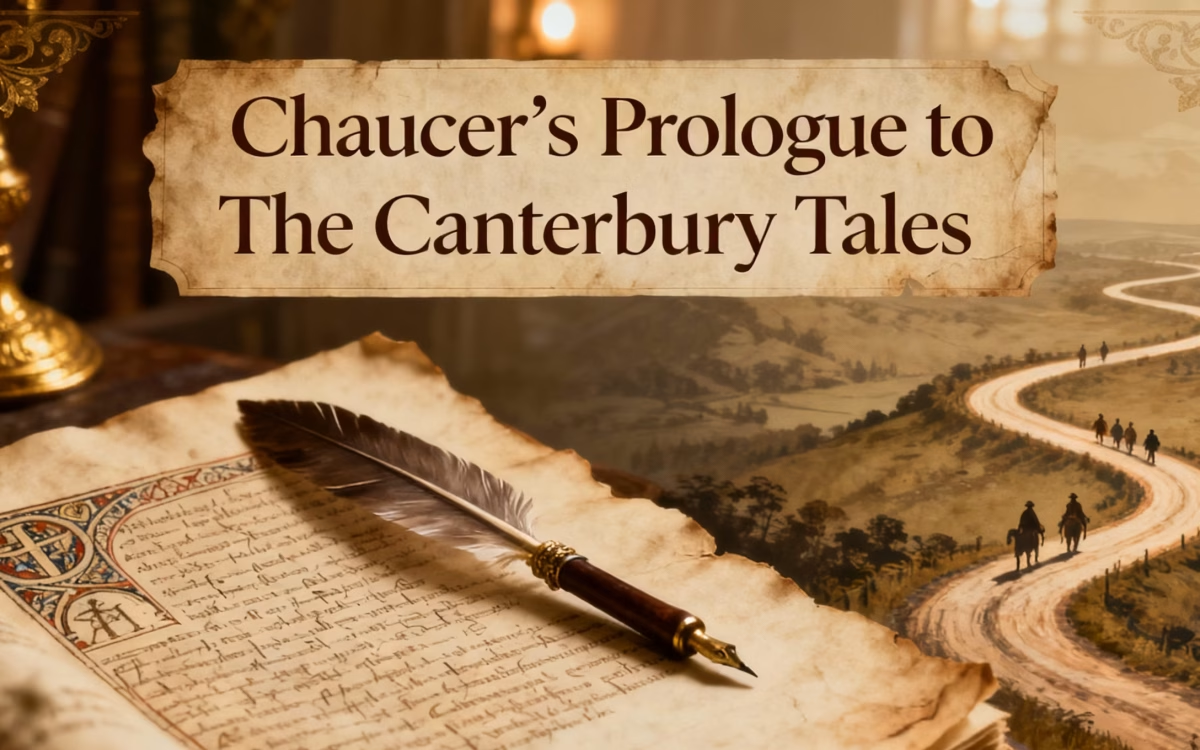
Geoffrey Chaucer’s Prologue to The Canterbury Tales holds a pivotal place in English literature. It marks a new era in poetic narrative during the late fourteenth century. Written in Middle English, this opening section is more than an introduction. It offers a comprehensive survey of the diverse social classes of medieval England. Through vivid and nuanced character portraits, Chaucer provides critical insight into his society. He exposes both its virtues and contradictions.
This analysis aims to clarify the Prologue’s thematic complexity and stylistic innovations. It examines the text’s lasting relevance for contemporary readers and scholars. By exploring Chaucer’s literary devices and the social commentary in his characterizations, it seeks to deepen understanding of this foundational work. Such an approach benefits students of English literature in India and elsewhere. They study this medieval text as part of modern academic curricula.
In this discussion, the focus will be on historical context, principal themes, and key characters. Ultimately, Chaucer’s Prologue remains essential for appreciating the intersection of narrative technique, social critique, and historical perspective in early English poetry.
Chaucer’s Prologue to The Canterbury Tales: Context and Significance
Chaucer’s Prologue to The Canterbury Tales was composed during the late fourteenth century, a period of significant social, political, and religious transformation in England. This work marks a critical moment in literary history, as Chaucer chose to write in Middle English at a time when Latin and French dominated literary circles. His decision to use the vernacular made literature more accessible to a wider audience and helped establish English as a legitimate vehicle for sophisticated poetic expression.
The Prologue introduces a diverse group of pilgrims journeying to the shrine of Saint Thomas Becket in Canterbury. These pilgrims collectively represent the broad spectrum of medieval English society—from knights and clergymen to merchants and peasants. Chaucer’s vivid and detailed sketches offer not only character portraits but also sharp social commentary, reflecting the complexities and contradictions of his time. Through humour, irony, and nuanced observation, the Prologue captures a transitional society where feudal hierarchies began yielding to mercantile influences. FULL TEXT
Chaucer’s Prologue to The Canterbury Tales: Plot Overview
Chaucer’s Prologue to The Canterbury Tales begins with the arrival of spring, as April showers awaken the English countryside and inspire people to embark on pilgrimages. The narrator, a fictionalized version of Chaucer himself, is staying at the Tabard Inn in Southwark when he encounters a group of twenty-nine pilgrims preparing for a journey to the shrine of Saint Thomas Becket in Canterbury. These travellers come from various walks of life, and their chance meeting at the inn sets the stage for the narrative.
The Host, Harry Bailly, proposes a storytelling competition to make the journey more enjoyable. Each pilgrim will tell two tales on the way to Canterbury and two more on the return, with the best storyteller winning a free meal at the Tabard Inn. The narrator joins the group and offers vivid descriptions of each pilgrim, highlighting their occupations, personalities, and social status. This setup introduces the framework for the entire collection of tales.
As the pilgrims set out, the Host reminds them of their agreement and draws lots to decide who will tell the first story. The Knight, chosen by chance, begins the storytelling, marking the transition from the Prologue to the individual tales. Chaucer’s Prologue thus establishes both the narrative structure and the rich social tapestry that defines The Canterbury Tales.
Chaucer’s Prologue to The Canterbury Tales: Themes
Social Satire:
Chaucer uses humour and irony to critique the various classes of medieval society. Each pilgrim is portrayed with exaggerated traits, exposing their flaws and pretensions. This satirical approach reveals the gap between social ideals and real behaviour, especially among the clergy and nobility.
Corruption:
Many characters, particularly those in religious positions like the Monk, Friar, and Pardoner, are shown as morally corrupt. Chaucer highlights the hypocrisy and greed present in the Church and other institutions, reflecting contemporary concerns about the misuse of power and authority.
Humanism:
Despite his satire, Chaucer treats his pilgrims with compassion. He acknowledges their imperfections but also their humanity, showing empathy and understanding. This approach suggests a more nuanced view of human nature, where flaws and virtues coexist.
Class and Social Mobility:
The Prologue presents a cross-section of society, from knights to peasants. Chaucer explores how characters attempt to rise above their station or maintain appearances, revealing the fluidity and tension within social hierarchies. The pilgrimage itself temporarily levels class distinctions, as all travellers are equal on the journey.
Appearance vs. Reality:
Many pilgrims present a false front to hide their true nature. The Prioress, for example, appears refined but is worldly, and the Merchant seems wealthy but is in debt. Chaucer uses these contrasts to explore the theme of deception and the difficulty of judging character.
Renewal and Spiritual Quest:
Set in spring, the Prologue symbolises new beginnings and the possibility of spiritual renewal. The pilgrimage to Canterbury represents a search for redemption and transformation, mirroring the personal journeys of the pilgrims.
Competition and Storytelling:
The tale-telling contest among the pilgrims introduces the theme of competition. Each character’s story reflects their personality and values, turning the pilgrimage into a stage for both entertainment and social commentary.
Friendship and Companionship:
The shared journey brings together people from different backgrounds, fostering a sense of community. Despite their differences, the pilgrims form a temporary fellowship, highlighting the value of human connection.
These themes collectively make Chaucer’s Prologue a rich and enduring commentary on medieval life, human nature, and the complexities of society.
Chaucer’s Prologue to The Canterbury Tales: Character Analysis
The Knight:
The Knight stands as the epitome of chivalry, honour, and military prowess. He is described as a “verray parfit gentil knyght,” embodying the ideal medieval warrior. Throughout the Prologue, he appears humble and modest despite his distinguished career in numerous battles and crusades. His character represents the noble ideals of the feudal aristocracy and serves as a moral benchmark for other pilgrims.
The Squire:
The Squire, son of the Knight, is youthful, energetic, and more concerned with courtly love and artistic pursuits than warfare. He is fashionable, well-educated, and skilled in singing, dancing, and jousting. His character contrasts with his father’s serious demeanour, illustrating a shift toward a more expressive and perhaps less disciplined generation.
The Prioress:
The Prioress, Madame Eglantine, presents a carefully cultivated image of gentility and piety. She exhibits refined manners, speaks French (though imperfectly), and shows sensitivity toward animals. However, Chaucer’s subtle ironic descriptions—such as her ornate jewelry and sentimental behaviour—suggest a critique of superficial religiosity and social affectation within the Church’s upper ranks.
The Monk:
The Monk defies traditional monastic vows by indulging in hunting, fine clothing, and worldly pleasures. He is portrayed as a wealthy and robust figure who disregards the ascetic lifestyle expected of his order. This characterization highlights the corruption and hypocrisy prevalent in some religious institutions of Chaucer’s time.
The Friar:
The Friar is a jovial, smooth-talking figure who is well-acquainted with taverns and innkeepers. He uses his position to extract money from parishioners and avoid contact with the poor and sick. Despite his outward charm and generosity, his character reveals a self-serving and corrupt clergy member.
The Merchant:
The Merchant is a shrewd and successful businessman, wearing fashionable clothes and flaunting his wealth. While he appears confident, Chaucer hints at financial difficulties, exposing the precarious nature of emerging middle-class prosperity.
The Clerk:
The Clerk is a dedicated scholar from Oxford who values learning above material wealth. He is thin and poor, spending his money on books rather than comforts. His earnestness and devotion to knowledge contrast with the more worldly pilgrims.
The Parson:
The Parson represents true Christian virtue and humility. He is a poor but deeply spiritual man who leads by example, caring for his parishioners with genuine kindness. He stands in stark contrast to the corrupt religious figures, embodying ideal pastoral care.
The Plowman:
Brother to the Parson, the Plowman is an honest, hardworking labourer who lives a virtuous and charitable life. His character symbolises the dignity of common labour and sincere faith.
The Miller:
The Miller is a brawny, crude man known for his strength and penchant for bawdy stories. He is a drunken and aggressive character who contrasts sharply with more refined pilgrims, representing the rougher edges of medieval society.
The Pardoner:
The Pardoner is a manipulative and hypocritical church official who sells fake relics for personal gain. His physical description and admission of deceit highlight the moral decay Chaucer observed in religious offices.
Each character in the Prologue serves as a vivid representation of social types in medieval England. Chaucer blends admiration, satire, and irony to offer complex portraits that enrich the narrative and underscore his critique of society.
Chaucer’s Prologue to The Canterbury Tales: Narrative Technique
Chaucer’s Prologue to The Canterbury Tales is a masterclass in narrative technique, showcasing several innovative approaches that have influenced English literature for centuries. Indeed, the most striking feature is the use of a frame narrative, where the overarching story—a pilgrimage to Canterbury—serves as a container for the individual tales told by the pilgrims. Furthermore, this structure allows Chaucer to present a diverse array of voices, genres, and perspectives, all unified by the shared journey and the storytelling contest proposed by the Host, Harry Bailey. In addition, the frame narrative provides a cohesive context for the tales, making it easier for readers to understand how each story connects to the larger theme. Moreover, the pilgrimage setting encourages interaction among the pilgrims, enriching the narrative with dialogue and social commentary. Ultimately, Chaucer’s narrative technique not only organizes the tales but also deepens their thematic significance and engagement for the reader.
Chaucer employs a first-person narrator, often identified as a fictionalized version of himself, who observes and describes the pilgrims. This narrative stance creates a sense of immediacy and realism, as if the reader is experiencing the gathering at the Tabard Inn alongside the narrator. The narrator’s tone is often ironic and subtly critical, guiding readers to read between the lines and question the true nature of each character.
Another notable technique is Chaucer’s use of character sketches. Each pilgrim is introduced with vivid, often satirical details about their appearance, behavior, and social status. These portraits are not merely descriptive; they function as miniature stories, revealing deeper truths about medieval society and human nature. Chaucer’s attention to speech, dress, and mannerisms makes the characters come alive and invites readers to engage with them as real people.
The Prologue also demonstrates Chaucer’s skill in blending realism with literary artifice. While the frame narrative is fictional, the pilgrims and their stories reflect the complexities of real social types and cultural attitudes. The interplay between the pilgrims’ own voices and the narrator’s commentary adds layers of meaning, making the text both entertaining and intellectually stimulating.
Narrative technique in the Prologue is characterized by the use of a frame story, first-person narration, ironic commentary, and vivid characterization.
Chaucer’s Prologue to The Canterbury Tales: Symbolism
Chaucer’s Prologue to The Canterbury Tales is rich in allegory and symbolism, using both to deepen the reader’s understanding of medieval society and human nature. The entire pilgrimage from the Tabard Inn to Canterbury is itself an allegory for the journey of life, with Canterbury symbolizing heaven or spiritual fulfillment. The pilgrims, gathered from all walks of life, represent the diversity of humanity, and their interactions reflect the trials, temptations, and virtues encountered on life’s path.
Springtime, which opens the Prologue, is a powerful symbol of rebirth, renewal, and fertility. The arrival of April and the blossoming of nature set the stage for the pilgrimage, suggesting both physical and spiritual rejuvenation. Yet, Chaucer also uses this imagery ironically, as many pilgrims pursue worldly pleasures rather than true piety, highlighting the gap between outward appearances and inner reality.
Clothing is another key symbol in the Prologue. Each pilgrim’s attire reflects their character and social status. For instance, the Knight’s stained armour signifies his dedication to duty, while the Prioress’s ornate wimple and jewelry hint at her vanity and worldliness. The Monk’s luxurious fur-lined sleeves betray his disregard for monastic simplicity, and the Squire’s floral brocade signals youthful vanity. These details allow Chaucer to comment on hypocrisy, pride, and the complexities of identity.
Physical features and behaviours also carry symbolic weight. The Squire’s vitality and the Knight’s humility are mirrored in their appearances and actions, while the Pardoner’s deceit is suggested by his ambiguous physical description. Chaucer’s use of physiognomy—the belief that one’s outward appearance reveals their inner nature—adds another layer of allegorical meaning.
Finally, the storytelling contest itself functions as an allegory for the diversity of human experience. Each tale reflects the teller’s values, flaws, and worldview, inviting readers to consider the broader moral and social lessons embedded in the narratives. Through allegory and symbolism, Chaucer transforms the Prologue into a profound meditation on the human condition, where every detail offers insight into the complexities of life, society, and the soul. EXPLORE MORE
Conclusion
Chaucer’s Prologue to The Canterbury Tales provides a vivid and comprehensive portrayal of late fourteenth-century English society. By assembling a diverse group of pilgrims, Chaucer not only introduces a narrative framework but also offers a profound social commentary that explores themes of class, corruption, human nature, and spirituality. The Prologue’s rich characterizations and narrative innovations continue to engage readers and scholars, revealing the complexities and contradictions of medieval life through humour, irony, and empathy.
Moreover, the Prologue’s enduring significance lies in its ability to connect historical context with timeless human concerns. Its portrayal of social diversity and moral ambiguity invites readers to reflect on their own societies and values. For contemporary students and enthusiasts, especially in India where Chaucer’s work remains an integral part of literary curriculum, the Prologue serves as an essential gateway to understanding medieval literature and its broader cultural implications.
Ultimately, Chaucer’s opening to The Canterbury Tales stands as a foundational text in English literature—a vibrant tableau of medieval humanity and a masterclass in storytelling that continues to inspire and challenge readers across centuries.
FAQS
What is the main purpose of the Prologue to The Canterbury Tales?
The Prologue serves to introduce the pilgrims and set up the narrative frame for the tales. It describes each character in detail, establishes the storytelling contest, and provides social commentary on medieval England.
Why does Chaucer use satire in the Prologue?
Chaucer uses satire to critique the hypocrisy, corruption, and pretensions he observes in various social classes, especially the clergy. His ironic descriptions expose the gap between public image and private reality, making his social commentary both humorous and insightful.
Who are the most idealized characters in the Prologue?
The Knight, the Parson, and the Plowman are presented as models of virtue, humility, and genuine piety. Chaucer contrasts their integrity with the moral failings of other pilgrims, highlighting the theme of true goodness versus superficial appearances.
How does Chaucer use appearance and clothing to characterize the pilgrims?
Chaucer describes each pilgrim’s clothing and physical traits to reflect their personality, social status, and inner nature. For example, the Monk’s luxurious fur-lined sleeves reveal his worldliness, while the Knight’s stained armour shows his dedication to duty.
What is the significance of the pilgrimage setting in the Prologue?
The pilgrimage to Canterbury symbolizes a journey of spiritual renewal and personal transformation. Moreover, the gathering of diverse pilgrims from all walks of life creates a microcosm of medieval society. As a result, Chaucer is able to explore themes of community, diversity, and the human condition in a way that remains relevant to readers today.