
Introduction
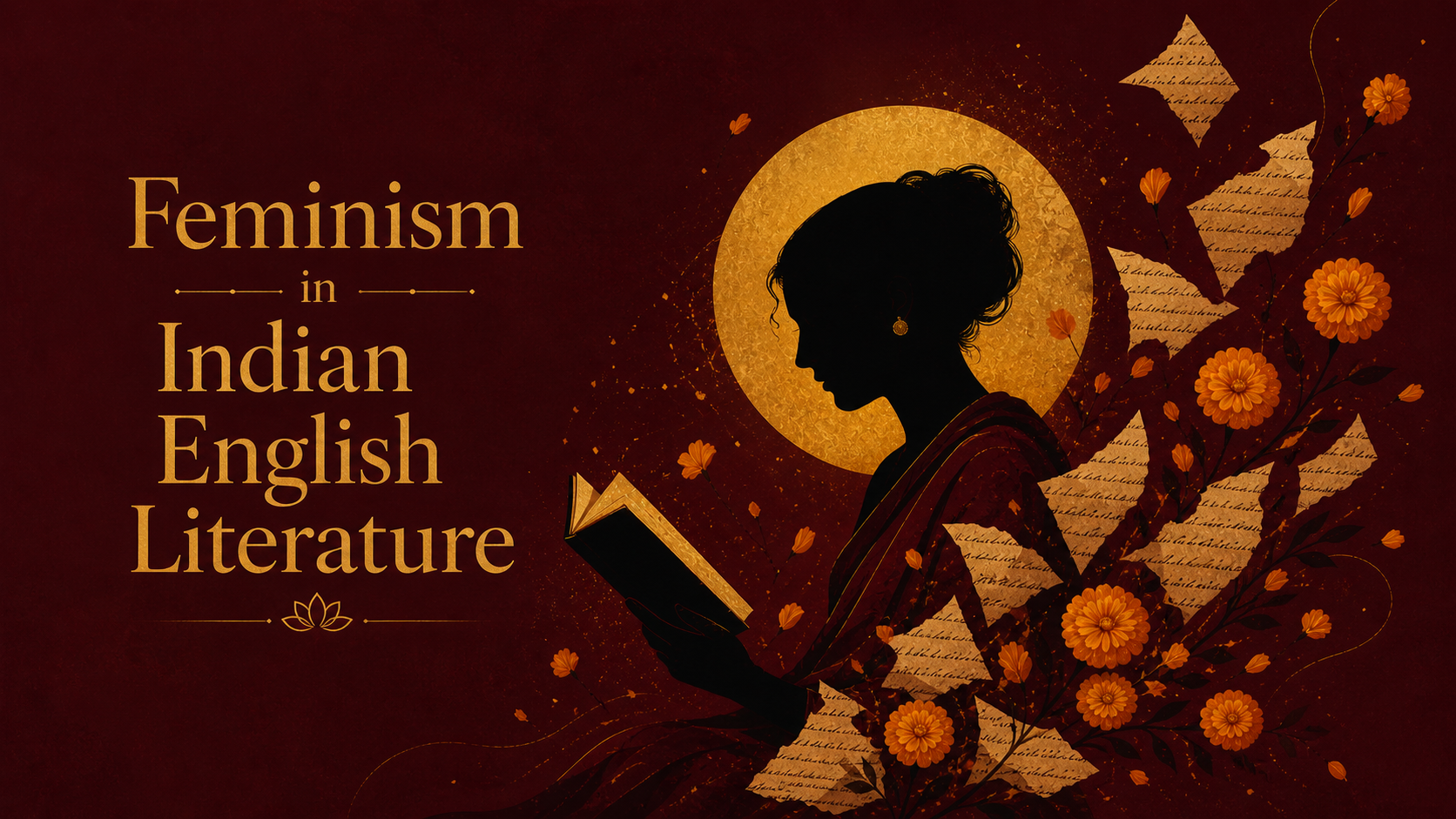
What does it mean to be a woman in India? For centuries, the answer was written by others — by tradition, by religion, by the patriarchal household. From the twentieth century onward, bold women writers grabbed their pens. They crafted their own answers through poetry, fiction, and autobiography. They turned feminism in Indian English literature into one of the world’s most powerful and politically charged literary traditions.
From Kamala Das’s defiant confessional poetry to Arundhati Roy’s searing indictment of caste and gender in The God of Small Things, Indian women writers have not merely reflected the social realities around them – they have challenged, dismantled, and reimagined them. Every English literature student must grasp this tradition. It proves essential for UGC NET, MA English, or any exam on Indian Writing in English.
This guide traces the evolution of feminist thought in Indian English literature. We explore key authors and texts. We explain why this movement matters—critically and academically.
Quick Summary
Feminism in Indian English Literature shows a powerful shift from personal struggles to political action. In the 1960s, confessional poets like Kamala Das started this radical movement. She bravely broke deep societal taboos. Das wrote openly about female sexuality, bodily autonomy, and traditional marriage. Over time, this feminist focus expanded greatly. Later authors like Arundhati Roy took these themes even further. Roy connects gender oppression directly to the harsh realities of caste, class, and political power. Therefore, the Indian feminist voice evolved. It grew from claiming personal identity to fighting massive social systems.
What is Feminism in Indian English Literature?
Feminism in literature questions, critiques, and resists patriarchal structures. These limit women’s lives. In India, feminist writing in English adds layers. It tackles gender, caste, class, religion, colonial history, and clashes over national identity.
Indian feminist literature skips Western imports. Instead, it forges unique concerns: arranged marriage critiques, joint family pressures, forced motherhood, taboo female sexuality, and gender-caste oppression. These give it a distinct voice and urgency.
| Key feminist themes in Indian English literature: identity and selfhood, the body and sexuality, silence and voice, domestic confinement, marriage and motherhood, caste and gender, and postcolonial womanhood. |
A Brief History: The Waves of Indian Feminist Writing
To understand where Indian feminist literature stands today, it helps to see how it evolved across different historical periods. The table below maps the major waves:
| Wave / Period | Key Authors | Core Feminist Concern |
| First Wave (pre-1947) | Pandita Ramabai, Toru Dutt | Education, sati, child marriage, colonial subjugation |
| Second Wave (1947–1980s) | Kamala Das, Anita Desai, Shashi Deshpande | Identity, sexuality, domestic silence, patriarchy |
| Third Wave (1990s–2000s) | Arundhati Roy, Manju Kapur, Shobha De | Caste, class, intersectionality, postcolonial feminism |
| Contemporary (2010s–present) | Bama, Meena Kandasamy, Perumal Murugan | Dalit feminism, queer theory, digital activism |
This evolution shows that feminism in Indian English literature is not a monolithic tradition but a dynamic, contested, and ever-expanding field of voices.
Kamala Das: The Pioneer of Confessional Feminist Poetess
No discussion of feminism in Indian English literature can begin anywhere other than Kamala Das (1934–2009). She was, without question, the most transgressive and fearless voice in Indian women’s writing of the twentieth century.
In her landmark poetry collection Summer in Calcutta (1965) and her autobiography My Story (1976), Das did something Indian women writers had never dared to do publicly before: she wrote about the female body, female desire, and female frustration with absolute honesty. She refused the role of the silent, self-sacrificing Indian wife. She named her dissatisfactions and claimed her sexuality as her own.
Key feminist themes in Kamala Das:
- The body as a site of oppression and liberation: Das’s poetry uses the female body not
as an object but as a subject — the speaker’s body is a place where desire, disappointment, and defiance all reside. - The politics of naming: In her poem “An Introduction”, Das famously writes about being told how to speak and who to be — and refusing. The act of writing in English is itself a political claim.
- Marriage and domestic confinement: Das portrays the Indian institution of marriage unflinchingly — as a system that reduces women to functions (wife, mother, housekeeper) while denying them selfhood.
- Female sexuality: At a time when Indian women’s sexuality was strictly policed, Das wrote about it openly — a revolutionary act in 1960s India.
Das’s work established a template for Indian feminist writing: the personal is political, the body is a text, and silence is complicity. Every major Indian feminist writer who followed her is, in some sense, in conversation with Kamala Das.
Anita Desai: The Inner World of the Indian Woman
Anita Desai (born 1937) approaches feminist themes not through the explicit political language of Das but through the finely textured interior lives of her female protagonists. Her novels are psychological explorations of what it costs a woman to be invisible, to be silenced, to have her desires systematically ignored.
Her most celebrated feminist text is Cry, the Peacock (1963), in which the protagonist Maya’s psychological breakdown is shown to be the direct consequence of a suffocating marriage and a society that refuses women’s interiority. Similarly, Fasting, Feasting (1999) — shortlisted for the Booker Prize — presents a devastating portrait of Uma, a daughter trapped by the relentless demands of Indian family life.
Key feminist themes in Anita Desai:
- Female interiority: Desai pioneered the use of the interior monologue in Indian English fiction to give voice to women’s inner lives that the outer world refuses to acknowledge.
- Tradition vs. modernity: Her women characters are caught between the expectations of traditional Indian womanhood and the emerging possibilities of modern selfhood – a tension Desai renders without easy resolution.
- The violence of domesticity: Desai’s households are not warm sanctuaries but claustrophobic spaces where women’s desires are quietly but systematically extinguished.
- Silence as protest: Many of Desai’s female characters resist not through rebellion but through withdrawal – a kind of interior emigration that is itself a feminist statement about the impossibility of full participation.
Shashi Deshpande: Naming the Unspoken
Shashi Deshpande (born 1938) is one of the most important and underread voices in Indian feminist literature. Where Kamala Das was explosive and confessional, Deshpande is quiet, precise, and devastating. Her fiction specialises in mapping the geography of female silence — the things Indian women do not say, cannot say, and the cost of that not-saying.
Her masterwork That Long Silence (1988) — winner of the Sahitya Akademi Award — is the story of Jaya, a middle-class wife and writer who confronts the compromises she has made in her marriage and her writing. The novel sears with truth. Even educated, articulate women swallow patriarchal values. They silence their own voices for marital harmony.
| Why Deshpande matters for UGC NET: Deshpande’s novels frequently appear in UGC NET English questions on Indian Writing in English. Key terms to know: female silence, internalised patriarchy, the domestic novel, Sahitya Akademi Award (That Long Silence, 1990). |
Arundhati Roy: Feminism at the Intersection of Caste and Class
If Kamala Das gave Indian feminist literature its confessional voice and Anita Desai gave it its psychological depth, Arundhati Roy (born 1961) gave it its political rage. Her debut novel The God of Small Things (1997), winner of the Booker Prize, is not simply a feminist text — it is an intersectional one, showing how gender oppression in India cannot be separated from caste oppression.
The novel’s central tragedy strikes hard: forbidden love between Ammu—a divorced upper-caste woman—and Velutha, an Untouchable man. This love story exposes caste hierarchy. It reveals gender double standards. And it unveils the violence of social law.
Ammu’s crime, in the eyes of her family and society, is not simply that she loves across caste lines. It is that she dares to desire at all.
Key feminist themes in Arundhati Roy:
- Intersectionality: Roy shows that gender cannot be analysed in isolation. In India, a woman’s experience is always shaped by her caste, class, and religious community. Ammu’s suffering is specifically that of a divorced upper-caste woman in post-Independence Kerala — the intersections are precise and deliberate.
- The female body as a battleground for social law: The punishment inflicted on Ammu and Velutha is not about personal morality — it is about enforcing the social order. Women’s bodies, Roy suggests, are where patriarchy and caste hierarchy meet.
- The “Love Laws”: Roy’s recurring phrase — “the Love Laws … that lay down who should be loved, and how, and how much” — is one of the most memorable formulations of how social power operates through intimate life.
- Post-Independence disillusionment: Roy situates her feminist critique within a broader disappointment with the promises of Indian independence — freedom that did not reach women, Dalits, or the poor.
Other Key Voices: Expanding the Feminist Canon
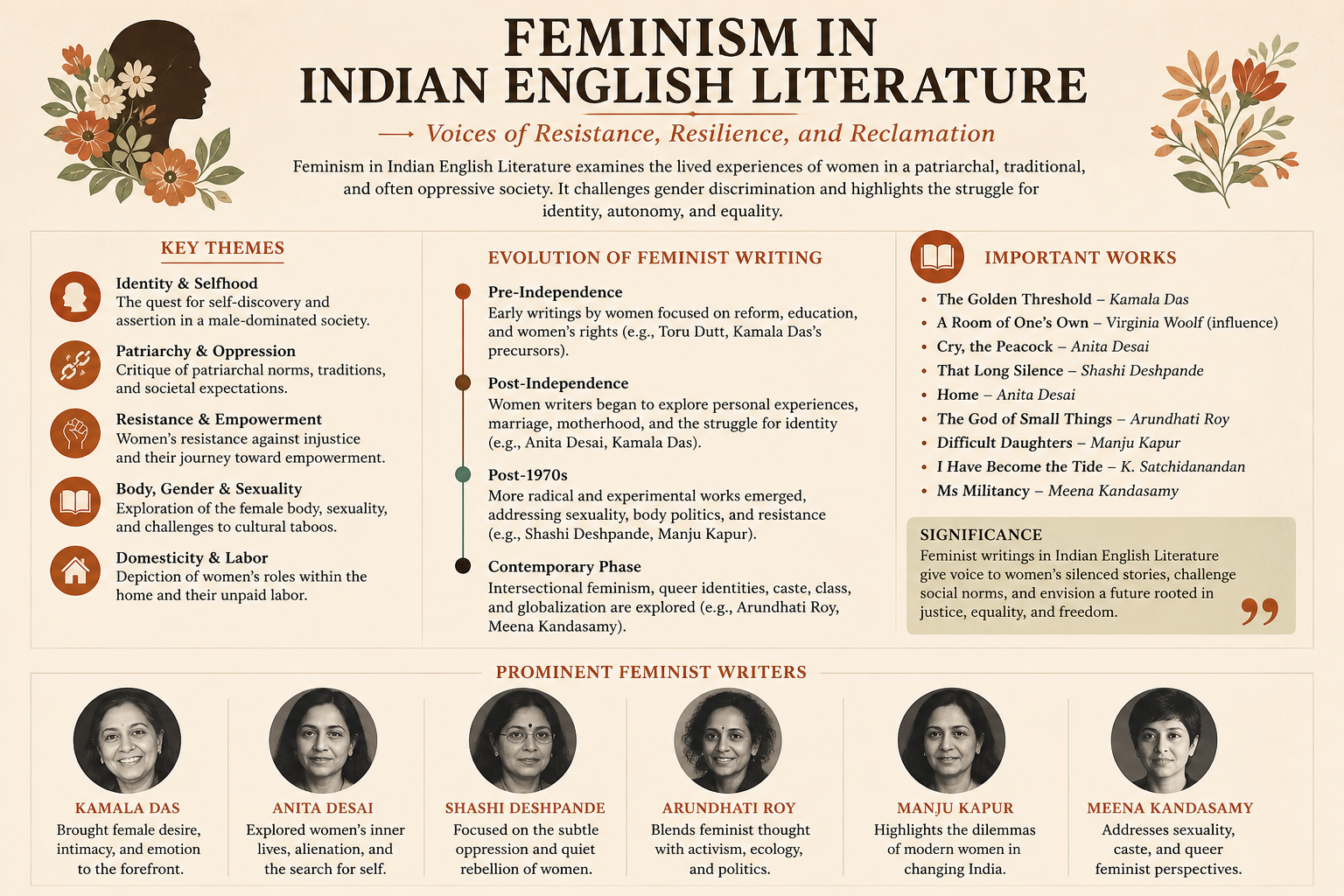
Feminist literary tradition in Indian English writing extends well beyond these four authors. Here are other essential voices every student should know:
- Manju Kapur — Difficult Daughters (1998): Partition seen through a woman’s desire for education and independence. First Indian Booker shortlistee for this theme.
- Shobha De — Socialite Evenings (1989): Urban, consumerist feminism; controversially commercial but culturally significant.
- Meena Alexander — Poetry and memoir exploring diaspora, displacement, and gendered identity.
- Bama — Karukku (1992): Dalit feminist autobiography that challenges both upper-caste Hindu society and the Catholic Church simultaneously.
- Meena Kandasamy — When I Hit You (2017): A visceral, formally experimental account of domestic abuse that uses poetry and fiction to resist the silencing of women survivors.
If you found the evolution of Indian feminist literature fascinating, wait until you see how it connects to the deepest layers of postcolonial theory. 💡 How do we hear the voices of women who are completely silenced by society?
Feminist Literary Theory and Indian English Literature
To fully analyse feminism in Indian English literature, students should be familiar with the key theoretical frameworks that critics apply to these texts:
- Gynocriticism (Elaine Showalter): The study of women as writers — their themes, genres, structures, and the traditions they create. Highly applicable to Kamala Das and Shashi Deshpande.
- Postcolonial Feminism (Gayatri Chakravorty Spivak): Spivak’s question “Can the Subaltern Speak?” is essential for reading Arundhati Roy — particularly the question of whose feminist voice gets heard in a postcolonial society.
- Intersectionality (Kimberlé Crenshaw): The framework that analyses how race, caste, gender, and class overlap to produce specific forms of oppression — essential for reading Bama and Roy.
- French Feminist Theory (Hélène Cixous): The concept of “écriture féminine” (feminine writing) — a mode of writing from the body, from desire, from the margins of language — illuminates Kamala Das’s poetics.
You cannot fully master feminist theory just by reading summaries—you need to read the primary texts!
Why This Matters for UGC NET and MA English
UGC NET English — Exam Focus:
Quick recall: Kamala Das = body and desire | Desai = interior silence | Deshpande = domestic internalisation | Roy = caste + gender intersectionality |
Conclusion:
Indian women writers refuse the stories imposed on them. This defines feminism in Indian English literature at its core. For instance, from Kamala Das’s defiant body to Arundhati Roy’s politically charged intersectionality, they build a tradition as diverse as India—and as urgent as the inequalities it confronts.
Yet these writers do not agree on everything. They hail from different castes, classes, regions, generations, and political commitments. Still, they share one core conviction: literature amplifies women’s voices, names their experiences, and exposes—and resists—the structures that silence them. Ultimately, grasp this tradition. It sharpens your exam performance. It also deepens your reading of all literature.
So, open any book and ask: Whose voice speaks? Whose silence hides? What worlds does it reveal—the one we built or the one we can build?
Enjoyed this guide? Explore more on a2zliterature.com — including our deep dives on Postcolonialism, Modernism vs Postmodernism, and Homi Bhabha’s Theory of Mimicry.
Frequently Asked Questions
What is feminism in Indian English literature?
Feminism in Indian English literature refers to a body of writing by Indian women authors — primarily in English — that challenges patriarchal structures, explores female identity and desire, and critiques the social systems (caste, class, marriage, domesticity) that limit women’s lives. It encompasses poetry, fiction, autobiography, and literary criticism from the early twentieth century to the present.
What feminist theories are relevant to Indian English literature?
The most relevant theories include: gynocriticism (Elaine Showalter) for studying women as writers; postcolonial feminism (Gayatri Spivak) for understanding the subaltern woman’s voice; intersectionality (Kimberlé Crenshaw) for caste–gender analysis; and écriture féminine (Hélène Cixous) for Kamala Das’s body-centred poetics.