Introduction
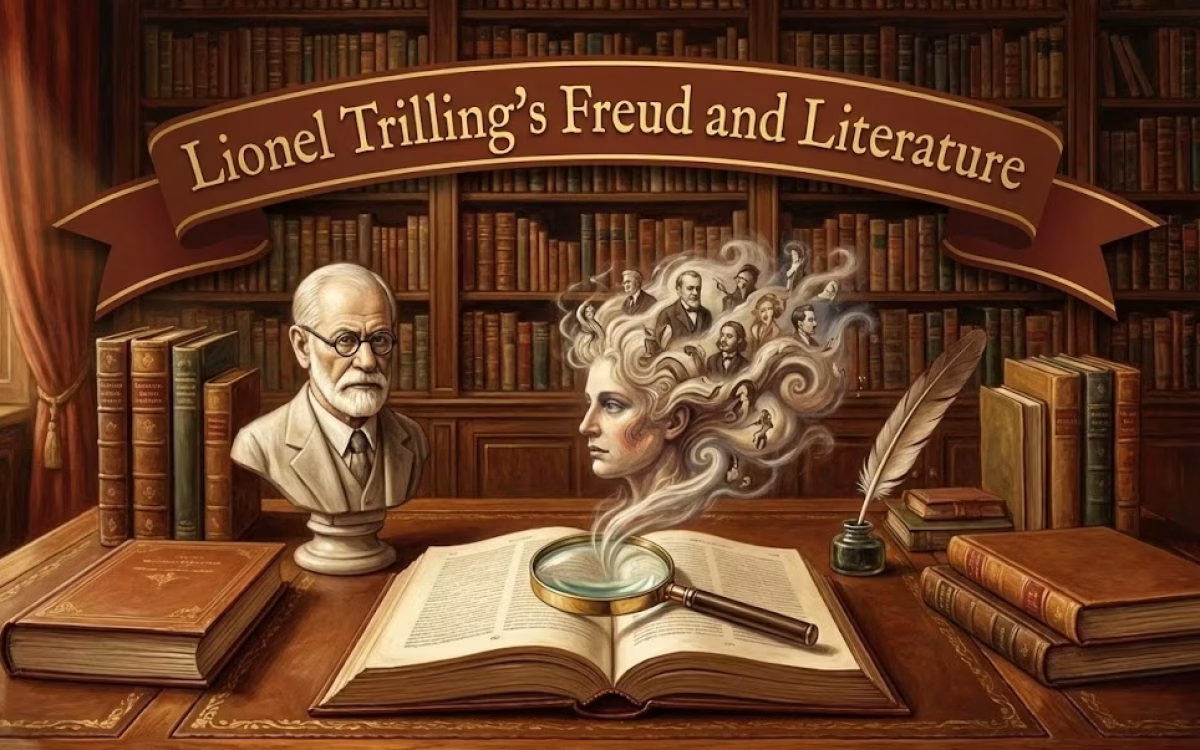
Lionel Trilling’s “Freud and Literature” is a landmark essay. It shapes how we think about psychology and art. Written by the influential American critic, the essay offers a nuanced look at how Freud’s psychoanalytic theories intersect with literary creation and criticism. For students, teachers, and readers interested in literary theory, Trilling’s analysis is accessible yet profound. It opens the door to the complex world of Freudian thought and its lasting impact on literature. In this post, we unpack Trilling’s central ideas. We also examine the historical context and why his insights remain relevant for Indian English literature students and global readers alike.
Trilling acknowledges Freud’s towering presence in modern intellectual life. Freud is not just a psychologist. He is a cultural figure whose ideas permeate art, philosophy, and everyday conversation. Freud’s concepts of the unconscious, repression, and wish fulfilment are now part of our understanding of human behaviour. Modern literature is hard to imagine without them. Trilling doesn’t just celebrate Freud’s influence. He offers a careful, balanced critique. His theories both illuminate and sometimes limit our appreciation of literature.
One of Trilling’s most important contributions is his argument about Freud’s themes. Hidden desires, inner conflicts, and the tension between individual and society appear in literature long before Freud gave them a scientific name. Writers like Shakespeare, Dostoevsky, and the Romantics grappled with these ideas. They explored them through characters and narratives. Freud’s work is less a revolution. It is more a systematisation of literary intuition. This perspective shows that literature and psychoanalysis are not separate domains. They are deeply intertwined, each enriching the other.
Trilling also highlights how Freud himself was shaped by literature. Freud’s case studies and breakthroughs often draw on literary examples. From Oedipus to Hamlet, his thinking is not purely clinical. It is also imaginative. This reciprocal relationship means Freud’s theories cannot be understood in isolation. They must be read alongside the literary traditions that inspired and challenged them.
In this blog post, we explore Trilling’s key arguments. We trace the influence of Freud on modern literature. We consider the implications for literary criticism today. By the end, readers will have a deeper understanding of why “Freud and Literature” remains essential. It is a vital text for anyone interested in the intersection of psychology and art. Whether you’re a student, teacher, or a lover of literature, this essay offers insights as relevant now as when Trilling first wrote it.
Lionel Trilling’s Freud and Literature: Historical Context
Lionel Trilling’s “Freud and Literature” emerged at a pivotal moment in literary criticism. It reflects the profound cultural shifts after World War II. Psychoanalysis was rising in the Western intellectual landscape. Trilling wrote his essay in the late 1930s. It was first published in 1940. At that time, Freud’s ideas were spreading across Europe and America. They shaped psychology, literature, art, and popular culture.
The early twentieth century saw Freud’s theories move from the margins to the mainstream. As psychoanalysis gained legitimacy, it influenced how writers and critics approached the human mind. Inner conflict and the creative process became central themes. Trilling’s essay responded to this change. He positioned Freud not just as a scientist but as a literary thinker. Freud’s ideas had deep roots in the Romantic tradition. His legacy would shape modern literature.
Trilling wrote during a period of optimism and anxiety. Modernism was rising. The war had ended. Traditional values were being questioned. There was urgency in understanding the psychological dimensions of art and culture. In this context, Trilling’s critique stood out. He balanced admiration with scepticism. He recognised Freud’s insights and also warned against reducing literature to psychological symptoms or neurotic daydreams.
The historical context also includes the rise of the New Criticism. This movement focused on close textual analysis. It often dismissed biographical or psychological approaches. Trilling offered an alternative. He argued that literature could not be fully understood without considering psychological and cultural forces. These shaped both writers and readers.
The context of “Freud and Literature” is one of intellectual ferment and cultural transformation. Trilling’s essay captures the spirit of an era. Literature, psychology, and philosophy converged. The essay offers enduring insights into the relationship between mind and art. FULL TEXT
About the Author
Lionel Trilling (1905–1975) was one of the most influential American literary critics of the twentieth century. He was born in New York City. Trilling taught English at Columbia University for over three decades. He became known for his erudition, moral seriousness, and commitment to the humanistic tradition in literature. His work bridged academic criticism and public intellectualism. He was a central figure in the New York Intellectuals group. This circle shaped mid-century American thought.
Trilling’s major works include The Liberal Imagination (1950) and Beyond Culture (1965). These reflect his belief in the ethical and social responsibility of literature. He argued that literature should engage with human experience. It should not retreat into aestheticism or ideology. In “Freud and Literature,” Trilling brought depth and balance to the discussion of psychoanalysis. He explored both its insights and limitations in understanding art and the human mind.
Trilling’s legacy endures in his critical writings. He also served as a mentor to generations of students and scholars. His nuanced approach to literary theory continues to inspire readers and critics around the world. His insistence on the moral dimension of literature remains influential.
Lionel Trilling’s Freud and Literature: Text Overview
The essay “Freud and Literature” by Lionel Trilling offers a comprehensive exploration of the intersection between Sigmund Freud’s psychoanalytic theories and literary art. Trilling begins by situating Freud within the broader tradition of Romantic and modern thought, arguing that Freud’s ideas about the unconscious, repression, and wish-fulfilment have deep roots in literature long before they were formalised by psychoanalysis. He highlights how writers like Shakespeare and Dostoevsky intuitively grasped psychological truths that Freud later systematised.
Trilling then examines the reciprocal relationship between Freud and literature: not only did Freud draw inspiration from literary works, but his theories in turn reshaped how literature was interpreted and written. He discusses Freud’s tendency to view creative writers as “daydreaming neurotics” seeking substitute gratification, but cautions against reducing art to mere fantasy or psychological symptom. Instead, Trilling emphasises literature’s capacity for moral and intellectual complexity, resisting simplistic psychoanalytic readings.
The essay also reflects on the broader cultural impact of Freudian ideas, showing how they influenced both literary criticism and modern writing. Trilling’s balanced approach—acknowledging Freud’s insights while preserving the autonomy and seriousness of literature—makes “Freud and Literature” a foundational text for understanding the relationship between psychology and art.
Trilling’s three central claims
Lionel Trilling’s “Freud and Literature” is structured around three central claims, each offering a nuanced perspective on the relationship between Freudian psychoanalysis and literary art. These claims are not only foundational to Trilling’s argument but also essential for understanding the broader impact of Freud on literature and criticism.
Pre-Freudian Literature Anticipates Psychoanalytic Themes
Trilling argues that the core ideas of psychoanalysis—such as the unconscious, repression, and the conflict between desire and social norms—were already present in literature long before Freud gave them scientific names. Writers like Shakespeare, Dostoevsky, and the Romantics explored psychological depth, inner conflict, and the tension between individual impulses and societal expectations. Trilling suggests that Freud’s work was less a revolution and more a systematisation of insights that literature had long provided, highlighting the continuity between literary intuition and psychoanalytic theory.
Literature as a Source for Freud’s Insights
Trilling emphasises that Freud himself was deeply influenced by literature. Many of Freud’s case studies and theoretical breakthroughs draw on literary examples, such as the stories of Oedipus and Hamlet. Freud acknowledged that poets and philosophers had discovered the unconscious before psychoanalysis, and his method was to develop a systematic approach to studying it. Trilling sees this as evidence of a reciprocal relationship: literature nourished Freud’s thinking, and Freud’s theories, in turn, reshaped how literature was interpreted.
Freud’s Impact on Literary Criticism and Modern Writing
Trilling notes that once Freud’s ideas entered the cultural mainstream, they transformed both literary criticism and modern writing. In fact, psychoanalytic concepts gave critics new tools for interpreting texts as symptoms of hidden wishes, anxieties, and family dramas. As a result, this led to the rise of psychoanalytic criticism. At the same time, modernist and later writers began to craft narratives that foregrounded dreams, neurosis, and psychic breakdown. These narratives echoed psychoanalytic case histories. Trilling sees this as part of a larger cultural process. In this process, literature became a privileged medium for exploring the complexity of human inner life.
Each of these claims underscores Trilling’s belief in the enduring dialogue between literature and psychoanalysis. Moreover, he resists reductive interpretations. Instead, he affirms the moral and intellectual complexity of both art and theory.
Freud’s model of the mind and its literary power
Freud’s model of the mind centres on the tripartite structure of the id, ego, and superego, which together shape human behaviour and personality. The id is the primal, unconscious part driven by instinct and immediate gratification, operating on the pleasure principle. The ego acts as the mediator, balancing the id’s impulses with the realities of the external world and societal norms. The superego embodies our internalised moral standards and ideals, striving for perfection and often inducing guilt or pride based on our actions.
This dynamic model gives literature immense power because it provides a framework for understanding the hidden motivations, conflicts, and desires that drive characters and narratives. Writers use these concepts to explore the complexities of human nature, revealing how internal struggles between instinct, reality, and morality shape both individual choices and broader social dynamics. Freud’s emphasis on the unconscious also highlights the role of dreams, slips of the tongue, and symbolic language in literature, allowing authors to delve into the deeper, often unspoken layers of the psyche. This makes Freud’s model a cornerstone of psychoanalytic literary criticism, enriching the interpretation of texts and deepening readers’ engagement with the psychological dimensions of art.
Trilling on artists, neurotics, and substitute gratification
Freud’s suspicion of literature as day dream
One of the most provocative sections of “Freud and Literature” deals with Freud’s tendency to pathologise the artist. Freud often compares creative writers to daydreaming neurotics, suggesting that both seek substitute gratification by turning unsatisfied wishes into imaginary scenarios.
In this view, literature becomes a socially acceptable outlet for fantasies that might otherwise disturb the individual or the community, functioning as a kind of psychic safety‑valve. The reading public, in turn, takes pleasure in identifying with these disguised wishes, though it may remain unaware of the deeper impulses at work.
Trilling’s defence of literature’s seriousness
Trilling recognises the insight in Freud’s analogy but resists the reduction of literature to mere daydream or narcotic illusion. He argues that while any imaginative work inevitably contains elements of wish‑fulfilment, the literary process also involves rigorous shaping, self‑criticism, and engagement with reality that distinguishes art from simple fantasy.
For Trilling, great literature holds illusion and reality in productive tension, exposing readers to uncomfortable truths rather than simply consoling them. This capacity for complexity is precisely what makes literature ethically and intellectually valuable, and it prevents psychoanalysis from having the last word on artistic motivation.
Freud, Romanticism, and the Enlightenment
Psychoanalysis as culmination of Romantic art
A striking move in Trilling’s essay is his classification of psychoanalysis as a late form of Romanticism. By placing Freud in line with nineteenth‑century explorations of passion, individuality, and the dark regions of the self, Trilling challenges the myth of Freud as purely rational or anti‑romantic.
In this framing, the Freudian emphasis on dreams, sexuality, and irrational drives continues the Romantic project of unveiling buried emotions and challenging rigid social norms. Psychoanalysis then appears less as a cold laboratory science and more as a sophisticated extension of the literary imagination.
Freud and the legacy of the Enlightenment
At the same time, Trilling never forgets Freud’s Enlightenment inheritance, especially his allegiance to scientific method, clarity, and demystification. Freud exposes religious belief and cultural ideals as, in part, illusions rooted in childhood dependency and collective neurosis, thereby participating in the modern critique of superstition.
Trilling reads this dual allegiance—to Romantic depth and Enlightenment critique—as a productive tension that shapes Freud’s style and influence. It explains why psychoanalysis can be both liberating and unsettling, inviting readers to recognise new complexities in themselves while also stripping away cherished consolations.
Lionel Trilling’s Freud and Literature: Relevance Today
Freud’s relevance in literature today remains strong, even though his scientific standing in psychology has been challenged. His theories of the unconscious, repression, and the tripartite structure of the mind—id, ego, and superego—offer a powerful lens for interpreting characters, themes, and narrative structures in both modern and classic literature. In fact, literary critics and scholars continue to draw on Freudian concepts to explore hidden desires, inner conflicts, and the complex interplay between individual psychology and social norms.
Moreover, contemporary classrooms and academic writing value Freudian psychoanalysis. It reveals the deeper, often unspoken layers of human experience that shape both literary works and reader responses. As new psychological models emerge, Freud’s emphasis on the unconscious, defence mechanisms, transference, and dream analysis continues to influence how readers interpret and teachers present literature. In this way, his theories remain a vital part of literary studies.
Freud’s legacy also reaches beyond the academy into popular culture. His ideas about the mind and human behaviour inform film, television, novels, and plays. Although some aspects of Freudian theory have been debunked or refined, his core insights into the complexity of the human psyche remain foundational. As a result, literature’s enduring power to illuminate the hidden dimensions of life is still deeply connected to Freud’s work. EXPLORE OTHERS WRITERS
Conclusion
Lionel Trilling’s “Freud and Literature” remains a cornerstone of modern literary criticism. It offers a nuanced and enduring exploration of the relationship between psychoanalysis and art. Not only does Trilling’s essay highlight how Freud’s theories illuminate the psychological depth of literature, but it also underscores the reciprocal influence between the two fields. For instance, by showing that literature anticipated many of Freud’s insights, and that Freud himself was shaped by literary traditions, Trilling demonstrates the profound dialogue between psychology and art.
Moreover, Trilling’s balanced approach resists reductive interpretations. He affirms the moral and intellectual complexity of both literature and psychoanalysis. In fact, he cautions against reducing literary works to mere psychological symptoms or neurotic daydreams. Instead, he emphasizes the unique capacity of literature to engage with the full spectrum of human experience. As a result, this perspective is especially valuable in today’s academic and cultural landscape. Interdisciplinary approaches are increasingly common, and the boundaries between psychology, literature, and philosophy continue to blur.
Furthermore, the enduring relevance of Freud’s model of the mind—its tripartite structure of id, ego, and superego—further underscores the essay’s significance. These concepts provide a powerful framework for understanding the hidden motivations, conflicts, and desires that drive characters and narratives. Consequently, readers’ engagement with both classic and contemporary texts is enriched. Freud’s emphasis on the unconscious, defence mechanisms, transference, and dream analysis continues to shape how readers interpret and teachers present literature. In this way, his theories remain foundational for understanding the psychological dimensions of art.
In conclusion, Trilling’s “Freud and Literature” is not just a historical document. It is a living, evolving conversation about the nature of human experience and the power of art to illuminate it. Its insights remain as relevant today as they were when Trilling first wrote. Ultimately, the essay offers readers and critics alike a deeper appreciation of the intricate connections between mind and art.
FAQS
What is the main argument of Lionel Trilling’s “Freud and Literature”?
Trilling argues that Freud’s psychoanalytic theories and literature are deeply interconnected. He demonstrates how literature anticipated many of Freud’s insights about the unconscious, repression, and human desire, while Freud’s theories, in turn, reshaped how readers interpret and writers create literature.
How did Freud influence literary criticism?
Freud introduced concepts like the unconscious, repression, and wish-fulfilment, which gave critics new tools for interpreting texts as symptoms of hidden desires and anxieties. This led to the rise of psychoanalytic literary criticism, where characters and narratives are analysed for their psychological depth.
What are the key components of Freud’s model of the mind?
Freud’s model consists of the id (primal instincts), ego (mediator between id and reality), and superego (moral standards). This tripartite structure helps explain human behaviour and is often used to analyse characters and narratives in literature.
How does Freud’s theory impact modern literature?
Freud’s ideas have influenced modernist and contemporary writers to explore themes of dreams, neurosis, and psychic breakdown. His theories encourage authors to delve into the deeper, often unspoken layers of the psyche, enriching the psychological dimensions of their works.